A Skill Gap Is Not a Deficit. It Is a Rate.
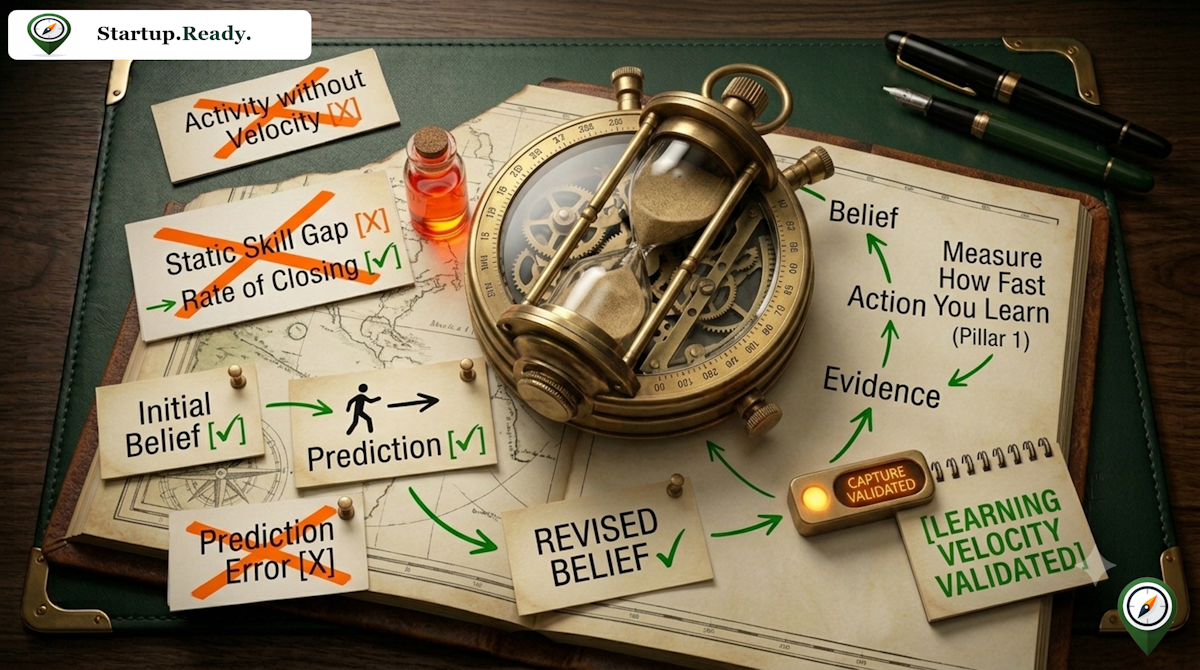
Two founders start with the same gap. Neither can sell, neither has done it, both know it. Ninety days later one of them closes deals and the other is still exactly where they started, and the difference has nothing to do with the gap they shared.
It has to do with how fast each one learned. A skill gap looks like a fixed thing, a box you either check or you do not. It behaves like a moving one. What matters is not the size of the gap on day one. It is the rate at which the gap is closing, and that rate varies enormously between founders who look identical on paper.
Most founders track the wrong number. They know what they cannot do. They have no idea how fast they are getting better at it, which is the number that actually predicts where they will be in three months.
A gap that is closing fast is a temporary condition. A gap that is not closing is the real problem, and it hides behind a lot of activity.
TL;DR: Measure How Fast You Learn, Not What You Know.
A skill gap is a learning problem, and learning has a speed. The founders who move through gaps are not the ones who started ahead. They are the ones whose beliefs change quickly in contact with reality. The measure is not effort, and it is not belief change for its own sake. It is how often what you believe gets corrected by real evidence, because that is the visible sign that your error is shrinking. Here is the move, in order:
Audit belief revision: name which of the beliefs your decisions depend on got corrected in the last thirty days, and by what evidence
Weigh, do not count: one consequential belief corrected by reliable evidence beats ten trivial revisions, and a belief revised on a single anecdote is thrash
Check it against prediction: a real revision makes your next forecast more accurate, where thrash only changes your story
Check your actions for disconfirmers: an action that cannot come back negative teaches nothing
Find the bottleneck: learning stalls at how you design actions, how you capture what you hear, or how you use it
Fix the one that is stuck, rather than resolving to "learn faster" in general
Four signals your learning has stalled while your effort has not:
You cannot name one belief about your business that changed in the last month
Every customer conversation confirms what you already thought
You are busy, in motion, and cannot say what any of it taught you
Disconfirming feedback keeps getting filed as an exception
If any of those describe you, this article shows you how to measure the rate you are actually learning at, and speed it up.
If You Found This Article by Searching for Something Else
Most founders who need this are not searching for "learning velocity." They are searching for something more immediate.
Why am I not making progress despite working hard.
How to get better at the parts of my startup I am weak at.
Why do my customer conversations feel useless.
How fast should a founder be learning.
I feel busy but stuck.
All of those point at the same underlying question. Is your activity changing what you believe, or just filling your calendar? This article shows you how to tell, and how to make the loop turn faster.
Activity Is Not Velocity
A slow-learning founder does not look slow. They look busy. The calendar is full of calls, the outbox is full of messages, the product keeps getting built. From the outside, and often from the inside, it reads as momentum.
Velocity is a different measurement. It is not how much you are doing. It is how much of what you are doing is changing what you believe. A founder can run twenty conversations in a month and end it believing exactly what they believed at the start, and those twenty conversations produced no velocity at all. They produced motion. Motion and learning feel the same in the moment and diverge completely over a quarter.
Be precise about what belief revision is standing in for, though, because the goal is not to change your mind a lot. The goal is to be wrong about your business less often than you were last month. Belief revision is not the prize. It is the most visible evidence that your error is shrinking, which is the thing you actually care about and cannot measure directly. That distinction matters, because it rules out the failure mode on the other side: a founder who flips their strategy after every single conversation is not learning fast, they are being whipsawed. A belief overturned by one enthusiastic stranger is thrash. A belief overturned by the same signal arriving from five independent directions is learning. Count the revisions that came from evidence sturdy enough to bet on, not the ones that came from the last voice in the room.
The tell, then, is evidence-driven belief revision. A founder who is learning fast can tell you what they thought a month ago that they no longer think, what changed their mind, and why that evidence was trustworthy. A founder who is learning slowly reaches for the question and comes back with nothing.
The Thirty-Day Belief Test
One question measures your learning velocity, and it takes about ten seconds to fail. Ask it before you read another word, because the rest of this article is about why you could or could not answer it.
In the last thirty days, what specific belief about your business changed because of something you observed or heard, and why did you trust the evidence?
Not a belief that could change. One that did. The thing that changed it, named specifically enough that you could point to the conversation, the number, the moment. And the reason the evidence was worth updating on, so you know the change was learning and not thrash.
If the answer arrives fast and concrete, your loop is turning. Something out in the world reached in and moved what you think, which is the entire mechanism by which a skill gap closes. If the answer takes real effort to produce, or comes back as "I have a better feel for things now," the loop is not turning at the rate you need, however busy the month felt.
One calibration, because the right rate depends on where you are. Early on, at pre-seed and seed, uncertainty is high and you should expect to revise beliefs often, because almost everything you think is a hypothesis that has barely met reality. As the company matures and product-market fit firms up, revisions get rarer and heavier: you change your mind less frequently, but each change moves more. A founder with real traction who revised nothing this month may be fine. A pre-validation founder who revised nothing this month is stalled. Read the number against your stage, not against a fixed target.
Run it monthly, and weigh the revisions rather than counting them. Ten small beliefs overturned can add up to nothing, and one belief that mattered, corrected by evidence you can trust, can move the whole company. A founder whose consequential beliefs keep getting corrected by reliable evidence is closing gaps, whatever their starting skill. A founder who cannot name one belief that mattered and moved, month after month, is standing still at speed.
Two Founders, One Gap, Different Speeds
Return to the two founders from the opening. Both need to learn sales. Both spend a month doing it. Watch what separates them.
Founder A sends two hundred cold emails. Same message to all of them, because he wrote one he liked and scaled it. The replies trickle in near zero, and after a month he draws the obvious conclusion: nobody wants this. He worked hard, he ran a real volume of activity, and he ended the month with one belief, the market is not there, which he did not hold at the start. On paper he revised a belief. In practice he learned almost nothing, because two hundred identical sends are one test run two hundred times. He varied nothing, so the result cannot tell him whether the problem is the market, the message, the audience, or the ask. He got a flat number and read a verdict into it.
Founder B sends fifty. She splits them into three groups with three different framings of the same product, and she writes down which framing each reply and non-reply belongs to. Halfway through she notices a pattern: the non-responses cluster around one objection, some version of "we already have something for this." That is signal, sturdy because it repeats across strangers who do not know each other. She rewrites the pitch to hit that objection head-on, sends the next batch, and the reply rate roughly doubles. Same starting gap as Founder A. She is closing it, because each batch corrected a specific belief about why the pitch was failing.
Both worked. Only one learned. The difference was not effort and it was not talent at sales, which neither had. It was that Founder B designed her activity so it could teach her something, and Founder A designed his so it could only hand him a verdict.
Better Predictions Are the Proof
There is a cleaner test than counting revisions, and it settles the vanity problem hiding inside this whole idea. You can change your mind ten times a month and learn nothing, if the beliefs were small or the changes were noise. The measure that does not lie is prediction. Learning shows up as predictions that get less wrong.
Put it in numbers. A founder who expected a two percent reply rate and got two-point-one understands her system. A founder who expected twenty percent and got two does not, however busy the month looked. The gap between what you predicted and what actually happened is your error, and shrinking that gap is the entire job that belief revision is doing. Belief revision matters because it improves the next forecast. That is the only reason it matters.
Founder B was running this loop whether or not she named it. She predicted the objection would repeat, and it did. She predicted the rewrite would lift replies, and it roughly doubled them. Her revisions were real because reality kept landing closer to her calls. So before you count a belief as learned, ask what it now lets you predict that you could not predict before. A revision that sharpens your forecast of the next result was learning. A revision that changes your story but not your accuracy was thrash in the costume of insight.
Where Learning Actually Stalls
"Learn faster" is not an instruction anyone can follow. Learning velocity slows at one of three specific points, and each one has a different fix. Naming the point is the whole intervention.
The first is how you design the action. What you are trying does not produce a clear signal, because it tests too many things at once, varies nothing, or is too slow to tell you anything this week. Founder A is stuck here. Two hundred identical emails cannot isolate a cause, so the only output available was a flat number and a guess about what it meant. The fix is not more sends. It is Founder B's move: change one variable at a time and design the action so a specific wrong answer is possible.
The second is how you capture what you hear. The actions are sharp, the signal is real, and none of it is being written down. Conversations blur together, results are remembered selectively, and the picture never accumulates because each piece evaporates before the next arrives. Founder B beat this by tagging every reply to its framing. Without that, she would have had a vague sense that things were not working and no idea which objection was doing the damage. The fix is a place to put what you hear, so the tenth data point can be compared against the first.
The third is how you use what you learn. The signal is clear and captured, and it is not changing anything, because accepting it would require changing something the founder does not want to change. Disconfirming information gets explained away, filed as an exception, acknowledged and then ignored. This is the hardest one, because it is not a skill problem or a system problem. It is a willingness problem wearing the mask of the other two.
Most founders assume they are in the third bucket when they are actually in the first. They think the problem is that the truth is hard to accept, when the real problem is that they never designed an action capable of producing a truth in the first place.
What Actually Gets Funded
Here is the stake, stated plainly, because it reframes what the number is measuring.
Investors fund skill gaps all the time. They back founders who have never sold, never hired, never managed a team, never raised a round. A missing skill is a normal, fundable condition, because everyone expects a first-time founder to be missing several. What is much harder to fund is a founder who keeps meeting the same lesson and never updates. The first founder has a gap that is closing. The second has a gap that is stuck, and a stuck gap is not a skill problem anymore. It is a learning problem, and learning problems do not resolve on their own the way skill gaps do.
This is why the rate matters more than the starting point. The question a sharp investor is really asking, underneath the pitch, is not "does this founder have every skill." It is "when this founder is wrong, how fast do they find out." You are being measured on velocity whether or not anyone says so. You may as well measure it yourself.
Why the Loop Stops Turning
There is a reason slow learning is comfortable, and the comfort is what keeps the loop stopped. A belief that never gets tested never gets to be wrong. Founder A's two hundred identical emails protected his plan from the one correction that would have improved it: that the message was the problem and he could fix it. "Nobody wants this" is a verdict about the market, and it sits easier than "my pitch is wrong," because the first demands nothing of him and the second puts the work back on his desk.
The cost stays invisible until it is not. Every week the loop does not turn, decisions get made on untested beliefs, and by the time flat results make the problem undeniable, a quarter is gone. Fast learning feels worse now and better across the year. It means inviting the correction while it is cheap, instead of receiving it later from the market, when it is not.
The One Sentence That Tells You Where You Stand
A founder who is learning fast can complete this statement without straining:
In the last thirty days, [number] of my core beliefs changed, and the one that moved most was [specific belief], because I saw [specific, repeating evidence].
The place my learning is slowing is [how I design actions / how I capture them / how I use them], and the one change I am making is [specific change].
A founder who is learning slowly can fill the second half in the abstract and stalls on the first, because no belief actually moved and there is no evidence to point to. That stall is not a character verdict. It is a reading on the instrument, and the instrument can be adjusted.
If you can name the belief and the trustworthy evidence that moved it, your loop is turning and the skill gap is a temporary condition you are actively closing. If the number is zero, the gap is not the problem. The stalled loop is. Find which of the three points it is stuck at, change that one thing, and re-read the instrument in two weeks. Either outcome moves you forward.
Learning Velocity and Your Founder Readiness
In the Startup Readiness Framework, Founder Readiness treats a skill gap as a learning problem rather than a fixed deficit, because the gap that matters is the one that is not closing. A skill mismatch is a common early flag, and it is far more serious when paired with slow learning, since the two compound: decisions made without the missing capability produce weak feedback, which makes the gap harder to see, which slows learning further.
Finding which gap sits on your critical path is its own piece of work, covered in the skills gap that is slowing your startup down. This piece is the layer beneath it: how fast you are closing whichever gap you find.
Founder Readiness is one of the six pillars in the framework. The Startup Readiness Assessment gives you a full-system diagnostic across all six in under twenty minutes.
Take your Startup Readiness Score free today at startupready.ai →
Keep Working on Your Founder Readiness
The Founder Pillar asks one question from many angles: can you, specifically, do the work this startup needs, and can you build the capacity you are missing? Each article below takes one piece of that question. Whether you are the right person to solve this particular problem. Where your real capacity gaps are, and whether they are gaps or just rates you have not run yet. What is draining your motivation, and whether the model is the cause. Which decision you keep making on repeat, and what would change it. Read them in any order. Each is a separate cut at the same pillar, and together they show you where your capacity holds and where it still has to be built.
More in the Founder pillar:
How to Find the Skills Gap That Is Slowing Your Startup Down
Why Startups Fail: The Founder Motivation Problem No One Talks About
How to Protect Your Time as a Founder Without Sacrificing Everything Else
The Task You Keep Avoiding Might Not Be a Skill Gap
A Mentor You Have Not Called in Six Months Is Not a Mentor
Your Network Is Not Gone. It Is in a Drawer.
You Are Not Losing Motivation. Your Model Is Draining It.
Your Startup Does Not Need More Goals. It Needs a Filter.
When Working Harder Stops Working, You Have a Leverage Problem
Your Constraints Are Not Obstacles. They Are Design Parameters.
Burnout Is Not Too Much Work. It Is Too Much Undirected Work.
Your Business Model Requires a Team You Do Not Have Yet
Before You Hire Someone, Try Deleting the Task
When You Are Missing the Skill and the Help, Fix One
You Do Not Make Bad Decisions. You Make the Same One Over and Over
Published
By Dr. Shaun P. Digan
Originally published on Startup.Ready.’s Startup Readiness: Validation, Framework, and Tools Blog at https://startupready.ai/startup-readiness/founder-learning-velocity
Original Publication Date: July 21, 2026
Last Updated: August 4, 2026
About the Author
Dr. Shaun P. Digan is the founder of Startup.Ready and the creator of the Startup Readiness Framework, a research-based system for evaluating and validating early-stage startups before launch and early growth. He holds a PhD in Entrepreneurship from the University of Louisville and has spent over 15 years teaching, advising, and consulting with founders on startup strategy, validation, and growth.
In his writing, including the Startup Readiness Blog and The Foundations of Innovation Essay Series, he focuses on how founders can make better decisions by improving clarity, alignment, and readiness before scaling.