The Task You Keep Avoiding Might Not Be a Skill Gap
There is a task you have been putting off for weeks. You know which one. It slides to next week's list, gets done just well enough, or quietly gets handed to a tool that does not quite do the job.
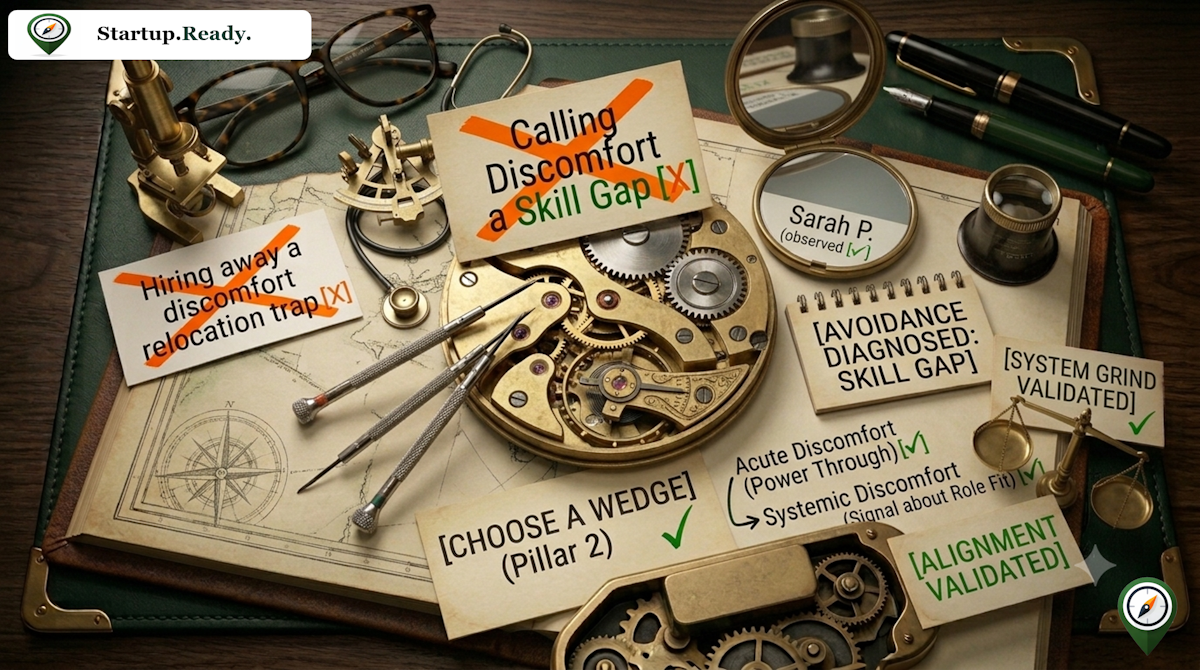
The instinct is to call it a skill gap. You avoid it because you are not good at it, so the fix is to get good at it, or hire someone who is. That is sometimes right. It is also, just as often, wrong, and the wrong version is expensive in a specific way: it ends with you paying someone to do a thing you were capable of, which does not remove the problem. It relocates it.
Some avoided tasks are genuine skill gaps. You cannot do the thing yet. Others are avoidance driven by discomfort. You can do the thing, competently, and you do not want to, so you route around it and tell yourself a story about capability. The two look identical from the outside, they feel identical on your calendar, and they need opposite fixes. Before you close the gap, you have to know which one you are looking at.
TL;DR: "Can't Do It" and "Won't Do It" Need Opposite Fixes.
An avoided task is a signal, not yet a diagnosis. Some avoidance is missing capability and some is discomfort, and most real cases are a mix with one side dominant. The whole question is which side. The work is to name what you avoid, test whether you actually could do it, and match the fix to the real cause. Here is the move, in order:
Name what you avoid: the tasks deferred, done just barely, or handed to a tool that half-works
Run the tomorrow test: if you had to do it tomorrow with no way out, could you do it competently
Read the answer honestly: cannot do it competently points to a skill gap, could but dread it points to discomfort
Match the fix: missing capability gets built, hired, borrowed, or designed around, while discomfort gets done
Watch the relocation trap, because hiring away a discomfort you could have handled just moves it somewhere more expensive
Four signals you are calling discomfort a skill gap:
You could clearly do the task if forced, and you keep not doing it
Your reason for avoiding it sounds like strategy and feels like relief
You want to hire someone mainly so you never have to do this again
The task is uncomfortable in a way that has little to do with difficulty
If any of those describe you, this article shows you how to tell the two apart before you spend anything closing the wrong one.
If You Found This Article by Searching for Something Else
Most founders who need this are not searching for a diagnosis of their avoidance. They are searching for something more immediate.
How to stop procrastinating on my startup.
When to hire for a skill I do not have.
Why do I keep avoiding sales.
Should I hire a cofounder for my weakness.
How to know what to delegate.
All of those point at the same underlying question. The thing you keep not doing, is it that you cannot, or that you will not? This article shows you how to tell, because the answer changes what you should do next.
The Tomorrow Test
Start with the diagnostic, because you can run it on your own avoided task right now, before any of the explanation.
If you had to do this task tomorrow, with no way out and no one to hand it to, could you do it competently?
Not comfortably. Competently. Strip away whether you want to and ask only whether you could.
If the honest answer is yes, you are looking at discomfort. The capability exists and something else is keeping you from using it: fear of the no, dislike of the task, the exposure it carries. If the honest answer is no, you would produce something and not even know how bad it was, you are looking at a real skill gap. The capability is missing and no amount of willpower conjures it.
Two honest complications, because the test is sharper when you know its edges.
The first is that most tasks are not pure. A founder avoiding sales might be sixty percent uncomfortable with rejection and forty percent missing an actual discovery-call process. Real cases mix. The point of the test is not to force a task into one box, it is to find which side dominates, because that tells you where to start. When both are present, close the skill part just far enough that the task becomes doable, and watch what is left. If the avoidance disappears, it was mostly skill. If you now can do it and still will not, the discomfort was the real weight all along.
The second is what the test assumes. It separates "cannot" from "will not," and it quietly assumes you are otherwise able to engage the work at all. Sometimes the true answer is neither capability nor discomfort but capacity. A founder who knows financial modeling cold and does not dread it can still postpone it every night after ten hours of everything else, because there is nothing left to think with. That is not a skill gap and not avoidance. It is depletion, and the fix is neither practice nor willpower but protecting the hours. If the tomorrow test comes back "I could, I am not afraid to, and I still never get to it," look at your capacity before you look at your character.
The Founder Who Wanted a Fundraising Cofounder
Take a founder who has decided he needs a cofounder to run fundraising. He is clear about it. Raising is not his thing, he says, and the responsible move is to bring in someone who can do it.
It sounds like a skill gap, diagnosed and ready for its fix. Then you watch him actually operate. He understands his business at depth. He explains it to a stranger in three clean sentences. In the two investor meetings he has taken, he answered hard questions well and the investors left interested. The capability is plainly there. Run him through the tomorrow test, could you walk into a pitch tomorrow and do it competently, and the honest answer is yes.
So what is he avoiding? Not the pitching. The asking. The moment of naming a number and requesting money. The stretch of silence before a no. The feeling of being weighed and possibly found short. That is discomfort, and it has taken the shape of a hiring plan, because "I need a fundraising cofounder" is a far more comfortable sentence than "I can raise and I am flinching from it."
Now hold it against a genuine skill gap sitting right next to it. The financial model behind the raise, the one an investor will ask to see, he cannot build. He does not know which assumptions drive the outcome or how the pieces connect, and forced to produce one tomorrow he would produce something wrong and not know it. Same founder, same fundraising process, two tangled tasks. One is discomfort wearing the mask of a skill gap. The other is an actual skill gap. If he treats them the same way, he gets at least one of them badly wrong.
Avoidance Wears the Mask of Judgment
A skill gap that goes unnamed does not sit still. It shapes behavior without asking permission, and it almost never announces itself as avoidance. The founder uncomfortable with customer conversations builds alone and calls it focus. The founder who dreads the ask reframes it as a cofounder search. From the outside these look like decisions, and that is what makes them dangerous. A problem disguised as a strategy cannot be fixed, because no one has noticed it is a problem.
The disguise has a reason, and the reason is identity. The skill-gap diagnosis is the one that lets you off. If the issue is a missing skill, the solution is external and flattering: take a course, hire an expert, bring on a cofounder. Nothing about you needs to change, you simply need to acquire a part you were missing. If the issue is discomfort, the solution points straight back at you. It says the capability was there and you were avoiding it, which is a harder thing to hold about yourself. Founders reach for the skill-gap label so often because it protects the self-image in a way the discomfort read does not. The relabeling is not stupidity. It is self-protection, and self-protection is exactly why the misdiagnosis feels so reasonable from the inside.
So the first move is never to close the gap. It is to check, honestly, which gap you named, knowing the more comfortable answer is the one you will be tempted toward.
Opposite Fixes
A missing skill and an avoided-out-of-discomfort task need almost mirror-image responses, which is why naming the wrong one costs so much.
A real skill gap is a resourcing question. You build the capability, hire it, borrow it from an advisor, or redesign the work so it is no longer required. Which of those is right depends on the gap and your constraints, and that choice is its own piece of work. The financial model is here. He should probably borrow it first, from someone who can build it alongside him, and learn enough to own it later.
Discomfort needs the opposite. There is nothing to acquire, because the capability already exists. The only fix is to do the task, or to build a structure that makes doing it harder to avoid than to face. Willpower is the weakest of these, because it is the thing discomfort defeats. Structure works better, and the good structures are specific.
Make the commitment public. Put a booking link for customer calls somewhere other people can see it, so the calls exist on a calendar you did not privately control. Force paired execution. Run the first sales calls with a cofounder on the line and your camera on before theirs, so backing out means backing out in front of someone. Attach a real stake. Set a hard date where missing the task costs something you feel, money to a person you dislike, a commitment you told a group you would keep. Each of these does the same job: it moves the task from "I will get to it when I feel ready" to "not doing this is now the more painful option." The ask is here for the fundraising founder. He does not need a cofounder. He needs the calls on a shared calendar and a partner on the line, because he is capable of the pitch and sitting in the discomfort on a schedule is how it stops running him.
One honest exception, because "just do it" is not always the right answer to discomfort. There is a difference between acute discomfort and systemic discomfort, and the fix diverges. Acute discomfort is the spike around a hard task you face occasionally: the first sales calls, the ask, the hard conversation. That kind you push through, because it fades with reps and the task is not most of your week. Systemic discomfort is different. It is a core, daily function of your role that grinds on you without relief, month after month, and no amount of reps softens it. A deeply introverted founder who has to personally manage fifty enterprise relationships every day is not facing a hurdle to power through. They are facing a signal about role fit. Push-through is the answer to acute discomfort. Persistent, soul-flattening discomfort in the center of your daily work is worth hearing as information about whether the role, or the shape of the company, is built right, rather than as a test of grit. The tomorrow test tells you it is not a skill gap. It does not tell you the discomfort is small.
Now watch the misdiagnosis play out, because this is the whole stake of the article. If he treats the ask as a skill gap and hires a cofounder to escape it, he has not closed a gap. He has relocated it. The discomfort is still his, and it resurfaces the next time the business asks him to do something exposing: the first firing, the price increase, the hard board conversation. Worse, he has given away the investor relationships at the exact stage a founder most needs to hear that room directly, and he has diluted the company to avoid a feeling he could have sat through. He spent equity to make a discomfort harder to see.
Hiring closes skill gaps. It cannot close a discomfort. It only moves it somewhere you will meet it again, usually later, usually costlier. The list of tasks this happens to is short and predictable: sales, customer interviews, recruiting, pricing, public speaking. If you are reaching to hire away any of those, run the tomorrow test first.
The One Sentence That Tells You Where You Stand
A founder who has diagnosed honestly can complete this statement for every task they avoid:
The task I keep avoiding is [specific task]. Forced to do it tomorrow, I [could do it competently / could not], which means the weight is mostly [discomfort / missing skill].
So the fix is [to do it, or build a structure that makes me / to build, hire, borrow, or design around it].
A founder who has been dodging the distinction names the task easily and goes quiet on the tomorrow test, because answering it honestly removes the excuse. The quiet is the tell.
If you can name the task and answer the tomorrow test straight, you know which fix follows. If the task is easy to name and the honest answer to "could I do it competently" is one you would rather not say out loud, you have probably found discomfort wearing the mask of a skill gap. That is not a reason to hire. It is a reason to make the ask, run the task, do the thing you have been routing around. Either outcome moves you forward.
Avoided Tasks and Your Founder Readiness
In the Startup Readiness Framework, Founder Readiness looks at the gap between what the business requires and what the founder reliably delivers, and it treats an avoided task as a signal to diagnose rather than a verdict. A skills gap is a common early flag, and it becomes most dangerous when it goes unnamed, because avoidance disguised as judgment quietly steers the whole company away from the work it most needs.
Which gap sits on your critical path, and how to close a real one, is covered in the skills gap slowing your startup down. This piece sits one step before it: whether the thing you avoid is a skill gap at all.
Founder Readiness is one of the six pillars in the framework. The Startup Readiness Assessment gives you a full-system diagnostic across all six in under twenty minutes.
Take your Startup Readiness Score free today at startupready.ai →
Keep Working on Your Founder Readiness
The Founder Pillar asks one question from many angles: can you, specifically, do the work this startup needs, and can you build the capacity you are missing? Each article below takes one piece of that question. Whether you are the right person to solve this particular problem. Where your real capacity gaps are, and whether they are gaps or just rates you have not run yet. What is draining your motivation, and whether the model is the cause. Which decision you keep making on repeat, and what would change it. Read them in any order. Each is a separate cut at the same pillar, and together they show you where your capacity holds and where it still has to be built.
More in the Founder pillar:
How to Find the Skills Gap That Is Slowing Your Startup Down
Why Startups Fail: The Founder Motivation Problem No One Talks About
How to Protect Your Time as a Founder Without Sacrificing Everything Else
A Skill Gap Is Not a Deficit. It Is a Rate.
A Mentor You Have Not Called in Six Months Is Not a Mentor
Your Network Is Not Gone. It Is in a Drawer.
You Are Not Losing Motivation. Your Model Is Draining It.
Your Startup Does Not Need More Goals. It Needs a Filter.
When Working Harder Stops Working, You Have a Leverage Problem
Your Constraints Are Not Obstacles. They Are Design Parameters.
Burnout Is Not Too Much Work. It Is Too Much Undirected Work.
Your Business Model Requires a Team You Do Not Have Yet
Before You Hire Someone, Try Deleting the Task
When You Are Missing the Skill and the Help, Fix One
You Do Not Make Bad Decisions. You Make the Same One Over and Over
Published
By Dr. Shaun P. Digan
Originally published on Startup.Ready.’s Startup Readiness: Validation, Framework, and Tools Blog at https://startupready.ai/startup-readiness/founder-avoided-tasks
Original Publication Date: August 4, 2026
Last Updated: August 4, 2026
About the Author
Dr. Shaun P. Digan is the founder of Startup.Ready and the creator of the Startup Readiness Framework, a research-based system for evaluating and validating early-stage startups before launch and early growth. He holds a PhD in Entrepreneurship from the University of Louisville and has spent over 15 years teaching, advising, and consulting with founders on startup strategy, validation, and growth.
In his writing, including the Startup Readiness Blog and The Foundations of Innovation Essay Series, he focuses on how founders can make better decisions by improving clarity, alignment, and readiness before scaling.