You Are Not Losing Motivation. Your Model Is Draining It.
The work has started to feel heavy in a way it did not at the beginning. Not harder in the interesting sense. Heavier. You push through it, and the pushing takes more each week, and somewhere underneath you have started to wonder whether you still want this.
The usual advice is to reconnect with your why. Reread your mission, remember what you set out to do, find the drive again. That advice assumes the drive is what broke. Usually it is not. The founder still wants what they wanted. What changed is that the daily work of the business has drifted away from the thing they actually want, and now the model asks them, every week, for something they do not want to give.
That is not a motivation problem. It is an alignment problem, and you do not fix it by trying harder to want what the model demands.
A quick word on what model means here, because it is broader than it sounds. It is not only how the company makes money. It is the operating system of your week: who you serve, how you acquire them, the commitments you take on, and the work the business asks of you again and again. That operating system, not your willpower, is usually the thing that has turned heavy.
Which points at the real reframe. Motivation is not only fuel to be topped up. It is also a signal, and a drive that keeps draining is often telling you the system around it is asking for the wrong thing.
TL;DR: When Motivation and Model Conflict, Change the Model.
Motivation rarely collapses from a single bad moment. It erodes when the business keeps demanding what the founder does not want to give, week after week, until the reserve runs out. The fix is not more drive. It is a model that asks for what you actually want to give. Here is the move, in order:
Name what you actually want from building this, the true driver, not the admirable one
Map what the model actually demands of your time, relationships, visibility, and energy in a normal week
Find the friction where the two conflict directly and repeatedly
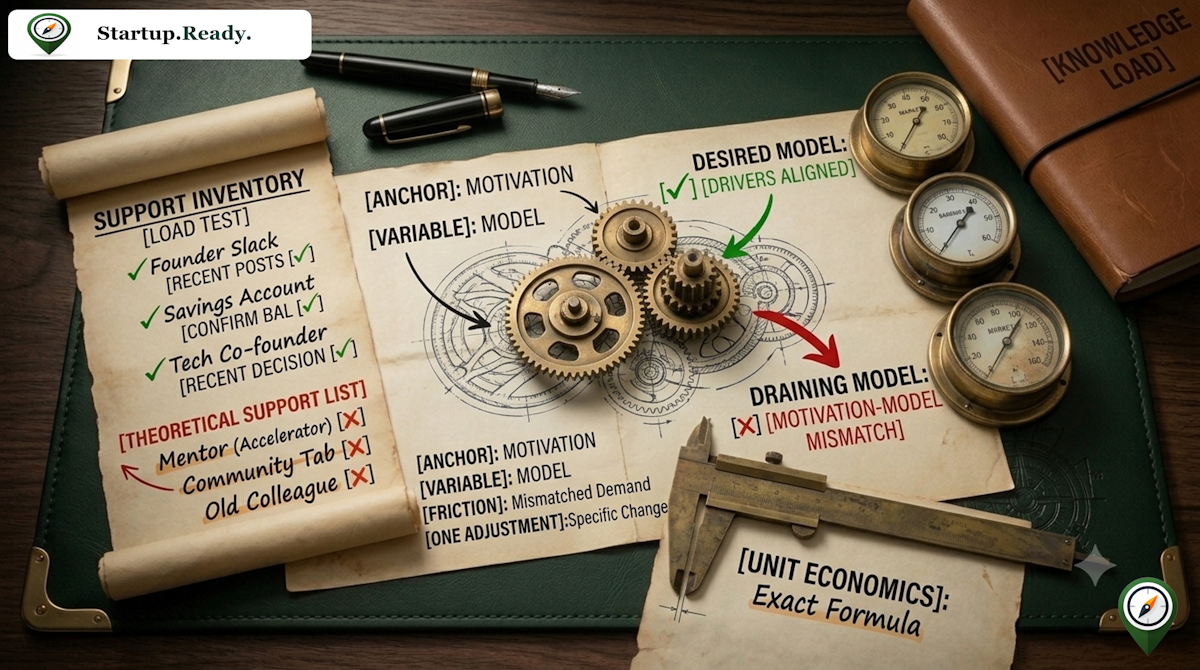
Adjust the model, not the motivation, because motivation is your anchor and the model is the variable you can change
Make one specific change that eases the biggest friction without breaking the value the business delivers
Four signals your model is fighting your motivation:
The work is heavier than it should be and you cannot point to why
You are avoiding a category of task that the model keeps requiring
You started this for a reason the daily work no longer touches
Your instinct is to blame your discipline, not your design
If any of those describe you, this article shows you how to tell a drained motivation from a mismatched one, and what to change.
If You Found This Article by Searching for Something Else
Most founders who need this are not searching for "motivation-model alignment." They are searching for something more immediate.
How to stay motivated as a founder.
Why do I dread working on my own startup.
Founder burnout without a clear reason.
I lost passion for my business.
How to get my drive back.
All of those point at the same underlying question. Has your motivation actually faded, or is the business demanding something you never wanted to give? This article shows you how to tell, and why the fix is usually the model rather than you.
Motivation Rarely Fails. It Gets Mismatched.
There is a failure mode that looks exactly like burnout and is not. A founder starts with real motivation, builds a model, and the model turns out to require a kind of work that runs against what actually drives them. Not once. Every week. The founder pushes through, because pushing through is what founders are told to do, and attributes the growing heaviness to execution problems, or market conditions, or their own flagging discipline.
The real cause is structural. The business is asking for something the founder does not want to give, and the founder keeps giving it anyway out of a reserve that is not infinite. Motivation does not collapse from a single hard moment. It drains through a slow leak the founder never located, because they were looking at their own willpower instead of at the shape of the work.
The reason this is so easy to misdiagnose is that the founder is genuinely motivated. The drive is right there. It is just pointed at something the model does not let them do. So they read the heaviness as a personal failing, a lack of grit, and the prescribed cure, more grit, makes it worse, because it asks them to spend even more of the reserve the mismatch is already draining.
The Driver Beneath the Driver
All of this depends on naming what you actually want, and that is harder than it sounds, because most founders answer with the acceptable version rather than the true one. Asked why they are building, they say impact, because impact is the answer you are supposed to give. Underneath it usually sits something more specific and less polished: independence, mastery, financial security, recognition, or a problem they lived through and cannot let go of.
None of those underneath-drivers is wrong. Each is a perfectly good reason to build. The danger is designing the company around a motivation you do not actually have. A founder who insists, to everyone and to themselves, that the driver is impact when it is really independence will build and defend a model that serves impact and quietly starves the independence doing the real work. The heaviness arrives on schedule, and it is baffling, because on paper they are serving their stated why and not their real one.
So name the driver beneath the driver before anything else. Every move that follows depends on that answer being honest rather than flattering, which is its own work, covered in what makes founder motivation hold.
The Founder Who Wanted Autonomy and Built a Cage
Take a founder who left a corporate job for one main reason: autonomy. She was tired of living inside other people's priorities and calendars. What she wanted, more than money or recognition, was control over her own time and direction. That is a clean, honest primary driver.
Then she built a done-for-you consulting business, because it was the fastest path to revenue and she was good at the work. Eighteen months later she has twelve clients. Each of them has her phone number, a standing call, and an expectation of quick replies. Her calendar is a wall of other people's meetings. She has, in the pursuit of autonomy, built a business that gives her less autonomy than the corporate job she left.
She does not see it that way at first. She sees a founder who is tired, behind, and quietly dreading her own inbox, and she concludes she is burning out or losing her edge. She reads productivity threads and books a silent retreat. None of it helps for long, because none of it touches the actual problem: the model she built demands constant availability to other people, and constant availability to other people is the precise thing her motivation cannot sustain. Her drive is intact. Her design is at war with it.
The heaviness she feels is not a lack of motivation. It is the sound of her motivation being spent against the grain, every single day.
The Friday Energy Test
Before you change anything, you have to tell an important difference apart: the difference between work you dislike and work that is misaligned. They are not the same, and confusing them is what turns this whole idea into an excuse to dodge hard things.
Here is the test. At the end of a normal week, ask two questions. What work gave you energy, and what work consistently drained it? Answer from the week you actually had, not the one you imagine, and be specific about the tasks.
Then interpret the drain, because where it sits is what matters. If the draining work is incidental, one slice of the week, a task among many, the move is to build a system around it: a tool, a contractor, a template, a boundary. That is necessary discomfort, the ordinary friction of building anything, and you handle it without touching the model. If the draining work is the core engine of the business, the thing the model runs on and will keep demanding forever, that is not necessary discomfort. That is misalignment, and no system around the edges will fix it, because the drain is the center.
The examples make the line clean. A founder who dislikes sales but needs a stretch of customer conversations to find fit is facing necessary discomfort. The selling is incidental and temporary, in service of something they do want. A founder who wants to spend their life on deep technical creation and has built a company that requires them to sell, personally and constantly, with no end, is facing misalignment. The selling is not a phase. It is the engine. One founder needs a better system around the edge. The other needs a different model.
Adjust the Model, Not the Motivation
Here is the move that resolves it, and it is the opposite of the usual advice. When your motivation and your model conflict, the motivation is the anchor and the model is the variable. You do not talk yourself into wanting what the model demands. You change what the model demands.
This inverts the reflex. The founder above kept trying to become someone who could tolerate twelve clients on her calendar. The fix was to stop trying to change herself and change the structure instead. One adjustment, not a rebuild: move from open-ended retainers to a productized offering with fixed scope and set times, cap the number of clients with direct calendar access, put the boundary into the model rather than into her willpower. The value she delivers does not change. What changes is the demand the model makes on the thing she actually cares about.
That is the whole principle. Motivation is expensive to manufacture and nearly impossible to fake for long. The model is just a set of choices, and choices can be remade. When the two fight, you do not spend scarce motivation trying to overpower a structure you are free to alter. You alter the structure so it stops fighting.
This is why the Friday Energy Test comes first. You push through necessary discomfort and you redesign misalignment, and telling them apart is the whole reason not to redesign on impulse. Adjust the model where it fights your primary driver at the core. Absorb the friction that is just the cost of building anything.
One Adjustment, Not a Teardown
The word "model" makes this sound bigger than it is. Aligning the model to your motivation almost never means burning the business down and starting over. It means changing one specific demand that conflicts with what you want.
If autonomy is the friction, move toward project-based or productized delivery and reduce the number of people with direct access to your time. If a long revenue timeline is draining a founder who needs income now, add a near-term service component instead of waiting on the long payoff. If operational load is smothering a founder who is driven by creative work, take the single most time-consuming administrative task and hand it to a tool or a contractor, and protect one weekly block for the generative work. If constant visibility is grinding down someone who would rather build quietly, shift acquisition toward channels that do not depend on personal presence.
Each of these is one change, aimed at one friction, and each one leaves the core of the business intact. The test of a good adjustment is that it eases the demand fighting your motivation without weakening the value the business delivers to customers. You are not lowering the bar. You are removing a mismatch that was quietly taxing every hour you worked.
There is a sharper version of that test, and it doubles as protection against fooling yourself. Before you change a demand, ask whether it exists because it creates value for the customer, or only because of how you happened to design the business. Talking to customers and delivering the outcome they pay for create value, and you keep those even when they drain you. Unlimited availability, customizing every single engagement, an operation built so it cannot run without you: those are design choices, not customer value, and they are exactly what you are free to change. If a draining demand turns out to be pure design artifact, adjusting it costs the customer nothing and costs you nothing but a habit.
Do You Want the Business That Works?
There is a question underneath all of this that founders rarely ask, and it is the one that matters most. Most founders ask whether the business can work. Can it reach customers, can it make money, can it grow. Fewer ask the harder question: if it works exactly as designed, will they want the life it creates?
A model can succeed and still be a trap. The founder from earlier could hit every revenue target and end up with a calendar full of other people's meetings, a success that costs her the autonomy she built the whole thing to get. That is the outcome the alignment idea exists to prevent. A business that works but produces a life you do not want is not a win you are on your way to. It is a mismatch you are scaling.
So before you optimize the model, look down the road it leads to. If the version of this business that succeeds exactly as planned is a life you would not choose, the problem is not execution and it is not your drive. It is that the model needs to change now, while the business is small and changing it is cheap.
The One Sentence That Tells You Where You Stand
A founder whose model fits can complete this statement without flinching:
What I actually want most from this business is [specific driver], and the demand the model makes that fights it hardest is [specific weekly demand].
The one adjustment I am making is [specific change], which eases that demand without changing the value we deliver.
A founder running on a mismatched model can name the heaviness easily and stalls on the driver, or names the driver and has never once questioned the model, because the model felt fixed and the willpower felt like the variable. That is the inversion to correct.
If you can name your true driver and the specific demand fighting it, you have found a design problem, and design problems are solvable this week. If you cannot say what you actually want, that is the first gap to close, because you cannot align a model to a motivation you have not named honestly. And if the heaviness turns out to have nothing to do with the model, that is worth knowing too, because it points you somewhere other than the redesign. Either outcome moves you forward.
Motivation, Model, and Your Founder Readiness
In the Startup Readiness Framework, Founder Readiness examines whether the founder's drivers, capabilities, and operating model reinforce each other or pull in different directions. A founder can be genuinely driven and still misaligned, their motivation sound and their model working against it. That mismatch is a common early flag, and a deceptive one, because the founder still feels driven and reads the resulting friction as a personal shortfall rather than a structural one.
Whether your motivation is specific enough to hold under pressure in the first place is the companion question, covered in why vague drive fails.
Founder Readiness is one of the six pillars in the framework. The Startup Readiness Assessment gives you a full-system diagnostic across all six in under twenty minutes.
Take your Startup Readiness Score free today at startupready.ai →
Keep Working on Your Founder Readiness
The Founder Pillar asks one question from many angles: can you, specifically, do the work this startup needs, and can you build the capacity you are missing? Each article below takes one piece of that question. Whether you are the right person to solve this particular problem. Where your real capacity gaps are, and whether they are gaps or just rates you have not run yet. What is draining your motivation, and whether the model is the cause. Which decision you keep making on repeat, and what would change it. Read them in any order. Each is a separate cut at the same pillar, and together they show you where your capacity holds and where it still has to be built.
More in the Founder pillar:
How to Find the Skills Gap That Is Slowing Your Startup Down
Why Startups Fail: The Founder Motivation Problem No One Talks About
How to Protect Your Time as a Founder Without Sacrificing Everything Else
A Skill Gap Is Not a Deficit. It Is a Rate.
A Mentor You Have Not Called in Six Months Is Not a Mentor
Your Network Is Not Gone. It Is in a Drawer.
Your Startup Does Not Need More Goals. It Needs a Filter.
When Working Harder Stops Working, You Have a Leverage Problem
Your Constraints Are Not Obstacles. They Are Design Parameters.
Burnout Is Not Too Much Work. It Is Too Much Undirected Work.
Your Business Model Requires a Team You Do Not Have Yet
Before You Hire Someone, Try Deleting the Task
When You Are Missing the Skill and the Help, Fix One
You Do Not Make Bad Decisions. You Make the Same One Over and Over
Published
By Dr. Shaun P. Digan
Originally published on Startup.Ready.’s Startup Readiness: Validation, Framework, and Tools Blog at https://startupready.ai/startup-readiness/motivation-model-alignment
Original Publication Date: July 21, 2026
Last Updated: August 6, 2026
About the Author
Dr. Shaun P. Digan is the founder of Startup.Ready and the creator of the Startup Readiness Framework, a research-based system for evaluating and validating early-stage startups before launch and early growth. He holds a PhD in Entrepreneurship from the University of Louisville and has spent over 15 years teaching, advising, and consulting with founders on startup strategy, validation, and growth.
In his writing, including the Startup Readiness Blog and The Foundations of Innovation Essay Series, he focuses on how founders can make better decisions by improving clarity, alignment, and readiness before scaling.