When You Are Missing the Skill and the Help, Fix One
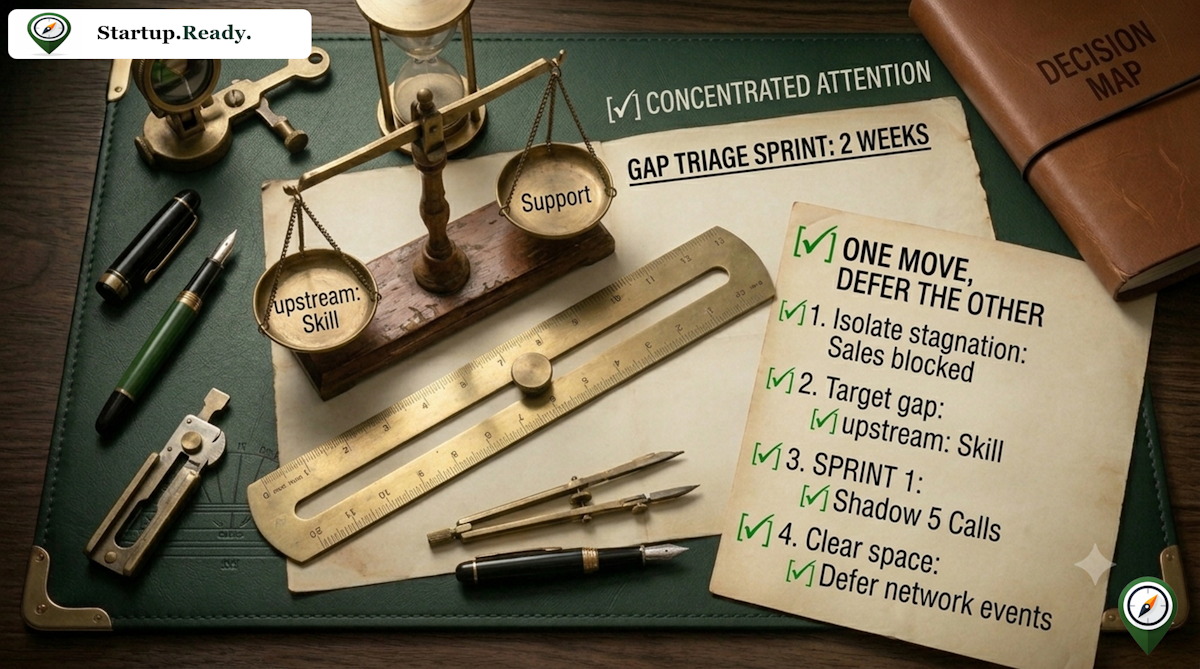
There is a particular kind of stuck that comes from two gaps at once. The business needs work you cannot do well, and there is no one around to help you do it. A skill gap and a support gap, open at the same time, feeding each other.
The natural response is to attack both. Start learning the skill, and start building a network, and keep the business running, all at once. It feels responsible and comprehensive, and it is the exact move that guarantees neither gap closes. A skill you are half-learning while also cold-messaging strangers for support while also doing everything else is a skill you will not learn and a network you will not build. Two gaps attacked simultaneously do not close twice as fast. They stall each other, and you end the month with two partial efforts and no progress on either.
When both gaps are open, the move is not to close both. Here is the part that feels backward: the fastest way to close both is usually to stop working on one of them. You triage, pick the gap that is holding up the other, pour everything into that one, and the second gap closes faster for having been set down.
TL;DR: The Fastest Way to Close Two Gaps Is to Stop Working on One.
A thin skill and a thin support structure at the same time produce drift, because the founder defaults to the work they can do while the critical work waits. Attacking both gaps at once produces two partial efforts that stall each other. The work is to name both gaps, find the one sitting earlier in the execution chain, and make a single move against it. Here is the move, in order:
Name both gaps specifically, the most critical undone work and the most significant missing support, each in one sentence
Find the upstream gap, the one more directly connected to the work that cannot wait, or the one whose closing makes the other easier
Look for a move that serves both, like one person who has the expertise you lack and can help you execute against it
Make one move, small enough to complete or clearly start in two weeks, and defer the other on purpose
Let the first close expose what matters next, rather than trying to plan the whole path now
Four signals you are stuck in a two-gap stall:
You are making partial progress on several fronts and finishing none
You default to the work you can do while the work that matters waits
You are trying to learn a skill and build a network and run the business in the same weeks
Your plan looks comprehensive and is delivering nothing
If any of those describe you, this article shows you how to trade a comprehensive plan for one move that actually compounds.
If You Found This Article by Searching for Something Else
Most founders who need this are not searching for "execution gap triage." They are searching for something more immediate.
I do not know what to work on first.
Solo founder with no skills and no network.
How to prioritize when everything is a weakness.
My startup is stuck and I am doing it alone.
How to make progress when I am missing too much.
All of those point at the same underlying question. You are short on both the skill and the help, so which do you fix first? This article shows you how to choose, and why choosing one is the whole point.
Why Two Gaps Stall Each Other
A single gap is a manageable problem. You are missing a skill, so you close it. You are missing support, so you go build it. What makes the two-gap situation different is not that there is more to do. It is that the two efforts compete for the same scarce founder attention, and neither gets enough of it to reach the threshold where it starts paying off.
Learning a real skill requires sustained, concentrated practice, the kind that only compounds if you stay with it. Building real support requires consistent, repeated contact, the kind that only becomes a relationship if you keep showing up. Both are threshold activities: below a certain level of sustained attention, they produce almost nothing. Split your limited attention across both and you keep each one below its threshold, so both stay in the zone where effort goes in and nothing comes out. You are busy on two fronts and advancing on neither, which feels like progress and is not.
This is why "do both" is not a cautious, thorough choice. It is the riskiest one, because it is the one most likely to leave you, a month later, exactly where you started with two half-built efforts and less energy. Concentration is what gets either gap across its threshold, and concentration means choosing.
The Drift Underneath It
There is a quieter failure hiding under the two-gap stall, and it is worth seeing clearly. When both the skill and the support are missing, the founder does not usually freeze. They keep working. They just keep working on the things they already know how to do, because those are the things available to them, and the critical work, the work that needs the missing skill or the missing help, quietly slides.
So progress continues in the areas of strength and stops in the areas that most need attention, and because the founder is genuinely busy and genuinely producing, the drift never announces itself. There is no dramatic failure, no obvious day the wheels came off. There is just a slowly widening gap between where the business is and where it needs to be, hidden under a full and productive-feeling calendar. Triage interrupts this by closing a gap and, just as importantly, by forcing the founder to point their attention at the work they have been avoiding because it sits behind a gap.
The Founder Who Could Not Sell and Knew No One
Take a founder whose startup lives or dies on customer conversations, and who has two problems at once. She is not good at sales and has never enjoyed it, and she knows almost no one in the industry she is selling into. A skill gap and a support gap, both blocking the same critical work.
So she attacks both. She reads three sales books. She joins two networking groups and starts going to founder events. She watches sales videos between tasks. It feels productive, and for three months it produces almost nothing. No customers, because reading about sales did not make her able to sell. No real relationships, because showing up occasionally at events is not how relationships form. Two half-efforts, both sitting below the line where they start to pay off.
Then she triages. She traces the critical undone thing, actual sales conversations, back to what is blocking it, and instead of splitting herself across both gaps she makes one move. She finds a single experienced seller in her space and arranges to shadow five of their calls. That one move closes part of both gaps at once. She learns more about selling from five real calls than from three books, and the seller becomes a genuine relationship in the industry rather than a business card. Both gaps start shrinking from one concentrated action, which three months of working on both at the same time never managed.
Find the Gap That Is Upstream
Triage means deciding which gap to close first, and the decision has a right answer more often than it feels like it does. One of the two gaps is sitting earlier in the execution chain, and closing it either unlocks the other or relieves enough pressure to face it clearly.
Two questions find it, and they are worth memorizing, because you can run them on any stuck week. First: what is the most important thing in the business that is not happening right now? Name the single most critical undone thing, the one the sales founder named as real customer conversations. Second: is it blocked primarily by missing skill or missing support? If the critical work is a task you cannot do, the skill gap is upstream. If it is work you could do but cannot judge alone, cannot get access to, or cannot stay accountable to, the support gap is upstream. Trace the one thing that most needs to happen back to the piece that is actually blocking it. That piece is where the move goes.
The Move That Closes Both
Before you commit to one gap, ask the question that can beat the whole triage: is there a single move that closes part of both gaps at once? This is the highest-leverage outcome available in this situation, and it is more reachable than founders expect, which is why it deserves to be the first thing you look for rather than a footnote.
The shape of it is almost always a person. One advisor, one mentor, one experienced peer, one contractor who teaches while they work, who has the expertise you are missing and, in the having of the relationship, is also the support you were missing. That single connection narrows the skill gap and the support gap in the same stroke. The founder who could not sell found exactly this. Shadowing one experienced seller taught her to sell and handed her a real relationship in the industry, two gaps closing from one move. A book closes at most one gap. The right person closes both.
So look for that person first. When a both-closing move exists, take it, because it collapses two problems into one action and beats any amount of parallel effort spent on the two gaps separately. When no such move is available, fall back to triage and close the gap blocking the work that cannot wait, letting the other one wait its turn.
One Move, Not a Program
Once you know which gap, the move against it has to be small, because the entire failure mode you are escaping is spreading effort too thin. A program is not the goal. One action is.
For a skill gap, the efficient first move is rarely "learn the whole subject." It is to find one person who has already closed this exact gap and ask for a single conversation about how, or to do the smallest real version of the task this week to surface precisely where the gap is, or to name the one specific resource that closes it fastest and start it by a date. For a support gap, it is to message one specific person who could fill the role, or to join the one community where that support already exists and make one genuine contribution this week, or to ask one person in your network for one introduction. In both cases the move is a single, completable action, not a plan with phases.
The test is whether you can complete it, or clearly set it in motion, within two weeks. If it cannot be started that fast, it is too big, and too big is how the two-gap stall reasserts itself under a new name. And because even one move needs room, name what you will stop or defer to make space for it. A move without space is the same overload you were already carrying, relabeled as a plan.
One move does not solve the gap. It reduces it enough to show you what matters next, and the next move comes into focus only after the first one is made. That is the rhythm: one gap, one move, then re-look. Momentum in this situation compounds from concentration, and concentration is the thing two simultaneous efforts make impossible.
The Two-Week Triage Sprint
Run your two-gap situation through four steps before you start, so the sprint concentrates instead of spreading.
Isolate the undone task. Name the single most important thing sitting stagnant this month, the deliverable or metric that is not moving. Everything else routes from this.
Choose your target. Decide whether that task is blocked more by missing skill or missing support, pick that upstream gap, and explicitly defer the other for fourteen days. Deferring is a decision, not a failure.
Size the action. Make sure your one move can be completed or clearly started within two weeks. If it cannot, it is too big, and too big is how the stall comes back under a new name.
Clear space. Remove or defer one recurring low-value task to protect the focus this needs. A move with no space is the same overload with a new label.
If any step is blank, that blank is the work to do before the sprint starts, not during it.
The One Sentence That Tells You Where You Stand
A founder who has triaged can complete this statement cleanly:
The gap creating the most immediate friction right now is my [skill gap / support gap], the one move I am making to reduce it is [specific, two-week action], and I am deferring [the other gap] on purpose until this one moves.
A founder still trying to fix everything cannot name a single gap or a single move, because their plan is a comprehensive list, and the inability to choose one is the diagnosis. The list feels safer than the choice, and it is exactly what has been keeping them stuck.
If you can name the upstream gap and one move against it, you have traded a stalled two-front campaign for a single effort that can actually cross its threshold. If you cannot choose, that is not a reason to keep pushing on both. It is the signal to trace the most important undone thing back to the gap that is blocking it, put your effort there, and let the other gap wait its turn. Either outcome moves you forward.
Triage and Your Founder Readiness
In the Startup Readiness Framework, Founder Readiness flags the combination of a thin skill set and a thin support structure as an execution gap, because together they produce exactly this drift: the founder defaulting to the work they can do while the critical work goes unaddressed and no one is there to help close the distance. The fix is not a comprehensive plan. It is one triaged move that reduces the friction where it is worst.
Which skill gap sits on your critical path is its own diagnostic, covered in the skills gap that is slowing your startup down, and whether a thin support system is genuinely absent or just dormant is covered in reactivating the network you already have.
Founder Readiness is one of the six pillars in the framework. The Startup Readiness Assessment gives you a full-system diagnostic across all six in under twenty minutes.
Take your Startup Readiness Score free today at startupready.ai →
Keep Working on Your Founder Readiness
The Founder Pillar asks one question from many angles: can you, specifically, do the work this startup needs, and can you build the capacity you are missing? Each article below takes one piece of that question. Whether you are the right person to solve this particular problem. Where your real capacity gaps are, and whether they are gaps or just rates you have not run yet. What is draining your motivation, and whether the model is the cause. Which decision you keep making on repeat, and what would change it. Read them in any order. Each is a separate cut at the same pillar, and together they show you where your capacity holds and where it still has to be built.
More in the Founder pillar:
How to Find the Skills Gap That Is Slowing Your Startup Down
Why Startups Fail: The Founder Motivation Problem No One Talks About
How to Protect Your Time as a Founder Without Sacrificing Everything Else
A Skill Gap Is Not a Deficit. It Is a Rate.
A Mentor You Have Not Called in Six Months Is Not a Mentor
Your Network Is Not Gone. It Is in a Drawer.
You Are Not Losing Motivation. Your Model Is Draining It.
Your Startup Does Not Need More Goals. It Needs a Filter.
When Working Harder Stops Working, You Have a Leverage Problem
Your Constraints Are Not Obstacles. They Are Design Parameters.
Burnout Is Not Too Much Work. It Is Too Much Undirected Work.
Your Business Model Requires a Team You Do Not Have Yet
Before You Hire Someone, Try Deleting the Task
You Do Not Make Bad Decisions. You Make the Same One Over and Over
Published
By Dr. Shaun P. Digan
Originally published on Startup.Ready.’s Startup Readiness: Validation, Framework, and Tools Blog at https://startupready.ai/startup-readiness/execution-gap-triage
Original Publication Date: July 21, 2026
Last Updated: August 4, 2026
About the Author
Dr. Shaun P. Digan is the founder of Startup.Ready and the creator of the Startup Readiness Framework, a research-based system for evaluating and validating early-stage startups before launch and early growth. He holds a PhD in Entrepreneurship from the University of Louisville and has spent over 15 years teaching, advising, and consulting with founders on startup strategy, validation, and growth.
In his writing, including the Startup Readiness Blog and The Foundations of Innovation Essay Series, he focuses on how founders can make better decisions by improving clarity, alignment, and readiness before scaling.