Your Constraints Are Not Obstacles. They Are Design Parameters.
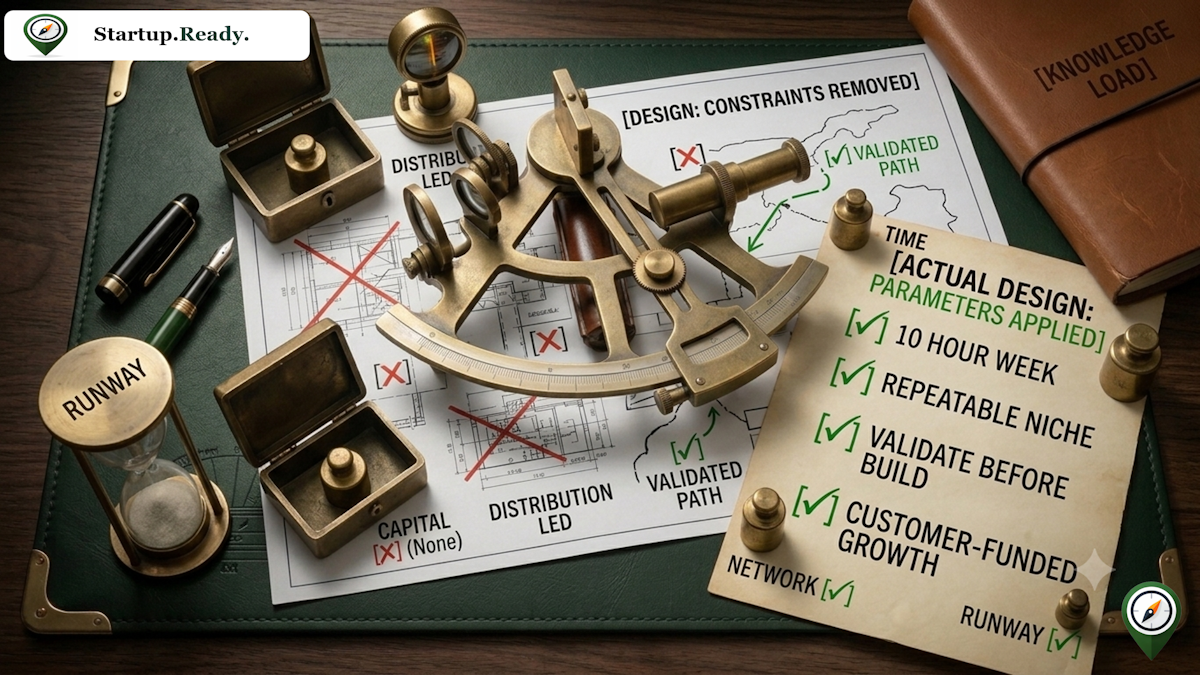
Most founders treat their constraints as things to overcome or hide. The full-time job, the ten real hours a week, the thin savings, the network that does not reach the customer. These feel like admissions of weakness, the gap between you and a "real" founder who has runway and time and connections, so the instinct is to build as though they are temporary, as though the real business starts once they lift.
They do not lift on your schedule, and building as if they have is how founders quietly exhaust themselves. A constraint you refuse to name does not go away. It just goes unaccounted for, shaping your pace and your stress from underneath while you design a business that assumes it is not there.
The founders who move steadily under real limits do something different. They stop treating constraints as obstacles to push through and start treating them as parameters to design around.
TL;DR: A Constraint-Aware Strategy Is Not a Smaller Strategy. It Is a More Executable One.
Every founder has constraints. What separates the ones who make steady progress is whether the business they built respects the limits they actually have. Ignore your constraints and you have not built an ambitious plan. You have built an imaginary one. Constraints define which models, which channels, and which pace are realistic right now, and they narrow your options without narrowing your responsibility to move inside them. The work is to name the limits that will not change soon and adjust the strategy to fit them. Here is the move, in order:
Name the real constraints: time, money, runway, network, and the personal ones founders leave unnamed
Mark what is fixed for the next six to twelve months, honestly, rather than what you hope will change
Pick the three most limiting to execution over the next ninety days
Adjust the strategy to fit each, narrowing scope or sequencing rather than lowering the ambition
Commit to the one change that removes the most friction in the next thirty days
Four signals you are building against your constraints instead of around them:
Your plan assumes more time, money, or access than you actually have
Everything feels harder than it should, without a single dramatic failure to point to
You keep deferring decisions until conditions improve
You are embarrassed by your constraints rather than designing with them
If any of those describe you, this article shows you how to turn the limits you have into the parameters you build with.
If You Found This Article by Searching for Something Else
Most founders who need this are not searching for "designing around constraints." They are searching for something more immediate.
How to build a startup with a full-time job.
Starting a business with no money.
How to make progress with limited time.
Can I build a startup with young kids.
Bootstrapping with no network.
All of those point at the same underlying question. How do you build a real business from inside real limits, instead of waiting for the limits to lift? This article shows you how to design with them rather than against them.
An Unnamed Constraint Still Runs the Business
The reason founders avoid naming constraints is that naming them feels like conceding something. Admitting you have ten hours a week, not forty, feels like admitting you are less serious, so the plan gets written for forty and the ten-hour reality is treated as a temporary inconvenience to power through.
The constraint does not care whether you named it. It shapes the business either way. Named, it shapes the design on purpose: you choose a narrower scope, a simpler path, a sequence that fits. Unnamed, it shapes the business through friction, and the friction is quieter and more corrosive. There is no single dramatic failure. There is fatigue, and decisions that keep getting deferred, and a growing sense that everything is harder than it should be, and none of it traces back to an obvious cause, because the cause is a mismatch the founder designed in by pretending the limit was not there.
That is the real cost of the unnamed constraint. Not that it stops you, but that it taxes every week invisibly, and the founder reads the tax as personal inadequacy rather than as evidence that the business was built for conditions they do not have.
Constraints Are Parameters, Not Verdicts
The reframe that changes everything is small and it is load-bearing. A constraint is not a judgment on whether you should be building. It is a specification of how. It tells you which business models are realistic from where you stand, which go-to-market paths you can actually walk, how fast you can move, and what success can look like this year. Those are design inputs, the same kind an engineer takes from the physical limits of a material. You do not resent a beam for having a load rating. You design within it.
This is where the separate limits combine into the one that matters most: the model constraint. Your hours, your capital, your access, and your obligations do not each cost you something in isolation. Together they rule out whole categories of business design. High-touch consulting is incompatible with ten hours a week. Enterprise sales is incompatible with no relationships. A capital-intensive product is incompatible with no funding. The model constraint is the shape your specific limits carve out of the space of possible businesses, and it is the one founders build straight past most often, because each individual limit felt survivable on its own. The overextension comes from the combination, not from any single line item.
This matters because it moves the constraint from a source of shame to a source of clarity. A founder with ten hours a week and no runway is not a lesser founder. They are a founder whose design space is defined more sharply than most, and a sharply defined design space is easier to build in, not harder, because it rules out most of the options that would have scattered their limited effort. The constraint does some of the strategy work for you, if you let it, by eliminating everything the limits cannot support.
The founders who struggle most are often the ones with the fewest visible constraints, precisely because nothing forces them to choose. A hard limit, named and accepted, is a forcing function. It makes the focus that unconstrained founders have to manufacture through discipline.
Narrow the Options, Not the Ambition
Two misreadings can hijack this idea, in opposite directions, and both need heading off.
The first is that designing around constraints means shrinking your ambition. It does not. Constraints change the route, not the destination. The founder with ten hours a week and no capital probably cannot build a marketplace, hire a team, or run paid acquisition this year. They can still validate a sharp problem, build a prototype, talk to a hundred customers, and earn a distribution advantage that compounds. The mountain is the same. The path up it is chosen to fit the climber. The ambition stays fixed while the sequence and the scope bend to what the founder can actually do from here.
The second misreading is more dangerous: treating constraints as permission. A constraint is not a reason to avoid hard work. It is a reason to choose the hard work that fits. Ten hours a week does not excuse a founder from doing difficult things. It obligates them to spend those ten hours on the most difficult and most valuable things and to cut everything else. Constraints narrow your options. They do not narrow your responsibility to move. A founder who uses a real limit as a reason to coast has inverted the whole idea, which is about concentrating effort and never about excusing its absence.
The Founder Building a Business He Did Not Have Time For
Take a founder with a full-time job and two young kids. His honest available time is about ten hours a week, his savings will not cover leaving the job, and his network does not reach the customers he wants. Those are his real constraints, and they are not changing in the next year.
Look at what he built. A go-to-market plan across four channels, content and ads and events and outbound, because that is what the playbooks say. A product roadmap sized for a team. An implicit assumption, never stated, that he would find the time. The plan is not wrong for some founder. It is wrong for this one, because it was designed for forty hours, runway, and a network he does not have, and every week the gap between the plan and his reality shows up as him falling behind a schedule that was never physically possible. He reads it as failing. He is not failing. He is executing a plan built for a different person's constraints.
Now design around the parameters instead. Ten hours a week means one channel, not four, the single most reachable path to customers, run consistently. No runway means charging from the first customer and validating with conversations before building anything expensive, so the business funds itself rather than waiting on savings he does not have. A thin network means one warm introduction a month treated as the primary acquisition method, plus narrow cold outreach to a specific segment, rather than a broad presence he has no hours to maintain. None of this lowers where he is going. It changes the route so the route is one he can actually walk from where he is standing. That is the whole move: same destination, a path sized for the vehicle he actually has.
Notice the deeper point buried in the network piece. His constraint was never only a thin network. It was choosing an acquisition strategy that required a network he does not have. Swap the strategy for one that fits, and the same thin network stops being the thing holding him back. This is worth watching for everywhere, because the constraint is often not the limit itself. It is a plan that quietly depends on not having that limit.
Fixed or Reducible
Before you design around a constraint, sort it, because not every limit is permanent and the two kinds get handled differently.
Some constraints are fixed for the planning horizon. The founder above is not going to have more than ten hours a week while the job and the kids are what they are, and pretending otherwise just resets the same disappointment monthly. Fixed constraints you design around. You accept them as parameters and build a strategy that fits inside them, without spending energy resenting them.
Other constraints look fixed and are actually reducible with a specific action. A thin network is often reducible: a deliberate month of reactivating dormant relationships can widen access more than it seems. A tight runway can sometimes be extended by cutting one real expense or adding a small income stream. The test is whether you can name a concrete action that would move the constraint in the next thirty days. If you can, it is reducible, and reducing it may be a better use of effort than designing around it. If you cannot, it is fixed for now, and the honest move is to design around it rather than wait on a change you cannot cause.
The mistake in both directions is the same: treating a reducible constraint as a life sentence and burning no effort to move it, or treating a fixed constraint as temporary and burning all your effort resenting it. Sort first. Then design or reduce, whichever the constraint actually allows.
The Constraint Can Become the Edge
There is a further turn here, past simply making a limit survivable. The constraint that feels like your disadvantage often becomes the source of your advantage, because it forces you to build in a way an unconstrained founder never would. A founder with no capital gets pushed toward customer-funded growth, and customer-funded growth is a stronger position than a war chest that lets you postpone selling. A founder with almost no time is forced to find a niche narrow enough to serve in the hours they have, and a narrow, sharply served niche is often worth more than the broad market they would have chased with more time. A founder without industry connections has to build a real system for reaching and understanding customers, and that system outlasts the connections it replaced.
None of this is guaranteed, and constraints are not secretly gifts. But the forcing function is real. Constraints force choices, and choices are where differentiation comes from, while the unconstrained founder, free to do everything, often ends up doing nothing distinctly. The disadvantage you would trade away first may be the one quietly building the thing that sets you apart.
The One Sentence That Tells You Where You Stand
A founder designing around their constraints can complete this statement plainly:
The constraint most limiting my execution right now is [specific, quantified limit], and the assumption I was quietly making that ignored it was [the part of the plan that assumed I did not have this limit].
It is [fixed for now / reducible by a specific action], and the strategy adjustment I am making to fit it is [specific change].
A founder building against their constraints can describe the ambition in detail and stalls at the limit, because the plan was written as if the limit were not there. That stall is the diagnosis.
If you can name your hardest constraint and the adjustment that fits it, you have a plan sized for the founder you actually are, and a plan you can execute beats an impressive one you cannot every week of the year. If you cannot name a single limit, or your plan quietly assumes conditions you do not have, the gap is not effort or ambition. It is a design built for someone else's circumstances. Name the limit, decide whether to reduce it or build around it, and change one thing so the strategy fits the founder standing here. Either outcome moves you forward.
Constraints and Your Founder Readiness
In the Startup Readiness Framework, Founder Readiness treats constraints as part of the design, not as disqualifiers, because a business that respects the founder's real limits is more executable than one that assumes them away. Constraints themselves are not a readiness problem. A strategy that ignores them is. The mismatch between the two is the real early flag, and it produces the slow overextension that resets a founder just as they gain momentum.
This is the same principle as matching the model to your motivation, applied to your circumstances instead of your drivers, covered in why your model, not your motivation, is the thing to change.
Founder Readiness is one of the six pillars in the framework. The Startup Readiness Assessment gives you a full-system diagnostic across all six in under twenty minutes.
Take your Startup Readiness Score free today at startupready.ai →
Keep Working on Your Founder Readiness
The Founder Pillar asks one question from many angles: can you, specifically, do the work this startup needs, and can you build the capacity you are missing? Each article below takes one piece of that question. Whether you are the right person to solve this particular problem. Where your real capacity gaps are, and whether they are gaps or just rates you have not run yet. What is draining your motivation, and whether the model is the cause. Which decision you keep making on repeat, and what would change it. Read them in any order. Each is a separate cut at the same pillar, and together they show you where your capacity holds and where it still has to be built.
More in the Founder pillar:
How to Find the Skills Gap That Is Slowing Your Startup Down
Why Startups Fail: The Founder Motivation Problem No One Talks About
How to Protect Your Time as a Founder Without Sacrificing Everything Else
A Skill Gap Is Not a Deficit. It Is a Rate.
A Mentor You Have Not Called in Six Months Is Not a Mentor
Your Network Is Not Gone. It Is in a Drawer.
You Are Not Losing Motivation. Your Model Is Draining It.
Your Startup Does Not Need More Goals. It Needs a Filter.
When Working Harder Stops Working, You Have a Leverage Problem
Burnout Is Not Too Much Work. It Is Too Much Undirected Work.
Your Business Model Requires a Team You Do Not Have Yet
Before You Hire Someone, Try Deleting the Task
When You Are Missing the Skill and the Help, Fix One
You Do Not Make Bad Decisions. You Make the Same One Over and Over
Published
By Dr. Shaun P. Digan
Originally published on Startup.Ready.’s Startup Readiness: Validation, Framework, and Tools Blog at https://startupready.ai/startup-readiness/designing-around-constraints
Original Publication Date: July 21, 2026
Last Updated: August 4, 2026
About the Author
Dr. Shaun P. Digan is the founder of Startup.Ready and the creator of the Startup Readiness Framework, a research-based system for evaluating and validating early-stage startups before launch and early growth. He holds a PhD in Entrepreneurship from the University of Louisville and has spent over 15 years teaching, advising, and consulting with founders on startup strategy, validation, and growth.
In his writing, including the Startup Readiness Blog and The Foundations of Innovation Essay Series, he focuses on how founders can make better decisions by improving clarity, alignment, and readiness before scaling.