You Do Not Make Bad Decisions. You Make the Same One Over and Over.
A founder makes dozens of decisions a week, most of them fast, most of them under pressure, most of them with incomplete information. Look back over a year of those decisions and the striking thing is not that some were wrong. It is that the wrong ones rhyme. The same kind of misstep, in different clothing, again and again.
That is the part worth understanding, because it changes the fix. You do not have a decision-quality problem, exactly. You have a pattern problem. Under pressure you fall back on the same cognitive shortcut every time, and that shortcut produces the same category of error, and you rarely notice because each instance looks like a fresh, reasonable call in the moment. The urgent thing wins again. The exciting thing pulls resources again. The uncomfortable conversation gets deferred again. None of these feels like a repeated mistake. Each one feels like this specific situation, decided on its merits.
You cannot out-think a reflex in the moment it fires. What you can do is install something that interrupts it.
TL;DR: You Cannot Fix Your Judgment Under Pressure. You Can Install an Interrupt.
Founders make one-off mistakes like anyone, but the expensive errors are the ones that repeat, driven by a small set of cognitive traps that fire automatically under pressure. Willpower and good intentions do not stop a reflex. A personal decision rule does, by interrupting the default pattern before it completes. The work is to find your recurring traps and build a specific if-then rule that catches them. Here is the move, in order:
Name your recurring traps, the two or three predictable errors you make again and again
Map the trigger, the condition that fires the trap and the earliest signal you can catch
Build an if-then rule that interrupts the default and redirects it, specific enough to apply without thinking
Reduce it to a line you can recall in three seconds under real pressure, and put it where you will see it
Track whether you actually use it, because a rule you ignore is not a rule
Four signals you are running on autopilot instead of a rule:
Asked how you decided something last week, the honest answer is "I went with my gut"
Your wrong calls share a shape, urgency, or excitement, or avoidance, showing up repeatedly
You keep making the same category of mistake and treating each one as a one-off
You decide fast under pressure and cannot describe the process you used
If any of those describe you, this article shows you how to interrupt the pattern before it commits you again.
If You Found This Article by Searching for Something Else
Most founders who need this are not searching for "personal decision rule." They are searching for something more immediate.
How to make better decisions as a founder.
Why do I keep making the same mistakes.
How to stop chasing shiny objects.
How to decide under pressure.
Founder decision-making framework.
All of those point at the same underlying question. Are your bad decisions random, or are they the same trap firing over and over? This article shows you how to name the trap and build the interrupt.
The Expensive Mistakes Repeat
Founders make plenty of one-off mistakes: situational, unlucky, sometimes unavoidable. Those are not the problem this article is about. The expensive mistakes are the ones that repeat, because a repeated error compounds in a way an isolated one never does, and because it is fixable in a way an isolated one is not. If your worst calls were scattered and unrelated, the only remedy would be to get generally smarter, which is not a plan. The repeated ones have a specific, nameable cause you can interrupt.
You will recognize your own in a lineup of founder types. The Firefighter always works on the fire instead of the foundation, choosing whatever is loudest this hour over whatever matters most this quarter. The Explorer starts over every month, pulled off the current build by the next exciting idea. The Avoider keeps postponing the uncomfortable thing: the hard conversation, the price increase, the customer interviews that might come back negative. The Builder answers every problem by adding more product, shipping another feature when the real issue is that nobody wanted the last three. The Loyalist keeps walking a path because of everything already sunk into it, finishing what should have been stopped.
Underneath each type sits a well-documented bias, urgency, excitement, avoidance, and the rest, but the founder-facing version is the useful one. What matters is that each is a groove your mind slides into, and under real pressure you slide into the same one or two nearly every time. Most founders, reading that list, feel one or two of them land a little too hard. Those are yours.
If none of the five obviously fits, run the fastest diagnostic there is. Think of the last three decisions you genuinely regret, and ask what they have in common. It is almost never nothing. Whatever shape they share is your groove, and finding it is good news, because a patterned error is a solvable one. You do not have to fix your judgment in general. You have to catch two or three specific traps, and traps that fire predictably can be interrupted predictably.
Why Willpower Does Not Work Here
The moment you need discipline most is the moment your judgment is least reliable. That single fact is why willpower does not solve this. The instinct, once you see your trap, is to resolve to do better, to notice the pattern and simply decide, going forward, not to fall into it. It never works.
The traps fire automatically and fast, below the level where deliberate intention operates. By the time the exciting new idea has your attention, the shortcut has already run, and the story your mind is telling you, this one is different, this is a real opportunity, is the trap talking rather than a neutral assessment. You cannot use the compromised system to catch itself in the moment it is compromised. Resolving to be more disciplined asks the fox to guard the henhouse, because the same in-the-moment judgment that falls for the trap is the judgment you are counting on to resist it.
What works is moving the intervention outside the moment. You decide, in advance and while calm, on a specific rule that will fire when the trigger appears, and the rule does the catching so your in-the-moment judgment does not have to. The rule is dumb and mechanical on purpose. It does not require you to be wise under pressure. It only requires you to recognize a trigger and follow a pre-set instruction, which is a far lower bar than out-reasoning your own bias in real time.
The Founder Who Kept Starting Over
Take a founder whose recurring trap is excitement bias. Every few weeks a new idea arrives, a different market, a clever feature, a pivot that suddenly seems obvious, and it feels more alive than the grind of the thing she is already building. So she reallocates. A week of research here, a prototype there, attention quietly draining from the current commitment toward the new one. Each time, it feels like a smart, opportunistic move. Each time, she is not lying to herself, exactly. She genuinely sees the potential.
Look at a year of it and the pattern is unmistakable. Four or five half-built starts, nothing carried far enough to work, and a business that has moved in every direction and arrived nowhere. It was never one bad call. It was the same call, made five times, dressed in five different exciting ideas. The problem was not any individual decision to explore. It was the groove.
So she builds a rule, and it is aimed precisely at her trigger. The trigger is a new idea that feels more alive than the current work. The earliest signal, the thing she can actually catch, is the moment she starts "just researching" the new thing. Her rule: before committing more than two hours to anything new, she writes down the specific thing it would displace, and she does not act for two weeks. The rule does not forbid the new idea. It just makes the displacement visible and puts a delay between the excitement and the reallocation, which is exactly the space the trap was skipping. Most of the exciting ideas do not survive two weeks and a written cost. The occasional one that does was probably worth it.
The Rule Has to Survive the Moment
A rule is only as good as your ability to recall it when the trap fires, and the trap fires when you are least calm and least reflective. A rule you can state beautifully in a worksheet and cannot summon in the three seconds before you commit is not a rule. It is a note about a rule.
So reduce it to a single line, in an if-then shape, short enough to run in your head under pressure. "If a new idea feels urgent, I name what it displaces before I touch it." "If a decision feels obvious, I write down what would have to be true for it to be wrong." "If I am about to continue something, I ask whether I would start it today knowing what I know now." Each is a trigger and an instruction, nothing more, because anything more will not survive the moment it is needed.
Then put it where the decision happens. On a card on your desk, next to the laptop, inside the notebook you actually open. Not buried in your phone, not filed in a document you will never reopen. The trap fires in the physical place where you work, so the interrupt has to live there too, visible, in the line of sight of the moment it is meant to catch. A rule you cannot see when you need it will lose to a reflex you cannot help.
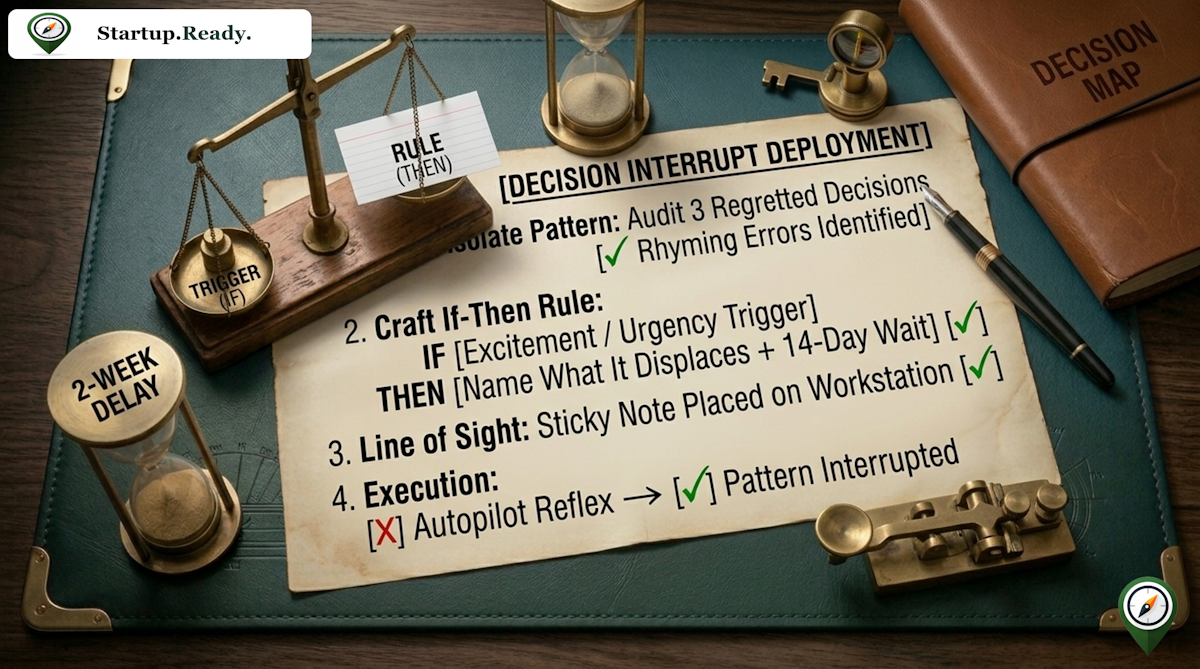
The Decision Interrupt Deployment
Four steps turn a trap you have noticed into an interrupt that actually fires.
Isolate the pattern. Audit your last three regretted decisions and name the trigger they share. That shared condition is what the rule has to catch.
Craft the if-then. Write one sentence: when [trigger], I [specific pause or action] before I commit. Short enough to run in your head in three seconds.
Place it in your line of sight. Put the written rule where the decision happens, a sticky note on the monitor, a card by the laptop, not buried in your phone. An interrupt you cannot see will lose to a reflex you cannot help.
Run the two-week test. For fourteen days, log every time the trigger fires and whether you used the rule. If you keep skipping it, the rule is too vague, too complex, or mistimed. Adjust it until it would have caught the decision that slipped through.
A rule that lives on a card and gets used is worth more than a perfect one that lives in a worksheet.
The One Sentence That Tells You Where You Stand
A founder who has built a real decision rule can complete this statement without reaching:
My most consistent decision trap is [specific trap], it fires when [specific trigger], and my rule is: when [trigger], I [specific action] before I [commit].
A founder still on autopilot can describe plenty of decisions and cannot name the pattern under them, because the whole problem is that each one looked like a separate, reasonable call. That inability to see the shape is the diagnosis, and it is exactly what keeps the pattern running.
If you can name your trap, its trigger, and the rule that interrupts it, you have moved one recurring error from automatic to catchable, which is the only kind of decision improvement that survives real pressure. If you cannot yet name the pattern, that is the first work: look back at the decisions you regret and find the shape they share, because it is almost never randomness. It is one or two grooves, firing again and again. Name the groove, build the interrupt, and put it where you will see it. Either outcome moves you forward.
Decision Rules and Your Founder Readiness
In the Startup Readiness Framework, Founder Readiness looks at whether a founder's decision-making under uncertainty is structured enough to produce consistent, directional progress, because dozens of unstructured decisions a week, each made from urgency or excitement rather than evidence, compound into a business that moved constantly and went nowhere. A weak decision process is a common early flag, and it hides well, because each individual call felt reasonable at the time.
What you are deciding toward is the companion question, covered in why a definition of success is a decision filter, and how fast you update your beliefs when the evidence changes is covered in learning velocity.
Founder Readiness is one of the six pillars in the framework. The Startup Readiness Assessment gives you a full-system diagnostic across all six in under twenty minutes.
Take your Startup Readiness Score free today at startupready.ai →
Keep Working on Your Founder Readiness
The Founder Pillar asks one question from many angles: can you, specifically, do the work this startup needs, and can you build the capacity you are missing? Each article below takes one piece of that question. Whether you are the right person to solve this particular problem. Where your real capacity gaps are, and whether they are gaps or just rates you have not run yet. What is draining your motivation, and whether the model is the cause. Which decision you keep making on repeat, and what would change it. Read them in any order. Each is a separate cut at the same pillar, and together they show you where your capacity holds and where it still has to be built.
More in the Founder pillar:
How to Find the Skills Gap That Is Slowing Your Startup Down
Why Startups Fail: The Founder Motivation Problem No One Talks About
How to Protect Your Time as a Founder Without Sacrificing Everything Else
A Skill Gap Is Not a Deficit. It Is a Rate.
A Mentor You Have Not Called in Six Months Is Not a Mentor
Your Network Is Not Gone. It Is in a Drawer.
You Are Not Losing Motivation. Your Model Is Draining It.
Your Startup Does Not Need More Goals. It Needs a Filter.
When Working Harder Stops Working, You Have a Leverage Problem
Your Constraints Are Not Obstacles. They Are Design Parameters.
Burnout Is Not Too Much Work. It Is Too Much Undirected Work.
Your Business Model Requires a Team You Do Not Have Yet
Before You Hire Someone, Try Deleting the Task
When You Are Missing the Skill and the Help, Fix One
Published
By Dr. Shaun P. Digan
Originally published on Startup.Ready.’s Startup Readiness: Validation, Framework, and Tools Blog at https://startupready.ai/startup-readiness/founder-decision-rule
Original Publication Date: July 21, 2026
Last Updated: August 4, 2026
About the Author
Dr. Shaun P. Digan is the founder of Startup.Ready and the creator of the Startup Readiness Framework, a research-based system for evaluating and validating early-stage startups before launch and early growth. He holds a PhD in Entrepreneurship from the University of Louisville and has spent over 15 years teaching, advising, and consulting with founders on startup strategy, validation, and growth.
In his writing, including the Startup Readiness Blog and The Foundations of Innovation Essay Series, he focuses on how founders can make better decisions by improving clarity, alignment, and readiness before scaling.