Your Startup Does Not Need More Goals. It Needs a Filter.
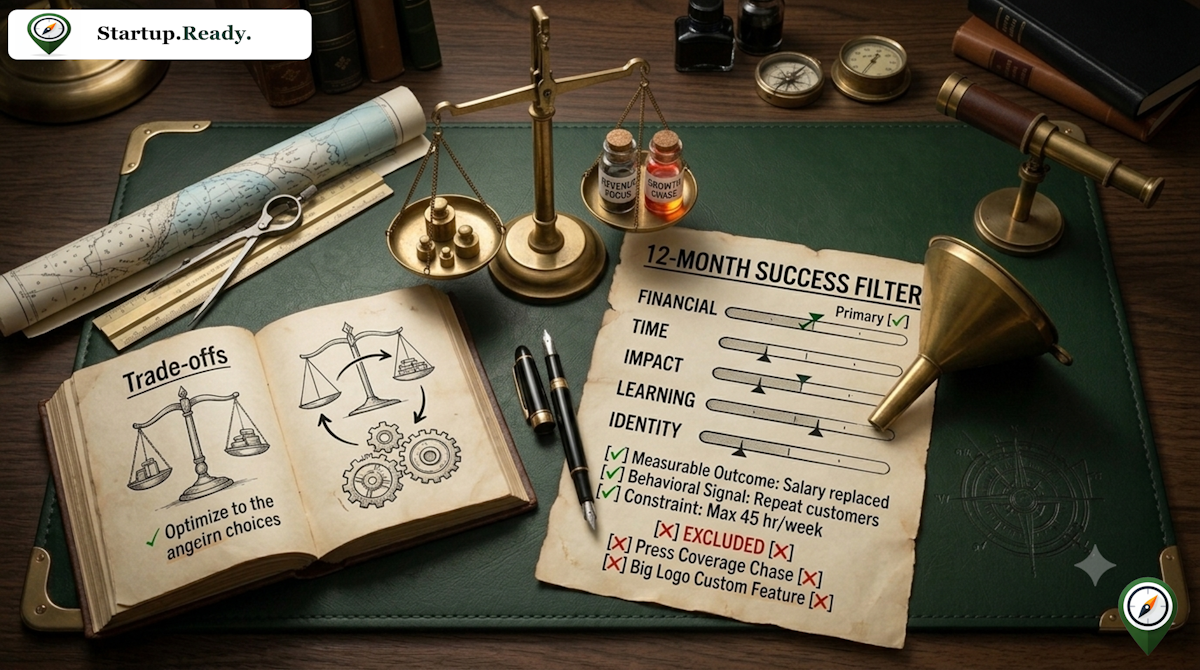
Ask a founder what success looks like in twelve months and you usually get a forecast. Revenue up. Users growing. A bigger version of the thing they are building.
The vision is not wrong. It just cannot answer the question a founder actually faces every week, which is not "where do I hope to end up" but "should I do this, or should I do that." A forecast tells you where you are aiming. A filter tells you which of the two options in front of you today deserves your time.
Those are different tools, and only one of them gets used on a Tuesday. A founder does not need a prediction of the future nearly as much as a way to choose between the things actually on the table this week. When success is defined as a hope rather than a filter, every option looks like progress, and a founder who cannot rule anything out ends up chasing all of it.
You are not building toward a forecast. You are building through a hundred small decisions, and a definition of success is only worth having if it helps you make them.
TL;DR: If Your Definition of Success Cannot Settle a Decision, It Is Too Vague.
Without a named target, a founder optimizes for whatever feels most urgent or most visible in the moment. The business moves and goes nowhere in particular. A useful definition of success is specific enough to check a real decision against. The work is to name what you want across the dimensions that matter, pick the one that matters most, and write it so it can settle a choice. Here is the move, in order:
Name success across five dimensions: financial, time, impact, learning, identity
Find the primary one: the dimension whose absence at twelve months would feel like real failure
Make it checkable: a number, a behavioral signal, and a constraint, not an aspiration
Test it as a filter: could it tell you which of two real paths to take right now
Use it, by running an actual upcoming decision through it
Four signals your definition of success is too vague to use:
It sounds like a forecast, revenue growing and users rising, rather than a line you could cross or miss
You switch priorities week to week and each one feels like progress
You cannot say which decision you would make differently because of it
It describes what sounds reasonable to want rather than what you actually want
If any of those describe you, this article shows you how to turn a hope into a filter you can decide with.
If You Found This Article by Searching for Something Else
Most founders who need this are not searching for "12-month success definition." They are searching for something more immediate.
How to prioritize as a founder.
Why does my startup feel unfocused.
How do I know what to say no to.
I keep chasing distractions and not finishing anything.
Why am I busy but not moving.
All of those point at the same underlying question. Do you have a target specific enough to choose with, or are you optimizing for whatever feels urgent this week? This article shows you how to build the first thing.
Vague Success Produces Vague Priorities
Every tradeoff a founder makes is optimizing for something. Every prioritization, every product call, every decision about where the week goes is implicitly serving some definition of success. The only question is whether the founder named that definition or left it to be filled in, moment by moment, by whatever feels most pressing.
When it is left blank, urgency fills it. The loudest customer, the nearest deadline, the most visible win. The founder is busy and the business moves, but it moves in whatever direction the week happened to push, and the directions do not add up. Priorities switch weekly. Visible work gets overvalued because it feels like proof. Paths get abandoned before they have had time to compound, and over a year the business has grown a little in several directions and committed to none of them.
None of that is a discipline problem, though it feels like one. It is a targeting problem. When everything could count as progress, nothing clearly is, and a founder with no named target cannot tell whether a given decision moves them closer to what they want, because they have not said what they want in terms specific enough to check. The fog is not in their work ethic. It is in the absence of a line.
The Decision-Filter Test
One test tells you whether your definition of success is doing any work, and you can run it in a minute.
Take a real decision in front of you right now, two paths you are actually weighing, and ask: does your definition of success tell you which one to take?
If it does, cleanly, the definition is a filter and it is earning its place. If both paths still look equally fine under it, or you find yourself reaching for gut feel instead, the definition is too vague to decide with, however good it sounds framed on a wall. A target you cannot choose with is decoration.
Watch the same test run across three ordinary decisions, and notice that the answer flips with the definition rather than with the decision. Should you hire a salesperson? If your primary is autonomy and steady profit, maybe not, a sales hire is payroll and management you did not want. If it is fastest revenue growth, maybe yes. Should you raise money? If success means venture-scale growth, probably. If it means keeping control, raising may trade away the exact thing you are optimizing for. Should you build the feature the big customer is asking for? If success means landing enterprise accounts, yes. If it means a lean, simple product, no. None of these has a universal right answer. Each has a right answer relative to your definition, which is the whole reason the definition has to exist before the decision does.
This is also the fastest way to know the work is done. A founder has a real definition of success not when the sentence sounds impressive, but when it has changed an actual decision, made them turn down something they would otherwise have chased or commit to something they would otherwise have deferred. Until it has moved a choice, it is a forecast. The moment it moves one, it is a tool.
The Five Dimensions of Success
Part of why success stays vague is that it is not one thing. It has at least five dimensions, and founders quietly weight them very differently.
Financial is how much economic value the business creates for you, in revenue, profit, or replaced income. Time is what the business does to your life, the hours it takes and the autonomy it gives back. Impact is who it helps and how much. Learning is the capability or knowledge you walk away with. Identity is who you get to become by building it.
Most founders privately run on one of these while talking as though they weight all five equally. The founder who actually needs income says they care most about impact, because impact sounds better. The founder who is really doing this to prove something to themselves calls it growth. The mistake is not choosing one dimension over the others, because choosing is unavoidable, and the primary one is simply the dimension whose absence at twelve months would make the year feel like a failure. The mistake is pretending you did not choose. A hidden primary still drives every decision. It just does so without your supervision, which is how a founder who believes they are optimizing for impact keeps making the choices of someone optimizing for reputation.
The Founder Who Was Busy in Every Direction
Take a founder a year into building a small software business who, asked what success looks like, says she wants it growing, generating revenue, and teaching her a lot along the way. All true, all reasonable, and completely unusable as a filter.
Watch what that vagueness does across a month. A press opportunity appears, so she spends a week chasing coverage, because visibility feels like winning. Then a large prospect asks for a custom feature, so she builds it, because a big logo feels like progress. Then she pivots to content because a founder she admires swears by it. Each move was defensible in the moment, each felt like momentum, and at the end of the month she is tired and no closer to anything in particular, because there was no particular thing to be closer to. She optimized for whatever was loudest that week.
Now give her a real target. Pushed to say which dimension would make the year a failure if she missed it, she does not say growth or learning. She says financial, specifically: if this business cannot replace her salary, the year did not work, because she cannot keep funding it from savings. That is the primary dimension, and naming it changes everything downstream.
She writes it so it can be checked. Not "growing and generating revenue," but: at twelve months the business earns enough monthly revenue to cover her personal obligations, at least one customer segment has paid more than once, and she is working no more than forty-five hours a week. A number, a behavioral signal, a constraint. Now run the month back through it. The press chase does not survive the filter, it touched none of the three. The custom feature for one big prospect fails too, unless that prospect represents the repeatable segment. The content pivot has to earn its place against revenue, not against a role model. The target did not tell her to work harder. It told her what to stop doing.
What Makes a Definition Checkable
The difference between a definition that filters and one that only inspires is specificity of a particular kind. Three parts, and a real target has all three.
A measurable outcome. A number or a clearly observable state you could stand at twelve months and say you hit or missed without having to argue about it. "Growing" is not one. "Enough monthly revenue to cover my obligations" is.
A behavioral signal. Something a real customer does, not something you feel. Repeat purchases, renewals, referrals, a segment paying twice. This is what separates a business that is working from one that is merely busy, because behavior is the part you cannot talk yourself into.
A constraint. A boundary on time, effort, or life that the success has to fit inside. "Working no more than forty-five hours a week" or "without raising outside capital." The constraint is what keeps a definition of success from quietly becoming success at any cost, which is a different and worse target than the one you meant.
A definition with all three can settle a decision. A definition missing one of them tends to collapse back into a vibe, and a vibe cannot tell you which path to take. The most common miss is the constraint, because founders write the outcome they want and forget to say what they are unwilling to trade for it, and then trade it anyway.
Three Ways Founders Define Success by Default
When a founder does not choose a definition deliberately, one usually gets chosen for them, borrowed from the environment. Three borrowed definitions are common, and each carries a cost.
The investor definition: success means raising money. The problem is that funding is a tool, and when the tool becomes the target, the founder optimizes for the round instead of for the business the round was meant to build. The market definition: success means growth. Growth is worth wanting, but growth pursued without reference to what you actually want can build a large business you do not want to run. The identity definition: success means proving you can build something. That one quietly optimizes for validation rather than value, and the two come apart more often than founders expect.
None of these is wrong to care about. The danger is inheriting one without noticing, and then making decisions against a definition of success you never actually chose. The useful definition is the one you would make real decisions against. Whether it sounds impressive is beside the point.
The One Sentence That Tells You Where You Stand
A founder with a usable target can complete this statement in concrete terms:
At twelve months, success means [measurable outcome, behavioral signal, constraint], and the dimension that matters most right now is [financial / time / impact / learning / identity].
The decision I am about to run through it is [specific upcoming choice].
A founder without one can describe an inspiring future and stalls at the decision line, because the definition was built to motivate rather than to choose, and choosing is the job. That stall is the diagnosis.
If you can state a checkable target and name a decision it settles, you have a filter, and the fog of a busy, directionless month starts to lift on its own, because most of the options that were competing for your week do not survive contact with a real target. If your definition sounds good and decides nothing, the gap is not effort. It is specificity, and the fix is to name the one dimension whose absence would make the year a failure and write it with a number, a signal, and a limit. Either outcome moves you forward.
Success Definition and Your Founder Readiness
In the Startup Readiness Framework, Founder Readiness begins with what the founder is actually building toward, because nearly every later decision inherits its direction from that answer. Business model, market choice, funding strategy, and the operating plan all depend on what success is defined to mean, which is why a vague target does not stay contained to the Founder pillar. It quietly distorts the others. A weakly defined target is a common early flag, and it hides well, since the founder is working hard and the business is moving, which feels like progress until a year passes with little to show for the motion.
Whether the motivation underneath the target is specific enough to sustain the work is the companion question.
Founder Readiness is one of the six pillars in the framework. The Startup Readiness Assessment gives you a full-system diagnostic across all six in under twenty minutes.
Take your Startup Readiness Score free today at startupready.ai →
Keep Working on Your Founder Readiness
The Founder Pillar asks one question from many angles: can you, specifically, do the work this startup needs, and can you build the capacity you are missing? Each article below takes one piece of that question. Whether you are the right person to solve this particular problem. Where your real capacity gaps are, and whether they are gaps or just rates you have not run yet. What is draining your motivation, and whether the model is the cause. Which decision you keep making on repeat, and what would change it. Read them in any order. Each is a separate cut at the same pillar, and together they show you where your capacity holds and where it still has to be built.
More in the Founder pillar:
How to Find the Skills Gap That Is Slowing Your Startup Down
Why Startups Fail: The Founder Motivation Problem No One Talks About
How to Protect Your Time as a Founder Without Sacrificing Everything Else
A Skill Gap Is Not a Deficit. It Is a Rate.
A Mentor You Have Not Called in Six Months Is Not a Mentor
Your Network Is Not Gone. It Is in a Drawer.
You Are Not Losing Motivation. Your Model Is Draining It.
When Working Harder Stops Working, You Have a Leverage Problem
Your Constraints Are Not Obstacles. They Are Design Parameters.
Burnout Is Not Too Much Work. It Is Too Much Undirected Work.
Your Business Model Requires a Team You Do Not Have Yet
Before You Hire Someone, Try Deleting the Task
When You Are Missing the Skill and the Help, Fix One
You Do Not Make Bad Decisions. You Make the Same One Over and Over
Published
By Dr. Shaun P. Digan
Originally published on Startup.Ready.’s Startup Readiness: Validation, Framework, and Tools Blog at https://startupready.ai/startup-readiness/12-month-success-filter
Original Publication Date: July 21, 2026
Last Updated: August 4, 2026
About the Author
Dr. Shaun P. Digan is the founder of Startup.Ready and the creator of the Startup Readiness Framework, a research-based system for evaluating and validating early-stage startups before launch and early growth. He holds a PhD in Entrepreneurship from the University of Louisville and has spent over 15 years teaching, advising, and consulting with founders on startup strategy, validation, and growth.
In his writing, including the Startup Readiness Blog and The Foundations of Innovation Essay Series, he focuses on how founders can make better decisions by improving clarity, alignment, and readiness before scaling.