Your Network Is Not Gone. It Is in a Drawer.
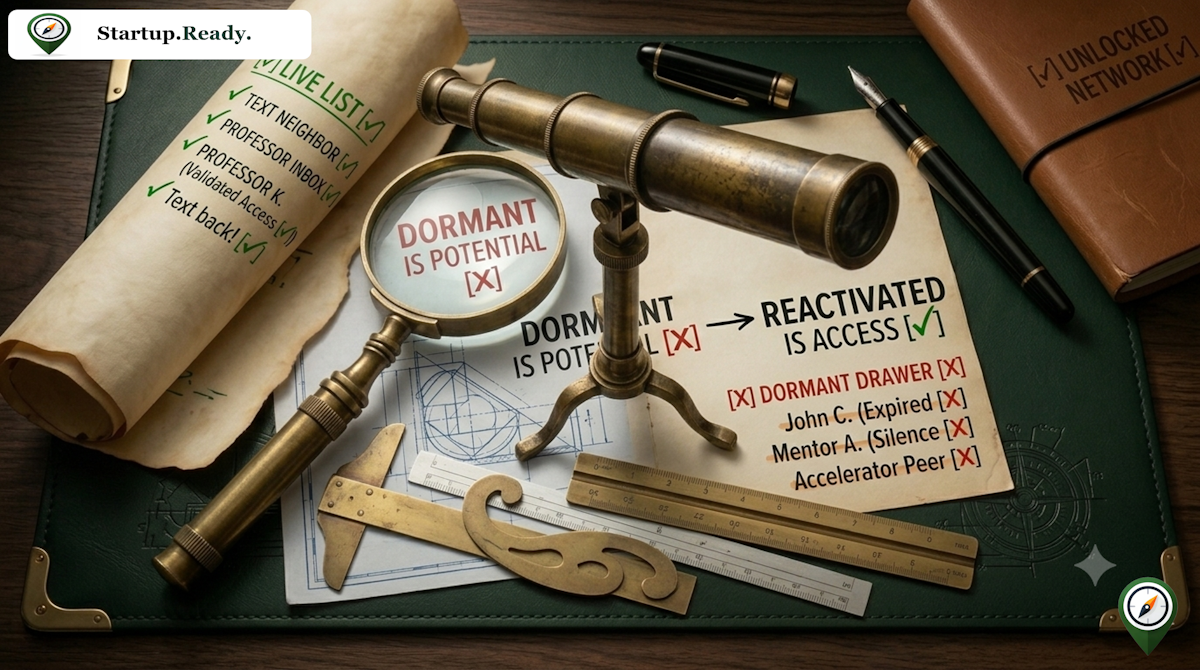
You know people. Former colleagues, a couple of past mentors, peers from an old program, people you helped once and people who helped you. If someone asked whether you have a network, the honest answer is yes.
If someone asked when you last used it, the honest answer is different. The names are all still there, and you have not had a real exchange with most of them in a year. That is not a missing network. It is a network you stopped using, and a network you stopped using quietly stops working, even though every contact is still sitting right there in your phone.
The relationship was real. The access is not, and the gap between those two is where founders get surprised.
TL;DR: A Relationship You Have Not Used in a Year Is Potential, Not Access.
Dormancy is not absence, and it needs a different fix. You are not short of contacts. You are short of live ones, and access decays in silence while the names stay put. The work is to pull the useful relationships out of the drawer, pick three worth reactivating, and send one message today. Here is the move, in order:
Inventory the dormant, not the missing: people once connected to your work you have not really spoken to in six months
Filter for who is worth it: real past warmth, a reason to hear from you beyond the ask, and specific help they could plausibly give
Give a reason that is not the ask: relationships reactivate on something mutual, even something small
Write short and honest: acknowledge the gap, give the real reason, make one small ask or offer, leave an easy out
Send one today, because the point of the first message is to break your own dormancy, not to land the biggest conversation
Four signals your network has gone dormant:
Asked who you would message for help this week, you would think about it and probably message no one
Your last contact with most useful people is "liked their post," not a real exchange
Reaching out now feels harder than it would to a stranger
You keep meaning to reconnect with someone and it keeps not happening
If any of those describe you, this article shows you how to move from a network you have to a network you use.
If You Found This Article by Searching for Something Else
Most founders who need this are not searching for "dormant network." They are searching for something more immediate.
How to network as a founder without being fake.
How to ask for help after losing touch.
How to reconnect with old contacts.
I need an introduction and do not know who to ask.
How to reach out to a mentor I have not spoken to in a while.
All of those point at the same underlying question. You have people, so why does using them feel impossible? This article shows you how to reopen a relationship without it landing as a cold transaction.
Dormant Is Not the Same as Absent
There is a real difference between a founder who has no network and a founder who has one and is not using it, and they need opposite responses. The first has to build. The second only has to reactivate, which is faster and cheaper, and which most founders in this position never do, because dormancy does not announce itself.
A dormant network feels like a safety net right up until you reach for it. Then you discover that asking someone for help after eighteen months of silence feels harder than asking a stranger. The relationship has cooled, your context is stale to them, and a request dropped into that silence reads as purely transactional, because there is nothing else in the recent history to carry it. The network was real. The access quietly expired while you were not looking, and nothing about the contact list changed to warn you.
This is why dormancy is easy to miss. Absence is visible, you can see that you do not know anyone in a space. Dormancy hides behind a full contact list. The names are all there, so it feels like access, right up to the moment you need it and cannot bring yourself to send the message.
Underneath this is a distinction founders collapse without noticing. A contact and a relationship are not the same thing. A contact is someone who would recognize your name. A relationship is someone who would take your call. Contact lists grow quickly and on their own, every conference and thread and connection request adds to them. Relationships grow only through maintenance, and they decay without it. The mistake is assuming a contact quietly ripens into a relationship while you are not looking. It does the opposite. Left alone, a relationship cools back toward being a mere contact, and a contact is not access.
The Could-You-Send-It-Today Test
One question tells you whether a relationship is live or dormant, and you can run it down your contact list in a few minutes.
Pick three people you think of as part of your network. For each one, could you send a message today, for a real reason, without first having to explain or apologize for why you went quiet?
If the message would feel natural, the relationship is live, and you can use it whenever you need to. If you would have to account for the gap first, work up to it, smooth over the silence, the relationship is dormant, whatever the contact list says. The awkwardness you feel imagining the message is a direct reading of how far the relationship has cooled.
Run it across the people you would most want in a hard moment. The ones that come back live are your real network, smaller than your contact list and far more useful. The ones that come back dormant are not lost. They are the drawer, and the rest of this article is about reopening it.
One filter before you start reopening lines. Not every dormant relationship should come back. Some went quiet for a reason. If a relationship was originally draining, one-sided, or the kind that always cost you more than it returned, the dormancy is not a problem to fix. It is a boundary that formed on its own. Reactivate for genuine past warmth, not for obligation and not for the size of someone's current title. The drawer worth reopening holds the relationships that were good and simply lapsed, not the ones you were quietly relieved to let fade.
The Message That Feels Impossible to Send
Take a founder whose entire go-to-market runs on warm introductions, because she is selling into hospital systems, and in that world cold outreach is dead on arrival. Procurement will not engage a name they do not recognize, and the deals that happen, happen because someone on the inside vouches. She needs one warm introduction to a clinical decision-maker to land her first pilot, and until she gets it the company does not really move. The stakes are not a nice-to-have conversation. They are whether the business has a path in at all.
She knows people who could make that introduction. A former colleague now senior at a regional health system. A peer from her accelerator who spent a year selling into exactly these buyers. A professor who sits on a hospital advisory board. Any one of them could open the door she is stuck outside.
She opens her phone to message the former colleague and closes it again. It has been over a year. Opening with the ask feels crude, and opening with anything else feels like a pretext for the ask, which it partly is. So she sends nothing, and tells herself she will reach out when she has a better reason. The introduction that was one message away does not happen, and she keeps grinding at cold paths into an industry that does not open to cold.
The thing blocking her is not the relationship. It is the silence around it, and the silence is fixable. What makes the message feel impossible is trying to make one message carry eighteen months of no contact plus a request. Split those. The reactivation and the ask do not have to be the same move, and a founder who understands that can reopen the door without shoving a demand through it.
Give a Reason That Is Not the Ask
The single thing that separates a reactivation that lands from one that reads as transactional is having a reason to reach out that is not the request itself.
The reason can be small. A piece of news relevant to them. A thank-you that was overdue anyway. A genuine question that respects their expertise. A useful introduction or article you can offer with nothing attached. It does not have to be large, it has to be real, because it is what tells the other person the message is about the relationship and not only about what you need from it. When the only content of the message is the ask, the recipient feels it, however politely it is worded.
So a good reactivation message does four small things, and stays under five sentences. It acknowledges the time without a groveling apology: "it has been a while since the accelerator." It gives the honest reason for reaching out now. It makes one specific, small ask or offer, not a vague "we should catch up." And it leaves an easy way out, so the person can decline without friction and the door still stays open. Short, honest, low-pressure. The goal of the first message is to turn a dead line back into a live one, not to extract the maximum favor on contact.
See the difference on the page. The version that fails collapses reactivation and ask into one move: "Hey, it's been a while. Could you introduce me to someone at a health system?" The silence goes unacknowledged, the whole message is the request, and the recipient feels handled rather than contacted. The version that works separates them. The first message carries no ask at all: "It's been too long since the accelerator. I saw the news about your round, congratulations, that one's a real milestone. I've been building in hospital procurement and would love to hear how your go-to-market evolved if you're ever up for twenty minutes." That message reopens the line and asks nothing. Then, once the line is live and there is an actual exchange happening, the introduction becomes a natural thing to raise, because now there is a relationship in the room instead of a cold request. The same ask that would have felt transactional as a first move feels ordinary as a second one. That sequencing is the entire skill.
Then the part that actually matters. Send one today. Three drafted messages are not three sent messages, and the founders who reactivate networks are not the ones who write the best drafts. They are the ones who hit send. Pick the easiest of the three, the lowest-stakes one, and send it before the end of the day, because the point of the first message is to break the dormancy in your own behavior. The higher-stakes reconnections get much easier once one line is live again.
Then, when a reply comes back, answer it quickly, inside a day. A freshly reopened line is fragile. The other person spent a little goodwill by responding, and a week of silence on your end teaches them exactly the lesson you were trying to undo. The rhythm is the whole thing: send today, reply fast, and follow through on whatever the exchange opens. A line you reopen and then go quiet on again is worse than one you never reopened, because now the drift has happened twice.
The One Sentence That Tells You Where You Stand
A founder using their network can complete this statement with real names and days:
This week I am reopening [name], [name], and [name], each with a reason that is not the ask, and I am sending the first one [today].
A founder sitting on a dormant network can list the names easily and stalls at "sending the first one today," because listing costs nothing and sending is the whole difficulty. That stall is the diagnosis, and it is a behavior gap rather than a network gap.
If you can name three people and a real reason to reach each one, your network is an asset you are about to start using again. If the names come easily and the sending keeps not happening, the problem was never a shortage of people.
Most founders in this position do not have a networking problem. They have a dormancy problem. The introductions, the advice, the candid second opinions are still attached to people you already know, sitting quiet because a relationship went untended, not because it ended. A line that went quiet comes back the way it went quiet, one message at a time. Reopen the easiest one this week, and the network you already have starts working again. Either outcome moves you forward.
Ractivation and Your Founder Readiness
In the Startup Readiness Framework, Founder Readiness counts the structure around the founder as part of the foundation, and a dormant network is one of the most recoverable gaps in it, because the relationships already exist and only need to be brought back into circulation. Isolated execution is a common early flag, and dormancy is its quiet cause: a founder who looks unsupported often has the support sitting one unsent message away.
Whether your wider support system is genuinely thin or just dormant is worth checking directly, which is its own piece of work.
Founder Readiness is one of the six pillars in the framework. The Startup Readiness Assessment gives you a full-system diagnostic across all six in under twenty minutes.
Take your Startup Readiness Score free today at startupready.ai →
Keep Working on Your Founder Readiness
The Founder Pillar asks one question from many angles: can you, specifically, do the work this startup needs, and can you build the capacity you are missing? Each article below takes one piece of that question. Whether you are the right person to solve this particular problem. Where your real capacity gaps are, and whether they are gaps or just rates you have not run yet. What is draining your motivation, and whether the model is the cause. Which decision you keep making on repeat, and what would change it. Read them in any order. Each is a separate cut at the same pillar, and together they show you where your capacity holds and where it still has to be built.
More in the Founder pillar:
How to Find the Skills Gap That Is Slowing Your Startup Down
Why Startups Fail: The Founder Motivation Problem No One Talks About
How to Protect Your Time as a Founder Without Sacrificing Everything Else
A Skill Gap Is Not a Deficit. It Is a Rate.
A Mentor You Have Not Called in Six Months Is Not a Mentor
You Are Not Losing Motivation. Your Model Is Draining It.
Your Startup Does Not Need More Goals. It Needs a Filter.
When Working Harder Stops Working, You Have a Leverage Problem
Your Constraints Are Not Obstacles. They Are Design Parameters.
Burnout Is Not Too Much Work. It Is Too Much Undirected Work.
Your Business Model Requires a Team You Do Not Have Yet
Before You Hire Someone, Try Deleting the Task
When You Are Missing the Skill and the Help, Fix One
You Do Not Make Bad Decisions. You Make the Same One Over and Over
Published
By Dr. Shaun P. Digan
Originally published on Startup.Ready.’s Startup Readiness: Validation, Framework, and Tools Blog at https://startupready.ai/startup-readiness/activate-dormant-network
Original Publication Date: August 4, 2026
Last Updated: August 4, 2026
About the Author
Dr. Shaun P. Digan is the founder of Startup.Ready and the creator of the Startup Readiness Framework, a research-based system for evaluating and validating early-stage startups before launch and early growth. He holds a PhD in Entrepreneurship from the University of Louisville and has spent over 15 years teaching, advising, and consulting with founders on startup strategy, validation, and growth.
In his writing, including the Startup Readiness Blog and The Foundations of Innovation Essay Series, he focuses on how founders can make better decisions by improving clarity, alignment, and readiness before scaling.