Your Business Model Requires a Team You Do Not Have Yet
You are building alone, or close to it, and everything is harder than it seems like it should be. The work never quite fits the week. Decisions pile up. You are pouring in real effort and the business is barely moving, and the natural conclusion is that you are not disciplined enough or not working hard enough.
Look closer and it is usually not a discipline problem. It is a fit problem. The business model you are running quietly assumes resources you do not have. High-touch delivery assumes time. Content-heavy acquisition assumes a content engine. Growth that spends before it earns assumes capital. A model built on those assumptions does not announce the gap. You do, by absorbing it, closing the distance between what the model needs and what you have with your own hours and your own nerves, week after week, until the absorbing is the reason everything feels so heavy.
The model is not wrong. It is just sized for a company you do not have yet, and you have been personally making up the difference.
TL;DR: Run the Version You Can Execute Now, and Earn the Complexity Back.
A solo founder under real constraints often runs a model built for a team, and absorbs the shortfall personally until it stalls them. Right-sizing is not lowering ambition. It is running the version that fits your current capacity, with explicit conditions for expanding later. The work is to see what the model demands, find where it exceeds you, shrink those pieces, and name the trigger that scales each one back up. Here is the move, in order:
Map what the model actually demands in time, money, skills, and delivery, against what you actually have
Find the constraint-dependent elements, the parts that assume resources not yet in place
Shrink each to a version that executes now, preserving the core value while cutting the demand
Name an unlock condition for each, the specific trigger that lets you add it back
Run the lean version and watch whether the unlock conditions get closer
Four signals your model is bigger than your capacity:
You are absorbing the gap with personal effort and calling it hustle
Everything feels harder than it should, with no single failure to point to
The model would work fine with a team, capital, or time you do not have
You keep pushing the important work aside for the work that cannot wait
If any of those describe you, this article shows you how to right-size the model without shrinking where it is going.
If You Found This Article by Searching for Something Else
Most founders who need this are not searching for "right-size the business model." They are searching for something more immediate.
Solo founder burnout.
My business model is too much for one person.
How to run a startup alone.
Bootstrapping a service business.
Everything depends on me and I am drowning.
All of those point at the same underlying question. Is the problem your effort, or is it a model sized for resources you do not have? This article shows you how to tell, and how to build the version you can actually run.
You Have Been Absorbing the Gap
Before going further, be clear on what business model means here, because it is broader than pricing. It is the whole system that turns effort into delivered value: how you acquire customers, how you build the product, how you serve them, and what resources each of those activities requires. When any one of those subsystems assumes resources you do not have, the model as a whole exceeds you, even if the pricing itself is fine. The gap can hide in delivery, or acquisition, or the quiet assumption of a team, and still sink the week.
The reason this is hard to see is that the founder is the shock absorber, and a shock absorber does its job silently. When the model needs forty hours of delivery and you have twenty, you do not usually notice a forty-hour model. You notice yourself working nights. When the model needs a marketing team and you are one person, you do not see an understaffed model. You see yourself falling behind on content. The mismatch never shows up labeled as a mismatch. It shows up as you, personally, straining to close a gap the model built in.
This is why the effort framing is so seductive and so wrong. From the inside, absorbing the gap feels like exactly what a founder is supposed to do. Push through, carry the load, out-work the constraints. So you interpret the strain as evidence of commitment rather than as evidence of a structural mismatch, and you double down on the very thing that is draining you, because the culture told you that is what grit looks like.
The strain is data. A model that requires you to personally absorb a large gap every week is not a model you are failing to execute. It is a model built for more people than you currently are. Reading the strain as a personal failing keeps you from reading it as the design signal it actually is.
There is a name worth giving this, because the name changes how you treat it. When a model needs resources you do not have, you take on resource debt. Instead of borrowing money to cover the shortfall, you borrow from your own time, attention, and energy, and like any debt it carries interest. The interest is the mounting fatigue and the decisions that keep getting deferred. And like financial debt, a small, deliberate amount can be a bridge, while a large, open-ended amount quietly owns you. A founder absorbing a small, temporary gap is investing. A founder absorbing a large, permanent one is servicing a debt the model will never pay back on its own.
The Company You Need Today, Not the One You Want to Become
A model has a stage as well as a size, and the stages come in order. Stage one is founder-led: the founder sells, delivers, and learns directly, because that is where the learning lives and there is no one else anyway. Stage two is systematized: repeatable processes, templates, automation, so the same work takes less of the founder. Stage three is team-scaled: delegation, specialists, management, a model that runs on people the founder hired.
Each stage earns the resources that unlock the next. Founder-led selling produces the revenue and the direct knowledge that make systematizing possible. Systematizing produces the margin and the repeatability that make hiring safe. The stages are a sequence, and the sequence runs one direction.
The mistake behind most of this strain is skipping stages, designing the company you want to become instead of the company you need to operate today. A solo founder who builds a stage-three model, team-dependent delivery, a content engine, spend-before-revenue growth, is trying to run on resources only stage three produces, from inside stage one where those resources do not exist yet. The model is not wrong for the company. It is wrong for the stage. Much of right-sizing is simply putting the model back on the stage the founder is actually standing in.
Right-Sizing Is Sequencing, Not Shrinking
The word "shrink" makes founders flinch, because it sounds like giving up on the ambition. It is not, and the distinction is the whole point. Right-sizing does not make the destination smaller. It changes which version of the model you run first, and puts the heavier version on a schedule instead of on your back today.
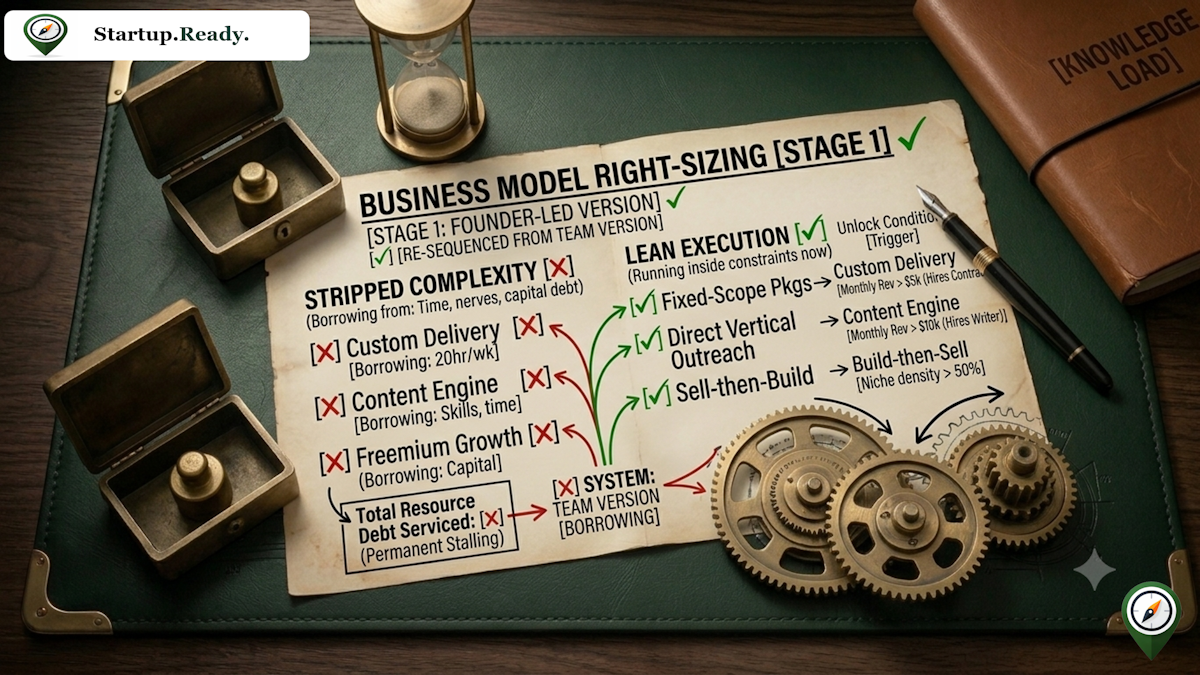
Here is what that looks like in practice. You take each element of the model that exceeds your constraints and find a leaner version that delivers the core value without the resource you lack. High-touch custom delivery becomes fixed-scope engagements with clear boundaries. Content-heavy acquisition becomes direct outreach to a narrow, reachable segment. Freemium becomes paid from the first customer. Build-then-sell becomes sell-then-build. None of these abandons the business. Each one strips out a demand you cannot currently meet while keeping the thing the customer actually pays for.
One line to hold while you do this, because right-sizing gets misread as cutting corners. It never means removing the thing customers actually value, or delivering that thing worse. The value stays fixed. What you strip is the complexity required to deliver that value before the business has earned the resources to support it: the custom variations, the extra channels, the team-sized processes. The customer should feel the same outcome from the lean version. They should just not be able to see the machinery you took out from behind it.
The other mistake to avoid is changing everything at once. Pick the two or three elements where the model most clearly outruns your capacity, and lean out those. A model with one change you can execute beats a total redesign you cannot. The goal is a version that runs cleanly inside your real constraints, not a different business.
The Unlock Condition Is What Makes This Temporary
This is the part that separates right-sizing from just settling for less, and it is the part founders skip. A smaller model without an unlock condition becomes a permanent limitation. A smaller model with an unlock condition becomes a strategy. Every element you strip back gets one: a specific, named trigger that tells you when to add it back. The lean version is not the final version. It is the current phase, and a phase needs a defined exit.
Write the condition concretely, tied to something observable. Not "when things are going better," but "I add custom delivery back when monthly revenue clears a level that lets me hire a delivery contractor." Not "eventually," but "I start the content engine when I can pay a writer, which the current fixed-scope revenue reaches at roughly this many clients." Each stripped-back element gets one of these, and suddenly the leaner model stops feeling like surrender and starts feeling like stage one. You are not abandoning high-touch delivery. You are scheduling it behind a revenue number you can watch approach.
The unlock conditions do something else useful: read together, they show you the natural next expansion. Whichever condition is closest to true is your next move, the first piece of the fuller model you will earn back. That turns a lean model from a holding pattern into a sequence with a visible path, where each phase funds the unlock of the next. The founder always knows both what they are running now and what they are running toward, and on what trigger the two connect.
The Founder Running a Ten-Person Model Alone
Take a solo founder offering a done-for-you marketing service. Her model, as designed, is heavy: fully custom delivery for each client, a content strategy she maintains to attract inbound, monthly retainer pricing, and an assumption that she will grow into a small team. On paper it is a real business. In practice she has time for about half of what it demands, so she absorbs the rest, delivering custom work at midnight and letting the content slip and feeling perpetually behind on all of it.
Map it against her actual capacity and the constraint-dependent elements are obvious. Custom delivery exceeds her time. Content-heavy acquisition exceeds her time and attention. The team assumption exceeds her runway. So she right-sizes. Custom delivery becomes three fixed-scope packages with defined inclusions, which cuts her delivery hours sharply while preserving the outcome clients pay for. Content becomes direct outreach to a narrow vertical she already knows, which she can run in a fraction of the hours. The team plan goes on hold. She keeps the retainer pricing, which fits fine.
Then the unlock conditions. Custom delivery comes back when revenue supports a part-time delivery contractor, which her fixed-scope packages reach at roughly twelve clients. The content engine restarts when she can pay a writer, a little past that. The first hire happens when retainer revenue covers it for six months without touching her own pay. Now she is not running a diminished business. She is running phase one of the same business, with three named triggers she can watch, delivering well inside her capacity instead of drowning just outside it. The ambition did not move. The sequence got honest.
The same logic runs through product companies, not only services. A solo software founder designing a marketplace is quietly assuming an engineering team, a marketing function, customer success, and operations, everything a marketplace eventually needs and none of which exists yet. The stage-one version is not a marketplace. It is a narrow product for one segment, with founder-led sales and onboarding done by hand, priced to bring in revenue now, and its unlock conditions have the same shape: automate the manual onboarding when volume justifies it, add the second side of the market once the first is dense enough to pull it. Services make the gap obvious, because delivery is visibly the founder's hours. Product hides it better behind code, but the mismatch is identical.
The Resource Debt Audit
Run your model through four questions to find where it is quietly borrowing from you and what would let you pay the debt down.
Identify the gap. Which task on your weekly schedule feels heaviest because you lack the software, capital, or team to handle it properly? That is where the model is charging you resource debt.
Strip to core value. What is the simplest, lowest-overhead way to deliver the exact outcome your customer pays for, without the complexity you cannot yet afford? The outcome stays fixed. The machinery behind it gets lighter.
Define the metric. What specific, observable number, revenue, client count, cash reserve, would unlock adding that complexity back? A leaner element without a trigger is a permanent cut. With one, it is a phase.
Commit to the stage. Honestly, are you operating the business you actually have today, or straining to run the business you hope to become? Right-sizing is choosing the first on purpose.
If any of the four is hard to answer, that is the part of the model to work on before the next hard week, not during it.
The One Sentence That Tells You Where You Stand
A founder who has right-sized can complete this statement plainly:
The version of my model that fits my current capacity is [specific lean version], the element I most need to add back is [specific element], and I add it when [specific, observable unlock condition].
A founder absorbing the gap can describe the full model in detail and stalls at the lean version, because admitting the model exceeds them still feels like admitting they are not enough. That flinch is the diagnosis, and it is pointing at a design fact, not a personal one.
If you can name the lean version and the unlock conditions, you have a model you can actually run and a visible path back to the fuller one, which beats an impressive model that quietly runs you into the ground. If you cannot name a lean version, or every part of the model feels essential exactly as it is, that is the signal to map the demands against your real capacity and find the two or three places the model is outrunning you. Right-size those, put the rest on a trigger, and let each phase fund the next. Either outcome moves you forward.
Right-Sizing and Your Founder Readiness
In the Startup Readiness Framework, Founder Readiness examines whether the business design matches the founder's current resources, capabilities, and constraints. A founder can have a strong idea and real commitment and still be running a model that requires a company they have not built yet. That model-founder mismatch is the flag, not the constraints themselves and not the effort, and it is fixable once it is named rather than absorbed.
This is the same move as designing your broader strategy around your constraints, focused specifically on the architecture of the model, and covered from the strategy side in why your constraints are design parameters.
Founder Readiness is one of the six pillars in the framework. The Startup Readiness Assessment gives you a full-system diagnostic across all six in under twenty minutes.
Take your Startup Readiness Score free today at startupready.ai →
Keep Working on Your Founder Readiness
The Founder Pillar asks one question from many angles: can you, specifically, do the work this startup needs, and can you build the capacity you are missing? Each article below takes one piece of that question. Whether you are the right person to solve this particular problem. Where your real capacity gaps are, and whether they are gaps or just rates you have not run yet. What is draining your motivation, and whether the model is the cause. Which decision you keep making on repeat, and what would change it. Read them in any order. Each is a separate cut at the same pillar, and together they show you where your capacity holds and where it still has to be built.
More in the Founder pillar:
How to Find the Skills Gap That Is Slowing Your Startup Down
Why Startups Fail: The Founder Motivation Problem No One Talks About
How to Protect Your Time as a Founder Without Sacrificing Everything Else
A Skill Gap Is Not a Deficit. It Is a Rate.
A Mentor You Have Not Called in Six Months Is Not a Mentor
Your Network Is Not Gone. It Is in a Drawer.
You Are Not Losing Motivation. Your Model Is Draining It.
Your Startup Does Not Need More Goals. It Needs a Filter.
When Working Harder Stops Working, You Have a Leverage Problem
Your Constraints Are Not Obstacles. They Are Design Parameters.
Burnout Is Not Too Much Work. It Is Too Much Undirected Work.
Before You Hire Someone, Try Deleting the Task
When You Are Missing the Skill and the Help, Fix One
You Do Not Make Bad Decisions. You Make the Same One Over and Over
Published
By Dr. Shaun P. Digan
Originally published on Startup.Ready.’s Startup Readiness: Validation, Framework, and Tools Blog at https://startupready.ai/startup-readiness/right-size-business-model
Original Publication Date: August 4, 2026
Last Updated: August 4, 2026
About the Author
Dr. Shaun P. Digan is the founder of Startup.Ready and the creator of the Startup Readiness Framework, a research-based system for evaluating and validating early-stage startups before launch and early growth. He holds a PhD in Entrepreneurship from the University of Louisville and has spent over 15 years teaching, advising, and consulting with founders on startup strategy, validation, and growth.
In his writing, including the Startup Readiness Blog and The Foundations of Innovation Essay Series, he focuses on how founders can make better decisions by improving clarity, alignment, and readiness before scaling.