Burnout Is Not Too Much Work. It Is Too Much Undirected Work.
You are exhausted, and the obvious explanation is that you are doing too much. So you try to do less. You rest, you cut hours, you step back, and the exhaustion does not really lift, because you were never tired from the volume of work. You were tired from carrying every open question at once with no way to put any of them down.
That is the quiet engine of early-stage burnout. Not the number of hours, but the number of unresolved things you are holding, all of them feeling equally urgent, none of them ever finished. When every question is a live priority, effort spreads across all of them and lands nowhere in particular. You stay busy. The business stays stuck. And the fatigue is not from working hard. It is from working hard without a finish line in sight.
The fix is not working less. It is working on fewer things, with a clear end point.
TL;DR: The Cure for This Kind of Burnout Is Decision Closure.
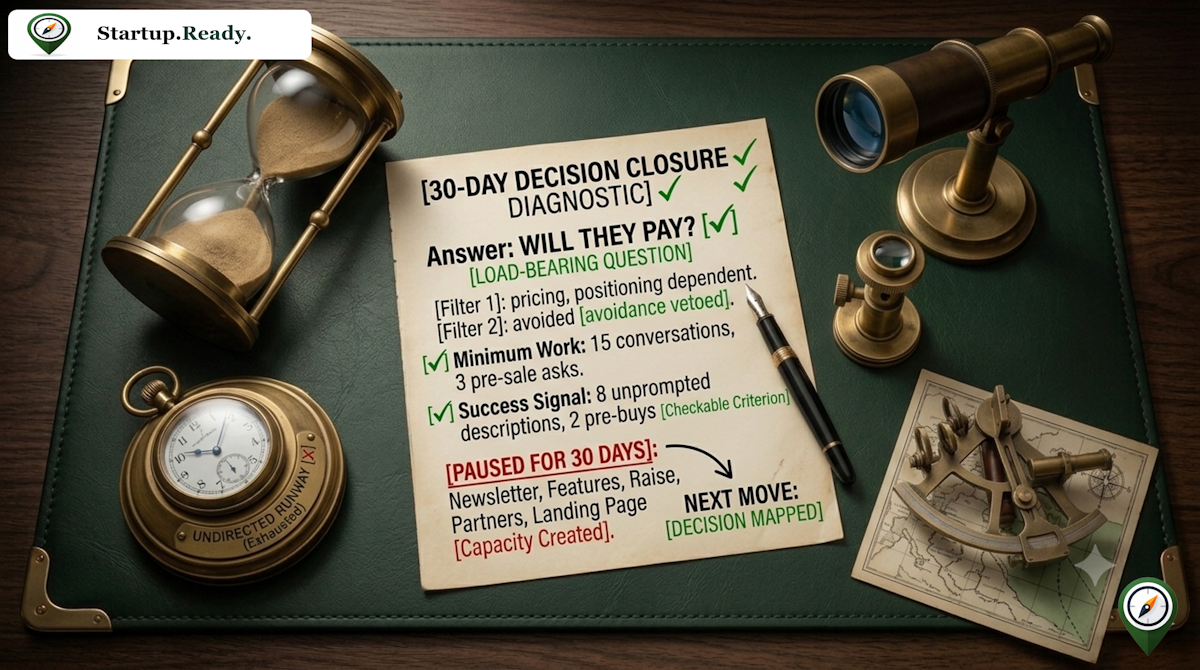
Undirected work with no visible finish drains a founder faster than hard work ever does, because nothing gets to feel resolved. The cure is decision closure: pick the question, define the test, reach the answer. In practice that means scoping, choosing the one question worth answering in the next thirty days, doing the minimum work to answer it, and clearing space by putting something down. Here is the move, in order:
Name the load-bearing question, the one whose answer makes your other open questions easier or unnecessary
Define the minimum work to answer it credibly, not perfectly, and small enough to actually run
Set a success signal specific enough that a stranger could tell whether you hit it
Remove one thing from your plate to make room, because a sprint without space is only an aspiration
Let the answer surface the next question, so momentum compounds instead of resetting
Four signals you are in undirected-work burnout:
You are busy and tired and cannot say what you are actually working toward
Every open question feels equally urgent
No task ever feels finished, so nothing gives you the sense of progress
You keep deferring decisions because everything feels unresolved
If any of those describe you, this article shows you how to trade an endless list for a single question with an end date.
If You Found This Article by Searching for Something Else
Most founders who need this are not searching for "validation scope." They are searching for something more immediate.
Founder burnout.
Why am I exhausted but not making progress.
How to focus as a solo founder.
Everything in my startup feels urgent.
How to stop spinning my wheels.
All of those point at the same underlying question. Are you tired from doing too much, or from never finishing anything? This article shows you how to tell, and what to do when it is the second one.
Why Undirected Work Drains You Faster
There are two kinds of startup workload, and founders routinely track one and underestimate the other. Execution load is the work you do: the building, the selling, the calls, the code. Decision load is the uncertainty you carry: which market, which customer, which feature, whether to raise. Execution load is visible, and it is the one founders measure. Decision load is invisible, and it is the one that quietly wears them down.
None of this means execution load never matters. Ninety-hour weeks break people on their own, and if that is genuinely where you are, the fix really is fewer hours. But the burnout that rest cannot reach, the kind where you cut back and stay just as tired, is almost always decision load rather than execution load. That is the pattern this article is about.
The tiredness it produces comes from holding open loops. Every unresolved question your business is carrying takes a small, continuous amount of attention just to stay held, and when you are carrying eight of them at once, most of your energy is going to the holding rather than the resolving. You are running a background process on every open decision, all the time, and it never gets to close.
This is why the volume explanation misleads you. Two founders can work the same hours and end the month in completely different states, one energized and one depleted, and the difference is not how much they did. It is whether their effort closed anything. Work that resolves a question returns energy, because a loop finally shuts. Work that spreads thin across ten open questions resolves none of them, so nothing closes, and the founder ends every week exactly as loaded as they started it, plus more tired.
Most advice on how to avoid startup burnout focuses on hours; the real fix is decision closure, giving open questions an actual end point.
Rest helps you recover from effort, but it does not resolve uncertainty, which is why the rest never quite works here. If the open loops are still waiting when you come back, the exhaustion comes back with them. What actually fixes it is closing a loop, and closing a loop requires pointing your effort at one question long enough to answer it, instead of spreading it across all of them so none of them ever resolves.
The Load-Bearing Question
Not all of your open questions are equal, even though under the fog of burnout they all feel equally heavy. One of them is load-bearing. It is the question whose answer changes the others, the one that, once resolved, makes several of the remaining questions easier or simply dissolves them. Find that one and answer it, and you close far more than a single loop. You collapse a whole cluster of them at once.
There are two filters that find it. The first: which question, if you answered it, would make the most of your other questions easier or unnecessary? A founder agonizing over pricing, positioning, which feature to build, and whether to raise money might notice that all four depend on one prior question, whether a specific segment will actually pay for this at all. Answer that, and pricing, positioning, and the feature list all get simpler, and the fundraising question can finally be asked from evidence instead of hope. That is a load-bearing question. It was underneath the others the whole time.
The second filter is quieter and just as useful: which question are you most avoiding? The one that keeps sliding to next week is very often the important one, because founders avoid the questions whose answers might require the most change. If both filters point to the same question, you have found your thirty-day target cleanly. If they point to different ones, take the first filter's answer, because the goal here is leverage, not comfort.
This is where the psychology and the validation turn out to be the same move. The fastest way to reduce founder anxiety is often not to solve every problem at once. It is to answer the one uncertainty that is making all the others impossible to resolve. Closing the load-bearing loop advances the business and lightens the founder in the same stroke, because the background process running on all the dependent questions can finally shut off.
The Founder Carrying Eight Open Loops
Take a solo founder eight months in who is working sixty-hour weeks and going quietly under. Ask her what she is working on and she lists eight things: pricing, the landing page, a new feature, which of two segments to focus on, whether to start a newsletter, a partnership conversation, her onboarding flow, and whether it is time to raise. All of it feels urgent. All of it is getting a slice of her week. None of it is getting finished, and she cannot tell you what she is actually trying to accomplish this month, only that she is behind on all of it.
Founder burnout rarely announces itself as burnout at first, it just feels like every week getting a little heavier without anything closing.
Run the filters. Which answer would make the most of the rest easier? Almost every item on her list assumes people will pay for this, and she has never actually confirmed that they will. That is the load-bearing question: will her primary segment pay, repeatedly, for this specific thing? And it is also, not by coincidence, the one she has been avoiding hardest, because a no would mean rethinking more than she wants to.
So she scopes it. The minimum work to answer it credibly is not a rebrand or a newsletter. It is fifteen real conversations with people in that segment and three direct pre-sale asks. Her success signal is specific: at least eight of the fifteen describe the problem in their own words before she explains it, and at least two agree to pay before the thing is fully built. And to make room, she puts down the newsletter and the landing-page polish for thirty days, because a sprint with nothing removed is just her existing overload with a label on it. For the first time in months she knows exactly what she is doing and exactly when she will know if it worked.
The Finish Line Has to Be Checkable
The scoping only works if the end point is real, and this is where founders quietly cheat. A thirty-day sprint aimed at "learning more about whether customers want this" has no finish line, because you can always have learned a little more, so the sprint never ends and quietly becomes the next month's fog. The success signal has to be something you either hit or missed, with no room to argue.
"I will understand my customers better" is not a finish line. "I will have spoken to fifteen target customers and at least eight described the problem unprompted" is. The test is whether a stranger, handed your signal at the end of thirty days, could tell you clearly whether you cleared it. If evaluating it requires your interpretation, it is too soft, and a soft signal lets the sprint blur back into the open-ended work it was supposed to interrupt.
The other half of a real finish line is the decision waiting on the far side of it. Name what you will be able to decide at the end that you cannot decide today. If answering the question does not unlock a specific decision, either it was not load-bearing or the signal was not sharp enough. A question worth thirty days is one whose answer moves you.
The 30-Day Decision Closure Diagnostic
Before you commit a month to a sprint, run it through four checks. Each should have a clear answer, and a blank on any one of them is where the sprint will quietly fail.
Single focus. Have you isolated one load-bearing question, the one whose answer simplifies or dissolves at least two other open loops? If you are still holding a list, you have not scoped yet.
Checkable criterion. Could a complete stranger, looking at your results on day thirty, give a plain yes or no on whether you hit your success signal? If evaluating it needs your interpretation, it is too soft.
Capacity creation. What specific task, channel, or initiative have you explicitly paused to make room? If nothing came off the plate, the sprint is sitting on top of your existing overload and will not run.
Decision mapping. If the answer comes back yes, what decision do you make? If it comes back no, what route do you abandon? A question worth a month resolves into a different next move in each case.
If any of the four is blank, that blank is the work to do before the sprint starts, not during it.
The One Sentence That Tells You Where You Stand
A founder who has scoped their month can complete this statement without vagueness:
The one question I am answering in the next thirty days is [specific question], the minimum work to answer it is [specific actions], my success signal is [specific, checkable outcome], and I am making room by putting down [specific thing].
A founder still carrying eight open loops cannot fill this in, because there is no single question, only the list, and every attempt to name one pulls in the others. That inability is the diagnosis. The fog is not a character flaw or a work-ethic problem. It is the absence of a scoped question with a finish line.
If you can name the question, the minimum work, and a checkable signal, you have traded an infinite list for a finite sprint, and the tiredness that rest could not touch starts to lift as soon as the first loop actually closes. If you cannot narrow it to one, that is not a reason to push harder through the fog. It is the signal to stop, run the two filters, and find the one question holding up the others. Either outcome moves you forward.
Scope and Your Founder Readiness
In the Startup Readiness Framework, Founder Readiness flags the combination of low capacity and heavy constraints as a burnout risk, because it produces exactly this pattern: a founder absorbing every open question as an active priority until effort continues but direction is lost. A scoped sprint does not remove the constraints. It interrupts the pattern that turns them into burnout.
Protecting a consistent, repeatable window to actually run the sprint is the companion problem, covered in how to protect your time as a founder.
Founder Readiness is one of the six pillars in the framework. The Startup Readiness Assessment gives you a full-system diagnostic across all six in under twenty minutes.
Take your Startup Readiness Score free today at startupready.ai →
Watch for founder burnout returning any time your task list grows faster than your closed questions do.
Keep Working on Your Founder Readiness
The Founder Pillar asks one question from many angles: can you, specifically, do the work this startup needs, and can you build the capacity you are missing? Each article below takes one piece of that question. Whether you are the right person to solve this particular problem. Where your real capacity gaps are, and whether they are gaps or just rates you have not run yet. What is draining your motivation, and whether the model is the cause. Which decision you keep making on repeat, and what would change it. Read them in any order. Each is a separate cut at the same pillar, and together they show you where your capacity holds and where it still has to be built.
More in the Founder pillar:
How to Find the Skills Gap That Is Slowing Your Startup Down
Why Startups Fail: The Founder Motivation Problem No One Talks About
How to Protect Your Time as a Founder Without Sacrificing Everything Else
A Skill Gap Is Not a Deficit. It Is a Rate.
A Mentor You Have Not Called in Six Months Is Not a Mentor
Your Network Is Not Gone. It Is in a Drawer.
You Are Not Losing Motivation. Your Model Is Draining It.
Your Startup Does Not Need More Goals. It Needs a Filter.
When Working Harder Stops Working, You Have a Leverage Problem
Your Constraints Are Not Obstacles. They Are Design Parameters.
Your Business Model Requires a Team You Do Not Have Yet
Before You Hire Someone, Try Deleting the Task
When You Are Missing the Skill and the Help, Fix One
You Do Not Make Bad Decisions. You Make the Same One Over and Over
Published
By Dr. Shaun P. Digan
Originally published on Startup.Ready.’s Startup Readiness: Validation, Framework, and Tools Blog at https://startupready.ai/startup-readiness/30-day-validation-scope
Original Publication Date: July 21, 2026
Last Updated: September 5, 2026
About the Author
Dr. Shaun P. Digan is the founder of Startup.Ready and the creator of the Startup Readiness Framework, a research-based system for evaluating and validating early-stage startups before launch and early growth. He holds a PhD in Entrepreneurship from the University of Louisville and has spent over 15 years teaching, advising, and consulting with founders on startup strategy, validation, and growth.
In his writing, including the Startup Readiness Blog and The Foundations of Innovation Essay Series, he focuses on how founders can make better decisions by improving clarity, alignment, and readiness before scaling.