Before You Hire Someone, Try Deleting the Task
You have found a task that does not need you. Good. That is the hard part, and once you see it, the instinct is immediate and almost always the same: find a person to hand it to. A virtual assistant, a contractor, a first hire. Get it off your plate by putting it on someone else's.
Hold on before you do, because a person is the most expensive and slowest way to reclaim your time, and it is the mode founders reach for first out of habit. Hiring costs money you may not have, takes weeks to arrange, and hands you a new job, managing the person, on top of the one you were trying to escape. Sometimes it is the right answer. Often the same hour comes back for a fraction of the cost and effort through a mode that never occurred to you, including the cheapest mode of all, which is deciding the task should not be done at all.
Handing off replaceable work is a decision with five options, not one. Reaching for a person by default skips the four cheaper ones.
TL;DR: Delegation Is the Most Expensive Way to Reclaim Your Time. Try the Cheaper Modes First.
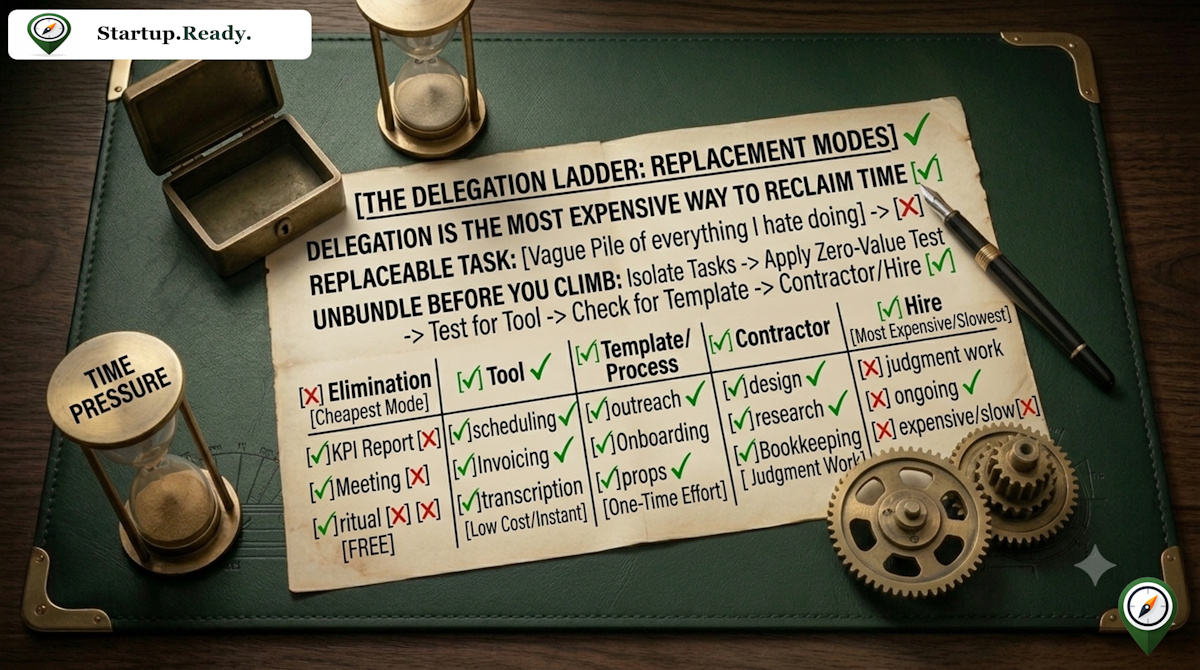
Once you know a task does not need you, the question is not whether to hand it off but how, and the modes are not equal in cost or speed. The work is to run each replaceable task down a ladder from cheapest to most expensive and stop at the first mode that works. Here is the ladder, cheapest first:
Eliminate: stop doing it entirely, because some work survives only out of habit and produces nothing worth its hours
Tool: let software carry anything repetitive and structured that needs no human judgment
Template or process: for work that recurs in the same shape, build it once so it stops requiring fresh thinking or you specifically
Contractor: for work that needs human judgment but not yours, buy the judgment rather than the full-time role
Hire: the last rung you evaluate rather than the first you reach for, and often the right answer once the cheaper rungs genuinely cannot handle the work
Four signals you are reaching for a person too fast:
Your first thought about any handoff is "who can I get to do this"
You are about to pay for work that a template would end permanently
You have never asked whether some of these tasks should simply stop
The bundle you want to delegate is really several different modes stuck together
If any of those describe you, this article shows you how to reclaim the same hours for less.
If You Found This Article by Searching for Something Else
Most founders who need this are not searching for "replacement modes." They are searching for something more immediate.
When should I hire a virtual assistant.
How to delegate as a solo founder.
What to outsource in my startup.
How to free up time without hiring.
Cheapest way to get help in my business.
All of those point at the same underlying question. You know you need this work off your plate, so what is the cheapest, fastest way to get it there? This article shows you the ladder, and why a person is usually the wrong first rung.
Finding the Work Is Not the Same as Choosing the Mode
This article assumes you have already done the finding. If you have not yet worked out which of your tasks do not require you, that is the prior step, covered in how to tell replaceable work from the work only you can do. This piece picks up after that, at the moment you have a task in hand and are about to decide what to do with it.
That moment is where the money leaks. A founder who has correctly identified twelve hours of replaceable work can still waste most of the benefit by defaulting every one of those tasks to a person. The tasks were right. The mode was lazy. Because "hand it off" and "hire someone" feel like the same thought, the founder skips straight to the most expensive option and never notices the four cheaper ones sitting above it on the ladder.
Choosing the mode well is where the actual leverage is captured. Finding the task tells you a handoff is possible. The mode determines what that handoff costs you and how fast the hours come back, and those two numbers are the whole point of doing this at all.
The Ladder, Cheapest First
The modes are not a menu you pick from by preference. They are a ladder you climb from the bottom, and you stop at the first rung that actually handles the task, because every rung up costs more money, more time, or more of your attention than the one below it.
Start at the bottom, with elimination, because it is the cheapest and the one founders never consider. A striking amount of what a founder does exists because the founder once created it. Rituals quietly become permanent. A weekly KPI report, a recurring meeting, a detailed proposal process, a customer check-in sequence, each made sense the day it was introduced, and few of them are ever re-examined. Years later they survive not because they create value but because they became routine, and the founder keeps paying for them in hours without re-asking whether they earn it.
So before you spend a cent moving a task to someone else, ask the question that starts this whole ladder. If this task disappeared tomorrow, who would notice? If the honest answer is nobody, start at elimination. Stopping it reclaims the hours for free, which no other mode can do.
The next rung is a tool. Anything repetitive, structured, and free of real judgment is a candidate for software: scheduling, formatting, transcription, reminders, data entry. A tool costs a little money and no ongoing management, and it does the task the same way forever. If a tool can carry it, a person is overkill.
Above that sits the template or the process. This is for work that recurs in the same shape and is founder-dependent only because the thinking lives in your head: outreach messages, proposals, onboarding steps, a recurring operational sequence. You build it once, well, and afterward the task either runs without fresh thought or can be handed to anyone with the document in front of them. A template converts a recurring founder task into a one-time founder task, which is one of the highest-return moves on the whole ladder.
Only above all of those does a contractor make sense, for work that genuinely needs human judgment but not your specific judgment: design, bookkeeping, research, support. You are buying the judgment by the task instead of hiring the whole role, which is far cheaper and faster than an employee and right for a large share of what founders try to hire out.
A hire sits at the top of this particular ladder, the last rung to evaluate rather than the first to reach for, because it is the slowest and most expensive way to reclaim a single task's worth of hours. There are good reasons to hire, and "I wanted this one task gone" is rarely one of them on its own.
The Ladder Is an Order, Not a Rule
Two clarifications, so the ladder does not get misread.
The first: none of this is anti-hiring. Hiring is often exactly the right answer, and a growing business will make many good hires. The point is only about sequence. A hire should be the last rung you evaluate, not the first you reach for, because when it is the first, you pay salary and management overhead for tasks a template or a deletion would have handled. Work down the cheaper rungs first, and then hire with clear eyes when the work genuinely needs a person on an ongoing basis. That is a stronger hire, not a skipped one.
The second: cost is not the only axis. Sometimes speed matters more. If building a template would take ten of your hours and a contractor would return those same ten hours starting tomorrow, the contractor is the better move even though it sits higher on the ladder. The ladder is about considering the cheaper modes first, not blindly choosing them. When a higher rung buys back time you need right now, take it on purpose, knowing exactly what you are paying for and why.
Unbundle Before You Climb
There is a trap that sends founders straight to the top of the ladder, and it is worth naming, because it wastes more money than any other mistake here. Founders bundle. They gather a pile of unrelated tasks, call the pile "everything I hate doing," and conclude the pile needs a person, because no single mode obviously handles all of it at once.
The pile does not need a person. It needs to be taken apart. Almost any bundle a founder wants to delegate is really four or five different tasks that each belong on a different rung. Pull it apart and the invoicing turns out to be a tool, the proposal drafting turns out to be a template, the calendar wrangling turns out to be a tool too, one genuinely judgment-heavy piece turns out to be a contractor task, and a couple of the items turn out to deserve elimination. What looked like one hire is actually two cheap tools, a template, one small contractor engagement, and two deletions, at a fraction of the cost and available this week rather than next month.
So unbundle first, then run each piece down the ladder on its own. The bundle is what makes hiring look necessary. The individual tasks almost never are.
The Operations Manager Who Was Not Needed
Take a founder who has decided it is time to hire an operations manager. The business feels chaotic behind the scenes, a dozen recurring operational tasks are eating her weeks, and a competent ops person would take all of it off her plate. Reasonable on its face, and a real salary about to be committed.
Before writing the job description, she lists everything the ops manager would own and runs each item down the ladder. The weekly KPI report she maintains? No one outside her own head has read it in months, and nothing would break if it stopped. Eliminate. Scheduling and calendar coordination? A booking tool. The onboarding steps she redoes for every customer? A template plus a simple sequence, built once. Invoicing and payment chasing? A tool. Vendor and bookkeeping work that needs real judgment but not hers? A part-time contractor. A recurring report a partner expects? A process document anyone could run.
By the time she reaches the bottom of the list, the operations manager has disappeared. What looked like a full-time role was a pile of unrelated tasks that resolve into two deletions, three tools, a template, a process doc, and one small contractor engagement. She reclaims more hours than the hire would have returned, spends a fraction of the salary, adds no one to manage, and has most of it running within a week. The role was not wrong because hiring is bad. It was wrong because it was one expensive answer to a question that had cheaper ones hiding inside it, and she had never taken the question apart.
The Task Unbundling Audit
Run your overload list through four steps, in order, and let each task fall out at the first one that catches it. What is left at the bottom is the small set that genuinely needs a contractor or a hire.
Isolate the task. Pull one discrete task out of the vague pile of "everything I hate doing." You cannot assign a mode to a pile, only to a task.
Apply the zero-value test. If this task stopped for thirty days, would any customer or stakeholder actually notice? If no, delete it and reclaim the hours for free.
Test for a tool. Is it rule-based and repeatable enough that low-cost software or an automation flow could run it? If yes, it is a tool, not a person.
Check for a template. Does it follow a repeatable pattern you could capture once in a template, a process doc, or a short video? If yes, build that once, and the task stops needing fresh thinking or you specifically.
Anything that survives all four is genuine judgment work. That, and only that, is where a contractor or a hire earns its place.
The One Sentence That Tells You Where You Stand
A founder who chooses modes well can complete this statement for any task they are handing off:
The replaceable task is [specific task], and the cheapest mode that actually handles it is [eliminate / tool / template or process / contractor / hire], which I am setting up by [date].
A founder defaulting to people can name the task easily and answers the mode question with "someone," every time, which is the tell that they are climbing straight to the top rung without checking the four below it.
If you can name the task and the lowest mode that handles it, you are capturing the leverage for what it should cost, which is usually far less than a hire. If your answer to every handoff is a person, stop and run the ladder: ask first whether the task can die, then whether a tool or template can take it, and reach for a contractor or a hire only when the cheaper rungs genuinely cannot. The hours come back either way. The difference is what you paid to get them.
Underneath the whole ladder is a goal worth stating plainly. The aim is not to build a team as fast as possible. It is to build a business that needs as little unnecessary labor as possible, whether that labor would have been yours or an employee's. Sometimes the work belongs with you. Sometimes it genuinely belongs with a hire. Often the highest-leverage move is making the work disappear before anyone has to do it at all. Either outcome moves you forward.
Replacement Modes and Your Founder Readiness
In the Startup Readiness Framework, Founder Readiness treats capacity as an allocation question as much as an hours question, because a founder who reclaims time expensively when they could reclaim it cheaply is leaving leverage on the table. Capacity constraints are a common early flag, and defaulting every handoff to a hire is one of the quiet ways founders fail to relieve them, spending money and weeks on what a template or a deletion would have solved for free.
Identifying which work is replaceable in the first place is the prior step, covered in when working harder stops working.
Founder Readiness is one of the six pillars in the framework. The Startup Readiness Assessment gives you a full-system diagnostic across all six in under twenty minutes.
Take your Startup Readiness Score free today at startupready.ai →
Keep Working on Your Founder Readiness
The Founder Pillar asks one question from many angles: can you, specifically, do the work this startup needs, and can you build the capacity you are missing? Each article below takes one piece of that question. Whether you are the right person to solve this particular problem. Where your real capacity gaps are, and whether they are gaps or just rates you have not run yet. What is draining your motivation, and whether the model is the cause. Which decision you keep making on repeat, and what would change it. Read them in any order. Each is a separate cut at the same pillar, and together they show you where your capacity holds and where it still has to be built.
More in the Founder pillar:
How to Find the Skills Gap That Is Slowing Your Startup Down
Why Startups Fail: The Founder Motivation Problem No One Talks About
How to Protect Your Time as a Founder Without Sacrificing Everything Else
A Skill Gap Is Not a Deficit. It Is a Rate.
A Mentor You Have Not Called in Six Months Is Not a Mentor
Your Network Is Not Gone. It Is in a Drawer.
You Are Not Losing Motivation. Your Model Is Draining It.
Your Startup Does Not Need More Goals. It Needs a Filter.
When Working Harder Stops Working, You Have a Leverage Problem
Your Constraints Are Not Obstacles. They Are Design Parameters.
Burnout Is Not Too Much Work. It Is Too Much Undirected Work.
Your Business Model Requires a Team You Do Not Have Yet
When You Are Missing the Skill and the Help, Fix One
You Do Not Make Bad Decisions. You Make the Same One Over and Over
Published
By Dr. Shaun P. Digan
Originally published on Startup.Ready.’s Startup Readiness: Validation, Framework, and Tools Blog at https://startupready.ai/startup-readiness/replaceable-founder-work
Original Publication Date: July 21, 2026
Last Updated: August 4, 2026
About the Author
Dr. Shaun P. Digan is the founder of Startup.Ready and the creator of the Startup Readiness Framework, a research-based system for evaluating and validating early-stage startups before launch and early growth. He holds a PhD in Entrepreneurship from the University of Louisville and has spent over 15 years teaching, advising, and consulting with founders on startup strategy, validation, and growth.
In his writing, including the Startup Readiness Blog and The Foundations of Innovation Essay Series, he focuses on how founders can make better decisions by improving clarity, alignment, and readiness before scaling.