A Mentor You Have Not Called in Six Months Is Not a Mentor
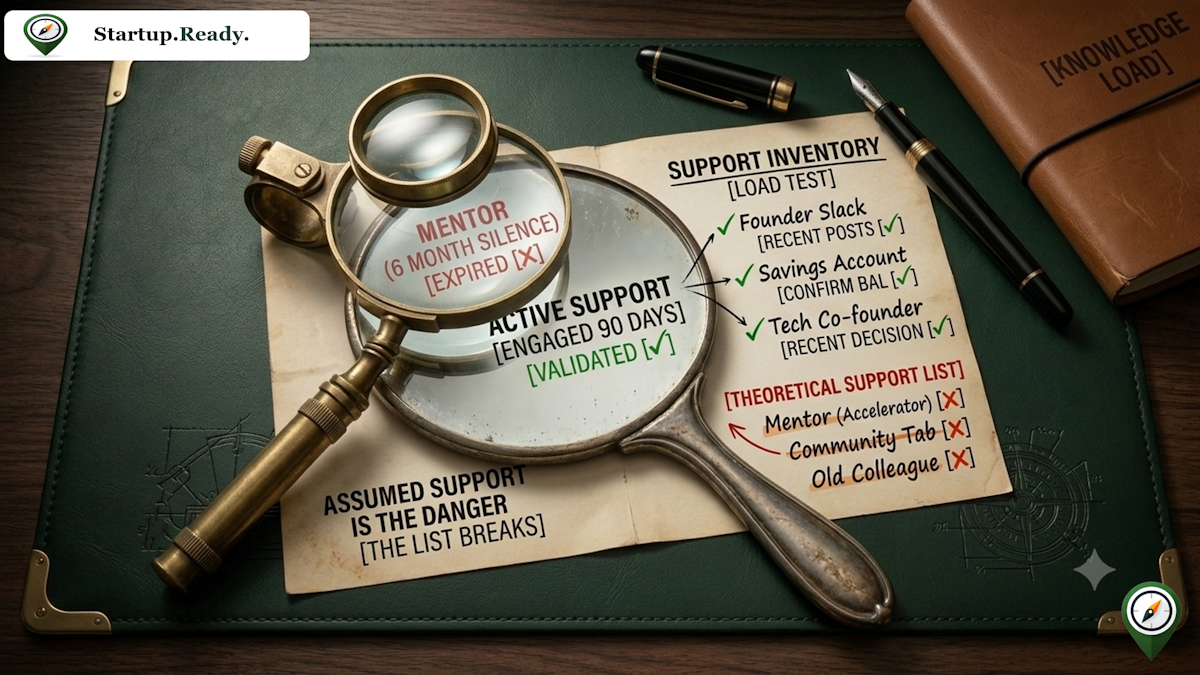
Ask a founder about their support system and the list sounds solid. A mentor from the accelerator. A co-founder. Some savings. A founder Slack they joined. On paper the founder is not alone.
Then something goes wrong, and the list turns out to be mostly furniture. The mentor has not been called in months, and the relationship has cooled enough that the ask now feels expensive. The co-founder is really a friend who likes the idea and has never made a hard decision with them. The savings are thinner than the runway math assumed. The Slack is a tab they have not opened in weeks. The support was real once. What the founder missed is that support expires when it stops being exercised, and it is not real now, when it is needed.
The danger is not the absence of support. It is counting support you do not actually have.
TL;DR: Real Support Is Support You Have Used, Not Support You Could Name.
A founder can be capable, skilled, and motivated and still break, because the structure around them cannot absorb the weight. The failure is rarely a missing resource. It is an assumed one, listed as present and functionally absent. The work is to inventory support by what you have actually engaged, find the thinnest of four load types, and make one real move. Here is the move, in order:
Inventory only what is real: a specific person engaged in the last ninety days, a specific dollar amount, an active presence, not "I could probably ask"
Sort by load type: knowledge, operational, emotional, and financial each absorb a different kind of weight
Stress-test by putting real load on it, because founders overrate support that has only shown up for easy moments, and underrate support they have never used
Name the load with nowhere to go and what its gap will cost specifically over the next ninety days
Make one move in that load type you can complete in thirty days
Four signals your support is thinner than your list:
You can name a mentor but not the last time you actually spoke
A resource on your list is one you would feel awkward using tomorrow
Your runway math assumes money or help that is not confirmed
If something went wrong next month, you are not sure who you would call
If any of those describe you, this article shows you how to tell real support from the kind that only exists on a list.
If You Found This Article by Searching for Something Else
Most founders who need this are not searching for "founder support system." They are searching for something more immediate.
How to avoid founder burnout.
I feel like I am doing this alone.
How to build a support network as a founder.
Do I need a co-founder or an advisor.
Why am I so exhausted three months in.
All of those point at the same underlying question. When the weight lands, is there anything real underneath you, or only a list? This article shows you how to check.
Assumed Support Is the Dangerous Kind
Thin support does not fail dramatically. It fails gradually, which is why founders miss it. There is no day the support system collapses. There is a slow accumulation of load the founder absorbs alone: decisions a partner would have caught, emotional weight a peer would have shared, financial pressure runway would have absorbed. None of it looks like failure on day one. It looks like exhaustion on day ninety, and by then it reads as a personal limit rather than a structural gap.
The quieter danger sits inside the assumption. Founders do not usually overestimate their own effort. They overestimate the resources around it. A mentor who has not been called in six months is not a mentor in any operational sense. A co-founder who has never made a real decision with you is not sharing execution risk. A community you have not engaged is not access. Each of these is easy to list and comforting to believe in, and none of it will be there in the form you are imagining when the weight actually lands.
The problem is not that these resources are missing. It is that they are absent and being counted as present, which is worse than knowing they are gone, because you do not plan to replace what you believe you already have.
Support Decays
Support is not a permanent asset. Relationships cool. Communities forget you exist. Savings shrink. Advisors change jobs and priorities. A support system that was real six months ago may not be real now, and nothing sends you a notice when a piece of it goes quiet.
The mistake is treating support as something you acquire once and keep. It behaves more like a muscle than a possession. It stays real through use and weakens through neglect.
That is why recency is a useful warning sign and not the actual variable. The variable is whether the resource can still carry load. A mentor you have not called in six months might pick up on the first ring and give you an hour, in which case the relationship never really decayed. A founder Slack you posted in yesterday might do nothing for you, because posting once is not the same as being known there. So the title of this piece is a heuristic, not a law. A long silence is a symptom worth noticing. What you actually test is load: can this resource take real weight off you right now.
Decay also comes in two forms that need different repairs, and founders apply the wrong one constantly. Relational support, the mentors, peers, and old colleagues, fails through drift. Nobody did anything wrong, the line just went untended and cooled, and the repair is reconnection. Contractual support, the formal advisors and the co-founder, fails a different way. It decays through role misalignment: a co-founder who took the technical seat and quietly avoids every commercial decision, an advisor whose expertise stopped matching where the company went. A friendly coffee does not fix that, because the problem is not warmth. The repair is a direct conversation about the role, and sometimes a change to the agreement. Treating a contractual gap like a relational one, hoping another warm check-in will make a co-founder start owning decisions they have dodged for a year, is how founders lose months being let down by a structure they never renegotiated.
Four Loads, Not One
Support is not a single thing, and treating it as one hides where the gap is. It comes in four kinds, and each absorbs a different load off the founder. A resource is worth exactly the load it can take, no more, which makes load the common unit: the way to compare a mentor and a savings account is by what each one lifts off your back.
Knowledge support absorbs the load of not knowing. Mentors, advisors, and peers who keep you from making avoidable mistakes twice. Operational support absorbs the load of manual work. Tools, templates, and contractors that keep founder hours off what a system could do. Emotional support absorbs the load of pressure. People who understand the weight, so decisions do not get made alone under private stress. Financial support absorbs the load of scarcity. Runway, income, and capital that keep money worry from distorting judgment.
Most founders are strong in one or two of these and quietly empty in the others, and the empty one is where the break happens. A founder rich in mentors and savings can still crack for lack of anyone who understands the weight. A founder with deep emotional support can still stall for lack of the operational leverage that would give them their hours back. So the sharper diagnostic is not which support type is weakest. It is which load has nowhere to go, because that load does not disappear. It lands back on the founder, and the founder absorbs it until something gives.
The Founder Whose List Did Not Hold
Take a founder six months in who, asked, describes a reasonable support system. A mentor from her accelerator. A technical co-founder. Eight months of savings. An active founder community.
Walk each one against a single test: when did you last actually use this, and could you ask it for real help tomorrow without it feeling strange?
The mentor gave one great session at demo day and she has not spoken to him since. Reaching out now, cold, for something specific would feel like an imposition, so on knowledge load the support is not currently there. The co-founder carries the technical load well and avoids every commercial decision, so on the choices that are breaking her, pricing, positioning, whether to raise, she is effectively alone. The eight months of savings is really five once she counts honestly, and she has been making decisions against the number she wished were true.
Then the community, which she had also been about to write off, because she lurks and has never posted. Instead of assuming, she tests it. She writes one honest post about where she is stuck. Three founders respond within a day. One makes an introduction to a potential customer, one sends her the pricing data she had been guessing at, one offers to review her pitch. The community was not weak support. It was dormant support, and it turned real the moment she put weight on it.
That is the whole lesson in one list. Three of the four were assumed, and the exhaustion she had been reading as her own weakness was the sound of a structure carrying less than she thought. The fourth was real all along and she had been treating it as furniture, because she had never used it. Support did not fail her across the board. Some of it was thinner than the list implied, and one piece was stronger than she believed, and the only way to tell which was which was to put load on each one.
The Who-Would-You-Call Test
One question cuts through the whole inventory faster than any list.
If something went seriously wrong with the startup next month, who would you call first, and what specifically could they do?
A name and a concrete action. Not "I have people," but "I would call her, and she would look at the financials with me by Friday." If you can answer with a specific name and a specific thing they would actually do, that piece of your support is real. If you reach for the question and come back with a category, "my network," "my advisors," or a name you would in fact hesitate to call, the support is more theoretical than you have been treating it.
Run it across the four load types. Who would you call for a decision you cannot make alone. Who for the emotional weight of a bad week. Who or what for the operational fire. What number is actually under you financially. The blanks are your real support map, and they are usually more honest than the inventory, because a name you would genuinely dial under pressure is a much higher bar than a name you can list on a calm afternoon.
The One Sentence That Tells You Where You Stand
A founder with a real support system can complete this statement without softening it:
The load with nowhere to go right now is [knowledge / operational / emotional / financial], and its gap will cost me [specific consequence] over the next ninety days.
The one move I am making in thirty days is [specific move], starting with [specific first step] this week.
A founder running on an assumed system names an impressive list and stalls on the who-would-you-call test, because the list was built for reassurance rather than for use. That stall is the finding.
If you can name your thinnest load and one real move to strengthen it, you are building structure instead of hoping the list holds. If the inventory looks full but no name survives the call test, the gap is not effort and not talent. It is a structure thin enough that the next hard month will find it. Better to find it first, on a calm afternoon, while you still have time to put something real underneath you. Either outcome moves you forward.
Support and Your Founder Readiness
In the Startup Readiness Framework, Founder Readiness treats the structure around the founder as part of the foundation, not a soft extra, because effort alone does not carry a startup and a capable founder on a thin structure still breaks. Thin support and resources is a common early flag, and it is most dangerous when the founder assumes resources that are not functionally there, since you do not move to replace what you believe you already have.
One of the fastest ways to strengthen a thin system is to reactivate the relationships you already have but have let go quiet, which is its own piece of work.
Founder Readiness is one of the six pillars in the framework. The Startup Readiness Assessment gives you a full-system diagnostic across all six in under twenty minutes.
Take your Startup Readiness Score free today at startupready.ai →
Keep Working on Your Founder Readiness
The Founder Pillar asks one question from many angles: can you, specifically, do the work this startup needs, and can you build the capacity you are missing? Each article below takes one piece of that question. Whether you are the right person to solve this particular problem. Where your real capacity gaps are, and whether they are gaps or just rates you have not run yet. What is draining your motivation, and whether the model is the cause. Which decision you keep making on repeat, and what would change it. Read them in any order. Each is a separate cut at the same pillar, and together they show you where your capacity holds and where it still has to be built.
More in the Founder pillar:
How to Find the Skills Gap That Is Slowing Your Startup Down
Why Startups Fail: The Founder Motivation Problem No One Talks About
How to Protect Your Time as a Founder Without Sacrificing Everything Else
A Skill Gap Is Not a Deficit. It Is a Rate.
Your Network Is Not Gone. It Is in a Drawer.
You Are Not Losing Motivation. Your Model Is Draining It.
Your Startup Does Not Need More Goals. It Needs a Filter.
When Working Harder Stops Working, You Have a Leverage Problem
Your Constraints Are Not Obstacles. They Are Design Parameters.
Burnout Is Not Too Much Work. It Is Too Much Undirected Work.
Your Business Model Requires a Team You Do Not Have Yet
Before You Hire Someone, Try Deleting the Task
When You Are Missing the Skill and the Help, Fix One
You Do Not Make Bad Decisions. You Make the Same One Over and Over
Published
By Dr. Shaun P. Digan
Originally published on Startup.Ready.’s Startup Readiness: Validation, Framework, and Tools Blog at https://startupready.ai/startup-readiness/founder-support-system
Original Publication Date: August 4, 2026
Last Updated: August 4, 2026
About the Author
Dr. Shaun P. Digan is the founder of Startup.Ready and the creator of the Startup Readiness Framework, a research-based system for evaluating and validating early-stage startups before launch and early growth. He holds a PhD in Entrepreneurship from the University of Louisville and has spent over 15 years teaching, advising, and consulting with founders on startup strategy, validation, and growth.
In his writing, including the Startup Readiness Blog and The Foundations of Innovation Essay Series, he focuses on how founders can make better decisions by improving clarity, alignment, and readiness before scaling.