
Know Where Your Founder Stands Before the Session Starts
A founder readiness assessment that hands mentors, advisors, and program leads instant context, then keeps founders building between sessions. Diagnose the real constraint. Develop it. Skip the forty minutes of catch-up.
The Mentor's Real Problem
Mentors get asked to deliver strategy with no diagnostic context. Every session starts from zero. The founder recaps what they have been doing. You reverse-engineer what is actually wrong. Then the clock runs out.
Founders call the result mentor whiplash. Conflicting, surface-level advice, session after session, because no two mentors are working from the same picture and none of them walked in with one.
Four failure modes show up again and again:
Reactive diagnosing. Forty minutes of a sixty-minute session spent figuring out what is wrong before any real guidance can start.
Activity bias. Founders report what they have done, not what they understand. Tasks get mistaken for readiness.
Inconsistent guidance. Advice tracks the mentor's intuition in the moment instead of the founder's objective gaps.
Hidden execution risk. A weak assumption in the business model or the market definition stays buried until it gets expensive to fix.
Diagnose: Walk In With the Picture
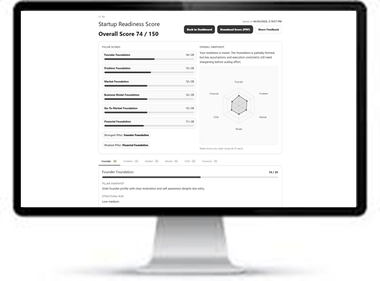
Before the session, you review a Startup Readiness Score and a pillar breakdown. It reads like a heat map of the founder's foundation. Strengths in one glance. Hidden risk in the next.
You know which pillar is holding them back before you say a word. Founder Readiness. Problem. Market. Business Model. Go-to-Market. Financial. The conversation opens on the constraint that matters instead of the topic the founder happened to lead with.
That is the assessment half. It gives you context. It is the easy half to imagine.
Develop: What Happens Between Sessions
Here is the part a scoring tool cannot do. The assessment triggers structured worksheets matched to the founder's gaps. The founder works through them between sessions. The work builds a living model of their startup: every assumption, the evidence behind it, the decisions it drives, and the dependencies that connect them.
So your advice compounds. You point at a weak market assumption on Tuesday. By the next session the founder has pressure-tested it against evidence, and the model shows you exactly what they found. You coach. The system develops. The two reinforce each other.
This is why it is an assessment and development system. It keeps working after you close the report. The founder keeps reasoning between the sessions you are not in the room for. That is the whole point, and it is what makes the guidance stick.
What the Assessment Reads: Six Pillars
The Startup Readiness Score evaluates a founder's foundation across six research-backed pillars, in order, because each one depends on the one before it.
Founder Readiness: Assessing bandwidth, skill-alignment, and the psychological resilience required for the next 90 days of execution.
Problem Clarity: Moving from abstract ideas to concrete, observable evidence that the customer’s pain is real and recurring.
Market Clarity: Defining a narrow, accessible entry segment rather than a vague "Total Addressable Market."
Business Model Clarity: Evaluating how value is created, delivered, and—most importantly—captured and defended.
Go-to-Market (GTM) Clarity: Validating the system that moves a customer from initial awareness to measurable action.
Financial Clarity: Understanding unit economics, core cost drivers, and the "time-to-learning" ratio before burning capital.
A founder can look strong on market size and be structurally weak on founder capacity or unit economics. That gap is exactly what the six pillars surface before it becomes expensive.
What Mentors Get
A structured system to evaluate startups consistently, guide better conversations, and improve decision-making across your entire cohort.
A Clear Startup Diagnosis
Stop "guessing" what the founder needs. Get a comprehensive diagnostic report that highlights strengths, gaps, and hidden risks before you even say hello. You enter every session with the context of a long-term advisor.
More Focused Conversations
Maximize the ROI of your time. By identifying the startup's primary constraint instantly, you spend less time diagnosing the problem and more time solving it. Move past the "fluff" and get straight to high-impact strategy.
Advice That Compounds
Whether you are mentoring one founder or a cohort of fifty, Structured development between sessions means your guidance builds instead of resetting. This consistency ensures that your guidance is objective, repeatable, and grounded in data.
Better Founder Accountability
Ground your sessions in clarity, not opinions. When a founder’s score shows a gap in Market Clarity, it creates a natural, non-confrontational opening to hold them accountable for validation before they move forward.

How It Works
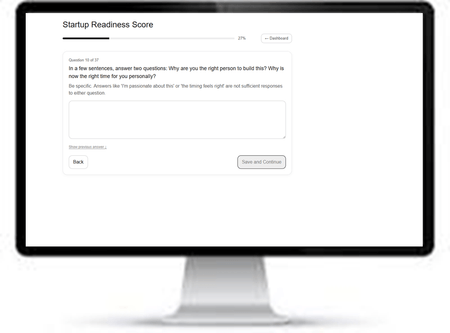
Founders Complete the Assessment
Founders work through the structured assessment (covering the 6 Pillars), answering questions that require evidence, not just intent. This process itself surfaces gaps they did not know where there.
You Review the Results
Before the session, the mentor reviews the generated Readiness Score and Pillar Breakdown. This report provides a visual heat map of the startup’s health highlighting strengths and hidden risks.
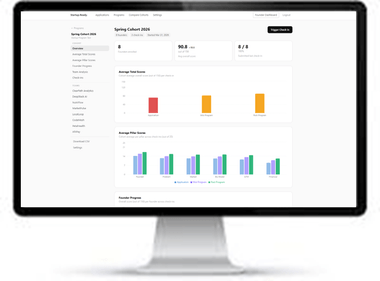
Use Results to Guide the Session
You and the founder open the session with the same "North Star." Instead of a broad discussion, they dive deep into the specific gaps identified by the score. The session becomes a surgical strike on the startup's most pressing risks.
Who This Is For
The Startup Readiness Score is designed for anyone responsible for the trajectory of an early-stage venture. If your goal is to reduce startup failure through better decision-making, this is your framework.
Accelerator & Incubator Mentors: Standardize how you evaluate founders across a cohort to ensure no one falls through the cracks.
Angel Investors & Advisors: Use the assessment as a due-diligence tool to see if a founder has truly validated their foundations before you commit capital or reputation.
Founder Coaches: Shift from purely psychological support to tactical readiness, helping founders bridge the gap between "vision" and "execution."
Venture Studios & Operators: Create a repeatable "Readiness Gate" that startups must pass through before moving from the ideation phase to the build phase.
Informal Mentors: Professionalize your "pro-bono" advice by giving founders a structured way to present their business to you, saving you hours of discovery.
Most mentors start blind. Start Mentoring With Clarity.
Developed By
The Startup Readiness Framework was developed by Dr. Shaun P. Digan, a researcher and strategist focused on founder decision making. Drawing on a PhD in Entrepreneurship and 15 years advising founders, Shaun built the framework to bridge academic rigor and practical execution. His peer-reviewed research on entrepreneurial learning and cognitive decision-making, together with experience coaching hundreds of founders, forms the backbone of the Six Pillars of Startup Readiness and the Startup Readiness Framework.
FAQ
Program's Frequently Asked Questions... Answered
How do you mentor a startup founder effectively?
Open on the founder's actual constraint. The most effective mentoring skips the live diagnosis and starts where the real gap is. A founder readiness assessment hands you that constraint before you sit down, so the session goes straight to guidance and to the structured work that closes the gap.
What is a founder readiness assessment?
A founder readiness assessment measures a founder's foundation across six dimensions: Founder Readiness, Problem, Market, Business Model, Go-to-Market, and Financial. It reads clarity and evidence. Completed tasks do not move the score. Validated understanding does, so you learn whether a founder has actually pressure-tested their foundation.
How does this make my mentoring more effective?
It shifts you from reactive to proactive. You review the Readiness Score beforehand and walk in already knowing which pillar is holding the founder back. Then the assessment triggers worksheets the founder works through between sessions, so your advice compounds instead of resetting each time.
What happens between sessions?
The assessment routes the founder to structured worksheets matched to their gaps. The work builds a living model of their startup: assumptions, the evidence behind them, the decisions they drive, and the dependencies between them. You coach the reasoning. The system develops it in the weeks you are not in the room.
Do mentors need special software or access?
No. The system is designed for frictionless collaboration. Founders complete the assessment and can then share their unique Readiness Report directly with their mentor via a secure link or PDF. This puts the founder in the driver’s seat of their own evaluation while giving the mentor a comprehensive, "under-the-hood" look at the startup’s foundational health without requiring a complex software setup.
Is the Startup Readiness Framework a replacement for mentorship?
Absolutely not. It is an enablement tool for mentorship. A diagnostic tool can identify that a startup has a "Problem Clarity" gap, but it takes an experienced mentor to help the founder navigate the human nuances of solving it. The framework handles the quantitative due diligence, allowing the mentor to focus on the qualitative strategy, coaching, and networking that only a human expert can provide.
Is this a replacement for the mentor’s intuition?
Not at all. The framework handles the quantitative diagnosis, showing where a gap exists, so you can focus on the qualitative work: coaching, strategy, and the human nuance of helping a founder close that gap. It sharpens mentor intuition. You keep the judgment. It gives you the diagnosis to aim it.
Can an accelerator use this across a whole cohort?
Yes. Program leads use it to apply one research-backed standard to every founder in a cohort, compare readiness consistently, and route each founder to the development work their gaps call for.
Can this framework be used for pre-seed due diligence?
Yes. Accelerators, incubators, educators, and other programs can use the framework as a pre-investment diagnostic to evaluate if a founder has actually validated their core assumptions or if they are simply "moving fast" on unstable foundations.
How does this framework support Startup Due Diligence for Investors?
The Startup Readiness Score provides a pre-investment due diligence framework. It forces founders to move past "pitch deck optimism" and present evidence of validation. For investors and mentors, this reduces the risk of funding "vanity metrics" and ensures the startup's core foundations are scalable.
Published: April 14, 2026
Last Updated: July 28, 2026
We use cookies to improve user experience. Choose what cookie categories you allow us to use. You can read more about our Cookie Policy by clicking on Cookie Policy below.
These cookies enable strictly necessary cookies for security, language support and verification of identity. These cookies can’t be disabled.
These cookies collect data to remember choices users make to improve and give a better user experience. Disabling can cause some parts of the site to not work properly.
These cookies help us to understand how visitors interact with our website, help us measure and analyze traffic to improve our service.
These cookies help us to better deliver marketing content and customized ads.