See it in action:
 2:32
2:32Give Your Cohorts a Development System That Runs Alongside Your Program
The Startup Readiness Score is an assessment and development system that runs in parallel to your accelerator, incubator, or university program. Screen applicants against a shared standard. Develop every founder between your sessions. See where risk is hiding across the whole portfolio.
The Problem Programs Live With
Most startup programs track activity. Applications submitted. Sessions attended. Features shipped. Founders look busy and still stall, because busy is not the same as ready.
By the time the gap shows, the program has already spent time, mentorship, and cohort slots on founders who were not ready to use them. Three things drive it:
Selection runs on narrative. A polished application outshines a stronger foundation, and the quiet founder with real evidence gets passed over.
Nothing structured happens between touchpoints. Founders develop in the sessions you run and drift in the weeks you do not.
Risk stays hidden until it is expensive. A weak market or business model assumption sits unvetted until demo day makes it obvious.
Runs in Parallel With Your Program
Here is the part that changes the economics of a cohort. The Startup Readiness Assessment is more than just a score, it is a development system, and it works in parallel to the curriculum you already run.
The assessment routes each founder into structured worksheets matched to their gaps. Founders work through them between your sessions. The work builds a living model of their startup: every assumption, the evidence behind it, the decisions it drives, and the dependencies that connect them. Your mentors coach. The system develops. Neither one waits on the other.
So your program keeps its shape. You add a development layer that runs on its own between touchpoints, moves founders forward without more staff hours, and hands your team a live read on where every founder actually stands. Your curriculum and this system pull in the same direction at the same time.
That parallel development is the difference between a program that tracks a cohort and a program that develops one.
Screening: One More Signal, and a Real Takeaway for Applicants
Most application review runs on judgment. Pitch, story, a read on the founder. That judgment matters, and it stays. The Startup Readiness Score adds one structured signal underneath it.
Every applicant completes the assessment and gets a readiness score and a pillar breakdown. Your reviewers see that same evidence-based read next to each application, one more input beside the narrative. It is a cleaner way to evaluate startups for an accelerator, without asking your team to trade its judgment for a number.
The real win sits with the applicant. Every founder who applies walks away with a diagnosis of where their foundation is strong and where it is thin, whether or not they get in. Your application process becomes something the founder keeps and acts on. A rejection turns into a reason to come back next cycle with the gaps closed.
The Six Pillars It Reads
The Startup Readiness Score assesses every founder across six research-backed pillars, in order, because each one depends on the one before it.
Founder. Does the founder have the bandwidth, skill alignment, and resilience to execute over the program timeline, not just a strong personal story?
Problem. Is there concrete, observable evidence the customer's pain is real and recurring, or is the problem still an assumption dressed up as a fact?
Market. Can the founder name a narrow, reachable entry segment, or only a vague total addressable market that sounds big in the application?
Business model. Is it clear how value gets created, delivered, and captured? A compelling product with no path to payment isn't investable yet.
Go-to-market. Is there a validated system for moving a customer from awareness to action, or is acquisition still improvised?
Financial. Does the founder understand unit economics and the time-to-learning ratio, how quickly they'll know if something is working, before capital runs out?
Scoring all six, consistently, across every applicant, is what separates startup evaluation criteria from intuition. It also holds up across very different businesses in the same cohort.
This six-dimension model is the same Startup Readiness Framework used across the site: see the full breakdown on the 6 Pillars page.
See it in action:
2:32What Programs Get
A structured system to evaluate startups consistently, guide better conversations, and improve decision-making across your entire cohort.
Development Layer That Runs Itself
Founders build between sessions on structured worksheets, in parallel with your curriculum, with no added staff load.
Consistent Startup Evaluation
Every startup is assessed across the same six criteria.
Portfolio Visibility
Move beyond surface-level updates. See where each startup is strong, where clarity is missing, and where risk is hiding, across the whole cohort.
Sharper Mentor Conversations
Mentors start from a shared diagnosis and open on the constraint that matters.
Better Founder Alignment
Founders gain a clearer understanding of their own gaps, shared language with mentors and program leaders, and a more structured way to think about progress
Measurable, Objective Program Metrics
Track readiness, progress, and gaps across your entire portfolio using a consistent, evidence-based framework.

How It Works
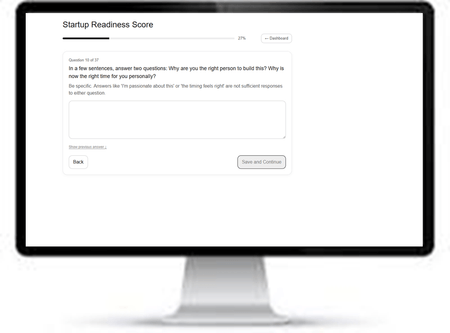
Founders Complete the Assessment
Founders complete a short (20-25 minute) assessment to probe assumptions, alignment, and execution readiness across the six pillars of a strong startup foundation.
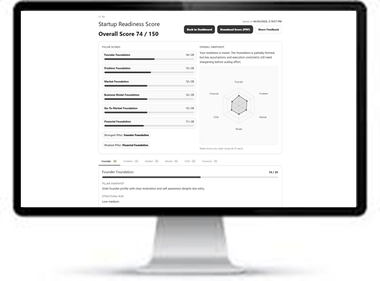
Startups Receive Readiness Results Instantly
Each startup receives their overall readiness score and a breakdown across each pillar, highlighting strengths, gaps, potential risk areas, and recommended actions.
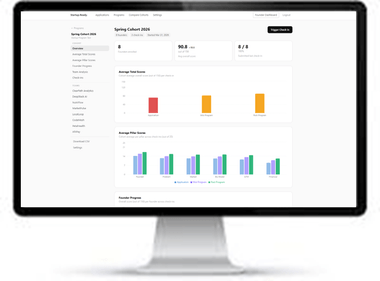
Development Runs in Parallel
The results route founders into structured worksheets they work between sessions, while your team uses the same output to focus mentorship and track the cohort. The program and the development system move together.
Where Programs Use It
The Startup Readiness Score earns its keep at every decision point, from the first application to alumni tracking. Every stage doubles as a development checkpoint.
Application Process. Give applicants a clearer read on their own readiness, separate strong narratives from strong foundations, and lift the quality of the incoming pool.
Screening & Intake. Give every applicant the same readiness read, surface hidden risk before acceptance, and add one evidence-based signal beside your own judgment.
Pre-Program. Set a baseline, align founders and mentors on where each startup stands, and route founders into the development work their gaps call for.
Mid-Program. See which founders are building and which are drifting, catch emerging risk before it blocks, and point mentor time at the highest-impact gaps.
End-Program. Pressure-test readiness before demo day or a raise, look past presentation polish to underlying strength, and back your investor recommendations with evidence.
Post-Program. Track how alumni evolve, understand long-term impact, and strengthen reporting to your own stakeholders.
Who It's For
Built for the people accountable for cohort outcomes.
Startup Accelerators
Incubators
University Entrepreneurship Programs
Venture Studios
Corporate Innovation Programs
Most programs measure activity.
The best programs measure readiness.
See how your program can develop your whole cohort in parallel, add a real signal to applicant review, and see portfolio risk before it costs you a slot.
FAQ
Program's Frequently Asked Questions... Answered
What is a startup accelerator assessment tool?
A startup accelerator assessment tool scores every applicant and cohort founder across a consistent set of criteria: Founder Readiness, Problem, Market, Business Model, Go-to-Market, and Financial. The Startup Readiness Score goes further than assessment. It routes founders into structured development work matched to their gaps, so the tool improves selection and develops the cohort in parallel with your program.
Is this a screening tool or a development tool?
Mostly a development tool that also gives your screening a real signal. It adds one evidence-based input to your applicant review, and it develops accepted founders through structured work between sessions. The same six-pillar framework runs both, so the read you get at intake connects straight to the work a founder does in the program.
How does the development system run alongside our program?
The assessment routes each founder into worksheets matched to their gaps, and founders work them between your sessions. That builds a living model of their startup while your curriculum runs on its own track. Your mentors coach the reasoning. The system develops it in the weeks between touchpoints. Neither adds staff hours to the other.
How do you use this to evaluate startups for an accelerator?
You keep your judgment and add one structured signal to it. Every applicant completes the same assessment, so your reviewers get a consistent, evidence-based read on the foundation next to each application. It informs the decision without replacing it, and every applicant gets a diagnosis they can act on whether or not they get in.
How does an accelerator application screening tool work here?
Applicants complete a 20 to 25 minute assessment scored on the same criteria your program uses throughout. Your team receives a readiness score and pillar breakdown for every applicant, one more evidence-based input beside the application. The applicant keeps their results too, so even a rejection sends the founder away with a real takeaway.
How is this different from existing program tracking tools?
Most tools track activity: meetings, updates, milestones. The Startup Readiness Score evaluates the underlying strength of each startup, develops it between sessions, and shows where clarity and risk still sit across the portfolio.
Is this meant to replace mentorship?
No. It strengthens mentorship by giving mentors a clearer starting point and a shared framework for more focused, productive conversations.
How long does it take founders to complete the assessment?
Most founders complete it in 15–20 minutes.
Can we use this during selection or only after startups are accepted?
Both. Many programs use it during screening and intake to support more consistent selection decisions, and then again during the program to track progress.
Do founders see their results?
Yes. Founders receive full results, which builds alignment between founders, mentors, and program leaders and gives founders a clear read on their own gaps.
Can mentors and program staff access results?
Yes. Results can be shared across your program to support more structured and consistent guidance.
Is this a one-time assessment or ongoing?
Ongoing. Founders are encouraged to work through the invisible work, return to the assessment, and determine what they should work on next. Programs use it at intake, mid-program, and end-program to develop founders and track how readiness changes across the cohort.
What kind of startup programs is this best suited for?
Any program working with early-stage founders that wants more structure, consistent selection, development that runs between sessions, and real visibility across its cohort.
Developed By
The Startup Readiness Framework was developed by Dr. Shaun P. Digan, a researcher and strategist focused on founder decision making. Drawing on a PhD in Entrepreneurship and 15 years advising founders, Shaun built the framework to bridge academic rigor and practical execution. His peer-reviewed research on entrepreneurial learning and cognitive decision-making, together with experience coaching hundreds of founders, forms the backbone of the Six Pillars of Startup Readiness and the Startup Readiness Framework.
Published: April 14, 2026
Last Updated: August 8, 2026
We use cookies to improve user experience. Choose what cookie categories you allow us to use. You can read more about our Cookie Policy by clicking on Cookie Policy below.
These cookies enable strictly necessary cookies for security, language support and verification of identity. These cookies can’t be disabled.
These cookies collect data to remember choices users make to improve and give a better user experience. Disabling can cause some parts of the site to not work properly.
These cookies help us to understand how visitors interact with our website, help us measure and analyze traffic to improve our service.
These cookies help us to better deliver marketing content and customized ads.