When Working Harder Stops Working, You Have a Leverage Problem
You are capable, and you are working hard, and the business has stopped moving the way it used to. The obvious response is to work harder still. You add hours, tighten the schedule, push through the weekend, and the needle barely moves. More effort is producing less.
That is not a sign you are failing. It is a sign you have hit a specific kind of ceiling, and it is not the ceiling you think. You are not out of effort. You are out of leverage. Everything in the business runs through you, and once a founder becomes the single channel every task flows through, adding effort stops helping, because the constraint was never how hard you work. It was how much of the work requires you at all.
The founders who break through this do not find another gear of effort. They stop being the bottleneck.
TL;DR: If More Hours Produce Less Movement, the Ceiling Is Leverage, Not Effort.
A strong founder can stall without slowing down, because output capped by founder effort has a hard limit that no additional hours can pass. The fix is not to work more. It is to move work off yourself that never needed you. The work is to see where your time actually goes, find what you are doing that does not require you specifically, and replace your effort there with a tool, a system, or a person. Here is the move, in order:
Audit where your time actually went, across the last two weeks, not where you planned it to go
Separate involvement from judgment: find the work that requires your involvement but not your judgment, the hours you spend on consistency rather than on something only you can decide
Protect the work that teaches you, because some tasks produce learning as well as output and the learning is the part you must not hand off
Replace your effort on the rest with a tool, a template, or a person who can do it well enough
Redeploy the freed hours into the work that genuinely only you can do
Four signals your ceiling is leverage rather than effort:
You are working more and moving less
Nearly every task in the business passes through you
You keep doing work you are good at that almost anyone could do
You cannot remember the last time you spent a full block on the one thing only you can do
If any of those describe you, this article shows you how to find the bottleneck, which is usually you, and get out of your own way.
If You Found This Article by Searching for Something Else
Most founders who need this are not searching for "founder leverage." They are searching for something more immediate.
Why am I working so hard and not growing.
How to get out of the weeds as a founder.
I am the bottleneck in my startup.
How to delegate when I cannot afford to hire.
Why does everything depend on me.
All of those point at the same underlying question. Has your business run out of opportunity, or has it run out of you? This article shows you how to tell, and what to do when the answer is you.
The Ceiling Is Leverage, Not Effort
There is a plateau that capable founders hit and misread. The early stretch rewards raw effort, because in the beginning almost everything is new and doing it yourself is the fastest way to learn it. So the founder does everything, and it works, and doing everything becomes the identity of the business. Then growth flattens, and the founder reaches for the tool that has always worked, more hours, and the tool stops working.
It stops working because the problem changed shape without announcing it. The constraint was effort, and now the constraint is that all of the effort has to pass through one person. A founder who is the single point every task routes through has a ceiling set by their own hours, and their own hours are finite in a way that opportunity is not. You can want more, and there be more available, and still be unable to reach it, because the path to it runs through a person who is already full.
This is why the harder-work reflex fails here specifically. More effort poured into a leverage bottleneck does not raise the ceiling. It just presses harder against it. The founder feels the resistance and reads it as a call for more force, when it is actually a call for a different structure. The tank is not empty. The valve is too narrow.
The Trap Is That You Are Good at It
The reason this ceiling is so hard to see is that it is built out of a strength. A capable founder is good at most of what the business needs, and being good at something makes it feel efficient to keep doing it yourself. Why hand off the onboarding call when you run it better than anyone you could hire? Why templatize the proposal when yours are excellent? The competence is real, and it is exactly what keeps the founder welded to work that does not need them.
Here is the distinction that breaks the trap. There is work only you can do, and there is work you happen to be good at, and they are not the same set. The founder's judgment on the product, the core positioning, the relationships that genuinely require their name and history: that is founder-specific value, the work that degrades badly when anyone else does it. Most of the rest is work you are good at, which is a completely different thing, because work you are good at can be done well enough by a tool, a template, or a competent other person, freeing the one resource that is actually scarce, which is you on the work that only you can do.
Being good at everything is not the asset it feels like at this stage. It is the reason you are still holding tasks you should have handed off months ago.
The Founder Who Did All of It
Take a founder running a small software business who is genuinely good at the whole stack. She designs well, sells well, onboards new customers warmly, and handles support faster than anyone she could hire. So she does all of it, sixty hours a week, and for a year that was the growth engine. Now it is the ceiling. Revenue has flattened, she is more tired than ever, and more hours are not moving it.
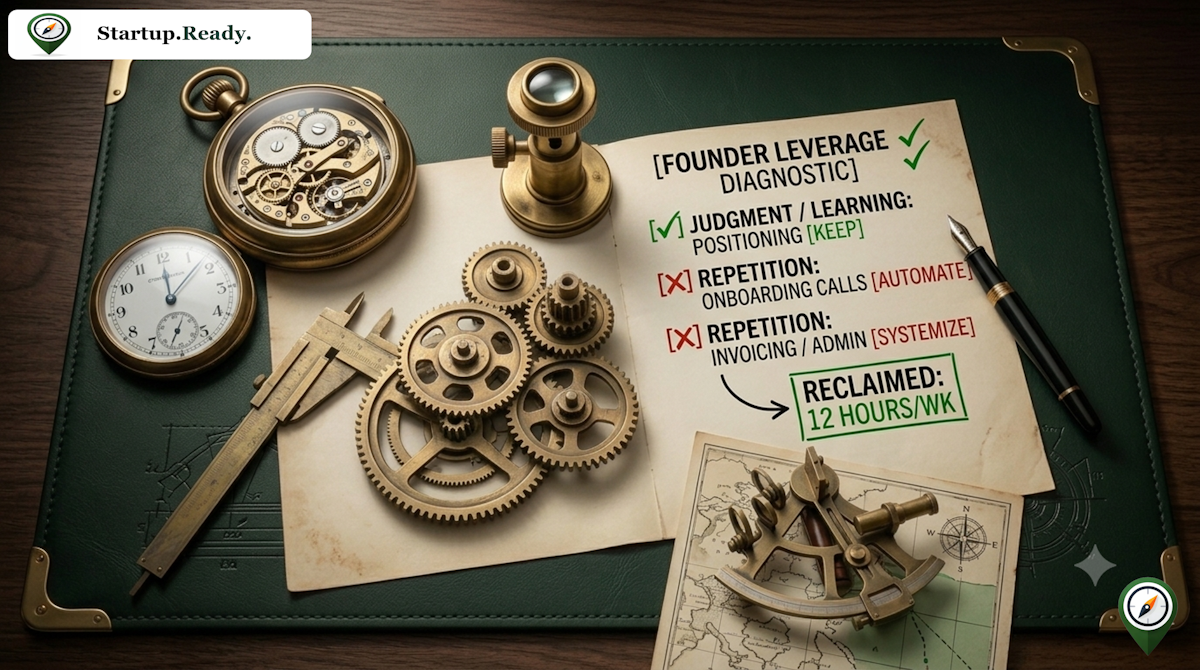
She does a two-week audit of where her time actually went, honestly, and the picture is clear the moment it is on paper. Twelve hours a week are going to customer onboarding, a warm, high-touch call she does personally with every new account, plus the follow-up. Another chunk goes to invoicing and scheduling admin. She is spending more than a third of her week on onboarding and paperwork, and almost none of it on the product direction and positioning that only she can set.
The onboarding is the tell, because it is the one she will defend hardest. She is genuinely great at it, customers love it, and it feels central. But run the real question at it: which parts of this need her specifically, and which only feel that way? One part is real and worth keeping, the moment she hears a new customer describe their problem in their own words and learns something she can use in the product. That is judgment and learning, and it stays. The rest, the standard walkthrough, the setup, the same questions in the same order every time, is repetition dressed as relationship. A strong onboarding video, a structured template, and one short personal check-in would protect the part that teaches her and cover the repetitive rest at a fraction of her hours. She was not irreplaceable on onboarding. Parts of it required her judgment, and the bulk of it required only her consistency, and she had been paying founder hours for both at the same rate.
Keep the Work That Is Teaching You
There is a critical exception to all of this, and skipping it turns leverage into a mistake. Some of the work that runs through you should stay there, not because it needs your judgment forever, but because it is teaching you something you cannot afford to stop learning. Early customer conversations, the first sales, the raw contact with how customers actually experience the problem: that work produces output and learning at the same time, and the learning is the part a founder must not delegate. Hand off your customer discovery to save the hours and you save the hours and lose the thing the hours were buying.
So before the leverage question, run a prior one. Is this task creating learning, or only creating repetition? Customer interviews create learning, so the founder owns them. Scheduling those interviews creates repetition, so automate it. Closing the first customers creates learning, so the founder owns that too. Sending the contracts afterward creates repetition, so systemize it. The line runs straight through many tasks, and it is the same line as the one in the onboarding call: keep the parts that require your judgment or teach you something, systemize the parts that require only your consistency.
This reframes what leverage is protecting. The goal is never to remove the founder from the customer relationship or from the work where understanding is still forming. It is to stop spending scarce founder hours on pure repetition, so more of those hours reach the judgment and the learning that only the founder can do.
The Leverage Question
One question turns a time audit into a decision.
For the task eating the most of your week, does it genuinely require you, or does it only feel that way because you are good at it?
Sit with the honest answer, because the reflex is to say everything requires you, and it almost never does. Most of what feels essential is essential to get done, not essential that you are the one doing it, and that gap is where all your leverage is hiding. If the honest answer is that the task needs you, keep it and look at the next-biggest one. If the honest answer is that it only feels that way, you have found the hours to reclaim, and the fix is one of three things: a tool that automates it, a template or system you build once and reuse, or a person who can do it well enough that the small loss in quality is dwarfed by what you do with the hours it returns.
The bar for handing off is not "someone can do it as well as me." At this stage, almost no one can, on almost anything, which is exactly the thinking that keeps you welded to the whole business. The real question is not whether someone else could do it better than you. It is whether your time is worth more somewhere else. That is opportunity cost, and it is the number founders never run, because they compare the handoff against their own quality instead of against what those hours could produce on the work only they can do. The bar is "someone or something can do it well enough that reclaiming these hours for that work is worth the tradeoff." Set the bar at as-good-as-me and you will never hand off anything. Set it at good-enough-and-worth-the-trade and the ceiling starts to lift.
Leverage Is Bigger Than Delegation
Handing off tasks is one kind of leverage, and it is the one to start with, but the concept is broader, and founders who think of leverage only as delegation miss most of it. Roughly, it comes in five forms.
Time leverage is getting hours back through automation, systems, and delegation, which is most of this article. Knowledge leverage is turning something you solved once into a reusable asset, a playbook, a template, a training doc, so you never solve it from scratch again. Technology leverage is letting software carry repeated effort, self-service onboarding, a customer portal, automation, increasingly the kind a capable tool can handle end to end. Capital leverage is spending money to buy back time through a contractor, a hire, or paid acquisition, which matters because some founders are bottlenecked not by a lack of options but by a refusal to spend.
The one founders miss most is distribution leverage, and it is often the biggest. A founder can work eighty hours a week and still lose if every new customer requires a fresh act of personal effort, because that is the bottleneck moved from operations to growth. Content that keeps working after you publish it, search that brings people to you, referrals, partnerships, a community that carries your word: these acquire customers without spending another founder hour each time. A business with distribution leverage grows on a different curve than one running on founder hustle, and building it is the same instinct as everything else here, more output without more of your hours.
The Hand-Off Decision
Everything above collapses into one short gate you can run on any task in about ten seconds. Three questions, and a task has to clear all three before it leaves your calendar.
Can a tool or another person do this at eighty percent of your quality? Not as well as you. Well enough. If nothing and no one can clear eighty percent, keep it for now.
Would the hours you reclaim produce more on the work only you can do? This is the opportunity-cost check. If the freed time would just refill with more of the same, the trade is not worth making yet.
Is this task repetition rather than active learning? If the work is still teaching you something real about your customer or your product, it stays, whatever the other two answers say. Learning is the veto.
If the answer to all three is yes, the task no longer belongs to you, and the move is not to schedule it for someday. It is to get it off your calendar this week, because the entire point of leverage is the hours it returns, and hours you plan to reclaim later are hours you are still spending now.
The One Sentence That Tells You Where You Stand
A founder with real leverage can complete this statement without hedging:
The task eating the most of my week that does not actually require me is [specific task], and I am replacing my effort there with [tool, template, or person] by [date].
That returns roughly [hours] a week, which I am redeploying into [the work only I can do].
A founder who is the bottleneck can name the time sink easily and stalls on the replacement, usually because they are still quietly convinced the task requires them. That conviction is the thing to test, not honor.
If you can name the replaceable work and where the freed hours go, you have found a structural lever, and structural levers raise ceilings that effort cannot. If every task still feels like it requires you personally, that feeling is the diagnosis rather than the truth, and the next move is to pick the single biggest time sink and prove to yourself, with one tool or one template, that the business survives you not doing it. Either outcome moves you forward.
Leverage and Your Founder Readiness
In the Startup Readiness Framework, Founder Readiness distinguishes a founder's capability from how that capability is deployed, because a strong founder can have capacity, skills, and motivation all in place and still be capped by running everything through themselves. High readiness with low leverage is a specific and common early flag, and it is deceptive, because the founder is doing excellent work and cannot understand why the excellent work has stopped producing growth.
Protecting the hours you free up so they actually reach the work that matters is the companion problem, covered in how to protect your time as a founder.
Founder Readiness is one of the six pillars in the framework. The Startup Readiness Assessment gives you a full-system diagnostic across all six in under twenty minutes.
Take your Startup Readiness Score free today at startupready.ai →
Keep Working on Your Founder Readiness
The Founder Pillar asks one question from many angles: can you, specifically, do the work this startup needs, and can you build the capacity you are missing? Each article below takes one piece of that question. Whether you are the right person to solve this particular problem. Where your real capacity gaps are, and whether they are gaps or just rates you have not run yet. What is draining your motivation, and whether the model is the cause. Which decision you keep making on repeat, and what would change it. Read them in any order. Each is a separate cut at the same pillar, and together they show you where your capacity holds and where it still has to be built.
More in the Founder pillar:
How to Find the Skills Gap That Is Slowing Your Startup Down
Why Startups Fail: The Founder Motivation Problem No One Talks About
How to Protect Your Time as a Founder Without Sacrificing Everything Else
A Skill Gap Is Not a Deficit. It Is a Rate.
A Mentor You Have Not Called in Six Months Is Not a Mentor
Your Network Is Not Gone. It Is in a Drawer.
You Are Not Losing Motivation. Your Model Is Draining It.
Your Startup Does Not Need More Goals. It Needs a Filter.
Your Constraints Are Not Obstacles. They Are Design Parameters.
Burnout Is Not Too Much Work. It Is Too Much Undirected Work.
Your Business Model Requires a Team You Do Not Have Yet
Before You Hire Someone, Try Deleting the Task
When You Are Missing the Skill and the Help, Fix One
You Do Not Make Bad Decisions. You Make the Same One Over and Over
Published
By Dr. Shaun P. Digan
Originally published on Startup.Ready.’s Startup Readiness: Validation, Framework, and Tools Blog at https://startupready.ai/startup-readiness/founder-leverage
Original Publication Date: July 21, 2026
Last Updated: August 4, 2026
About the Author
Dr. Shaun P. Digan is the founder of Startup.Ready and the creator of the Startup Readiness Framework, a research-based system for evaluating and validating early-stage startups before launch and early growth. He holds a PhD in Entrepreneurship from the University of Louisville and has spent over 15 years teaching, advising, and consulting with founders on startup strategy, validation, and growth.
In his writing, including the Startup Readiness Blog and The Foundations of Innovation Essay Series, he focuses on how founders can make better decisions by improving clarity, alignment, and readiness before scaling.