Some Buying Friction You Remove. Some You Listen To.
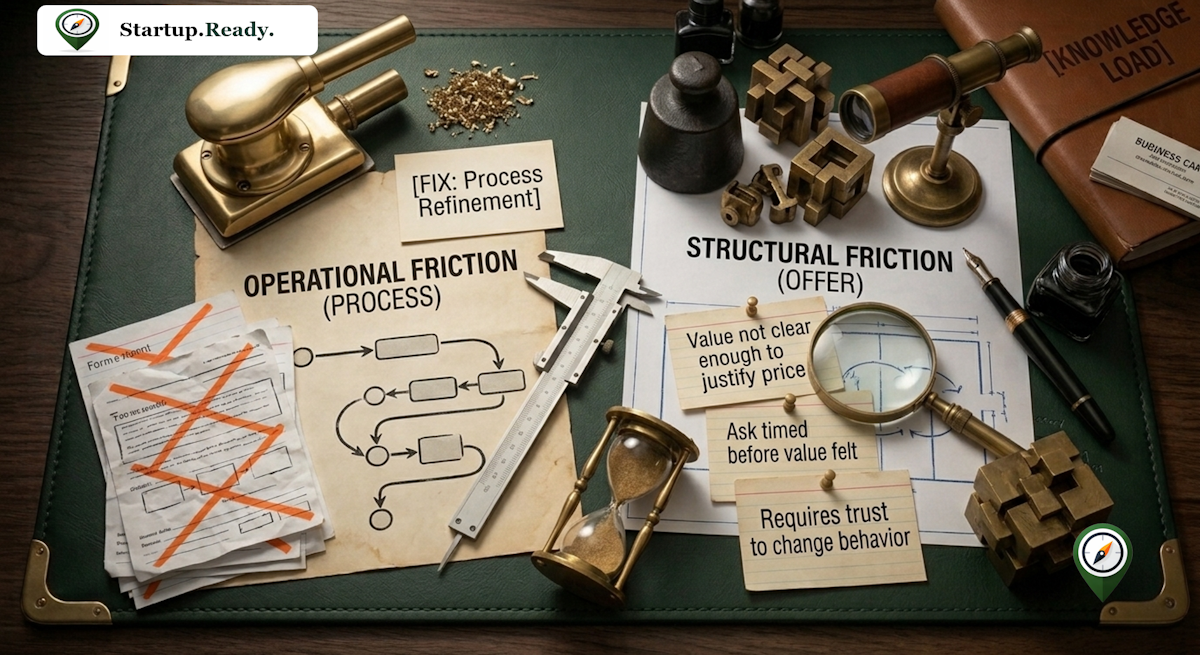
Every purchase has friction. A customer who wants what you sell still has to cross a pricing page, a payment step, an approval, a moment of doubt, and each is a place they can slow down or stop. The instinct is to sand all of it away and make buying as frictionless as possible. That instinct is half right, and the half it gets wrong is expensive.
Some friction is a flaw in your process, and removing it lifts conversion. Some friction is not a flaw at all. It is a signal, something about what it will actually take to earn a yes, telling you what the customer cannot quite say out loud. Sand that kind down and you have fixed nothing. You have muffled the one voice trying to tell you what is actually wrong.
The whole skill is telling the two apart, because from where you sit they look identical. A customer stalls. The stall alone does not reveal whether you built a clumsy checkout or aimed a good offer at the wrong moment. Guess wrong, and you pour work into smoothing a process while the real problem sits untouched, or worse, pour money into acquisition to push more customers into a funnel that was never going to convert them.
TL;DR: Operational Friction Lives in the Process. Structural Friction Is the Offer Talking. Don't Confuse Them.
Buying friction comes in two kinds. Operational friction lives in the process, a confusing pricing page or a premature payment step, and removing it improves conversion. Structural friction lives in what it takes to earn a yes, value, trust, authority, timing, switching cost, and no amount of process polish removes it, because it is a signal about the model itself. The work is to map where real customers actually stall, classify each friction point as operational or structural, and fix the process where you can while reading the structural friction as the diagnosis it is. Here is the move, in order:
Map the real purchase path from awareness to payment, from observation, not assumption
Mark where customers actually stall, slow down, defer, or go quiet
Classify each friction point as operational (in the process) or structural (in what has to be true before a customer can say yes)
Fix the operational, read the structural, because one is a process problem and the other is a message
Do not buy more traffic until the structural friction is named
Four signals you are misreading your friction:
You keep improving the demo, the onboarding, or the pricing page and conversion does not move
The friction you are fixing is one you assumed, not one you watched a customer hit
Customers stall at the same point for the same reason and you are treating it as a process problem
Your plan for weak conversion is more leads
If any of those describe you, this article shows you how to tell removable friction from friction that is trying to tell you something.
If You Found This Article by Searching for Something Else
Most founders who need this are not searching for "buying friction." They are searching for the stall.
Why do customers say yes then disappear.
How to improve my conversion rate.
Why do people abandon my checkout.
Why do demos not close.
How to reduce friction in my sales process.
All of them come back to one question. When a customer slows down, are you looking at a flaw in your process or a signal about your offer? This article shows you how to tell, and what to do with each.
The Friction You Assumed Is Rarely the Friction They Hit
Before classifying friction, you have to be looking at the real friction, and most founders are not. They map the purchase path in their head, decide where customers probably hesitate, and go fix that. The friction they imagine is reasonable and often wrong, because the place a plan looks weakest is rarely the place a real person actually stops.
The correction is the same one that runs through all of this work: watch, do not guess. The evidence is already sitting in your last five conversations that did not convert. At what specific point did each one slow down or stop? If you can answer that from memory, in the customer's own words, you have a friction map. If the answer is different for every conversation, or you are reconstructing it from what seems likely, the friction has not been mapped yet, and every fix you make is aimed at a guess. Assumed friction and observed friction are different things, and only one of them is worth intervening on.
Two Kinds of Friction
Once you are looking at real friction, every point on the map is one of two kinds, and the difference decides what you should do about it.

Operational friction is a process defect. It slows the customer without saying anything deeper about whether they want the thing. A checkout that asks for a credit card before showing value, a contract that demands legal review for a small purchase, an onboarding step that stands between the customer and the outcome they came for. Remove it and conversion rises, cleanly, because the customer wanted to move and something in the way was stopping them.
Structural friction is a message. It does not live in the process, so improving the process does not touch it. It lives in the conditions that have to be true before a customer will say yes. Does the value justify the price? Is the person hesitating the one with the authority to commit? Has enough trust been built to take the risk? Is the outcome worth changing how they already work? The customer hesitates because one of those conditions is not yet met, and not one of them is a step in your funnel. This is also why structural friction survives every process improvement you throw at it. A smoother process serves a customer who wants to move faster. It does nothing for a customer who wants to be more certain, and structural friction is always about certainty, not speed. You can make the checkout gorgeous and the onboarding effortless, and they will still stall, because the friction was never in the checkout. Smooth it over and you have not removed the objection. You have just made it harder to hear.
Not All Operational Friction Is Bad
One exception to "remove operational friction" deserves its own line, because it is a real nuance, not a footnote. Removing friction is right in one context and wrong in another. For a low-price, self-serve product, smoothing every step is almost always correct: friction between the customer and the purchase is pure loss. For a high-touch, high-value sale, some operational friction is deliberate and useful. A ten-question intake form or a manual review before a demo is friction on purpose, a filter that screens out low-intent leads and protects a sales team's limited hours. Strip it away and conversion does not rise; the pipeline fills with unqualified leads and the win rate downstream drops.
So operational friction gets one more question before you sand it down: is it costing you customers, or qualifying them? Remove the friction that blocks good-fit buyers. Keep the friction that screens out bad-fit ones.
The Most Expensive Mistake Is Buying More Traffic
There is one response to weak conversion that costs more than any other, and it is the most common: pour money into acquisition. Conversion is low, so the founder reasons that more leads will produce more customers, and turns up the spend.
If the friction slowing customers is structural, this sets money on fire. More traffic into a funnel with a structural block does not convert better. It fails at the same rate, on more people, at higher cost, and it hides the failure inside a bigger top-of-funnel number that looks like progress. The founder ends up with rising spend, flat conversion, and a diagnosis that gets more expensive by the week, because every new lead is another data point confirming a problem they have not named. Naming the structural friction first is not a delay before scaling acquisition. It is the thing that determines whether scaling acquisition does anything at all. This is the same logic as testing the weakest link before building past it, covered in validating your acquisition system: volume amplifies a working funnel and bankrupts a broken one.
What Structural Friction Is Trying to Tell You
Structural friction is worth reading closely, because the specific way a customer stalls points at a specific problem in the model, and each one has its own repair, none of which is a smoother process.
They stall on the price, not the amount but the sense of it → the value is not clear enough to justify the number → the work of naming the value exchange.
They go quiet after the ask, before they had felt the product work → the ask is mistimed → why "let me think about it" is a timing problem.
They have to sell it internally, to a boss, procurement, or security who was never in the room → the ask is aimed past the person's authority, or your champion wants to buy and cannot sell it upward → get the decision-maker in earlier, or equip your champion to make the case without you.
Saying yes means changing how they work, or trusting this won't be another tool that overpromised → the friction is behavioral or trust → de-risk the decision rather than streamline it.
Value, timing, stakeholder, behavioral change, trust, plain uncertainty: each is the model telling you where it is not yet ready to be sold, and each sends you back to fix the thing itself rather than the path to it.
Stakeholder friction especially is often misread as an offer problem when it is really an enablement gap. Your champion may be fully sold and simply unable to sell it onward, with no business case to carry into procurement or security. That calls for enablement, not a new offer: hand your champion the specific collateral that makes your argument in the rooms you will never enter, the numbers, the security answers, the one-page case a busy executive can approve. Sometimes the fix for a structural stall is not changing what you sell but arming the person already trying to buy it.
The Restaurant Tool That Kept Getting Cheaper for No Reason
Take a founder with an inventory tool for independent restaurants. Demos went well, owners nodded along, saw the waste it would catch, said some version of "yeah, I like this." Then they went quiet, for weeks, and the deal died. The silence tended to fall right after the pricing conversation, so price was the obvious suspect, and she did the operational thing: simplified the pricing page, then added a discount, then a longer free trial. Conversion did not move a point.
She had misclassified the friction. She went back through her last several stalled conversations and listened for where they actually broke, and it was not the price. Owner after owner circled the same worry in different words: "the last system we tried was supposed to save time and just made more work," "I don't have someone to babysit another rollout." That is not operational friction. No pricing page fixes it. It is structural, and specifically it is trust and risk: restaurant owners running on thin margins and long hours had been burned before, and the ask arrived before they believed this would not burn them again. A cheaper price actually made it worse, reading as one more too-good-to-be-true promise from software.
So she stopped smoothing the process and changed the offer to answer the real friction. Done-for-you setup, so adopting it added no work. A first month where she personally guaranteed the waste it caught would exceed what they paid, or they walked. She was not reducing friction. She was answering it, speaking to the exact fear the stall had been pointing at the whole time. Conversion moved, not because buying got easier, but because the thing standing in the way finally got addressed instead of sanded down.
The One Sentence That Tells You Where You Stand
A founder who has mapped their friction can complete this statement concretely:
The friction most worth addressing is [specific friction, observed in real conversations], it is [operational or structural], and I am [the specific fix: a process change, or a change to the offer, price, timing, or trust it takes to say yes], which I expect to move [specific conversion behavior].
A founder who has not will describe conversion as generally weak and reach for a process fix or more leads, because the friction was never mapped closely enough to know which kind it is. That stall is the diagnosis. It is usually the reason months of tuning the funnel and buying traffic never moved the number.
If you can name where real customers stall and whether the friction is in your process or your model, you know exactly what to fix and what not to waste effort on. If you cannot, that is not a reason to smooth another step or buy another batch of leads. It is the signal to walk your last five stalled deals, find the exact point each one stopped, and ask of each whether a better process would have saved it. The ones a better process would not have saved are the ones worth listening to. They are your business model, trying to tell you something.
Buying Friction and Your Go-to-Market Clarity
In the Startup Readiness Framework, Go-to-Market Clarity treats a purchase path built on assumed friction as a common early flag, because the friction a founder imagines is rarely the friction real customers hit, and the wrong fix costs both effort and conversion. Structural friction in particular is the point where go-to-market hands the problem back to the business model.
That handoff is deliberate. Structural friction on price is the value exchange. Structural friction on timing is the payment-timing problem. And the discipline of reading real behavior instead of assumed behavior runs through reconstructing what customers actually did and auditing the assumptions your plan rests on.
Go-to-Market Clarity is one of six pillars in the Startup Readiness Framework. If your go-to-market understanding is strong, the next question is whether the rest of your startup is as ready as your evidence.
The Startup Readiness Assessment gives you a full-system diagnostic across all six pillars in under twenty minutes.
Take your Startup Readiness Score free today at startupready.ai →
Keep Working on the Go-to-Market Pillar
The Go-to-Market Pillar asks one question from many angles: can you reliably move a stranger to a paying customer, with a message that lands and a channel that fits? Each article below takes one piece of that question. Whether your message creates urgency or only agreement. Whether you picked the channel your customer is actually in, rather than the one convenient to you. Whether you can walk one real person all the way from stranger to paid. Which assumption your whole plan is quietly resting on. Read them in any order. Each is a separate cut at the same pillar, and together they show you where your path to customers is repeatable and where it still runs on hope.
More in the Go-to-Market pillar:
Customer Encounter Design: How to Reach Your First Customers at the Right Moment
How Early-Stage Startups Build a Scalable Customer Acquisition System
A Funnel That Works on Paper Has Never Met a Customer
Agreement Is Not Urgency: Why Customers Say Yes and Never Buy
You Don't Have a Channel Problem. You Have a Channel Selection Problem.
Stop Asking Customers Where They'd Look. Ask Where They Went.
Can You Walk One Person From Stranger to Paying Customer?
Getting Your First Customers and Having a Repeatable Path Are Two Different Things
Your Go-to-Market Plan Is a Stack of Assumptions. One of Them Is Load-Bearing.
The Most Dangerous Response to Your Message Is "That's Interesting."
A Great Message in the Wrong Channel Reads Like Spam.
Published
By Dr. Shaun P. Digan
Originally Published on Startup.Ready.’s Startup Readiness: Validation, Framework, and Tools Blog at https://startupready.ai/startup-readiness/understanding-buying-friction
Original Publication Date: August 5, 2026
Last Updated: August 5, 2026
About the Author
Dr. Shaun P. Digan is the founder of Startup.Ready and the creator of the Startup Readiness Framework, a research-based system for evaluating and validating early-stage startups before launch and early growth. He holds a PhD in Entrepreneurship from the University of Louisville and has spent over 15 years teaching, advising, and consulting with founders on startup strategy, validation, and growth.
In his writing, including the Startup Readiness Blog and The Foundations of Innovation Essay Series, he focuses on how founders can make better decisions by improving clarity, alignment, and readiness before scaling.