Your Go-to-Market Plan Is a Stack of Assumptions. One of Them Is Load-Bearing.
Every go-to-market plan is built on assumptions. That is not a flaw, it is the starting condition, because at the early stage you cannot know most of what the plan depends on. The danger is not that the assumptions exist. It is that some of them have quietly stopped feeling like assumptions.
A belief you have held long enough starts to read as a fact. The customer has budget. They are actively looking. This channel reaches them. Each of those began as a guess, and somewhere along the way it hardened into a premise you build on without noticing you are building on it. The plan looks coherent because every piece rests on the piece beneath it, and the piece at the bottom is a guess you have stopped seeing.
That bottom guess is the one to find. Not every assumption matters equally. Most can be wrong and the plan bends to absorb it. A few are load-bearing: if one of them is wrong, the whole plan comes down at once, and you find out months and dollars later. This is an audit for locating those before they locate you.
TL;DR: Find the Assumption That, If Wrong, Takes the Whole Plan Down. Test That One First.
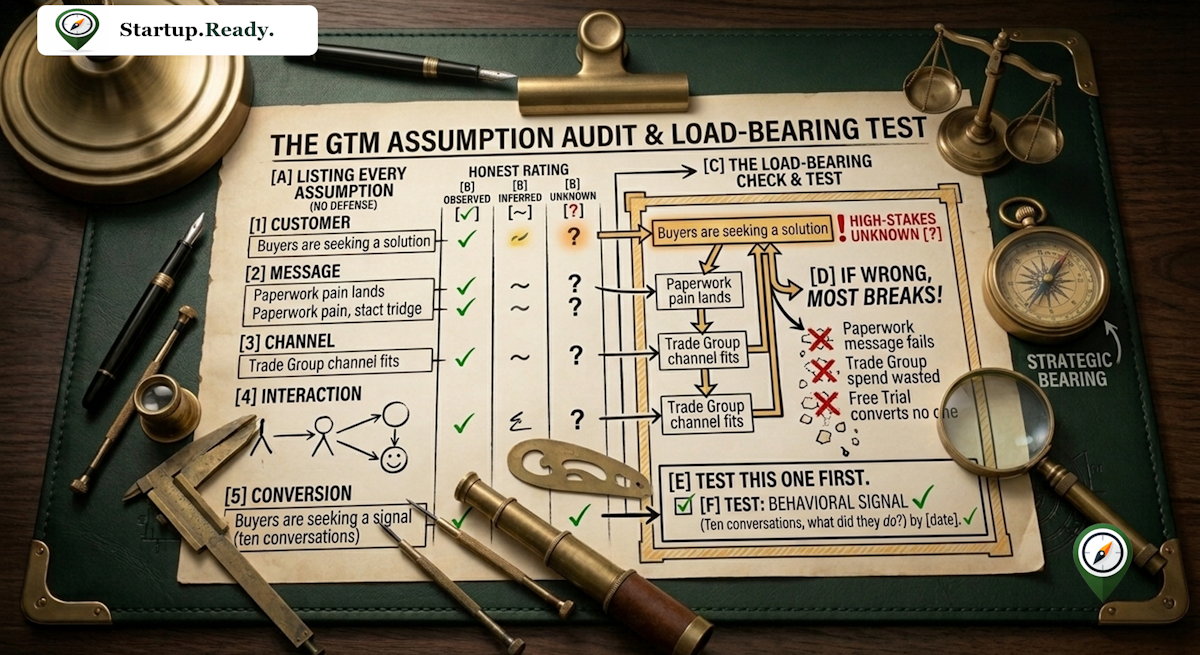
A go-to-market plan is a stack of beliefs about customer, message, channel, first interaction, and conversion. Some are observed, some inferred, and some pure unknowns wearing the confidence of facts. The work is to surface every assumption, mark which kind each one is, find the load-bearing ones whose failure collapses everything downstream, and test the highest-stakes unknown before investing further. Here is the move, in order:
List every assumption across customer, message, channel, first interaction, and conversion, without defending any of them
Rate each one observed, inferred, or unknown, honestly
Find the load-bearing ones, where "if this is wrong, what breaks?" answers "most of it"
Pick the highest-stakes unknown, the assumption that is both load-bearing and untested
Test that one, with a behavioral signal, before you build anything else on top of it
Four signals your plan is running on unexamined assumptions:
If your three most important beliefs turned out wrong, "everything would change"
You can state your plan fluently but cannot name which belief it depends on most
Most of what the plan requires, you have not actually seen happen
You find yourself defending an assumption you have never tested
If any of those describe you, this article shows you how to find the load-bearing assumption and test it before it fails on its own schedule.
If You Found This Article by Searching for Something Else
Most founders who need this are not searching for "GTM assumption audit." They are searching for the unease.
Why did my go-to-market plan not work.
How to validate a go-to-market strategy.
Why are my customer acquisition assumptions wrong.
How to de-risk a startup launch.
What to test before scaling marketing.
All of them come back to one question. Which belief is your entire go-to-market resting on, and have you ever actually seen it be true? This article shows you how to find that belief and test it first.
A Defended Assumption Is a Bias, Not a Hypothesis
The audit only works if you can tell the truth about what you have actually seen, and that turns out to be the hard part, because founders instinctively defend their assumptions the moment they name them. You write down "customers are actively looking for this," and before the ink dries you are explaining why it must be true. That reflex is the enemy of the exercise.
Defending an assumption is not the problem by itself, because a hypothesis can be argued for too. The difference is what you do when the evidence pushes back. A hypothesis changes when the evidence changes. A bias explains the evidence away. One goes looking for the test that could prove it wrong; the other reaches for reasons the test does not count. The tell is emotional: a hypothesis is something you are curious about, a bias is something you are attached to. When naming an assumption makes you want to protect it from a test rather than run one, you have found one that has hardened, and hardened assumptions are exactly where the load-bearing risk hides, because you stopped questioning them long ago.
So list them flat, with no defense attached. The goal is not to decide which assumptions are right. It is to see them clearly enough to sort, and you cannot sort what you are busy protecting.
Observed, Inferred, Unknown
Once the assumptions are listed, each one is really a claim about evidence, and there are only three honest ratings. Sorting them is where the plan's real condition becomes visible.
Observed means you have directly seen this in customer behavior. Not reasoned toward it, not heard something adjacent to it. Watched it happen: five customers actually paid. Inferred means you have indirect support, a logical case, adjacent data, a pattern from a similar market, but you have not seen this specific thing be true: similar companies charge this price, so ours should hold. Unknown means you have no meaningful evidence either way, and the assumption exists purely because the plan needs it to: buyers will switch from the workflow they already use. That last category is the one founders undercount, because an unknown the plan requires feels, from the inside, a lot like something you know.
Then count. If unknowns dominate the list, you do not have a plan grounded in evidence. You have a hypothesis about a path no one has walked, drawn confidently enough to look like a map. That is not a failure, it is the normal early state, but it is worth seeing plainly, because the count tells you how much of your plan is currently faith. The categories that fill up with unknowns also tell you where you are weakest: unknowns clustered in channel point one direction, unknowns clustered in conversion point another.
The five categories are worth walking deliberately, because each maps to a different kind of question the rest of this work goes deeper on. Assumptions about the customer and how urgently they feel the problem. Assumptions about the message, whether it earns recognition and whether it makes inaction feel costly. Assumptions about the channel, whether the customer is there when the problem is live. Assumptions about the first interaction, whether the encounter is built for where the customer actually is. Assumptions about conversion, whether they will pay at the price and moment you are counting on. A plan can be solid in four and hollow in the fifth, and the hollow one is where it will break.
Load-Bearing Is Not the Same as Important
Here is the distinction the whole audit turns on. An important assumption is one that matters. A load-bearing assumption is one that everything else is standing on, so that if it fails, it does not fail alone. Those are not the same, and founders test the wrong one constantly, because the important assumptions are the ones on their mind and the load-bearing ones are the ones they forgot were assumptions at all.
The test is a single question asked of each assumption: if this is wrong, what else breaks? Most answers are local. If the price is a little high, you adjust the price. But a few answers are catastrophic. If your customer does not actually have the authority to buy, then the channel that reaches them, the message that moves them, and the conversion step designed for them all fail at once, because they were all built to reach a decision-maker who turns out not to be one. That assumption was holding up the entire structure, and its failure is not a dent. It is a collapse.
The reason one assumption can take down five is that a go-to-market is a dependency chain, each stage resting on the one above it:
Customer has authority to buy ↓ Customer feels the problem ↓ The right channel reaches them ↓ The message moves them ↓ The offer converts them
A wrong assumption high in the chain invalidates everything beneath it, no matter how well the lower stages are built. A perfect message and a perfect offer aimed at someone who cannot buy convert no one. This is also why load-bearing is about impact, not likelihood. A load-bearing assumption can be quite likely to be true; what makes it dangerous is the size of the collapse if it is not, and its position high in the chain is what determines that size. You are not hunting for the assumption most likely to fail. You are hunting for the one that is most expensive if it does.
One more sort sharpens the ranking. Some assumptions are strategic: if they are wrong, the business model itself has to change. The buyer has budget and authority. The customer feels this problem acutely. Others are tactical: if they are wrong, you adjust the mechanics and keep going. Cold email converts at three percent. This subject line beats that one. Both can be load-bearing in the narrow sense that a lot rests on them, but they fail differently. A wrong strategic assumption is a pivot. A wrong tactical one is a Tuesday. When you decide what to test first, weight the strategic foundation above the tactical mechanics, because the mechanics are cheap to change and the foundation is the thing the whole company is standing on.
Find the assumptions whose failure answers "most of it" or "everything downstream." Those are load-bearing. Then apply one more filter, because even among load-bearing assumptions, one is usually the most expensive to be wrong about. That intersection, the assumption that is both load-bearing and still unknown, is where the audit has been pointing the whole time. It is the single belief most capable of sinking the plan that you have the least evidence for. Test that one first. Not the comfortable one, not the one nearest to hand. The one the most depends on.
The Agent Tool Built on a Buried Assumption
Take a founder building a client-management tool for independent insurance agents. Her plan was detailed and coherent: reach agents through a specific set of trade groups, a message about the hours they lose to paperwork, a free trial that converts to a monthly subscription. Every stage connected. She was ready to spend on all of it.
List the assumptions flat and one sits underneath everything, unexamined. The whole plan assumes independent agents can freely adopt a new tool. But many agents operate inside a parent agency whose technology stack is chosen for them, and cannot simply add software on their own. She had never marked that as an assumption, because from where she sat it was obviously true, agents are independent, it is in the name. Rated honestly, it was unknown. She had never watched an agent actually adopt a tool outside their agency's stack. And it was load-bearing to the point of absurdity: if agents cannot choose their own tools, then the trade-group channel reaches people who cannot buy, the paperwork message moves people who cannot act, and the free trial converts no one, because the person feeling the pain is not the person holding the decision. One buried assumption, and the entire coherent plan was resting on it.
So that is the one she tested first, ahead of any spend. Not a campaign. Ten conversations with independent agents, one question underneath them: the last time you adopted a new tool, could you just do it, or did someone above you decide? Notice the shape of that question. She did not ask whether agents can choose their own tools, which invites an optimistic opinion. She asked what they actually did the last time, which surfaces a behavior. Test the dependency, not the belief about it. The answer would either confirm the foundation and free her to build, or reveal in an afternoon that the plan needed a different buyer entirely. Either way, she learned the most important thing in her go-to-market before investing a dollar in a structure that might have had nothing under it.
One caution before you act on a result like hers. A test can fail for two very different reasons: the assumption was wrong, or the test was. A leading question, the wrong five people, a hypothetical where you needed a behavior, and you get a clean-looking "no" that disproves nothing except your own test design. A false negative that kills a viable plan costs as much as the false confidence you ran the test to escape. So before you abandon a load-bearing assumption on a negative result, make sure the test actually put it at risk: real people who match, a past behavior rather than an opinion, and a signal you defined before you started. A negative result is only as trustworthy as the test that produced it.
The One Sentence That Tells You Where You Stand
A founder who has run the audit can complete this statement concretely:
The most load-bearing unvalidated assumption in my plan is [specific assumption], if it is wrong then [what collapses] all fail at once, and the test I am running before I build further is [specific behavioral test] by [specific date].
A founder who has not will describe a fluent, connected plan and stall on which single belief it depends on most, because the load-bearing assumption stopped looking like an assumption long ago. That stall is the diagnosis. It is usually the reason a plan that made complete sense on paper failed in a way no one could trace.
If you can name the belief holding up your plan and the test that would confirm it, you have one thing worth doing this week that is worth more than any amount of execution on an untested foundation. If you cannot, that is not a reason to start building faster. It is the signal to lay every assumption out flat, mark honestly which ones you have actually seen, find the one that is both holding up the structure and still a guess, and go see whether it is true. The plan does not need more confidence. It needs one load-bearing guess turned into a fact.
The Assumption Audit and Your Go-to-Market Clarity
In the Startup Readiness Framework, Go-to-Market Clarity treats an untested plan as the most serious early flag, not because the plan is wrong but because no one yet knows which part of it is. A go-to-market built entirely on assumption looks identical to one built on evidence, right up until it is executed, which is the most expensive moment to find out.
This audit sits over the whole go-to-market, and each category it surfaces has its own deeper work: the message assumptions in making the customer recognize themselves, the channel assumptions in choosing your channel by fit, the first-interaction assumptions in designing the customer encounter, and the stage-by-stage confirmation in validating your acquisition system.
Go-to-Market Clarity is one of six pillars in the Startup Readiness Framework. If your go-to-market understanding is strong, the next question is whether the rest of your startup is as ready as your evidence.
The Startup Readiness Assessment gives you a full-system diagnostic across all six pillars in under twenty minutes.
Take your Startup Readiness Score free today at startupready.ai →
Keep Working on the Go-to-Market Pillar
The Go-to-Market Pillar asks one question from many angles: can you reliably move a stranger to a paying customer, with a message that lands and a channel that fits? Each article below takes one piece of that question. Whether your message creates urgency or only agreement. Whether you picked the channel your customer is actually in, rather than the one convenient to you. Whether you can walk one real person all the way from stranger to paid. Which assumption your whole plan is quietly resting on. Read them in any order. Each is a separate cut at the same pillar, and together they show you where your path to customers is repeatable and where it still runs on hope.
More in the Go-to-Market pillar:
Customer Encounter Design: How to Reach Your First Customers at the Right Moment
How Early-Stage Startups Build a Scalable Customer Acquisition System
A Funnel That Works on Paper Has Never Met a Customer
Agreement Is Not Urgency: Why Customers Say Yes and Never Buy
The Customer Won't Translate Your Message
You Don't Have a Channel Problem. You Have a Channel Selection Problem.
Stop Asking Customers Where They'd Look. Ask Where They Went.
Some Buying Friction You Remove. Some You Listen To.
Can You Walk One Person From Stranger to Paying Customer?
Getting Your First Customers and Having a Repeatable Path Are Two Different Things
The Most Dangerous Response to Your Message Is "That's Interesting."
A Great Message in the Wrong Channel Reads Like Spam.
Published
By Dr. Shaun P. Digan
Originally Published on Startup.Ready.’s Startup Readiness: Validation, Framework, and Tools Blog at https://startupready.ai/startup-readiness/gtm-assumption-audit
Original Publication Date: August 6, 2026
Last Updated: August 6, 2026
About the Author
Dr. Shaun P. Digan is the founder of Startup.Ready and the creator of the Startup Readiness Framework, a research-based system for evaluating and validating early-stage startups before launch and early growth. He holds a PhD in Entrepreneurship from the University of Louisville and has spent over 15 years teaching, advising, and consulting with founders on startup strategy, validation, and growth.
In his writing, including the Startup Readiness Blog and The Foundations of Innovation Essay Series, he focuses on how founders can make better decisions by improving clarity, alignment, and readiness before scaling.