Stop Asking Customers Where They'd Look. Ask Where They Went.
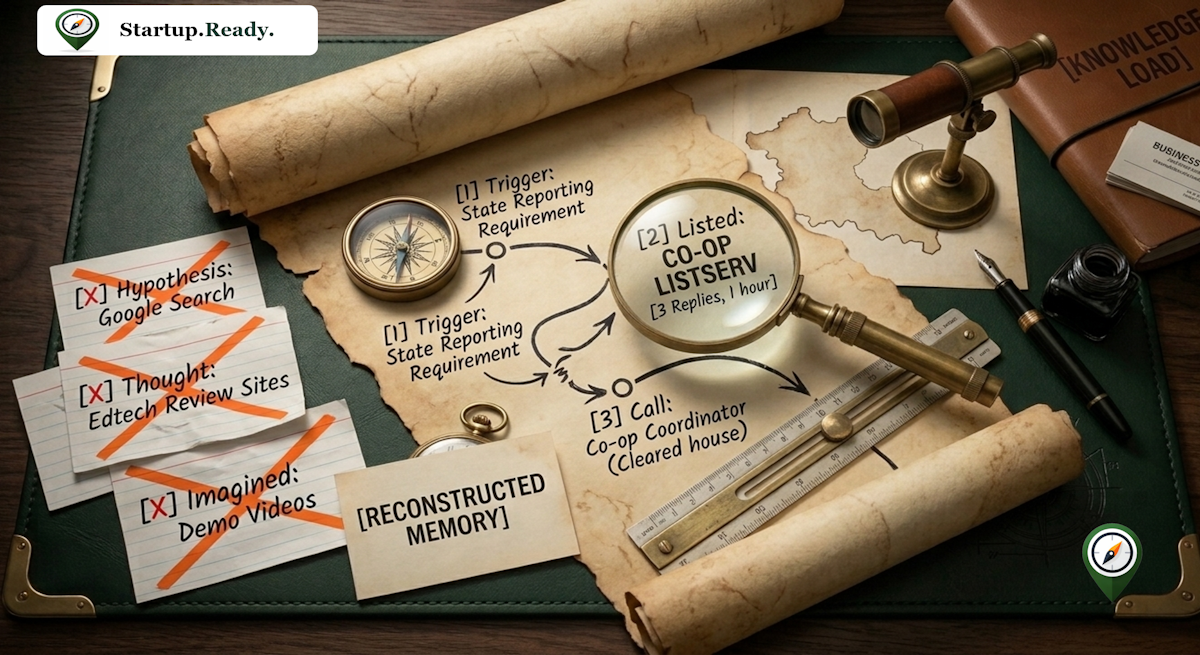
You cannot usefully ask a customer where they will look for your product. The moment you ask a person to predict their own behavior, they hand you their idealized self: the organized one who researches carefully, compares options, chooses well. That person is not the one who will actually go looking when the problem hits.
So stop asking them to predict. Ask them to remember. The last time they needed something like what you sell, they already ran the search, and the route they took is sitting in their memory, specific and real. Your job is not to forecast where customers will go. It is to reconstruct where they already went.
That one shift, from prediction to memory, is the whole game. It separates channel research that produces a real answer from channel research that produces a tidy, plausible, wrong one. What to do with the channels the search reveals, how to score and choose among them, is a separate job covered in choosing your channel by fit. This article is about the step before that: getting evidence you can trust about where your customer actually looks.
TL;DR: Don't Ask Where Customers Would Look. Reconstruct Where They Already Did.
Stated intent is a customer predicting themselves, and people predict an idealized version that rarely matches what they do. Memory is different: the last real search a customer ran actually happened, and walking them back through it, in order, surfaces the specific channels, people, and terms they used. Memory is imperfect too, but it is anchored to a real event rather than an imagined future. Here is the move, in order:
Reject the hypothetical. "Where would you look" gets an aspiration; "where did you look" gets a fact
Anchor on one real event, the last time they actually searched, not their theory of how they search
Walk it chronologically, because order pulls back detail that a summary flattens
Capture the specifics, exact platforms, communities, terms, and names, not tidy categories
Read what appeared and what didn't, because the channel you expected and never heard is itself the finding
Four signals you are guessing instead of remembering:
Your channel plan describes where you would look, not where a customer told you they looked
The evidence behind it is a hypothetical answer, "I'd probably Google it," never a real search
You cannot name the exact first move your last customer made when the problem hit
Your channels underperform and you have no behavioral reason why
If any of those describe you, this article shows you how to trade the guess for a memory.
If You Found This Article by Searching for Something Else
Most founders who need this are not searching for "customer search behavior." They are searching for the uncertainty.
Where do my customers find products like mine.
How to do customer discovery for marketing.
Why are my channels not working.
How do customers actually search for solutions.
What questions to ask in customer interviews.
All of them come back to one thing. You are building channels on a guess about where your customer looks, and you have never asked anyone who actually looked. This article shows you how to get that evidence in a few short conversations.
You Are Reconstructing Memory, Not Predicting Behavior
Two questions sound almost identical and are not remotely the same. "Where would you look for a tool like this?" and "Where did you look last time you needed one?" One asks for a forecast. The other asks for a record. Only the record is worth anything, and understanding why protects you from trusting the forecast.
When a person answers the hypothetical, they are predicting their own future behavior, and people are bad at it in a specific, consistent direction. They imagine the disciplined version of themselves. They tell you they would search methodically and compare options on a review site, and they believe it, because that is who they intend to be. They are not lying. They are describing an aspiration. Then the real moment arrives, messy and rushed, and they text a colleague who already solved it, because it is faster and they trust her, and the tidy answer they gave you never happens.
When the same person recalls what they actually did, they are not predicting anything. They are retrieving an event that already occurred, with a real trigger, a real first move, a real sequence. Memory is not a perfect recording, and it should not be treated as one. It is reconstructive. It drops detail and edits as it goes. But it is anchored to something that actually happened, which a forecast of future behavior never is, and imperfect evidence about a real event beats confident invention about an imagined one. Prediction imagines. Memory reconstructs. Build your channel strategy on the one tethered to something that occurred.
This is really a lesson about customer discovery, not just channels. Founders reach for hypothetical questions everywhere, would you use this, would you pay for that, because they are easy to ask and pleasant to answer. They produce agreement and almost no evidence. A behavioral question, what did you actually do the last time, is harder to ask and worth far more, because it trades a comfortable prediction for an uncomfortable fact.
Walk the Search in Order
Memory does not give up its detail on demand. Ask someone to summarize how they found a tool and you get a flattened headline, "I think I just Googled it," that skips the three steps that actually mattered. Ask them to walk the event in sequence and the detail comes back. This is not a quirk. Investigators who interview witnesses learned it long ago: reconstruct an experience in order, from the start, and specifics surface that a summary erases.
So the conversation is a reconstruction, not a survey, and it is short. Ten to fifteen minutes, one real search, walked start to finish. Anchor the moment first: what was happening when they decided they needed something, and what made them start looking right then? The trigger sets the scene, and where a person looks is bound up with what pushed them to look. Then move through the path in order. What did they do first, and where did they go first? Then what? Did they ask anyone, and who exactly? Did they search, and what words did they type? A community, a group, a review site? How did they finally decide? Follow the story instead of marching through a checklist, and keep them in sequence, because the sequence is what does the retrieving.
Then capture the specifics while they are fresh, in the customer's detail rather than your summary. Not "they searched online," but the exact phrase. Not "they asked a peer," but who, in what group, and why that person. The entire value of the exercise lives in that grain. "They used LinkedIn" tells you nothing you can act on. "They posted in a 4,000-member Slack for operations leads and had three replies in an hour" tells you exactly where to stand. Record and transcribe if you can, because your memory will smooth out precisely the detail you came for.
The Absence Is the Finding
The instinct is to hunt for the channel that shows up across the conversations, and that matters. The channel that appears in all three is a far better bet than anything you were assuming, because it came from behavior instead of imagination. But the sharper insight usually hides in what is missing.
You have been building toward a channel, pouring months into it, and across three real searches not one person mentioned it. That silence is not noise to explain away. The absence is the finding. It is the exercise telling you, before you spend the next quarter, that your customer does not pass through that channel when the problem is live. Founders learn as much from the channel that never appeared as from the one that did, and the never-appeared one is usually the channel they were most committed to, which is exactly why the silence is worth more than the confirmation. A confirmed guess buys confidence. A disconfirmed one buys back a quarter.
When Three Conversations Are Enough, and When They Aren't
Three is not a magic number. It is enough for a specific job under specific conditions, and it is worth being honest about both.
Three matching conversations are enough to surface an initial pattern and to kill an obviously wrong assumption, when your customer is a reasonably defined, homogeneous role and the buying decision sits with one person. A narrow B2B niche, one job title, one clear moment of need: three searches will rhyme, and the pattern they show is trustworthy enough to redirect effort. That is the common early-stage case, and three conversations that take an afternoon can save a quarter.
Three is not enough when the market is fragmented or the decision is shared. A consumer product with many distinct buyer types, a regulated purchase in healthcare, a committee-driven enterprise deal, a Fortune 100 procurement process with six people touching it: there the search is run by different people in different ways, and three conversations catch a sliver. Treat three as a hypothesis to widen, not a verdict to bet on. The rule is simple. Scale the number of conversations to how varied your buyer is and how many people touch the decision. Three homogeneous searches are a signal. Three searches across a scattered market are an anecdote.
The Coordinator Who Was Never on Google
Take a founder selling an assessment tool to special-education coordinators in public school districts. His channel plan assumed the obvious: coordinators search for edtech tools, compare them on review sites, maybe watch a demo video. So he was spending on search ranking and a review-site listing, getting almost nothing, and unable to say why.
He ran three "where did you look" conversations with coordinators who had adopted a tool in the last year, and walked each through the last real search. Not one started at Google. The trigger was always the same, a new state reporting requirement or a parent complaint that exposed a gap, and the first move was never a search bar. One posted to a state special-education directors' listserv and got six replies by end of day. One called the coordinator at her regional education co-op, the person everyone in her area treats as the clearinghouse. One had seen the tool demoed in a breakout session at the annual state conference and kept the handout. Three coordinators, three institutional, relationship-driven paths, and search appeared only at the very end, to look up a name someone had already given them.
The absence was the finding. He had built his entire channel plan on the one step his customers took last, and ignored the listserv, the co-op coordinator, and the conference where the decision actually formed. Three conversations, one afternoon, and a quarter of misdirected spend caught before it went out. He treated the pattern as a strong hypothesis rather than proof, because coordinators across a whole state are varied enough to warrant a few more conversations before betting big, and widened from there.
The One Sentence That Tells You Where You Stand
A founder who has done this can complete this statement concretely:
The last time three matching customers went looking, the path they actually took ran through [specific channel or person], the channel I was building toward that never appeared was [specific channel], and the change I am making is [specific change] by [specific date].
A founder who has not will describe where they assume customers look and stall on naming one customer they actually asked, because the plan was built from the founder's habits rather than the customer's memory. That stall is the diagnosis. It is usually the reason a channel that made sense on paper returns a response rate no one can explain.
The fix is not to think harder about where your customer probably looks. It is to find people who match, walk each through the last time they actually went searching, and write down exactly where they went, in order, including the places you were sure you would hear and did not. The route is already recorded in the memory of people who ran it. You only have to ask them to retrace it.
And the principle reaches well past channels. When observed behavior and stated intention disagree, trust the behavior. It holds for pricing, for positioning, for onboarding, for what to build next, anywhere a founder is tempted to ask what people would do instead of learning what they did. Where customers look is one of the clearest places to practice a rule worth carrying everywhere.
Where Customers Look and Your Go-to-Market Clarity
In the Startup Readiness Framework, Go-to-Market Clarity evaluates whether a founder's read on where customers look is built on behavior or assumption. A channel plan grounded in the founder's habits is one of the most common flags in early assessments, and a handful of memory-based conversations is often enough to correct it.
This is the evidence step. Scoring and selecting among the channels it reveals is the work of choosing your channel by fit rather than familiarity. Designing what happens once you arrive is the customer encounter. Confirming the channel actually converts is a link in validating your acquisition system.
Go-to-Market Clarity is one of six pillars in the Startup Readiness Framework. If your go-to-market understanding is strong, the next question is whether the rest of your startup is as ready as your evidence.
The Startup Readiness Assessment gives you a full-system diagnostic across all six pillars in under twenty minutes.
Take your Startup Readiness Score free today at startupready.ai →
Keep Working on the Go-to-Market Pillar
The Go-to-Market Pillar asks one question from many angles: can you reliably move a stranger to a paying customer, with a message that lands and a channel that fits? Each article below takes one piece of that question. Whether your message creates urgency or only agreement. Whether you picked the channel your customer is actually in, rather than the one convenient to you. Whether you can walk one real person all the way from stranger to paid. Which assumption your whole plan is quietly resting on. Read them in any order. Each is a separate cut at the same pillar, and together they show you where your path to customers is repeatable and where it still runs on hope.
More in the Go-to-Market pillar:
Customer Encounter Design: How to Reach Your First Customers at the Right Moment
How Early-Stage Startups Build a Scalable Customer Acquisition System
A Funnel That Works on Paper Has Never Met a Customer
Agreement Is Not Urgency: Why Customers Say Yes and Never Buy
The Customer Won't Translate Your Message
You Don't Have a Channel Problem. You Have a Channel Selection Problem.
Some Buying Friction You Remove. Some You Listen To.
Can You Walk One Person From Stranger to Paying Customer?
Getting Your First Customers and Having a Repeatable Path Are Two Different Things
Your Go-to-Market Plan Is a Stack of Assumptions. One of Them Is Load-Bearing.
The Most Dangerous Response to Your Message Is "That's Interesting."
A Great Message in the Wrong Channel Reads Like Spam.
Published
By Dr. Shaun P. Digan
Originally Published on Startup.Ready.’s Startup Readiness: Validation, Framework, and Tools Blog at https://startupready.ai/startup-readiness/where-did-you-look-interviews
Original Publication Date: August 5, 2026
Last Updated: August 5, 2026
About the Author
Dr. Shaun P. Digan is the founder of Startup.Ready and the creator of the Startup Readiness Framework, a research-based system for evaluating and validating early-stage startups before launch and early growth. He holds a PhD in Entrepreneurship from the University of Louisville and has spent over 15 years teaching, advising, and consulting with founders on startup strategy, validation, and growth.
In his writing, including the Startup Readiness Blog and The Foundations of Innovation Essay Series, he focuses on how founders can make better decisions by improving clarity, alignment, and readiness before scaling.