A Funnel That Works on Paper Has Never Met a Customer
Ask a founder how they will get customers and a good one has an answer ready. Ads to a landing page, a demo booking, a follow-up sequence, a close. It is fluent, it is logical, and every step connects to the next. It sounds like a system that works.
It is a description of a system that should work. Whether it does work is a separate question, and the two get confused constantly. A plan describes what should happen. A validated path describes what has happened, what actually produced movement, and what the evidence says about whether the thing runs reliably. Until a stage has been tested and returned an observable result, it is a hypothesis wearing the clothes of a plan.
The map is not the territory. A founder can draw a clean four-step funnel and have no idea which of those four steps is about to collapse the first time a real customer walks through it.
TL;DR: Your Acquisition System Is a Chain. Test the Weakest Link Before You Build Past It.
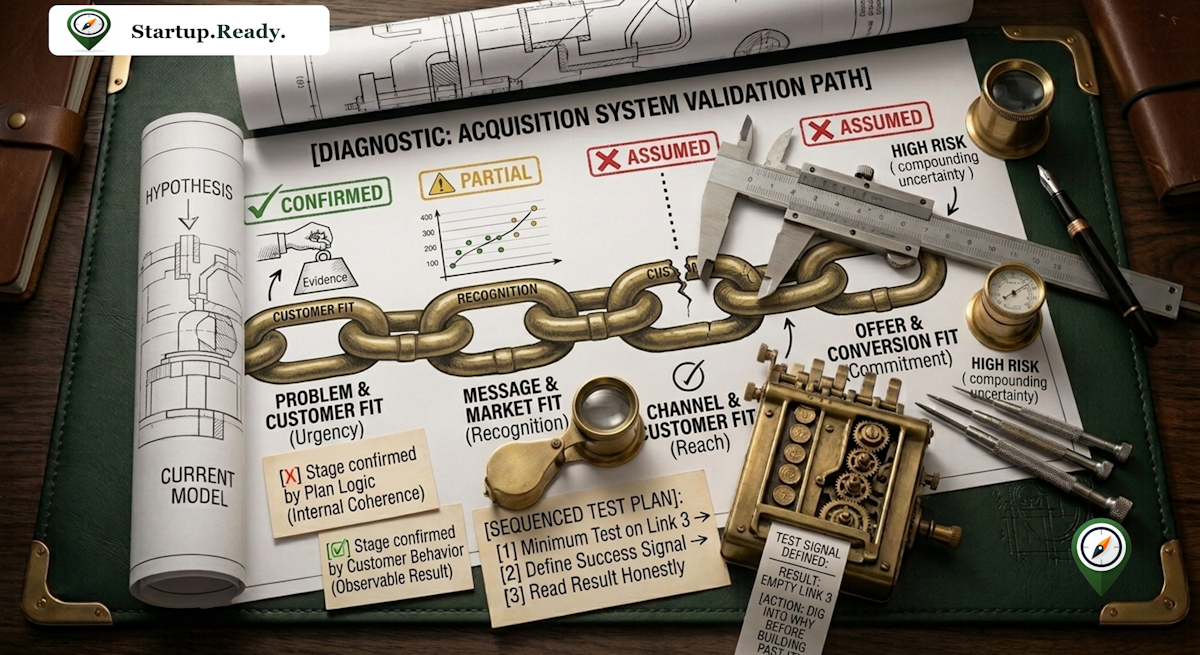
An acquisition system moves a customer through four fits: problem and customer, message and market, channel and customer, offer and conversion. Each is a link in a chain, and the system is only as validated as its least-tested link. Most founders invest in later stages before confirming earlier ones, so uncertainty compounds and the eventual failure is expensive to diagnose. The work is to rate each stage by evidence, find the one resting on plan-logic rather than observed behavior, and run the smallest test that would prove or break it. Here is the move, in order:
Map the four stages and rate each one confirmed, partial, or assumed, against real customer behavior
Find the weakest link, the stage most assumed and most damaging if it fails
Design the minimum test, the smallest action that returns a real result about that stage
Define the success signal first, before you run, so the result cannot be reinterpreted later
Run it and read it honestly, then move to the next least-validated link
Four signals your system is described but not validated:
Your confidence in a stage rests on the logic of the plan, not on something a customer did
You are optimizing acquisition volume before you know the offer converts
You cannot point to a stage and name the customer behavior that confirmed it
Your funnel looks complete on a slide and has never produced a customer end to end
If any of those describe you, this article shows you how to find the weakest link and test it before you build past it.
If You Found This Article by Searching for Something Else
Most founders who need this are not searching for "acquisition system validation." They are searching for the symptom.
Why is my funnel not converting.
How to validate my go-to-market.
Why do demos not turn into customers.
How to test my sales process.
Why does my marketing produce leads but no sales.
All of those trace to one question. Which stage of your acquisition system has actually been confirmed by customer behavior, and which one are you still taking on faith? This article shows you how to tell the difference and test the stage that matters most.
A Plan Describes. Evidence Confirms.
A complete acquisition system moves a customer through four fits, and each one is a claim that can be true or false independent of the others.
Problem and customer fit asks whether the right customer feels the problem urgently enough to act, and whether you can find them before they find you. Message and market fit asks whether your explanation produces immediate recognition, the customer seeing themselves in it without needing it decoded. Channel and customer fit asks whether you can reliably reach that customer at or near the moment the problem is urgent. Offer and conversion fit asks whether they actually commit, moving from interest to payment without heroic effort from you.
Written down, they read like a sequence you either have or do not. In reality each is a separate hypothesis with its own evidence, and a system can be solid at three fits and hollow at the fourth. The founder who has confirmed problem, message, and channel and never actually closed anyone does not have a system that is seventy-five percent working. They have a chain with one broken link, which is a chain that does not hold weight.
Confidence Usually Rests on the Logic of the Plan
Here is the trap that makes validation feel unnecessary. Ask a founder which stage they are most confident in, and they will name one quickly. Then ask what that confidence is based on. The answer is usually that the stage makes sense, that it follows from the one before it, that of course a customer who recognizes the message will click the channel. That is confidence in the logic of the plan, and the logic of a plan is exactly the thing that has never been tested.
Customer behavior is a different kind of evidence than internal coherence. A funnel can be perfectly reasoned and still fail at the first contact with a real person, because customers do not move through the steps your logic says they should. They ignore the message that reads as obviously compelling to you. They click and then do nothing. They take the demo and say the words every founder learns to dread, "this looks great, let me think about it," and never return.
So the honest audit is not whether each stage makes sense. It is whether each stage has produced an observable result. Rate them plainly. Confirmed means you have watched it work with real customers. Partial means you have seen it work, but not enough times to know whether it repeats. Assumed means it has never been tested, however sound it looks. The stages you rate assumed are not weaker parts of a working system. They are the parts you do not actually know anything about yet.
Test the Weakest Link, Because Uncertainty Compounds
Once the stages are rated, the priority is not the easiest one to test or the one nearest to fixing. It is the stage most assumed and most damaging if it fails, because in a chain, an untested early link contaminates everything downstream. When several stages are assumed at once, one rule orders them: test the earliest assumed stage, unless a later stage would invalidate all the effort before it. A broken offer makes a confirmed channel worthless, so if conversion is in doubt, it goes first no matter where it sits in the sequence.
Jumping ahead to the offer comes with one caution. To get a clean read, you need a good-enough message in front of a good-enough audience. Pitch the right offer to the wrong person in the wrong words, and a rejection tells you nothing, because you cannot separate a bad offer from bad delivery. Testing conversion early is right. Testing it in a vacuum wastes the test. Give the offer the minimum message and audience alignment it needs to fail honestly, so that a no points at the offer rather than the setup around it.
Watch how the cost compounds. A founder unsure whether the message lands still goes and picks channels. Unsure whether the channel reaches anyone, they still build volume. Unsure whether the offer converts, they still pour in leads. Each investment sits on top of an assumption that was never confirmed, so when something finally fails visibly, the failure could originate anywhere in the stack, and the cost of finding it has been multiplied by every decision built above it. The founder ends up debugging a whole system when a single early test would have isolated the break.
Testing the weakest link first inverts that. You spend your next unit of effort on the stage that, if broken, would waste all the others. Frequently that is offer and conversion, because it is the stage founders most avoid testing honestly. Interest is cheap to generate and pleasant to collect, and a pipeline full of interested people can hide the fact that not one of them has been asked to actually commit. The stage you are least eager to test is often the one carrying the most unexamined risk. Most founders fail at the fourth fit while spending money to optimize the third.
Define the Signal Before You Run It
A test without a success signal defined in advance is not a test. It is an experience you will interpret generously afterward. Before running anything, write down the specific result that would confirm the stage and the specific result that would break it, so the outcome cannot be reread to mean whatever keeps the plan alive.
Vague signals protect the assumption. "Customers responded positively" can describe a warm demo that closed nothing. A real signal is countable and set beforehand. Three of five conversations produce an unprompted question about pricing or next steps. The channel returns two qualified conversations in the first ten attempts. Three of eight demo-stage leads put a card down for a paid pilot. You decide the number before you run, because the version of you that runs the test wants it to pass, and that version cannot be trusted to grade it.
The strongest signals cost the customer something. Time, money, urgency, reputation, a change in behavior. Enthusiasm is free, which is why it validates nothing. When a customer sacrifices something real to move forward, that sacrifice is the evidence, and it is the only thing that turns an assumed stage into a confirmed one.
One honest limit on a minimum test. Eight conversations tell you a direction, not a conversion rate. Three of eight putting a card down means real commitment exists in the room. Zero of eight means it has not shown up yet. Neither means your conversion rate is thirty-seven percent, because eight is far too few to carry a number that precise. Read a small test as a signal of direction, strong, empty, or mixed, and let it tell you whether to keep going or dig into why. Small samples find out whether the thing works at all. They do not set the number you scale on, and a founder who reads eight data points as a rate can abandon a viable offer on a bad week or pour money behind a fluke.
The Founder Whose Funnel Worked on Paper
Take a founder with a review-collection tool for dental and salon owners. Ask how customers arrive and the answer is smooth: local ads to a landing page, the owner books a demo, they see the dashboard fill with real reviews, they subscribe at ninety-nine dollars a month. Four clean stages, every one connected.
Rate them against evidence and the picture changes. Problem and customer fit: partial, some owners clearly feel the review problem, others shrug. Message and market fit: assumed, the ad has never been tested against a real audience. Channel and customer fit: partial, local ads reach owners but at unknown cost. Offer and conversion fit: assumed. She has run a handful of demos, and every one ended in "looks great, let me think about it." The stage she was quietly most confident in, the ninety-nine-dollar close, is the one with the least evidence and the most damage if it fails, because every ad dollar upstream depends on demos converting. And she was about to spend two thousand dollars on local ads next month, pouring more owners into a demo step that had never once produced a paid commitment.
So that is the link she tests first. The minimum test: take eight owners already at the demo stage and ask each to start a paid thirty-day pilot with a card on file today. The success signal, set before she starts: at least three of eight put a card down. Not "they seem interested." A card. If three do, the conversion stage is real and she can go spend on the channel with confidence. If zero do, she has learned the most important thing in her business for the price of eight conversations, that the funnel she was about to pour money into ends at a wall. Either result is worth more than another month of demos she grades as encouraging.
The One Sentence That Tells You Where You Stand
A founder who has validated deliberately can complete this statement concretely:
The stage I am testing is [specific stage], my success signal is [specific, countable outcome], and I will have a result to read by [specific date], which tells me [specific thing] about whether the system holds at that link.
A founder who has not will describe the whole funnel fluently and stall on which stage a customer has actually confirmed, because they have been grading the plan for coherence rather than testing it against behavior. That stall is the diagnosis. It is usually the reason the funnel looks ready and has never produced a customer end to end.
If you can name the weakest link and the signal that would prove it, you have a test worth running this week. If you cannot, that is not a reason to build more of the funnel. It is the signal to rate each stage honestly, find the one resting on plan-logic, and design the smallest thing that would tell you the truth about it. Validate one link at a time, and the system stops being a story you tell and becomes a path you have walked.
Every confirmed stage removes uncertainty. Every assumed stage hides it. The goal is not a bigger funnel. The goal is a shorter list of things you are still guessing about.
Acquisition System Validation and Your Go-to-Market Clarity
In the Startup Readiness Framework, Go-to-Market Clarity evaluates whether a founder has moved from a described acquisition system to a validated one, tested stage by stage against real customer behavior. A system that exists only as a plan is one of the most common flags in early assessments, and it usually traces to confidence built on the logic of the funnel rather than on anything a customer did.
These questions stack into three layers.
1. Can each acquisition stage work on its own, which is this article.
2. Can one specific customer move through all four, which is mapping the path to your first three customers.
3. Can strangers move through them repeatably without you, which is mapping the path to your first ten customers.
The single moment of contact inside any stage is the work of designing a customer encounter.
Validation is what turns each layer from a design into a confirmed link.
Go-to-Market Clarity is one of six pillars in the Startup Readiness Framework. If your go-to-market understanding is strong, the next question is whether the rest of your startup is as ready as your evidence.
The Startup Readiness Assessment gives you a full-system diagnostic across all six pillars in under twenty minutes.
Take your Startup Readiness Score free today at startupready.ai →
Keep Working on the Go-to-Market Pillar
The Go-to-Market Pillar asks one question from many angles: can you reliably move a stranger to a paying customer, with a message that lands and a channel that fits? Each article below takes one piece of that question. Whether your message creates urgency or only agreement. Whether you picked the channel your customer is actually in, rather than the one convenient to you. Whether you can walk one real person all the way from stranger to paid. Which assumption your whole plan is quietly resting on. Read them in any order. Each is a separate cut at the same pillar, and together they show you where your path to customers is repeatable and where it still runs on hope.
More in the Go-to-Market pillar:
Customer Encounter Design: How to Reach Your First Customers at the Right Moment
How Early-Stage Startups Build a Scalable Customer Acquisition System
Agreement Is Not Urgency: Why Customers Say Yes and Never Buy
The Customer Won't Translate Your Message
You Don't Have a Channel Problem. You Have a Channel Selection Problem.
Stop Asking Customers Where They'd Look. Ask Where They Went.
Some Buying Friction You Remove. Some You Listen To.
Can You Walk One Person From Stranger to Paying Customer?
Getting Your First Customers and Having a Repeatable Path Are Two Different Things
Your Go-to-Market Plan Is a Stack of Assumptions. One of Them Is Load-Bearing.
The Most Dangerous Response to Your Message Is "That's Interesting."
A Great Message in the Wrong Channel Reads Like Spam.
Published
By Dr. Shaun P. Digan
Originally Published on Startup.Ready.’s Startup Readiness: Validation, Framework, and Tools Blog at https://startupready.ai/startup-readiness/validate-acquisition-system
Original Publication Date: August 5, 2026
Last Updated: August 5, 2026
About the Author
Dr. Shaun P. Digan is the founder of Startup.Ready and the creator of the Startup Readiness Framework, a research-based system for evaluating and validating early-stage startups before launch and early growth. He holds a PhD in Entrepreneurship from the University of Louisville and has spent over 15 years teaching, advising, and consulting with founders on startup strategy, validation, and growth.
In his writing, including the Startup Readiness Blog and The Foundations of Innovation Essay Series, he focuses on how founders can make better decisions by improving clarity, alignment, and readiness before scaling.