The Customer Won't Translate Your Message
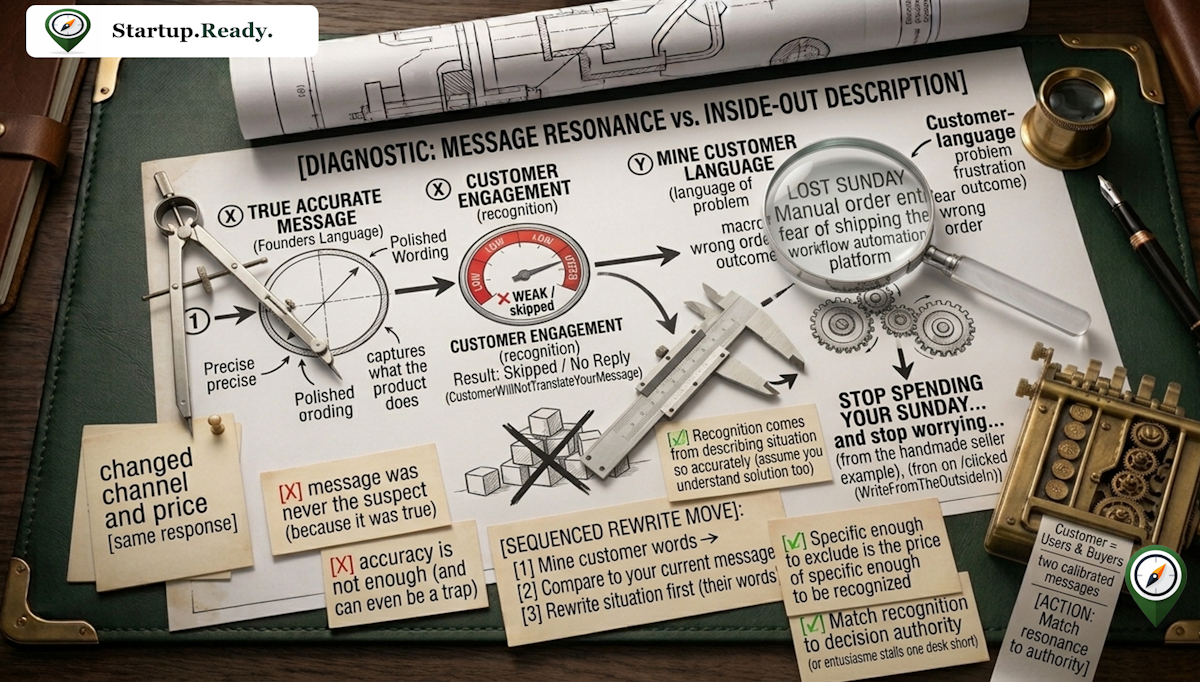
A founder writes a message they are proud of. It is accurate, it is polished, it captures what the product does. Then they put it in front of the customer it was written for, and the customer feels nothing. No recognition, no click, no reply. The founder assumes the channel was wrong, or the price, or the timing, and goes to change one of those. The message was never the suspect, because it was true.
True and resonant are different things. A message can describe the product perfectly and still be written from the inside, in the founder's language, about what the product does rather than about what the customer is living through. The customer reads it and has to translate it into their own situation before they can tell whether it is for them, and translation is work, and most people do not do work for a message from a stranger. They move on. The message was accurate. It was just not written for them.
A message dies two ways. The customer recognizes their situation and feels no reason to act, or they never recognize their situation at all. This article is about the second, the message that fails before it gets the chance to persuade anyone, because the reader never saw themselves in it.
TL;DR: The Customer Will Not Translate Your Message. Written From the Inside, It Just Gets Skipped.
A message with weak resonance is written from the founder's side, describing the product, so the customer has to translate it into their own words before it means anything. Most will not, so an accurate message produces no response. The fix is to build the message from the customer's own language, so recognition happens before persuasion. The work is to compare what you say against what the customer actually says, find the gap, and rewrite from the outside in. Here is the move, in order:
Write down your current message exactly as it is, not the improved version in your head
Mine the customer's language, the words they use for the problem, the frustration, and the outcome
Compare the two and mark every place your message uses your words instead of theirs
Rewrite from the outside in, starting with their situation, in their words, before your product
Test for recognition, asking real customers "does this describe your situation," not "do you like it"
Four signals your message has weak resonance:
Your message describes what the product does more than what the customer experiences
A target customer reads it and has to think about whether it applies to them
You have changed channel and price and gotten the same weak response
The words in your message are words you would use, not words you have heard a customer say
If any of those describe you, this article shows you how to rewrite the message from the customer's language so they recognize themselves before they evaluate anything.
If You Found This Article by Searching for Something Else
Most founders who need this are not searching for "message resonance." They are searching for the symptom.
Why is my messaging not landing.
How to write copy that converts.
Why does no one respond to my outreach.
How to describe my product so people get it.
Why do people not understand what I do.
All of those trace to one gap. Your message describes your product in your language, and the customer needs to hear their own situation in their own words before any of it registers. This article shows you how to close that gap.
The Message Is the Leverage Point
Before fixing the message, it helps to see why it is worth fixing first, ahead of the channel and the price the founder usually blames. When conversion is weak, the message is the cheapest and most powerful thing to change, and it is the thing founders change last.
Consider what every other marketing activity quietly assumes. Advertising amplifies the message. Outreach delivers it. SEO helps people find it. A price sets what happens after someone already believes the thing is for them. Every one of them sits downstream of the message and inherits whether it works. Improve the message and each of them gets more effective for free. Leave it broken and each of them faithfully carries a message that lands on no one.
Watch what happens when the message is the actual problem and the founder treats it as something else. They switch channels, and the new channel delivers the same message to new people who also do not recognize themselves, so the response stays flat. They lower the price, and a message that never made the customer feel understood now offers a discount on something they were not sure was for them, so the response stays flat. Every fix that leaves the message untouched produces the same weak result, and the founder slowly concludes the market is wrong, when the message was quietly wasting every channel and every price they tried.
The message is the leverage point. Everything else is distribution. Get it right and every channel works better and the price conversation gets easier, because the customer arrives already understanding the thing is for them. Get it wrong and you can optimize distribution forever around a core that never lands.
Inside-Out Asks the Customer to Do the Translation
The specific failure has a shape worth naming. An inside-out message describes the product from the founder's vantage point: what it does, what category it is in, what capabilities it has. It is written in the language of someone who already understands the product completely, which is exactly the one person who does not need to read it.
The customer starts somewhere else entirely. They are not thinking about your product or your category. They are thinking about their situation, in their own words, and when your message arrives describing features and categories, they have to perform a translation: does "workflow automation platform" mean the thing where I waste every Sunday on order entry? Maybe. Probably? They are not sure, and being not sure is enough. The message asked them to do the work of connecting your language to their life, and a person scanning a feed or an inbox does not stop to do that work for a stranger. They keep moving, and the founder records it as a channel that did not convert.
This is why accuracy is not enough and can even be a trap. The more precisely a message describes the product in product terms, the more it sounds like it was written for someone who already gets it, and the more translation it demands from someone who does not. A founder polishing an inside-out message is often making it more precise and less recognizable at the same time, sanding it into something technically excellent that the customer still slides right past.

Recognition Comes Before Persuasion
The message that works does something before it tries to convince anyone. It makes the customer feel seen. They read the first line and think "that is exactly my situation," and that recognition happens before they have evaluated the product, the price, or the claim. Recognition is the door. Persuasion is everything that happens after the customer has walked through it, and a message that skips straight to persuasion is arguing with someone still standing outside.
Recognition comes from describing the customer's situation so accurately that they assume you understand it, and the assumption transfers. A customer who reads their own frustration written back to them in their own words concludes, without deciding to, that whoever wrote this must understand the solution too. You have not made a single claim about the product yet, and you have already earned the credibility that makes your claims land. The order matters. Situation first, in their language, then the product. Reverse it and you are asking for belief before you have shown you understand what they are dealing with.
There is a mechanism under this, worth understanding rather than taking on faith. Words a customer already uses are words their mind processes without effort, so a message in their language reads as easy, familiar, and, because the brain quietly equates easy-to-process with true, more credible, before they have judged a word of the content. Words they do not use force that small act of translation, and the friction registers as doubt. Not quite for me. Same information, opposite reactions, decided by whose words carry it. Recognition is not a nicety. It is the mind rewarding a message it did not have to work to understand.
This is also what makes the right customer lean in and the wrong customer self-select out, which is a feature. A message written for one specific person in one specific situation will be ignored by everyone that situation does not fit, and that is correct. A message vague enough to include everyone produces recognition in no one, because no one sees their particular life in a description built to fit all lives. Specific enough to exclude is the price of specific enough to be recognized.
Whose Recognition Are You Buying?
Recognition in the customer is the goal, but in business-to-business the word "customer" hides a problem. The person feeling the daily frustration is often not the person who signs off on spending. The manager drowning in manual entry is not the CFO approving the budget, and a message calibrated only to the manager can win enormous enthusiasm that dies the moment it reaches someone who never felt the pain.
So resonance has to be aimed at the role that holds the decision, not only the role that feels the problem. Sometimes that means writing to the buyer's situation instead: the cost, the risk, the number they answer for, in their language rather than the user's. More often it means two calibrated messages, one that makes the user feel seen enough to champion you internally, and one that makes the buyer recognize the problem as worth funding, each mapped to its own outcome the way ae multi-sided value exchange is. A message that produces high end-user love and no budget approval resonated with exactly the wrong person. Match the recognition to the authority, or the enthusiasm stalls one desk short of the signature.
Customer Language Is the Raw Material
None of this works from the founder's imagination, because the whole problem is that the founder's language is the founder's language. The raw material for a resonant message is the customer's actual words, and those have to be gathered, not invented. This is the step founders skip and the reason their rewrites still sound like them.
The words are already out there. They are in the conversations you have with customers, in the phrases they use before you have coached them into your vocabulary. They are in the communities and forums where your customer talks to other customers with no founder in the room. They are, most usefully, in the one and two star reviews of competing and adjacent products, where people describe in vivid, specific, unhappy detail exactly what is broken and what they wish worked. A person writing a frustrated review is handing you your message in their own language, the problem named the way they name it and the outcome they wanted stated the way they state it.
Gather that language and the rewrite becomes assembly rather than invention. You replace your abstract words with their concrete ones, you start with the situation they described instead of the product you built, and you keep the phrases that made you flinch with recognition when you read them. The test at the end is not whether you like the message. It is whether a real customer, hearing it, says "that is exactly what I am dealing with." That sentence is the whole goal, and it is only reachable in words the customer already owns.
One caution, because founders take this too literally and it matters. The lesson is not to paste customer quotes into your headline. It is to capture the mental model underneath their words. Which brings up the objection you are probably already forming: my customers all describe the problem differently, so whose words do I use? They do describe it differently. Ten customers give you ten phrasings, and if you wait for the one wording they all share, you wait forever. Listen past the words to the thing they keep circling: the same moment, the same frustration, the same job they were trying to get done. That shared model is what you write to. The specific phrases are evidence of it, not the thing itself. Use their language to find the model, then write to the model in words any of them would recognize as their own.
The Order Tool No Handmade Seller Recognized
Take a founder with an order-management tool for handmade sellers, the people running small shops on marketplaces and shipping physical goods. The first message was crisp and inside-out: "a workflow automation platform for creative entrepreneurs." Accurate. Every word defensible. And no seller who read it felt a thing, because no seller thinks of themselves as a creative entrepreneur running workflows. They think about their Sunday.
The founder went looking for their language, in seller forums and in the one and two star reviews of the clunky tools they used instead. The words came back nothing like his. "I spend my whole Sunday copying orders into a spreadsheet by hand." "I'm always terrified I'll ship the wrong order to the wrong person." Concrete, specific, and absent from his polished message. His described the machinery. Theirs described their Sunday and their fear.
He did not paste a review into a headline. He wrote to the model underneath all of them, the Sunday lost to manual entry and the fear of the wrong shipment, in words any of those sellers would recognize: "Stop spending your Sunday copying orders into a spreadsheet, and stop worrying you'll ship the wrong thing to the wrong person." Same product, same audience, same facts. The first message asked a seller to translate "workflow automation" into their life and gave up nothing to help them. The second handed them their own Sunday back, in their own words, and the recognition was instant. He had not learned anything new about the product. He had stopped describing it and started describing them.
The One Sentence That Tells You Where You Stand
A founder whose message resonates can complete this statement concretely:
My message starts with the customer's situation in their own words, and the specific phrase I know came from a customer rather than from me is [specific phrase], which I heard or read [where you found it].
A founder whose message is inside-out will describe the product clearly and stall on naming a single phrase that came from a customer, because the whole message came from them, in their vocabulary, about their product. That stall is the diagnosis. It is usually the reason the message reads well to the founder and lands on no one else.
If you can point to the customer's own words inside your message, you have built recognition into the first line, and the customer will see themselves before they evaluate anything. If you cannot, that is not a reason to polish the wording you have. It is the signal to go where your customer talks and gather the way they actually describe their situation, then rebuild the message out of their language instead of yours. A message in the customer's words earns recognition. A message in yours asks for translation, and the customer will not do it.
Message Resonance and Your Go-to-Market Clarity
In the Startup Readiness Framework, Go-to-Market Clarity evaluates whether a message is built from the customer's language or the founder's, because a message written from the inside produces no recognition no matter how accurate it is. Weak resonance is one of the most common and most misdiagnosed flags in early assessments, usually blamed on the channel or the price when the message was the leverage point all along.
This is one of two ways a message fails. It can fail because the customer never recognizes their situation in it, which is this article. Or it can fail because they recognize it and feel no reason to act now. A message usually needs both recognition and a reason to move. Finding the customer's actual language is the work in.
Go-to-Market Clarity is one of six pillars in the Startup Readiness Framework. If your go-to-market understanding is strong, the next question is whether the rest of your startup is as ready as your evidence.
The Startup Readiness Assessment gives you a full-system diagnostic across all six pillars in under twenty minutes.
Take your Startup Readiness Score free today at startupready.ai →
Keep Working on the Go-to-Market Pillar
The Go-to-Market Pillar asks one question from many angles: can you reliably move a stranger to a paying customer, with a message that lands and a channel that fits? Each article below takes one piece of that question. Whether your message creates urgency or only agreement. Whether you picked the channel your customer is actually in, rather than the one convenient to you. Whether you can walk one real person all the way from stranger to paid. Which assumption your whole plan is quietly resting on. Read them in any order. Each is a separate cut at the same pillar, and together they show you where your path to customers is repeatable and where it still runs on hope.
More in the Go-to-Market pillar:
Customer Encounter Design: How to Reach Your First Customers at the Right Moment
How Early-Stage Startups Build a Scalable Customer Acquisition System
A Funnel That Works on Paper Has Never Met a Customer
Agreement Is Not Urgency: Why Customers Say Yes and Never Buy
You Don't Have a Channel Problem. You Have a Channel Selection Problem.
Stop Asking Customers Where They'd Look. Ask Where They Went.
Some Buying Friction You Remove. Some You Listen To.
Can You Walk One Person From Stranger to Paying Customer?
Getting Your First Customers and Having a Repeatable Path Are Two Different Things
Your Go-to-Market Plan Is a Stack of Assumptions. One of Them Is Load-Bearing.
The Most Dangerous Response to Your Message Is "That's Interesting."
A Great Message in the Wrong Channel Reads Like Spam.
Published
By Dr. Shaun P. Digan
Originally Published on Startup.Ready.’s Startup Readiness: Validation, Framework, and Tools Blog at https://startupready.ai/startup-readiness/message-resonance
Original Publication Date: August 5, 2026
Last Updated: August 5, 2026
About the Author
Dr. Shaun P. Digan is the founder of Startup.Ready and the creator of the Startup Readiness Framework, a research-based system for evaluating and validating early-stage startups before launch and early growth. He holds a PhD in Entrepreneurship from the University of Louisville and has spent over 15 years teaching, advising, and consulting with founders on startup strategy, validation, and growth.
In his writing, including the Startup Readiness Blog and The Foundations of Innovation Essay Series, he focuses on how founders can make better decisions by improving clarity, alignment, and readiness before scaling.