Getting Your First Customers and Having a Repeatable Path Are Two Different Things
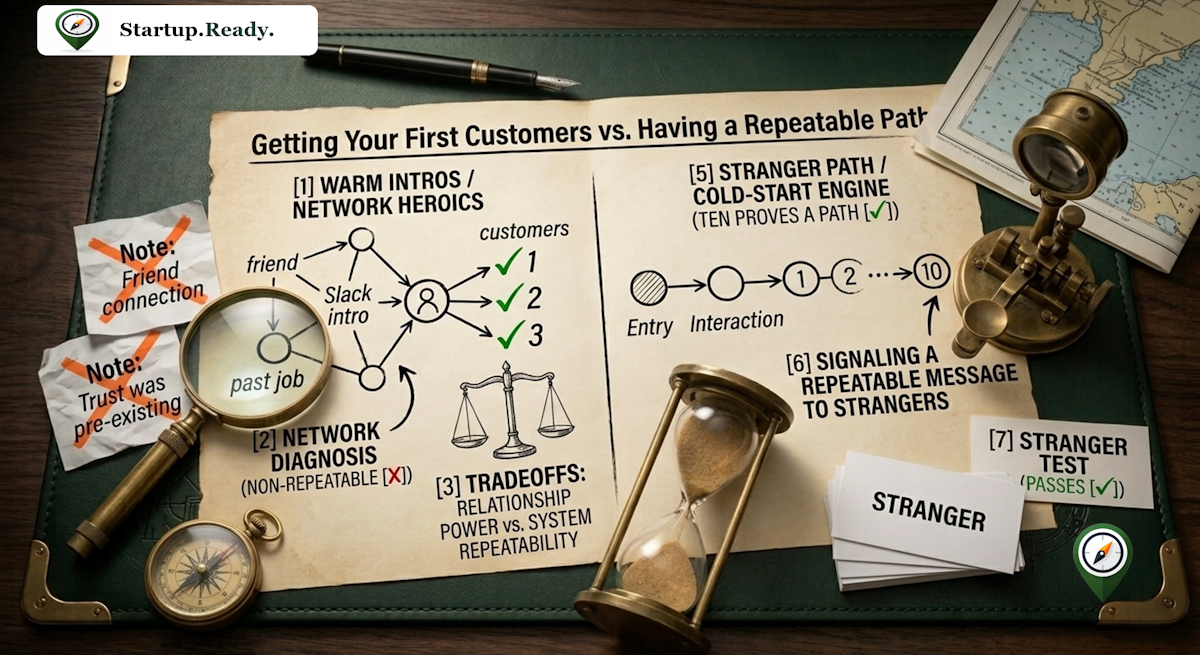
The first few customers feel like proof. Someone paid. The product is real, the problem is real, the thing works. A founder who has closed three customers has earned a genuine milestone, and they are right to feel it.
Then they try to get the fourth from a stranger and nothing happens. The first three came through a friend, a warm introduction, a conversation that started because someone already trusted them. Strip those away and the path underneath is empty. Getting your first customers and having a repeatable path to customers are different achievements, and the first one hides whether you have the second.
The first three prove demand. The next ten prove a path. Those are different achievements, and the gap between them is where a lot of promising startups quietly stall, because the founder reads early traction as a working engine when it was actually a working network.
TL;DR: Your First Customers Came Through You. The Question Is Whether the Next Ten Can Come Without You.
A repeatable path is one a stranger with your pitch could follow without your personal network, your specific relationships, or circumstances unique to one customer. Most founders get their first few through founder heroics and warm intros, which proves demand and hides the absence of a path. The work is to map what actually worked, mark every step that required you specifically, and replace the earliest non-repeatable step with one that could work for a stranger. Here is the move, in order:
Map your best evidence, the real path that produced your most successful customer, heroics included
Apply the stranger test to each step: could someone with your pitch do this without your network
Find the earliest non-repeatable step, because everything after it depends on heroics to reach
Design one repeatable replacement, executable without your personal involvement
Test it three times, because a replacement you have not run is another assumption
Four signals your path is not yet repeatable:
Your first customers all trace back to your personal network or a warm introduction
You cannot name a customer who arrived through a route a stranger could have followed
The step that closes deals is you, personally, showing up in a way that will not scale
Your plan for the next ten customers is "more of what worked," and what worked was who you know
If any of those describe you, this article shows you how to find the step that needs you and replace it before your network runs out.
If You Found This Article by Searching for Something Else
Most founders who need this are not searching for "repeatable acquisition path." They are searching for the stall.
How to get customers beyond my network.
Why did my early traction stop.
How to scale past warm introductions.
Why can't I get customers who don't know me.
How to get customers without a personal network.
All of those point at one question. Of the customers you have, how many came through a path a stranger could have followed without you personally in it? This article shows you how to answer that honestly and build the path that does not depend on you.
First Three Proves Demand. First Ten Proves a Path.
The distinction that matters here is between two different kinds of evidence, and founders collapse them because both produce customers.
Three customers tell you demand is real. The product is wanted, the problem is worth paying to solve, someone chose you over doing nothing. That is a real and necessary proof, and it is the whole point of getting to three. What it does not tell you is whether the way you got there can happen again without the specific conditions that made it work the first time.
Ten customers through the same route tell you something else: that a path exists. Not that people want the thing, which you already knew, but that there is a repeatable sequence carrying strangers into paying customers without you improvising each time. The work of getting from three to ten is not more of the same effort. It is a different question asked of the same evidence, whether what worked required you specifically or would work for anyone holding your pitch.
That is why the founder who nails the first three and expects the next seven to follow the same way so often stalls. The first three were built on relationships and circumstances that do not repeat, and running out of them feels like losing momentum when it is actually reaching the end of a path that was never longer than your network.
The Stranger Test
There is a clean test for whether a step is repeatable, and it is worth applying to every step you took to get a customer. Run it as a checklist on each step:
Could a stranger execute this without my personal network?
Without my reputation, or a mutual connection vouching for me?
Without circumstances unique to that one customer?
If the answer is no to any of the three, the step is not repeatable.
Run it honestly and the results sting, because the steps that felt like your strengths are often the ones that fail the test. The warm introduction that opened the door. The prospect who already trusted you from a previous job. The founder friend who vouched for you in a Slack. The demo that closed because you personally spent two hours walking one customer through it. Every one of those produced a real customer, and not one of them is a step a stranger could repeat. They were advantages, and advantages that cannot be handed off are exactly what a path cannot be built on.
This is not an argument against using your network. Using it is correct. Heroics are a valid way to prove demand. They are a dangerous way to judge repeatability, and the mistake is mistaking the network for a path. Founders think they have an acquisition engine. What they have is a reservoir. Every introduction drains it. Nothing refills it. The day it runs dry is the day they find out whether an engine was ever there, and it runs dry sooner than most expect, usually around the fourth or fifth customer, when the introductions stop and the product still needs selling.
Replace the Earliest Step That Needs You
Once you have marked the non-repeatable steps, the priority is not the most important one or the easiest to fix. It is the earliest one, the first point in the path where a stranger would be stopped, because everything downstream of it only ever gets reached through heroics in the first place.
Usually that earliest step is awareness. The first three customers knew you existed because they knew you, or knew someone who did. A stranger has no such thread, so the very first step, becoming aware of you at all, is the one with no repeatable version yet. Fixing a brilliant closing sequence does nothing if no stranger ever reaches it, so the close is not where the work is. The entry is.
This is worth stating precisely, because the stranger test is easy to over-apply. It targets the source of your leads, not your presence in the sale. Founder-led closing is healthy and often necessary well past the first ten customers, especially in B2B, where the first ten or twenty deals usually need you in the room. Running the sales call yourself is fine for a long time. Being the only way a lead ever appears is the ceiling. Make lead generation repeatable first, and you can stay on the calls as long as the deals require it.
The replacement does not have to match the original in power. A warm introduction converts far better than a cold encounter, often ten or twenty times better, and that changes the volume math completely. Three customers from warm intros might take five conversations. Three from a cold, repeatable path might take a hundred touches or more. Those hundred touches are the normal price of a route that does not spend your network, and a founder who expects warm-intro rates from cold traffic will abandon a working path after a dozen rejections, mistaking normal cold-start volume for failure. The replacement only has to be executable without you specifically and testable without special circumstances. A specific community where your customer already gathers when the problem is fresh. A designed encounter staged there, the work of designing the moment a customer meets you, built for the trigger that brings them and ending in one clear ask. It will be weaker than the intro that closed your first deal. It will also still be there after your network is gone, which is the entire point.
The Founder Whose First Three Came Through a Friend
Take a founder with a tool for indie game studios, three customers in and feeling the momentum. Map the path honestly and the shape is clear. The first customer was a friend from a game-dev Discord. The second and third were warm introductions that friend made. Awareness, in all three cases, came from one relationship. Trust, in all three cases, came from the same vouch. The founder had been reading three customers as an acquisition engine, and it was one friend making introductions.
Apply the stranger test step by step. First contact through a personal Discord relationship: not repeatable. Trust established by a mutual friend's endorsement: not repeatable. A closing call where the founder hand-held the studio through setup: barely repeatable and not scalable. The earliest failing step is the first one, awareness, and every warm lead from that one friendship was about to run out, because a single person only knows so many studios.
So the replacement targets the entry. Instead of waiting for introductions, the founder designs a repeatable awareness step: showing up in a specific subreddit where indie studios post about the exact production-pipeline mess the tool solves, at the moment they are venting about it, with a designed encounter rather than a pitch. It converts worse than the friend's intro did. It also does not depend on the friend, which means it can produce a tenth customer and a fiftieth. He tests it three times with three strangers before trusting it, because a replacement he has only imagined is just another assumption wearing the word "plan." Three strangers through the new entry step would tell him the path finally reaches past his network. Not the three customers he already had. The next three he has never met.
The One Sentence That Tells You Where You Stand
A founder who has made the path repeatable can complete this statement concretely:
The earliest step that required me specifically is [specific step], the repeatable replacement is [specific replacement], and I will have tested it with three strangers by [specific date], which tells me [specific thing] about whether the path reaches past my network.
A founder who has not will point at their first customers as proof the engine works and stall on naming a single one who arrived without them personally in the path, because early traction built on relationships feels identical to early traction built on a system. That stall is the diagnosis. It is usually the reason the first three came easily and the fourth will not come at all.
If you can name the step that needs you and the replacement that does not, you have something to test this week with three strangers. If you cannot, that is not a reason to work your network harder for one more introduction. It is the signal to map what actually worked, mark every step that required you, and replace the earliest one with a step a stranger could take. Ten customers through a path that does not need you is the beginning of a system. Three through your network is the beginning of a countdown.
The question is not whether your first customers came through you. Almost everyone's did. The question is whether the next ten still need to.
Building a Repeatable Path and Your Go-to-Market Clarity
In the Startup Readiness Framework, Go-to-Market Clarity evaluates whether a founder's early customers arrived through a repeatable path or through founder heroics that cannot be handed off or scaled. Early traction that depends entirely on the founder's network is one of the most common flags in the assessment, and it usually hides behind the real demand those first customers prove.
This is the third of three layers. Whether each acquisition stage can work at all is validating your acquisition system. Whether one specific customer can move through the whole route is mapping the path to your first three customers. Whether strangers can move through it repeatably without you is this article. The single moment of contact inside any repeatable step is the work of designing a customer encounter.
Go-to-Market Clarity is one of six pillars in the Startup Readiness Framework. If your go-to-market understanding is strong, the next question is whether the rest of your startup is as ready as your evidence.
The Startup Readiness Assessment gives you a full-system diagnostic across all six pillars in under twenty minutes.
Take your Startup Readiness Score free today at startupready.ai →
Keep Working on the Go-to-Market Pillar
The Go-to-Market Pillar asks one question from many angles: can you reliably move a stranger to a paying customer, with a message that lands and a channel that fits? Each article below takes one piece of that question. Whether your message creates urgency or only agreement. Whether you picked the channel your customer is actually in, rather than the one convenient to you. Whether you can walk one real person all the way from stranger to paid. Which assumption your whole plan is quietly resting on. Read them in any order. Each is a separate cut at the same pillar, and together they show you where your path to customers is repeatable and where it still runs on hope.
More in the Go-to-Market pillar:
Customer Encounter Design: How to Reach Your First Customers at the Right Moment
How Early-Stage Startups Build a Scalable Customer Acquisition System
A Funnel That Works on Paper Has Never Met a Customer
Agreement Is Not Urgency: Why Customers Say Yes and Never Buy
The Customer Won't Translate Your Message
You Don't Have a Channel Problem. You Have a Channel Selection Problem.
Stop Asking Customers Where They'd Look. Ask Where They Went.
Some Buying Friction You Remove. Some You Listen To.
Can You Walk One Person From Stranger to Paying Customer?
Your Go-to-Market Plan Is a Stack of Assumptions. One of Them Is Load-Bearing.
The Most Dangerous Response to Your Message Is "That's Interesting."
A Great Message in the Wrong Channel Reads Like Spam.
Published
By Dr. Shaun P. Digan
Originally Published on Startup.Ready.’s Startup Readiness: Validation, Framework, and Tools Blog at https://startupready.ai/startup-readiness/path-to-first-10-customers
Original Publication Date: August 5, 2026
Last Updated: August 5, 2026
About the Author
Dr. Shaun P. Digan is the founder of Startup.Ready and the creator of the Startup Readiness Framework, a research-based system for evaluating and validating early-stage startups before launch and early growth. He holds a PhD in Entrepreneurship from the University of Louisville and has spent over 15 years teaching, advising, and consulting with founders on startup strategy, validation, and growth.
In his writing, including the Startup Readiness Blog and The Foundations of Innovation Essay Series, he focuses on how founders can make better decisions by improving clarity, alignment, and readiness before scaling.