A Great Message in the Wrong Channel Reads Like Spam
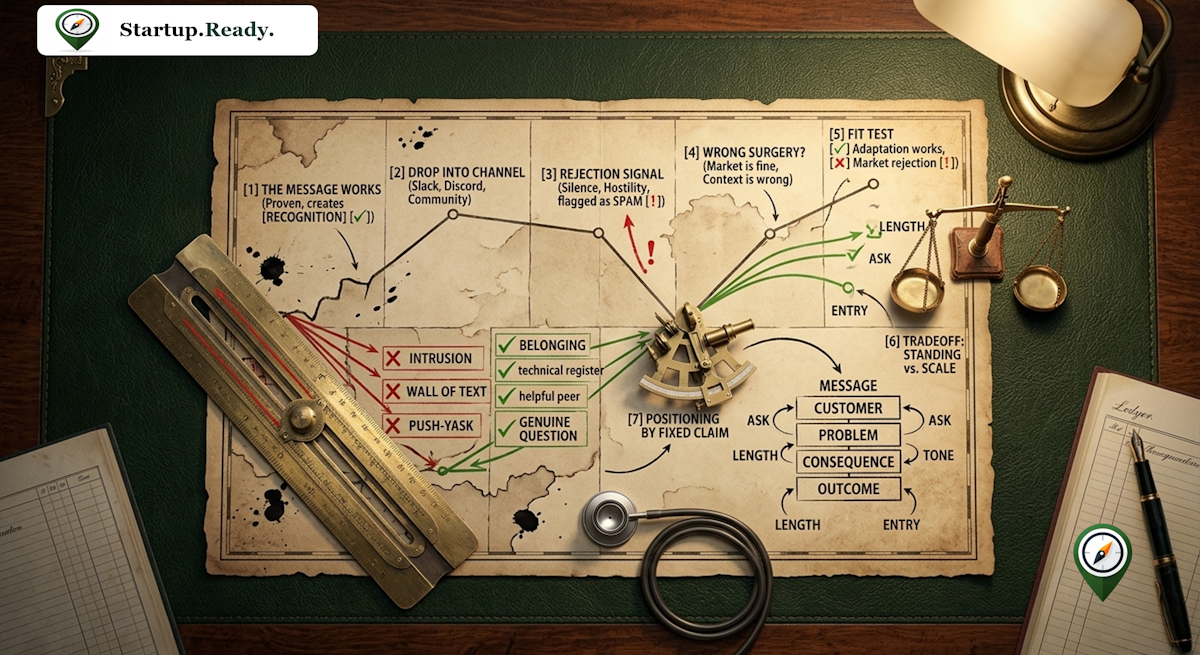
You have a message that works. You have tested it, it earns recognition, people hear it and say "that is exactly my situation." So you take that proven message, paste it into a Slack community or a cold DM, and the response is nothing, or worse, mild hostility. The natural conclusion is that the message was not as good as you thought, or that these people are not really your market.
Both conclusions are usually wrong. The message is fine and the market is real. What failed is fit between the message and the specific place you put it. The exact words that land as a welcome insight in a direct email land as an intrusion in a community thread, not because the claim changed but because the context did, and every context has its own rules about what belongs. A message that ignores those rules gets rejected for being an interruption, no matter how true it is.
This failure is dangerous precisely because it is disguised. Fit rejection and market rejection produce the identical signal, silence, and a founder reading silence as "nobody wants this" will walk away from a message and a market that were both working, killed by a mismatch they never diagnosed.
TL;DR: The Same Message Belongs in One Channel and Intrudes in Another. Adapt the Fit, Keep the Claim.
A message written for one context rarely works unchanged in another, because tone, length, format, and the acceptable kind of ask differ from channel to channel. Deployed in the wrong context, a strong message reads as an interruption and gets ignored, which looks exactly like the market rejecting it. The work is to hold the core claim fixed and adapt everything around it to how people actually behave in the specific place you are using it. Here is the move, in order:
Name the specific context, not "LinkedIn" but the exact channel and audience within it
Map its behavioral norms: length, tone, ask style, and whether cold contact is even acceptable
Keep the core claim fixed, the customer, problem, consequence, and outcome do not change
Adapt the presentation, the length, tone, opening, and ask, to what belongs in that context
Run the fit test: would a real participant feel this belongs here, or feel interrupted
Four signals you have a channel-message mismatch, not a market problem:
A message that earns recognition in conversation gets silence in a community or cold channel
Your outreach reads the same everywhere, regardless of where it is going
You are getting flagged, ignored, or told "this feels like spam" despite a solid claim
You are about to abandon a message or a market based on a response rate from one context
If any of those describe you, this article shows you how to adapt the message to the channel so the claim gets a fair hearing.
If You Found This Article by Searching for Something Else
Most founders who need this are not searching for "channel-message fit." They are searching for the failure.
Why does my cold outreach get no response.
Why am I getting flagged as spam in communities.
How to write outreach that does not feel salesy.
Why does my message work in person but not online.
How to post in a community without getting ignored.
All of them come back to one question. Is your message actually being rejected, or is it being deployed in a context where it was never going to belong? This article shows you how to tell the difference and fix the fit.
Fit Rejection Wears the Mask of Market Rejection
The reason this problem persists is that it hides behind the same signal as a completely different problem. When a message underperforms in a channel, the founder gets silence, and silence is ambiguous. It could mean the market does not want the product. It could mean the message is weak. Or it could mean the message is strong and simply does not belong in this particular room. All three produce the same quiet, and the founder almost always reads it as one of the first two, because those are the fears already on their mind.
So the founder does the wrong surgery. They weaken a message that was working, softening the sharp claim that earned recognition elsewhere, or they abandon a channel their customer actually uses, or they conclude the market is smaller than they hoped. Each of those is a real cost paid to fix a problem they did not have. The actual issue, that a message built for one context was dropped unchanged into another, never gets named, so it recurs in the next channel and the one after that.
Naming it is most of the fix. Before you touch the message or write off the market, ask a narrower question: is this message being rejected, or is it being deployed somewhere it was never going to fit? A message that lands beautifully in a direct email and dies in a Slack channel is not a message the market rejected. It is a message that showed up somewhere it did not belong.
Every Channel Has Norms, and Breaking Them Reads as Intrusion
A channel is not just where people gather. It is a culture, with expectations about what belongs, who gets to speak, and how ideas are exchanged. People enforce that culture instantly, mostly without thinking, and show up outside it and you register as an intruder before anyone has evaluated a word of your actual claim. Four dimensions carry most of the difference.
Length is the obvious one: a paragraph that reads as thorough in an email reads as a wall of text in a chat thread. Tone is the next: the same directness that signals confidence in a cold email can read as pushy in a community that prefers a softer, peer-to-peer register. Ask style matters enormously: a channel where people trade help and questions punishes a direct sales ask that would be perfectly normal in a targeted email. And entry norms are the one founders miss most: some channels assume cold contact is fine, and others expect standing, a history of contribution, a reason you are here beyond wanting something, before any outreach is acceptable at all.
Two kinds of norms are worth separating, because founders confuse them. Some are technical, the hard limits of the platform. Some are social, what the culture actually rewards, and the social ones bite harder. On X the technical rule is that posts are short; the social rule is that a candid opinion outperforms polished marketing. In Slack the technical limit on length is generous; the social rule still favors a short, plain message over a formatted pitch. Meet the technical rule and break the social one and you will still read as an outsider, because the culture, not the character count, is what people are responding to.
There is a fifth dimension underneath the other four: the intent state the channel puts people in. The same person carries a different mindset on each platform. On a professional network they are browsing and networking, half-present. In a peer work channel they are in active troubleshooting mode, trying to solve something right now. On a search engine they are in high intent, actively hunting a solution. The platform sets the mindset, and the ask has to match it. A direct "want to try this?" that is welcome from someone in high-intent search reads as an interruption to someone idly browsing a feed. Map the channel's intent state alongside its length, tone, and entry norms, because reaching a person in the wrong mindset fails even when every other norm is met.
Entry is where "this feels like spam" usually comes from. Set aside the things that are spam in any context, the deceptive hooks, the mass automation, the irrelevant blasting. The failure this article is about is subtler and far more common: a message can feel like spam purely because it violates the expectations of the place it lands, even when the value proposition is completely legitimate. The identical message, sent where cold contact is the norm or to someone who invited it, reads as fine. Dropped into a community that expects contribution first, it reads as an intrusion. Belonging is less about the words than about whether the words fit the place they arrive in.
Hold the Claim Fixed. Move Everything Around It.
Adapting to a channel is not writing a new message, and this is the distinction that keeps adaptation from becoming drift. Underneath every version is one core claim that must not change: the specific customer, the problem in their language, the consequence of inaction, and the outcome. That is the thing you tested and proved. If it moves from channel to channel, you no longer have a message, you have a different pitch every place you show up, and you will never learn what works.
What flexes is everything around the claim. The length expands or compresses. The tone shifts to match the register of the room. The opening line changes to whatever makes someone in this specific channel stop and read, which might be specificity in one place, a shared frustration in another, a status-relevant hook in a third. And the ask reshapes to fit: in a community it might be a genuine question, in a direct message a low-key request to talk, in a referral thread an introduction. Same claim, different clothes for a different room. Size the ask to readiness, too: a room of people actively looking can take a direct ask, while a room of people who merely have the problem and are not yet searching can take only something that sharpens it, with no ask attached yet.
The entry problem gets its own rule, because it is the one that turns good messages into spam. If cold contact is not normal in this channel, the message has to earn the right to be there before it asks for anything. A specific observation about the person, a shared community you are both actually part of, a real contribution you have already made, a mutual connection: something that makes the outreach feel warranted rather than random. Skip that and the best-adapted message in the world still reads as an intruder, because you walked into a room where you had not earned a voice and immediately asked for something.
There is a boundary worth naming, because adaptation can quietly slide into drift. If you find yourself changing the customer, the problem, or the consequence to fit a channel, you have not adapted the message. You have changed it, and you are now running a different pitch in every room, which teaches you nothing. If you are changing the tone, the length, the opening, and the ask, you are adapting. The core claim is the fixed point. Everything else is free to move, and the moment the fixed point starts moving, stop and put it back.
The Developer Tool That Got Flagged as Spam
Take a founder with an API tool for developers, and a message that genuinely worked. In targeted emails to engineering leads it earned real replies: it named a specific integration headache, the hours lost to it, and the outcome, cleanly and directly. Proven message, right audience. So she took that same message into the developer communities where her customers actually spend their time, the Slacks and Discords where engineers trade help all day, and posted it. Silence, then a moderator quietly flagged it, then someone replied "is this an ad?"
Read as market rejection, this says developers do not want the tool. Read correctly, it says a direct-email message was dropped into a peer help channel where it broke every norm. It was too long and too polished for a chat thread. Its tone was outbound-sales in a room that runs on developers helping developers. It made a direct ask in a place where she had never once contributed, so she had no standing to ask anything. The claim was strong. The fit was zero, and zero fit reads as spam.
So she kept the claim and changed everything around it. She started actually being present in the community, answering integration questions where she genuinely knew the answer, building the standing the channel required. When the exact problem her tool solved came up in a thread, as it regularly did, she replied the way a helpful peer would: short, specific, in the room's plain technical register, describing how she had solved it and offering to share what she built, no pitch. Same core claim, the same integration headache and outcome she had proven in email, now wearing the length, tone, and ask that belonged in a developer channel, offered by someone who had earned a voice there. She had not changed what she believed. She changed how she entered the conversation. The replies came. The market had wanted it the whole time. The message had just been showing up as a stranger shouting an ad into a room of people helping each other.
Earn Your Way In to Learn, Pay Your Way In to Scale
There is an honest limit to the standing the developer example depends on. Contributing your way into a community until you have earned the right to make an ask is a superb way to discover whether a message and a channel fit. It is a poor way to scale, because it runs on founder hours and reaches one small room at a time, and doing it across ten or twenty communities is a full-time job that still touches very few people.
So treat earned standing as a discovery mechanism, not a growth engine. Its job is to prove that this claim, adapted this way, lands in this kind of room. Once it has, scaling means buying the reach the community makes available on purpose: a native sponsored placement, a paid thread, a partnership with the person who runs the room, the surfaces that permit commercial contact openly. The fit you earned by hand is what makes the paid version work, because you already know the adapted message belongs. Earn your way in to learn what works. Pay your way in to do it at volume.
The One Sentence That Tells You Where You Stand
A founder who has adapted the message can complete this statement concretely:
The channel is [specific channel and audience], its norms require [the key adaptation, in length, tone, ask, or entry], and I have kept the core claim fixed while changing [what flexed] so the message belongs there instead of interrupting.
A founder who has not will run the same message everywhere and read the weak responses as the market's verdict, because a mismatch and a rejection produce the identical silence. That stall is the diagnosis. It is usually the reason a message that clearly worked somewhere is quietly written off as not working at all.
If you can name the channel's norms and what you changed to fit them while holding the claim steady, you have given a proven message a fair hearing in a new room. If you cannot, that is not a reason to weaken the message or abandon the channel. It is the signal to study how people actually behave in that specific place, adapt the length, tone, ask, and entry to fit it, and keep the core claim exactly as it was. A message that belongs gets read. A message that intrudes gets flagged, and the two can carry the very same words.
Channel Adaptation and Your Go-to-Market Clarity
In the Startup Readiness Framework, Go-to-Market Clarity treats a channel-message mismatch as one of the most misread flags in the assessment, because it fails in a way that looks exactly like the market saying no. A strong message deployed against the norms of its channel produces low response that founders attribute to the message or the market, when the fix is fit.
This work sits at the seam between two others. Which channel to be in is choosing your channel by fit. What the core claim should say is making the customer recognize themselves and giving them a reason to act now. Adapting that claim to the specific place is the layer between them, and once the message fits, what happens on contact is the customer encounter.
Go-to-Market Clarity is one of six pillars in the Startup Readiness Framework. If your go-to-market understanding is strong, the next question is whether the rest of your startup is as ready as your evidence.
The Startup Readiness Assessment gives you a full-system diagnostic across all six pillars in under twenty minutes.
Take your Startup Readiness Score free today at startupready.ai →
Keep Working on the Go-to-Market Pillar
The Go-to-Market Pillar asks one question from many angles: can you reliably move a stranger to a paying customer, with a message that lands and a channel that fits? Each article below takes one piece of that question. Whether your message creates urgency or only agreement. Whether you picked the channel your customer is actually in, rather than the one convenient to you. Whether you can walk one real person all the way from stranger to paid. Which assumption your whole plan is quietly resting on. Read them in any order. Each is a separate cut at the same pillar, and together they show you where your path to customers is repeatable and where it still runs on hope.
More in the Go-to-Market pillar:
Customer Encounter Design: How to Reach Your First Customers at the Right Moment
How Early-Stage Startups Build a Scalable Customer Acquisition System
A Funnel That Works on Paper Has Never Met a Customer
Agreement Is Not Urgency: Why Customers Say Yes and Never Buy
The Customer Won't Translate Your Message
You Don't Have a Channel Problem. You Have a Channel Selection Problem.
Stop Asking Customers Where They'd Look. Ask Where They Went.
Some Buying Friction You Remove. Some You Listen To.
Can You Walk One Person From Stranger to Paying Customer?
Getting Your First Customers and Having a Repeatable Path Are Two Different Things
Your Go-to-Market Plan Is a Stack of Assumptions. One of Them Is Load-Bearing.
The Most Dangerous Response to Your Message Is "That's Interesting."
Published
By Dr. Shaun P. Digan
Originally Published on Startup.Ready.’s Startup Readiness: Validation, Framework, and Tools Blog at https://startupready.ai/startup-readiness/adapt-message-to-channel
Original Publication Date: August 5, 2026
Last Updated: August 5, 2026
About the Author
Dr. Shaun P. Digan is the founder of Startup.Ready and the creator of the Startup Readiness Framework, a research-based system for evaluating and validating early-stage startups before launch and early growth. He holds a PhD in Entrepreneurship from the University of Louisville and has spent over 15 years teaching, advising, and consulting with founders on startup strategy, validation, and growth.
In his writing, including the Startup Readiness Blog and The Foundations of Innovation Essay Series, he focuses on how founders can make better decisions by improving clarity, alignment, and readiness before scaling.