You Don't Have a Channel Problem. You Have a Channel Selection Problem.
A founder posts on LinkedIn, sends some cold emails, starts a newsletter, shows up on the platform where they already have a following, and after a few months of steady effort, none of it has produced a repeatable way to get customers. The natural conclusion is that the channels are not working, and the natural next move is to add another one.
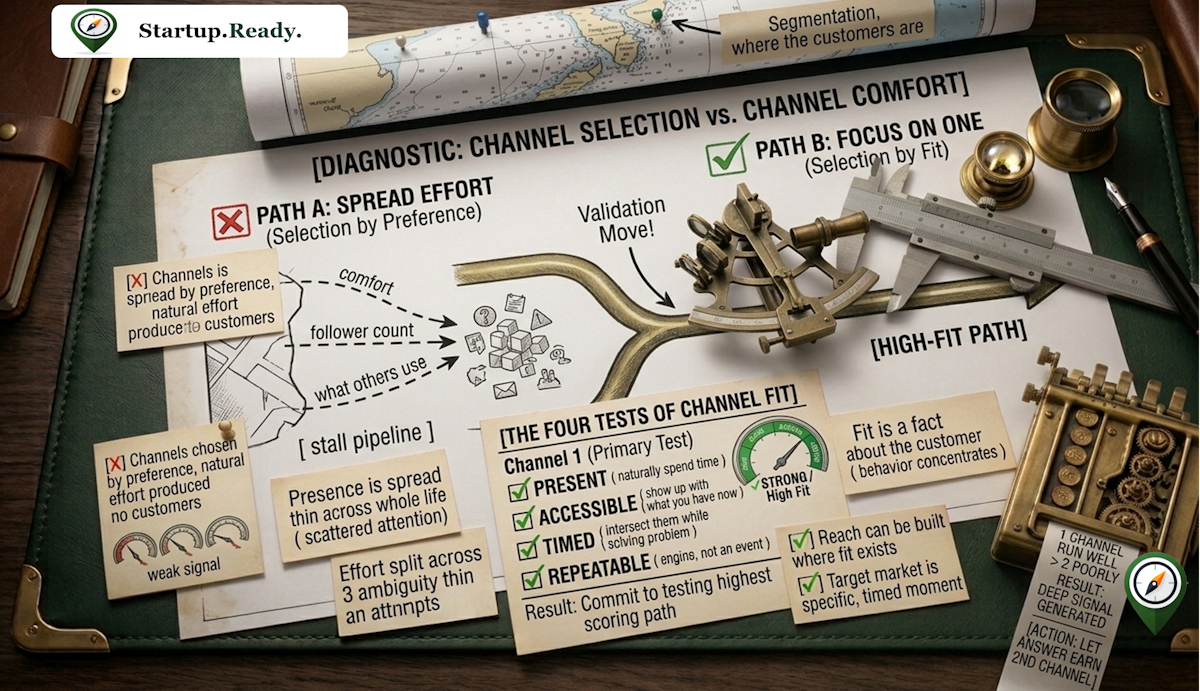
The channels are usually fine. The right one for this customer exists and works for other companies reaching the same person. It has not been chosen, because the choosing was never done on purpose. The founder picked the channels they were comfortable with, or already had a presence on, or had watched other startups use, and spread their effort across all of them. That is not a channel problem. It is a channel selection problem, and adding a fifth channel picked the same way makes it worse.
The difference matters because the two have opposite fixes. A channel problem says the routes to your customer are broken, so work harder or find new ones. A selection problem says the route exists and you have not identified it, so stop spreading effort and start choosing.
TL;DR: The Right Channel Exists. Pick It by Fit, Not by Familiarity, and Test One.
Channel selection is not a branding decision or a matter of where you are most comfortable. It is about where your specific customer already is when the problem is live, and whether you can show up there consistently with what you have right now. Effort spread across channels chosen by preference never compounds, because none of them was the right one. The work is to list every plausible channel, score each against four fit tests, and commit to testing the highest-scoring one.
This is what a real go to market strategy requires: not more channels, but the right one, chosen on purpose instead of by comfort. Here is the move, in order:
List every plausible channel, where your customer could actually discover you, not just the ones you use
Score each against four fit tests: present, accessible, timed, repeatable
Rank by fit, not by comfort or follower count
Pick one, because one channel run well beats two run poorly
Design one test with a success signal defined before you start
Four signals you have a selection problem, not a channel problem:
Your effort is spread across several channels and none is compounding
You chose your channels because you know them, not because your customer is in them
Asked which one channel you would use to reach a customer this week, you hedge toward "a few options"
After months of activity you cannot tell whether the message, the product, or the channel is the issue
If any of those describe you, this article shows you how to choose the channel by fit and commit to testing it.
If You Found This Article by Searching for Something Else
Most founders who need this are not searching for "channel selection." They are searching for the frustration.
What is the best marketing channel for my startup.
Why is my marketing not working.
How to get customers without paid ads.
Which channel should I focus on.
Why do my LinkedIn posts get engagement but no customers.
All of those trace to one question. Where is your specific customer when the problem is live, and can you show up there consistently right now? This article shows you how to answer it and choose accordingly.
Fit Is Not Preference
The first thing to correct is what "the right channel" even means, because founders quietly use the wrong definition. The right channel is not the one you are best at, not the one you have the most followers on, not the one that worked for a startup you admire. Those are all facts about you and other companies. None of them is a fact about where your customer goes when they need what you sell.
Fit is a fact about the customer. It is whether your specific customer is in a channel at the moment the problem is live for them, and whether you, with what you have today, can reliably show up there. A founder with ten thousand followers on a platform their customer only uses for entertainment has reach and no fit. A founder with no presence in a niche forum where their customer asks for exactly this kind of tool has fit and no reach yet, and the second position is far better, because reach can be built where fit already exists and fit cannot be manufactured where it does not.
This is why comfort is such an expensive way to choose. The channel you are most comfortable in is the one you already use, which is why you are comfortable, and your comfort tells you nothing about whether your customer is there in a buying frame of mind. Most founders default to the channels that feel natural to them and then wonder why natural effort produces no customers. The effort was real. It was just aimed where the founder lives, not where the customer looks.
The Four Tests of Channel Fit
Fit is not a single yes or no. A channel earns a test slot when it passes four separate checks, and a channel that fails two of them is not worth prioritizing no matter how appealing it looks.
This is different from how to get your first customer: that's the step-by-step walk from stranger to paid, while a real go to market strategy is the channel decision that happens before that walk begins.

Present and Timed sound alike and do different jobs, so keep them apart. Present is the baseline: does your customer spend time in this channel at all? A platform they never open fails here no matter how good it looks. Timed is sharper: even in a channel they use every day, does it catch them while they are actually trying to solve the problem, or only while they are there for something else? A customer can be highly present on a channel and never once meet you there in a buying frame of mind. Present gets you in the room. Timed decides whether you reach them when it counts.
Accessible keeps you honest about your current stage, and it is the test founders skip most eagerly, because the inaccessible channels are often the most impressive ones. SEO is an excellent channel and closed to you at six weeks old with no domain authority. Conference speaking is powerful and unavailable to most founders who have not built a name. Enterprise partnerships and channel resale can be transformative and are almost never open early. Paid acquisition looks accessible and quietly is not, once the budget required to learn anything exceeds what you can spend. A channel that would work beautifully with resources you do not have is not your channel today, however good it looks on a slide. Accessible asks the deflating but necessary question: not whether this channel works, but whether it works for someone standing exactly where you stand right now.
Repeatable separates a channel from a one-time event, and the distinction is worth naming, because founders count all three as channels. A channel is something you can run again and again: Google search, cold outreach, showing up in a community. A campaign is bounded, a conference sponsorship, a launch, a seasonal push, real but finite, and then it is over. A tactic is a single move, a post that went viral, a lucky feature, that you cannot reliably reproduce. Campaigns and tactics can bring customers. They cannot be the thing you build acquisition on, because acquisition has to keep working on an ordinary Tuesday and again the next. A move you can make only once is an event, not an engine.
Fit Gets You Into the Room. It Doesn't Win It.
The four tests find a channel where your customer is reachable at the right moment. They do not promise the channel is empty. The best-timed channels are often the most crowded, precisely because their fit is obvious to everyone: high-intent search terms, niche directories, the active forum where buyers ask for recommendations. Show up there and you are standing next to incumbents with more domain authority, more trust, and bigger budgets than you have.
So treat fit as the prerequisite, not the finish. Passing the four tests earns you a place in the right room. Winning it takes a distinct angle, a message that says something the incumbents do not, a wedge narrow enough that the crowd's size stops mattering. Channel fit decides where you compete. Your message decides whether you get noticed once you are there, which is the work of making the customer recognize themselves and giving them a reason to act now.
Learning how to choose a marketing channel on purpose is what a real go to market strategy actually requires, not more channels chosen by comfort.
One Channel Run Well Beats Two Run Poorly
Once the channels are scored, the temptation is to test the top two or three at once, to move faster. It moves slower. Effort split across channels is effort that never accumulates enough signal in any one of them to tell you whether it works.
Watch what a spread does to learning. Ten hours across three channels is roughly three thin attempts, each too shallow to produce a clear read, so at the end you have three ambiguous results and no idea which channel deserved more. Ten hours in one channel is a real test, deep enough that the result means something, and a result that means something is the only thing that lets you decide what to do next. Focus is not about doing less. It is about generating enough signal in one place to actually learn.
There is a real exception, and it is narrow. If two channels score nearly identically and one is genuinely free of the other in time and effort, running both can be fine. But most founders invoke that exception to avoid the harder discipline of choosing, and a second channel added to dodge a decision is not a hedge. It is a way to stay busy while learning nothing. When in doubt, pick the single highest-scoring channel, run it deep enough to get a real answer, and let that answer earn the second channel or rule it out.
One clarification, because "one channel" gets misread. Concentrating your effort means concentrating your active outreach, the place you show up and do the work. It does not mean the customer only ever touches you there. B2B buyers move across surfaces: they find you in a forum, then check your site and your profile to decide whether you are real before they book anything. Those supporting surfaces do not need working the way a channel does. They only need to exist and not embarrass you. A clean landing page and a credible professional profile are the price of admission, and if they are missing, your one primary channel converts no one, because the buyer who got interested there quietly checked and found nothing. Work one channel. Keep the trust surfaces standing.
The Contractor Tool Marketed Where Contractors Aren't
Take a founder with an inspection and compliance tool for small construction contractors. She had been posting on LinkedIn and Twitter for months, thoughtful content, decent engagement, and not one customer. The channels felt productive because the likes came in. They were the channels she knew.
Score them on fit and the picture turns fast. LinkedIn: are small contractors there when a compliance headache is live? Rarely. They are on a job site, and when they hit the problem, they do not open LinkedIn. Present, weak. Timed, weak. The engagement she was getting came from other founders and consultants, not from contractors in problem-solving mode. Meanwhile the channels that scored strong were ones she had never touched, because they were unfamiliar: the specific trade forums where contractors ask each other which tool handles a particular inspection, the supply-house counter where they already stand, the regional Facebook groups where a compliance question gets forty replies. Present, timed, accessible, repeatable, all strong, and all invisible to her because she did not personally live there.
So she stopped spreading and picked one, the trade forum that scored highest, and designed a single test: answer real compliance questions there for two weeks, with a defined signal set in advance, at least three contractors asking her directly what she used. Read the example carefully, because it is easy to draw the wrong lesson. LinkedIn is not a bad channel. It is excellent for reaching the people who are on LinkedIn in a buying frame of mind, and a contractor mid-inspection is not one of those people. No channel is good or bad in the abstract. Fit is always fit for this customer, at this moment, and a channel that is wrong for a contractor is right for someone else. She had been running LinkedIn hard because it was hers, not because it was theirs.
But My Customers Are Everywhere
Every founder eventually raises the same objection: my customer is not in one place. They are on LinkedIn and Instagram and email and three forums and Google. Choosing one channel means missing them everywhere else.
They are everywhere. Their buying behavior is not. A customer scattered across six platforms is only in a problem-solving frame of mind on one or two of them, and usually only at one moment in their week. Being everywhere your customer exists was never the goal. Being in the one place they are when the problem is live and they are ready to look is. Presence is spread thin across a whole life. Buying behavior concentrates. Chase the presence and you spread yourself as thin as their scattered attention. Follow the behavior and you find the one or two channels that actually convert, which is the entire reason to choose.
The One Sentence That Tells You Where You Stand
A founder who has chosen by fit can complete this statement concretely:
The channel I am testing first is [specific channel], it scores highest because my customer is there when the problem is live and I can run it repeatedly right now, and my success signal is [specific observable outcome] by [specific date].
A founder who has not will name several channels they are "doing" and stall on which one their customer is actually in when the problem is live, because the channels were chosen for familiarity and never scored for fit. That stall is the diagnosis. It is usually the reason months of real effort produced engagement and no customers.
If you can name the highest-fit channel and the signal that would prove it, you have one test worth running deep this week. If you cannot, that is not a reason to add another channel. It is the signal to list every place your customer could plausibly find you, score each on whether they are present, whether you can reach them now, whether it hits the urgent moment, and whether you can repeat it, then pick the one that wins and run it until it tells you something. The right channel is probably already on your list. It just has not been chosen yet.
Channel Fit and Your Go-to-Market Clarity
In the Startup Readiness Framework, Go-to-Market Clarity evaluates whether a founder has chosen channels by fit with their specific customer or by familiarity and preference. Effort spread across channels selected by comfort is one of the most common flags in early assessments, and it usually traces to a selection problem the founder has been treating as a channel problem.
Choosing well depends on knowing where your customer actually looks, which is the evidence produced by running three "where did you look" interviews. Once a channel is chosen, what happens when you show up there is the work of designing the customer encounter, and confirming the channel actually converts is one link in validating your acquisition system.
Go-to-Market Clarity is one of six pillars in the Startup Readiness Framework. If your go-to-market understanding is strong, the next question is whether the rest of your startup is as ready as your evidence.
The Startup Readiness Assessment gives you a full-system diagnostic across all six pillars in under twenty minutes.
Take your Startup Readiness Score free today at startupready.ai →
Retest channel fit for startups any time a channel that used to convert quietly stops working.
Keep Working on the Go-to-Market Pillar
The Go-to-Market Pillar asks one question from many angles: can you reliably move a stranger to a paying customer, with a message that lands and a channel that fits? Each article below takes one piece of that question. Whether your message creates urgency or only agreement. Whether you picked the channel your customer is actually in, rather than the one convenient to you. Whether you can walk one real person all the way from stranger to paid. Which assumption your whole plan is quietly resting on. Read them in any order. Each is a separate cut at the same pillar, and together they show you where your path to customers is repeatable and where it still runs on hope.
More in the Go-to-Market pillar:
Customer Encounter Design: How to Reach Your First Customers at the Right Moment
How Early-Stage Startups Build a Scalable Customer Acquisition System
A Funnel That Works on Paper Has Never Met a Customer
Agreement Is Not Urgency: Why Customers Say Yes and Never Buy
The Customer Won't Translate Your Message
Stop Asking Customers Where They'd Look. Ask Where They Went.
Some Buying Friction You Remove. Some You Listen To.
Can You Walk One Person From Stranger to Paying Customer?
Getting Your First Customers and Having a Repeatable Path Are Two Different Things
Your Go-to-Market Plan Is a Stack of Assumptions. One of Them Is Load-Bearing.
The Most Dangerous Response to Your Message Is "That's Interesting."
A Great Message in the Wrong Channel Reads Like Spam.
Published
By Dr. Shaun P. Digan
Originally Published on Startup.Ready.’s Startup Readiness: Validation, Framework, and Tools Blog at https://startupready.ai/startup-readiness/channel-selection-and-fit
Original Publication Date: August 5, 2026
Last Updated: September 5, 2026
About the Author
Dr. Shaun P. Digan is the founder of Startup.Ready and the creator of the Startup Readiness Framework, a research-based system for evaluating and validating early-stage startups before launch and early growth. He holds a PhD in Entrepreneurship from the University of Louisville and has spent over 15 years teaching, advising, and consulting with founders on startup strategy, validation, and growth.
In his writing, including the Startup Readiness Blog and The Foundations of Innovation Essay Series, he focuses on how founders can make better decisions by improving clarity, alignment, and readiness before scaling.