Agreement Is Not Urgency: Why Customers Say Yes and Never Buy
A founder reads their message to a target customer and the customer nods. Yes, that is a real problem. Yes, that happens to me. It sounds like the message worked. The customer understood it, agreed with it, saw the problem clearly. Then they do nothing, and the founder cannot understand why a message that landed produced no movement.
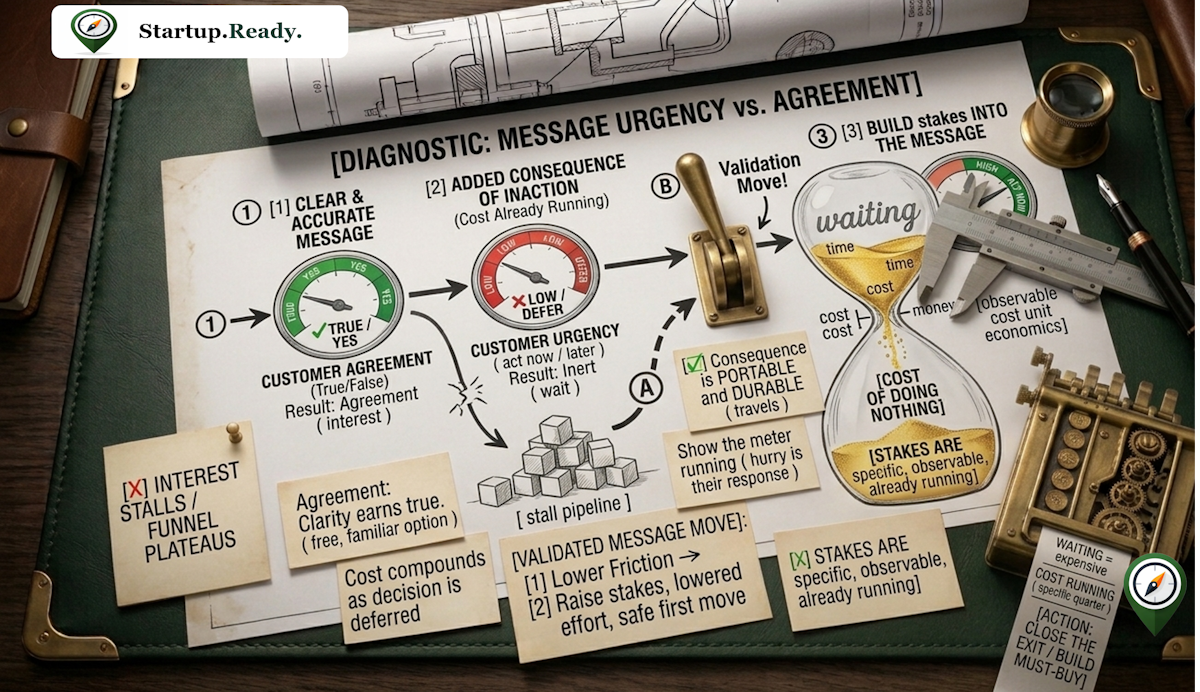
It landed as understanding. It did not land as urgency, and those are different results. A message can be perfectly clear, perfectly accurate, and completely inert, because clarity earns agreement and agreement is not the same as a reason to act now. The pipeline fills with people who think the problem is real and interesting, and conversion stays flat, because nothing in the message made waiting feel more expensive than moving.
A message dies two ways. The customer does not recognize themselves in it, or they recognize themselves and still feel no reason to move. This article is about the second death, the one that is harder to see, because from the outside it looks like the message is working.
TL;DR: Clarity Gets Agreement. Consequence Gets Action. If Nothing Bad Happens by Waiting, No One Moves.
A message with weak urgency describes the problem accurately and gives the customer no reason to act now rather than later. It produces interest without action, a pipeline of people who agree and do not move. The missing ingredient is the consequence of inaction, the specific cost of doing nothing, made real enough that waiting feels expensive. The work is to build the message from customer inputs and add the one component founders leave out. Here is the move, in order:
Name the specific customer, one person in one situation, not a segment
Name the problem in their words, the way they would say it to a colleague when you are not in the room
Name the consequence of inaction, what already happens or happens soon if they do nothing
Name the specific outcome, the observable change after the product, not a feature
Assemble and cut to one line that carries the stakes without any urgency words
Four signals your message has weak urgency:
Customers agree the problem is real and still do not act
Your pipeline is full of people who found it "interesting" and went quiet
Your message describes the problem and stops before the cost of ignoring it
You are reaching for words like "limited," "now," or "don't wait" to manufacture the urgency the message does not carry
If any of those describe you, this article shows you how to build the reason to act into the message itself.
If You Found This Article by Searching for Something Else
Most founders who need this are not searching for "weak urgency message." They are searching for the symptom.
Why do people say yes and never buy.
How to create urgency without being pushy.
Why is my messaging not converting.
How to make customers act now.
Why does my pipeline stall after interest.
All of those trace to one gap. Your message tells the customer the problem is real and never tells them what it costs to leave it unsolved. This article shows you how to close that gap without faking urgency.
Agreement Is Not Urgency
The most misleading signal in early go-to-market is the customer who agrees. Agreement feels like progress. Someone heard your message, recognized the problem, confirmed it matters. It is the response founders are hoping for, and it is exactly the response that hides the real problem, because agreement and action run on different fuel.
A customer agrees when the message is clear and true. They act when doing nothing has become more expensive than doing something. Those are separate thresholds, and a message can clear the first without coming anywhere near the second. The customer who says "yes, that is a real problem" is telling you the message is accurate. They are not telling you they intend to solve it, and most of the time they do not, because the problem, however real, is sitting comfortably below the line where it forces a decision.
Two questions sit underneath every message. Agreement answers the first. Is this true? Urgency answers the second. Should I do something about it now? A message can win the first and never touch the second.
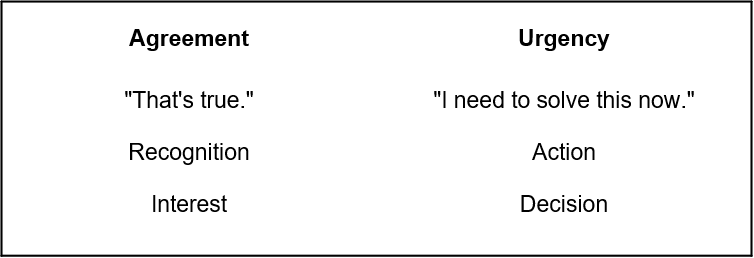
This is why a pipeline full of interested people can feel like traction and produce almost no revenue. Interest is agreement without urgency. Every "this looks great, let me think about it" is a customer who understood you perfectly and felt no pressure to move, and a hundred of them stack into a funnel that looks healthy and closes nothing. The founder reads the agreement as near-conversion and keeps generating more of it, when the missing ingredient was never awareness. It was a reason to act now.
The Missing Ingredient Is the Cost of Doing Nothing
The component that turns agreement into action is the consequence of inaction, and it is the piece founders most consistently leave out. A message that names the problem and the solution has described a transaction the customer can take or leave. A message that also names what continuing to do nothing will cost has described a situation the customer has to respond to.
Most messages stop one step too early. They say, here is your problem, and here is what we do about it. Both halves are about the product's relationship to the problem. Neither says anything about what happens if the customer simply keeps living the way they live now, which is the option every customer is actually choosing between, because the real competition is rarely another product. It is the customer doing nothing, which is free, familiar, and always available. A message that does not make doing nothing feel costly is a message losing to the easiest option on the table.
So the message has to close the exit the customer will otherwise take. Not by adding pressure from the outside, but by making visible a cost that is already there. The customer with the problem is already paying for it, in time, money, risk, or opportunity, whether or not they have named the price. The job of the message is to name it, to hold up the meter that has been running the whole time so the customer sees what another quarter of the status quo actually costs them.
Consequence is not the only real source of urgency. Deadlines, budget cycles, a season, a competitor's move, a new regulation, a trigger event in the customer's world, each creates a genuine reason to act, and none of them is manufactured. What makes consequence the one to build the message on is that it travels. A budget cycle belongs to some customers and not others. The cost of the problem going unsolved belongs to every customer who has the problem. It is the most portable and durable urgency you have, and the one to reach for when nothing external is forcing the customer's hand.
Consequence Is a Cost Already Running, Not a Hypothetical
There is a wrong way to do this, and it is the first way most founders reach for. They manufacture a consequence. A vague future risk, a someday-this-could-hurt, a scare that the customer can tell was invented to sell them something. Customers discount manufactured stakes instantly, because they can feel the difference between a real cost and a sales prop, and a fake consequence damages the message more than no consequence at all.
A real consequence is specific, observable, and already in motion. It is not what might go wrong in some distant scenario. It is what is happening right now, or will clearly happen in the next thirty to ninety days, if the customer keeps doing what they are doing. The test is whether the customer would recognize the cost from their own experience, whether they would say "yes, that is already happening to me" rather than "I suppose that could happen." The first is a consequence they feel. The second is a threat they dismiss.
The strongest version comes straight from the customer's mouth. Ask what happens if they keep doing what they are doing, and their answer is the consequence, already in the language that will land. A founder guessing at the stakes writes something plausible. A founder repeating what a customer told them writes something that makes the reader flinch, because the cost on the page is the one they have been living with.
Urgency Comes From the Stakes, Not From Urgency Words
Once the consequence is real, the message does not need urgency language, and adding it actively weakens the piece. "Limited time," "act now," "do not wait," "last chance." These are the words a message reaches for when the stakes underneath it are too weak to create urgency on their own. They announce pressure instead of producing it, and a customer who has learned to tune out marketing tunes them out first.
Real urgency is quiet. It comes from the customer seeing, clearly, what doing nothing costs, and drawing the conclusion themselves. You do not tell them to hurry. You show them the meter running, and the hurry is their own response to a cost they can now see. A message built on a genuine consequence creates more urgency in a plain declarative sentence than a message stacked with exclamation points and deadlines, because the pressure is coming from their situation rather than from your copy.
This is also the honest version. Manufactured urgency is a trick, and customers who fall for it once stop trusting you. Urgency built from a real cost is just accurate: you show the customer something true they had not fully priced, and the decision stays theirs. A message that clarifies builds a business you can keep selling to. A message that pressures spends its credibility once.
Weigh the Consequence Against the Effort to Act
Naming the cost of doing nothing is half the equation. The other half is the cost of doing something, and the customer weighs the two against each other whether or not your message acknowledges the second.
Every customer runs a rough ratio. On one side, the price of the problem continuing. On the other, the effort to fix it: the switching cost, the setup, the learning curve, the risk that the change makes things worse before it makes them better. When the fix feels heavier than the problem, the customer defers, and they defer even while agreeing the problem is real and the consequence is urgent. High stakes lose to higher friction every time. This is why a message that only raises the alarm can still move no one.
So the strongest message does two jobs at once. It makes the cost of inaction visible, and it makes the first step feel small, safe, and reversible. Raise the stakes and lower the effort in the same breath. A customer who sees a real cost and an easy first move acts. A customer who sees a real cost and a heavy, risky change keeps living with the cost, because at least the cost is familiar.
The Retention Tool Everyone Agreed With and No One Bought
Take a founder with a tool that flags which employees are at risk of quitting, sold to managers at small companies. The first message was clean and accurate: "understand your team's engagement and keep your best people." Ask any manager whether engagement and retention matter and they agree instantly. Everyone agreed. Almost no one bought.
The message was clear, true, and inert. It named a problem every manager accepts in the abstract and gave them no reason to act this quarter rather than next year, because "engagement" is a slow, ambient good that never forces a decision. The founder had built the whole message out of the problem and the outcome and left out the one thing that would move a manager: what doing nothing is already costing them.
So she went back to managers and asked what actually kept them up at night. Not one said "engagement." That was her word, not theirs. What they described, over and over, was the surprise: their best person walks in with a resignation, already holding another offer, weeks past the point where anything could have changed their mind. The fear was never low engagement in the abstract. It was the shock. She rebuilt the message around that cost, and it started there: "Your best employee is already interviewing somewhere else, and you will find out at the exit interview." Same product, same audience, same clarity. The first message described a problem managers agreed with. The second described a cost they were trying to avoid. No urgency words. The stakes did the work.
What If There Is No Consequence?
Sometimes a founder does this honestly and comes up empty. They ask what doing nothing costs, and the answer is a shrug. Nothing much happens. That result is worth taking seriously rather than writing around.
If you dig and find no real cost to inaction, the problem is not your message. It is a signal. A problem with no consequence for ignoring it is a nice-to-have, and no wording turns a nice-to-have into a must-buy. Trying to manufacture the stake is the manipulation customers smell instantly, and it is also just bad information about your business, worth having early.
More often the consequence is there and unspoken. The customer feels it and has never put it into words, so it does not surface in a casual conversation, and the founder mistakes silence for absence. That is not an absence. It is a cost running quietly under the customer's routine, and the job is to surface it, in their language, not to invent one. The gap between no consequence and an unspoken one is the gap between a product problem and a message problem. Knowing which you have is worth more than any headline.
The One Sentence That Tells You Where You Stand
A founder whose message carries urgency can complete this statement concretely:
My message names the problem in the customer's words, and it names what doing nothing costs them: [specific consequence already running], which I know is real because [the customer has said it or I have watched it happen].
A founder whose message is inert will describe the problem and the product fluently and stall on the cost of inaction, because they built the message out of the two halves that feel natural and left out the one that drives the decision. That stall is the diagnosis. It is usually the reason the customers all agree and the funnel does not close.
If you can name a consequence the customer would recognize from their own experience, you have the ingredient that turns agreement into action, and you can build it into the first line. If you cannot, that is not a reason to add "limited time" and hope. It is the signal to go back to the customer and find out what continuing to do nothing actually costs them, in their words, then put that cost where the message can be seen. The meter is already running. A message that names the price of waiting gives the customer a reason to move. A message that only names the problem gives them one more thing to agree with.
Message Urgency and Your Go-to-Market Clarity
In the Startup Readiness Framework, Go-to-Market Clarity evaluates whether a message gives the right customer a reason to act now, not just an accurate description they can agree with and set aside. A message that produces interest without action is one of the most common flags in early assessments, and it almost always traces to a missing consequence of inaction.
This is one of two ways a message fails. It can fail because the customer does not recognize their own situation in it, the resonance problem covered in why your message describes your product instead of your customer. Or it can fail because they recognize it and feel no reason to move, which is this article.
Go-to-Market Clarity is one of six pillars in the Startup Readiness Framework. If your go-to-market understanding is strong, the next question is whether the rest of your startup is as ready as your evidence.
The Startup Readiness Assessment gives you a full-system diagnostic across all six pillars in under twenty minutes.
Take your Startup Readiness Score free today at startupready.ai →
Keep Working on the Go-to-Market Pillar
The Go-to-Market Pillar asks one question from many angles: can you reliably move a stranger to a paying customer, with a message that lands and a channel that fits? Each article below takes one piece of that question. Whether your message creates urgency or only agreement. Whether you picked the channel your customer is actually in, rather than the one convenient to you. Whether you can walk one real person all the way from stranger to paid. Which assumption your whole plan is quietly resting on. Read them in any order. Each is a separate cut at the same pillar, and together they show you where your path to customers is repeatable and where it still runs on hope.
More in the Go-to-Market pillar:
Customer Encounter Design: How to Reach Your First Customers at the Right Moment
How Early-Stage Startups Build a Scalable Customer Acquisition System
A Funnel That Works on Paper Has Never Met a Customer
The Customer Won't Translate Your Message
You Don't Have a Channel Problem. You Have a Channel Selection Problem.
Stop Asking Customers Where They'd Look. Ask Where They Went.
Some Buying Friction You Remove. Some You Listen To.
Can You Walk One Person From Stranger to Paying Customer?
Getting Your First Customers and Having a Repeatable Path Are Two Different Things
Your Go-to-Market Plan Is a Stack of Assumptions. One of Them Is Load-Bearing.
The Most Dangerous Response to Your Message Is "That's Interesting."
A Great Message in the Wrong Channel Reads Like Spam.
Published
By Dr. Shaun P. Digan
Originally Published on Startup.Ready.’s Startup Readiness: Validation, Framework, and Tools Blog at https://startupready.ai/startup-readiness/craft-core-message
Original Publication Date: August 5, 2026
Last Updated: August 5, 2026
About the Author
Dr. Shaun P. Digan is the founder of Startup.Ready and the creator of the Startup Readiness Framework, a research-based system for evaluating and validating early-stage startups before launch and early growth. He holds a PhD in Entrepreneurship from the University of Louisville and has spent over 15 years teaching, advising, and consulting with founders on startup strategy, validation, and growth.
In his writing, including the Startup Readiness Blog and The Foundations of Innovation Essay Series, he focuses on how founders can make better decisions by improving clarity, alignment, and readiness before scaling.