Can You Walk One Person From Stranger to Paying Customer?
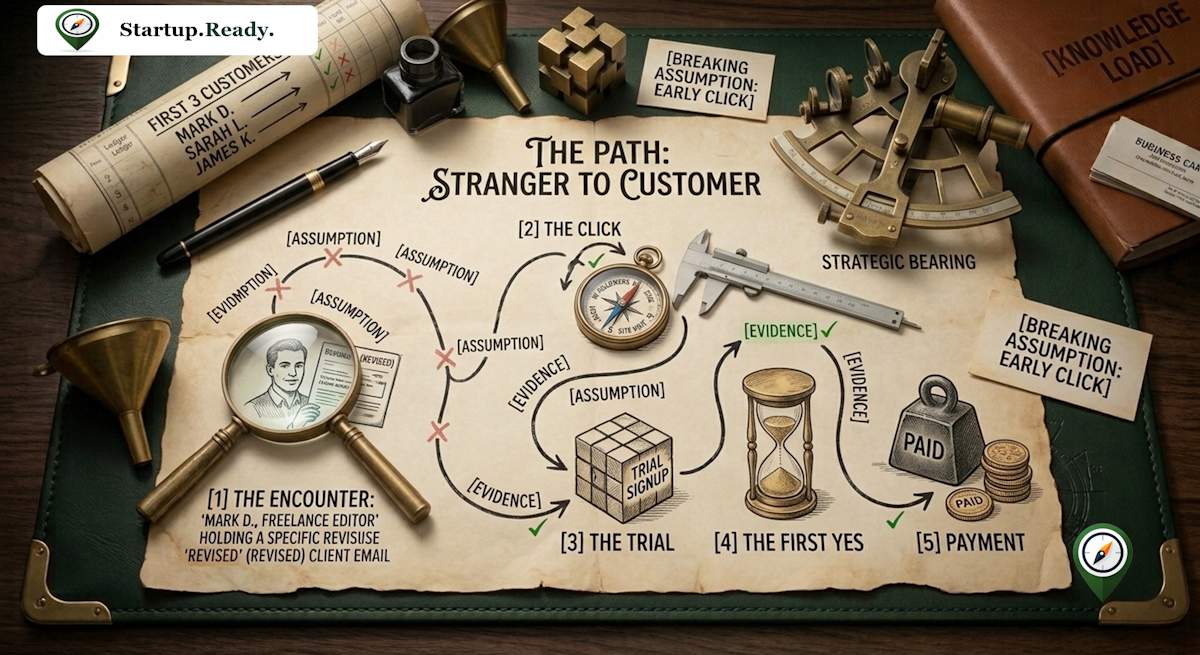
Ask a founder how they will get their first customers and many describe motion. They will post, they will reach out, they will show up in the right places, they will build an audience and let it convert. It sounds like progress, and it usually involves real effort. What it does not involve is a path.
Effort in a general direction is not the same as a described path to one specific person. A path is a sequence of steps concrete enough that someone else could follow it from stranger to paying customer without stopping to ask you a question. Motion is what happens when the sequence does not exist yet, so the founder substitutes energy for structure and hopes customers arrive as a byproduct.
They rarely do. And when one does, the founder cannot say why, which means they cannot do it again.
TL;DR: If You Can't Walk One Stranger to Paid Step by Step, You Have Hope, Not a Path.
A path to your first customers is the exact sequence of steps that takes one specific person from not knowing you exist to paying you, with every step named. Most founders can describe the direction and stall on the steps, because they have been applying effort rather than designing a route. Naming the path lets you see which steps are real and which you are assuming, and run the whole thing on purpose. The work is to pick one real person, map every step to payment, mark each step evidence or assumption, and run the path with three of them.
Learning how to get your first customers starts with one person, not a segment, walked through every step on purpose. Here is the move, in order:
Pick one real person, not a segment, someone specific enough that you could contact them today
Map every step from first awareness to payment, each one concrete enough to hand off
Mark each step evidence or assumption, based on whether you have seen a real customer take it
Find the step that breaks first, the earliest assumption that would end the path
Run it three times with three named people, because one customer is a story and three is the start of evidence
Four signals you have motion, not a path:
You can name your channels but not the steps a specific customer takes through them
When a customer converts, you cannot fully explain what moved them from one step to the next
More than half the steps to your first sale are things you assume a customer will do
Your plan for the first three customers is "keep showing up and building an audience"
If any of those describe you, this article shows you how to turn effort in a direction into a path you can run.
If You Found This Article by Searching for Something Else
Most founders who need this are not searching for "path to first customers." They are searching for the frustration.
How to get my first customers.
Why is my audience not converting.
How to get first customers with no network.
Why do people follow me but not buy.
How to actually start selling my product.
All of those point at one question. Can you describe, step by concrete step, how one specific stranger becomes a paying customer, or are you applying effort and hoping the steps fill themselves in? This article shows you how to build the path and find the step most likely to break.
One Person, Not a Segment
A path starts with a person, not a market. Founders reach for the segment because it feels safer and bigger. Small e-commerce brands. Freelance designers. Early-stage founders. A segment lets you describe an average customer, and an average customer cannot be contacted, watched, or sold to, because they do not exist. Only specific people do.
Markets do not buy. People buy. A segment cannot become your customer. A person can.
So name one. A real person, or a description so specific you could find someone who matches it today and reach out this week. The point of the specificity is that it forces every downstream step to be real. You cannot design a vague message for a vague person in a vague place. The moment the person is concrete, the path has to become concrete too, because you can immediately ask whether this actual human would do the thing your step assumes.
The path to three customers starts with the path to one. Generality produces plans that read well and never execute, because the first time you try to run a plan built for the average customer, you are standing in front of a particular one whose situation does not match the average anywhere.
Map Every Step, Then Mark What You Actually Know
Now write the sequence. From the moment this person first becomes aware you exist to the moment they pay, name every step. Every action the customer takes, every action you take, every point where something has to happen for the path to continue. Write it plainly enough that another person could execute it without turning to ask you what you meant.
The fastest way to learn how to get your first customers is running the same path with three different strangers and watching where it breaks.
This alone exposes most of the problem. Founders discover the path in their head was three steps with a canyon in the middle: they see my post, then, somehow, they are a customer. The steps between "somehow" are the whole job, and they were never named because naming them would have revealed how much was being assumed.
So mark each step, honestly, with one of two labels. Evidence, meaning you have watched a real customer take this exact step. Assumption, meaning it makes sense but no customer has actually done it yet. It looks like this:

Then count the assumptions. If more than half the steps are assumptions, you have not observed a path. You have designed one, which is a fine starting point as long as you know that is what you are holding. A designed path is a hypothesis. An observed path is a route. Confusing the first for the second is how founders spend months running a sequence no customer has ever actually completed. Most founders, doing this honestly, discover the path they thought they were running is two observed steps and a long stretch of hope.
An Audience Is Not a Path
The most common version of this mistake deserves its own name, because so many founders are living inside it. They have built an audience and they are treating it as a path. Followers, subscribers, a growing list, real engagement. It feels like go-to-market, and it produces almost no customers, and the founder cannot understand why the numbers do not convert.
An audience is a place, not a path. It is a room full of people near the problem, which is genuinely valuable and completely different from a sequence that moves one of them to pay. An audience reduces the cost of finding people. It does not reduce the cost of converting them. Those are different jobs, and a growing follower count only does the first one. The step from passive follower to paying customer is not automatic, and it is usually the exact step the founder never designed. The audience grows, the founder points at the growth as evidence of progress, and the un-designed step in the middle quietly converts no one.
Naming that step is where the audience starts to pay off. It is a specific moment of contact with a specific ask, the encounter, the work of designing the moment a customer meets you. A path is a chain of those moments. An audience gives you a place to stage the first one. It does not build the chain for you.
A real first customer acquisition path names every step from stranger to paying customer, not just the direction of effort.
The Step That Breaks First
Not all assumptions are equal. In a path, the assumption that matters most is the one that sits earliest and, if wrong, ends the path before any later step gets a chance. You can have a beautifully designed close at step nine, and it is worth nothing if the assumption at step three, that a follower will click through to the product at all, turns out to be false. Everything downstream of a broken early step is effort spent reaching a wall.
So find it. Read the path and locate the earliest step where you are assuming a customer behavior you have never actually seen. That is the step most likely to break first, and it is the one to address before you run the whole sequence, because running the full path while the earliest assumption is untested means you learn nothing except that it did not work, with no idea where.
This is what separates a path you can improve from motion you can only intensify. When a designed path breaks, it breaks at a named step, and a named break is a thing you can fix. When undesigned motion fails, there is nothing specific to adjust, so the founder does the only thing available and tries harder, which sends more effort at the same invisible wall.
The Founder With Followers and No Customers
Take a founder building a project-management tool for freelance video editors. Months of posting in editor communities and on social, a few thousand followers, real replies, and zero paying customers. Ask for the path and the answer is motion: "I post useful stuff, people follow me, and then they check out the tool and sign up."
Map it into actual steps and the canyon appears. Step one, she posts, evidence, she does this constantly. Step two, an editor sees it and follows, partial evidence, it happens. Step three, that follower visits the product site, assumption, she has never confirmed a single follower does this. Step four, they start a trial, assumption. Step five, they convert to paid, assumption. Four of five steps are assumptions, and they cluster after the follow, which is exactly where her confidence had been highest, because the audience was growing and growth felt like proof.
The earliest breaking assumption is step three, the leap from passive follower to someone who actually goes and looks. She had no evidence for it, and everything past it depended on it. So instead of posting more, she designs that step as a real encounter: a post built around a specific moment an editor hits, the panic of a client revision request buried in twelve versions of a file, ending in one low-friction ask matched to that moment. The encounter works because it meets the editor inside a community they already chose to be in, on their own terms, rather than intercepting them somewhere they never invited her. A pain-timed message pushed through the wrong channel stops being an encounter and becomes spam, and it teaches the customer to distrust you at the exact moment you wanted their attention. Then she runs the path with three named editors from her replies, not the audience in aggregate, three specific people. Three customers through the same described path would tell her the product is wanted and the route is real. Not the follower count. The route.
The One Sentence That Tells You Where You Stand
A founder who has built a path can complete this statement concretely:
The path to my first three customers starts with [specific first action], the step most likely to break is [specific step], and I will have run it with three named people by [specific date].
A founder who has not will describe channels and energy and stall on the steps in between, because they have been applying effort in a direction rather than designing a route a customer travels. That stall is the diagnosis. It is usually the reason the audience grows and the customer count does not.
The question this article asks is whether you can describe the path. Whether it scales without you, whether a stranger could run it when your network runs out, is the next question, and it cannot be answered until this one is. Description comes first. A route you cannot see, you cannot repeat.
Notice, too, what running the path by hand with three people proves and what it does not. It confirms the value lands and the message resonates, that real people move through real steps to payment. It does not yet confirm the path scales, because a route that works on your personal effort, your authority, your custom setup, may not survive being handed to a stranger. That handoff is a distinct, later step, the work of the next layer.
If you can name the path and the step most likely to break, you have something to run this week with three real people. If you cannot, that is not a reason to post more or reach out harder. It is the signal to pick one specific person, write every step to payment, and mark honestly which steps a customer has actually taken and which you are still assuming. Three customers through one described path is the beginning of evidence. Motion in a direction is not.
Mapping the Path and Your Go-to-Market Clarity
In the Startup Readiness Framework, Go-to-Market Clarity evaluates whether a founder can describe the actual route a customer travels from stranger to paid, step by concrete step, rather than the direction they are pushing in. A path that exists only as motion is one of the most common flags in early assessments, and it usually traces to effort standing in for a designed sequence.
This is the middle of three layers. Whether each acquisition stage can work at all is validating your acquisition system. Whether one specific customer can move through the whole route is this article. Whether strangers can move through it repeatably without you is mapping the path to your first ten customers. The single moment of contact inside any step is the work of designing a customer encounter.
Go-to-Market Clarity is one of six pillars in the Startup Readiness Framework. If your go-to-market understanding is strong, the next question is whether the rest of your startup is as ready as your evidence.
The Startup Readiness Assessment gives you a full-system diagnostic across all six pillars in under twenty minutes.
Take your Startup Readiness Score free today at startupready.ai →
Revisit how to get your first customers any time growth stalls, since the path that worked once often needs re-walking, not replacing.
Keep Working on the Go-to-Market Pillar
The Go-to-Market Pillar asks one question from many angles: can you reliably move a stranger to a paying customer, with a message that lands and a channel that fits? Each article below takes one piece of that question. Whether your message creates urgency or only agreement. Whether you picked the channel your customer is actually in, rather than the one convenient to you. Whether you can walk one real person all the way from stranger to paid. Which assumption your whole plan is quietly resting on. Read them in any order. Each is a separate cut at the same pillar, and together they show you where your path to customers is repeatable and where it still runs on hope.
More in the Go-to-Market pillar:
Customer Encounter Design: How to Reach Your First Customers at the Right Moment
How Early-Stage Startups Build a Scalable Customer Acquisition System
A Funnel That Works on Paper Has Never Met a Customer
Agreement Is Not Urgency: Why Customers Say Yes and Never Buy
The Customer Won't Translate Your Message
You Don't Have a Channel Problem. You Have a Channel Selection Problem.
Stop Asking Customers Where They'd Look. Ask Where They Went.
Some Buying Friction You Remove. Some You Listen To.
Getting Your First Customers and Having a Repeatable Path Are Two Different Things
Your Go-to-Market Plan Is a Stack of Assumptions. One of Them Is Load-Bearing.
The Most Dangerous Response to Your Message Is "That's Interesting."
A Great Message in the Wrong Channel Reads Like Spam.
Published
By Dr. Shaun P. Digan
Originally Published on Startup.Ready.’s Startup Readiness: Validation, Framework, and Tools Blog at https://startupready.ai/startup-readiness/path-to-first-3-customers
Original Publication Date: August 5, 2026
Last Updated: August 5, 2026
About the Author
Dr. Shaun P. Digan is the founder of Startup.Ready and the creator of the Startup Readiness Framework, a research-based system for evaluating and validating early-stage startups before launch and early growth. He holds a PhD in Entrepreneurship from the University of Louisville and has spent over 15 years teaching, advising, and consulting with founders on startup strategy, validation, and growth.
In his writing, including the Startup Readiness Blog and The Foundations of Innovation Essay Series, he focuses on how founders can make better decisions by improving clarity, alignment, and readiness before scaling.