The Most Dangerous Response to Your Message Is "That's Interesting."
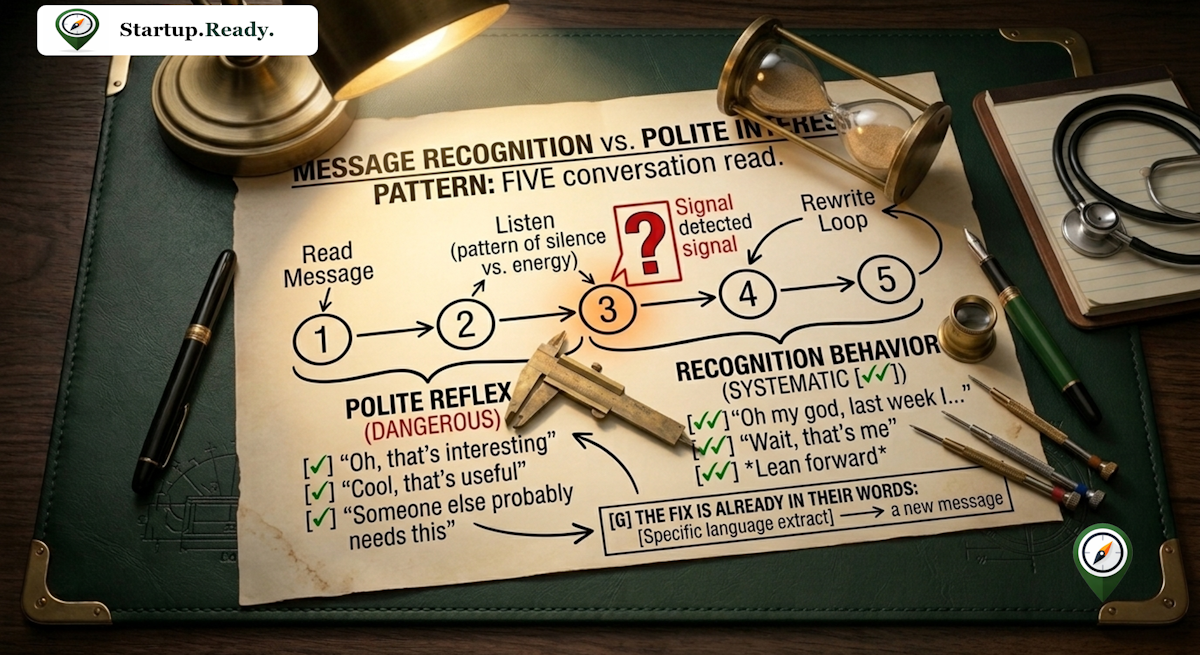
A flat "no" is easy to learn from. The response that quietly kills messages is the warm one. You read your message to someone who fits your customer, and they nod and say "oh, that's interesting," or "cool, yeah, that could be useful." It feels like a small win. It is the sound of your message missing.
Polite interest is the near-miss that looks like a hit. The person understood you, they were friendly, they did not object, and none of that is recognition. Recognition sounds different. Recognition is "wait, that is exactly what I am dealing with," said with a little energy, usually followed by them telling you about their own situation before you have asked. "Interesting" is what people say to be nice about something that is not about them. "That is me" is what they say when it is.
The whole point of testing a message with real users is to hear which of those two you are getting, honestly, before you spend months and a marketing budget amplifying a message that earns polite interest and converts no one. This is how to run that test so the answer is unmistakable.
TL;DR: Read Your Message to Five Target Users, Then Shut Up and Listen for Recognition.
Polite interest and recognition feel similar in the room and could not be more different in the funnel: one converts, the other trails off. A message you have never read to a real target user is an untested guess, and the most common result of finally testing it is the discovery that it earns "interesting" rather than "that is me." The work is to read it to five matching people, stay silent, and listen for two specific signals. Here is the move, in order:
Find five people who actually match the target customer, with no prior context on your product
Read the message and stop, no explaining, no "does that make sense?"
Listen in the first few seconds for recognition and for urgency, and write their exact words
Read the pattern across five, including where people went quiet
Rewrite with their language and one consequence you actually heard, not one you invented
Four signals your message is earning interest instead of recognition:
People say "interesting" or "useful" more than "that is exactly my situation"
They are polite and do not describe their own version of the problem back to you
You have never read the message to someone who did not already know what you are building
After the read you feel the urge to explain what you meant, because it did not land on its own
If any of those describe you, this article shows you how to test the message so you can hear the difference.
If You Found This Article by Searching for Something Else
Most founders who need this are not searching for "message testing." They are searching for the doubt.
How to test my startup messaging.
Why do people say my idea is interesting but never buy.
How to know if my value proposition is clear.
How to get feedback on my pitch.
Why is my messaging not converting.
All of them come back to one question. When a real target customer hears your message cold, do they recognize themselves in it or just find it agreeable? This article shows you how to find out in five conversations.
Why "Interesting" Converts Nothing
It helps to understand why the warm response is so misleading, because the instinct is to bank it as progress. Start with what "interesting" usually means, which is rarely "I need this." Sometimes it means "I understand." Sometimes "I hadn't thought of that." Sometimes "that's clever," or "someone else probably needs this." All of them are real reactions, and not one of them is a person recognizing their own problem. "Interesting" is a social reflex and a comprehension report rolled together, the polite thing you say about something reasonable that is not about you. It costs the speaker nothing and tells you almost nothing.
There is a reason founders bank it anyway, and the reason is emotional. "Interesting" feels like validation. It rewards the founder's identity, the sense that the idea is good and building it was right, and the reward arrives immediately, in the room, on a real person's face. That hit is exactly what makes founders stop digging. The warm word confirms what they hoped, so they pocket it and move on, when the honest read is that a confirmation costing the customer nothing confirms nothing.
Recognition is a different animal. It is an involuntary reaction to seeing your own situation named accurately, and it shows up in behavior the speaker does not fully control: a change in energy, an interruption, a specific memory offered up unprompted, "oh my god, last week I..." A person does not perform recognition to be nice. They perform politeness to be nice. That is why one is a strong early signal that the message landed and the other is mostly noise. The customer who recognizes themselves has begun evaluating the message as personally relevant. The customer who finds it interesting has filed it under things that were pleasant to hear about.
This is the same principle underneath reconstructing where customers actually looked: trust the behavior, not the stated opinion. A rating is an opinion. A spontaneous "that is exactly my problem," told back to you in the customer's own words, is behavior. The test is built to catch the second and refuse to be satisfied by the first.
The Two Signals You Are Listening For
The test is not asking whether people like the message. It is listening for two specific things, and both have to be present, because either one alone is a message that stalls.
The first is recognition: does the person describe their own situation back to you, in a way that tells you the message actually landed on them and not near them? The second is urgency: is there any energy, any reference to when this last happened to them, any question about timing, or does the interest trail politely off into nothing? Recognition without urgency is a message that describes the customer accurately and gives them no reason to move. Urgency runs the other way: a person can already feel a desperate need and simply not see that your message is about it, so recognition is usually the doorway through which their urgency becomes relevant to you. What you want is both present at once: they see themselves, and something in them leans forward.
What each of those signals is made of is its own subject. Recognition is the work of writing in the customer's language rather than your own, covered in why the customer will not translate your message. Urgency is the work of naming what doing nothing costs. This test does not build those. It measures whether the message you have actually produces them in a real person, which is the only verdict that counts.
A rough field guide to what you tend to hear, and what to do with it:

Read It, Then Stop Talking
The protocol is almost entirely about what you do not do. Read the message. Then stop. Do not add context, do not explain what you meant, do not fill the silence, and above all do not ask "does that make sense?" The silence after the read is the test, and founders ruin it constantly by rushing to rescue the message before the person has had a chance to react to it.
The reason is that everything you add after the message contaminates the signal. Every extra sentence quietly changes what you are testing: the question stops being whether the message works and becomes whether you can personally rescue it, and you will not be there to rescue it on the landing page. Explain what you meant and you have just done the customer's translation for them, so you will never learn whether the message did it on its own. Ask "does that make sense?" and you will get "yeah, sure," a verdict on your clarity, not on their recognition, which tells you nothing. The message has to stand in the world exactly as it will stand on a landing page or in an inbox, alone, with no founder beside it to interpret. That is the only condition under which the test is real, because that is the condition the message actually operates in.
So read it and watch the first few seconds. Those few seconds, before the person has composed a polite thing to say, are where the truth is. A flash of recognition, a lean-in, a specific memory: signal. A beat of hesitation, a search for something nice, a redirect to a different topic: also signal, of the opposite kind. Capture what they actually said, word for word, not your summary of it, because the exact words are both the evidence and the raw material for the fix.
The Fix Is Already in Their Words
The rewrite is not an act of creativity. It is an act of transcription, because the five conversations handed you the better message if you wrote down what people actually said. This works because the customer already owns the raw materials: the language for the problem, the emotional framing, the specific consequences of living with it. You are not inventing those from the outside and hoping they fit. You are extracting what the customer already carries and handing it back to them, which is why it fits. Two things from the test go straight into the new version.
First, the language. When a target user described their situation back to you, they used words, and some of those words were sharper than yours, because they were the customer's own. The phrase that showed up in more than one response, the one you did not use in your message, is the phrase to put in it. Their language earns recognition because it is theirs. Yours earns translation, which most people decline to do. Second, the consequence. If the urgency signal was weak, listen back through the responses for a cost someone actually named, the thing that happens to them when the problem goes unsolved, and put that observed consequence in the message instead of a plausible one you invented. A consequence a real customer said out loud carries a weight a founder's guess never will.
That is the whole loop. Read the current message, stay silent, capture the exact words, and rebuild the message out of the recognition and the cost that five real people gave you. The version you end with is not your message improved. It is their message, assembled from what testing revealed they were already saying.
The Planner Who Kept Hearing "Oh, Nice"
Take a founder with a client-management tool for independent wedding planners. Her message was tidy: "streamline your client workflow and stay organized across every event." She had read it to planners at a couple of events and come away encouraged, because everyone was warm. "Oh, that's nice." "Yeah, organization is huge." She read that as validation and was about to build a whole channel plan on it.
She ran the real test with five planners who did not know her, read the line, and made herself stop talking. The few seconds were damning in their politeness. Nods, "useful," "I could see that," and not once did a planner describe her own week back. Nobody recognized themselves in "streamline your client workflow," because no planner lies awake thinking about workflows. But in the quiet that followed, when she did not rush to explain, two of them drifted into what actually stresses them, and it came out messy and specific, the way real fear does. One: "I had a bride's nut allergy sitting in some email from months back and I only caught it the week of, I still get cold thinking about it." The other kept circling Sunday nights, not the calendar exactly, just the feeling of not knowing what she'd dropped across six weddings running at once. That was the recognition, and it arrived only because she stopped selling and let the silence pull it out.
So she rewrote from what she heard, messy as it was, and distilled it: "Never lose a detail in an old email thread again, across every wedding you're juggling at once." Not as raw as their words, but built entirely from them, their fear and their Sunday night rather than her workflow. Same product. The first message earned "oh, nice" and would have earned the same on a landing page, at scale, forever. The second earned "how do I get this," and she only found it because the test refused to let polite interest count as a yes.
What the Live Read Doesn't Catch
The five-person read is powerful for one thing and blind to two others worth naming.
It is built to test whether the message creates recognition and stakes when someone actually takes it in. That is the hard part, and the protocol is designed to nail it. What it cannot test is the two-second skim. A person sitting across from you gives your message ten or fifteen seconds of undivided, socially obligated attention. The same person on a landing page or scrolling a feed gives it under two, distracted and half-gone. The live read tells you the message lands when it is read. It does not tell you whether the first line survives a glance. That is a separate test, run where the message actually lives, in a page or an inbox, and measured by whether people stop rather than by what they say. Use the live read to get the message right. Use the page and the inbox to find out whether anyone reads it at all.
The second blind spot is who you read to. When the user and the buyer are the same person, as they are for a solo operator, one read covers it. When the person who feels the problem is not the person who signs, they are two different tests. The end user may light up, "I hate chasing missing attachments," while the economic buyer hears the identical message and says, politely, "interesting," because the pain is not theirs and the message was never built for what they answer for. Decide which role you are testing, read the message written for that role, and never let a user's recognition stand in for a buyer's, or the reverse.
The One Sentence That Tells You Where You Stand
A founder who has run the test can complete this statement concretely:
Out of five matching users, [number] recognized their own situation in the message and [number] showed any urgency, which told me [what the pattern revealed], and the change I made was to swap in the phrase [their exact words] and the consequence [the cost a real user named].
A founder who has not will describe warm reactions, "people seem to like it," and stall on how many actually recognized themselves versus were merely being nice, because the test that separates the two was never run. That stall is the diagnosis. It is usually the reason a message that got encouraging feedback converts strangers at a rate the feedback never predicted.
If you can name how many of five saw themselves and which of their words made the message sharper, you have tested the highest-leverage thing in your go-to-market with an afternoon of conversations. If you cannot, that is not a reason to keep collecting warm reactions from people who know you. It is the signal to find five strangers who match, read them the message, stop talking, and listen for the difference between "that is interesting" and "that is me." Only one of those is a message. The other is a nod.
Message Testing and Your Go-to-Market Clarity
In the Startup Readiness Framework, Go-to-Market Clarity treats an untested message as one of the highest-leverage gaps a founder can close, because the message is the variable that multiplies every channel it runs through. A message that has produced only polite interest, or has never been read to a real target user at all, is a common early flag, and five honest conversations often move it further than months of channel work.
This test measures the message. Building the two things it listens for is separate work: recognition in why the customer will not translate your message, urgency in why agreement is not urgency. And the discipline of trusting what a customer does over what they say runs through reconstructing where they actually looked.
Go-to-Market Clarity is one of six pillars in the Startup Readiness Framework. If your go-to-market understanding is strong, the next question is whether the rest of your startup is as ready as your evidence.
The Startup Readiness Assessment gives you a full-system diagnostic across all six pillars in under twenty minutes.
Take your Startup Readiness Score free today at startupready.ai →
Keep Working on the Go-to-Market Pillar
The Go-to-Market Pillar asks one question from many angles: can you reliably move a stranger to a paying customer, with a message that lands and a channel that fits? Each article below takes one piece of that question. Whether your message creates urgency or only agreement. Whether you picked the channel your customer is actually in, rather than the one convenient to you. Whether you can walk one real person all the way from stranger to paid. Which assumption your whole plan is quietly resting on. Read them in any order. Each is a separate cut at the same pillar, and together they show you where your path to customers is repeatable and where it still runs on hope.
More in the Go-to-Market pillar:
Customer Encounter Design: How to Reach Your First Customers at the Right Moment
How Early-Stage Startups Build a Scalable Customer Acquisition System
A Funnel That Works on Paper Has Never Met a Customer
Agreement Is Not Urgency: Why Customers Say Yes and Never Buy
The Customer Won't Translate Your Message
You Don't Have a Channel Problem. You Have a Channel Selection Problem.
Stop Asking Customers Where They'd Look. Ask Where They Went.
Some Buying Friction You Remove. Some You Listen To.
Can You Walk One Person From Stranger to Paying Customer?
Getting Your First Customers and Having a Repeatable Path Are Two Different Things
Your Go-to-Market Plan Is a Stack of Assumptions. One of Them Is Load-Bearing.
A Great Message in the Wrong Channel Reads Like Spam.
Published
By Dr. Shaun P. Digan
Originally Published on Startup.Ready.’s Startup Readiness: Validation, Framework, and Tools Blog at https://startupready.ai/startup-readiness/test-message-clarity
Original Publication Date: August 5, 2026
Last Updated: August 5, 2026
About the Author
Dr. Shaun P. Digan is the founder of Startup.Ready and the creator of the Startup Readiness Framework, a research-based system for evaluating and validating early-stage startups before launch and early growth. He holds a PhD in Entrepreneurship from the University of Louisville and has spent over 15 years teaching, advising, and consulting with founders on startup strategy, validation, and growth.
In his writing, including the Startup Readiness Blog and The Foundations of Innovation Essay Series, he focuses on how founders can make better decisions by improving clarity, alignment, and readiness before scaling.