"Let Me Think About It" Is a Timing Problem, Not a Price Objection
The demo goes well. The customer understands the product, sees the value, seems genuinely interested. Then you make the ask, and the energy changes. They need to think about it. They want to loop in a colleague. They will circle back next month. And often they mean it, and often they never do.
The reflex is to read that stall as an objection to price or value. So you discount, or re-explain the value, or add a feature, and none of it works, because you misdiagnosed what happened. The customer did not balk at the price. They balked at the timing. You asked at a moment they were not yet ready, and no persuasion fixes a good ask that arrived too early.
Wanting the product and being ready to pay for it are two different states, separated by a specific moment. Miss that moment and the best pitch in the world still stalls.
TL;DR: A Stalled Close Is Usually Mistimed, Not Overpriced.
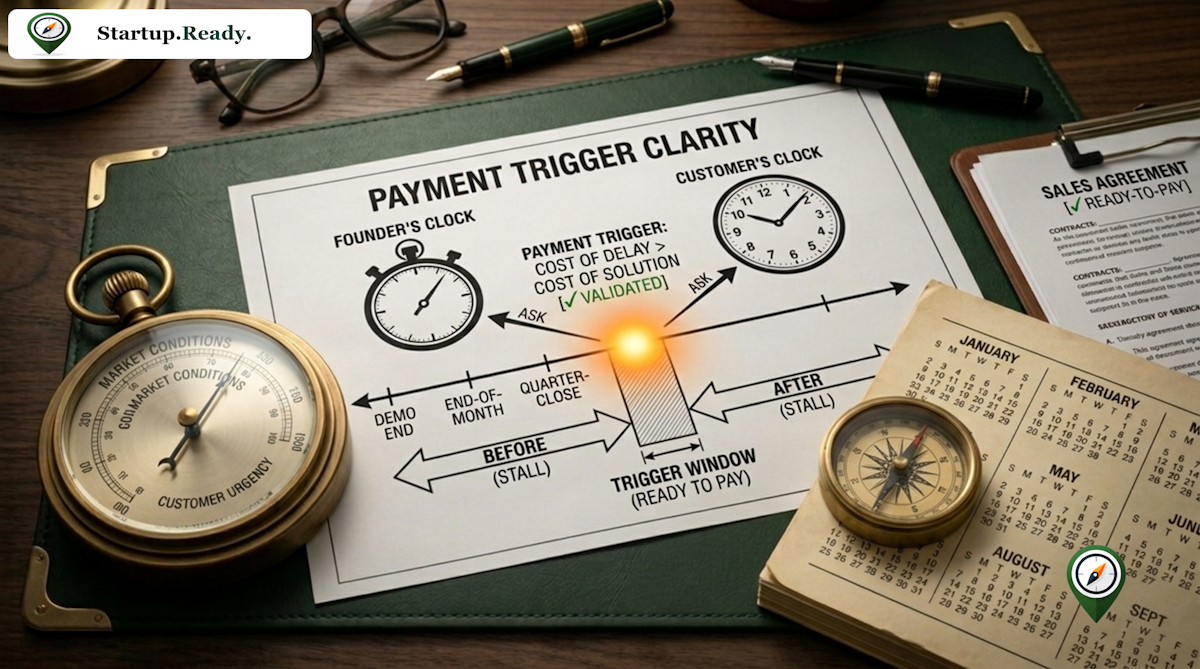
Customers move from interested to ready-to-pay at a specific trigger, an event or threshold in their world that makes the problem worth paying to solve right now. Ask before that trigger and the close stalls, no matter how good the product or the price. The work is to find the payment trigger and time the ask to it. Here is the move, in order:
Separate delivery clarity from payment clarity: understanding the value is not the same as being ready to buy it
Name the payment trigger, the specific event that flips a customer from "interesting" to "I will pay for this now"
Check when your ask currently lands, before, at, or after that trigger
Time the ask to the trigger, so the request arrives when the cost of waiting is visible to the customer rather than when it is convenient for you
Test the new timing on the next few conversations and compare the result
Four signals your close is mistimed rather than overpriced:
Prospects are enthusiastic in the demo and go quiet at the ask
"Let me think about it" is your most common loss, not "it's too expensive"
Discounting does not rescue the stalled deals
You ask for payment on your schedule, the end of the demo, the first of the month, rather than on theirs
If any of those describe you, this article shows you how to move the ask to the moment it will actually land.
If You Found This Article by Searching for Something Else
Most founders who need this are not searching for "payment trigger." They are searching for something more immediate.
Why do my deals stall at the close.
Prospects love the demo but do not buy.
How to handle "let me think about it."
Why is my sales cycle so long.
Should I lower my price to close more.
All of those point at the same underlying question. Are your prospects rejecting the price, or are you asking at the wrong moment? This article shows you how to tell, and how to fix the timing.
Delivery Clarity Is Not Payment Clarity
Here is the distinction founders collapse. A customer can fully understand what your product does, believe it would help, and want it, and still not be ready to pay, because wanting and buying are gated by different things. Wanting is gated by understanding the value. Buying is gated by a specific moment when the problem becomes worth paying to solve right now. The demo opens the first gate and rarely touches the second.
This is why a great demo can produce a stalled close. The founder reads the enthusiasm as readiness to buy, when it is readiness to want. The customer leaves understanding exactly what you offer and still missing the one thing that turns understanding into payment: a reason it has to be now. Without that reason, "later" is the honest answer, and later usually means never. So when a close stalls, the value was clear enough to generate interest; the real question is whether the moment that makes this customer pay had arrived when you asked. Often it had not.
Diagnose the Stall Before You Fix It
Timing is the most common cause of a stalled close and the most missed, but it is not the only one, and applying the timing fix to a non-timing stall wastes the effort. So before you conclude it is timing, run four quick checks on what actually happened in the conversation.
Did they believe the problem is real? If not, the stall is a value problem, and no change in timing fixes it. Did they believe your solution actually works? If not, it is a trust or proof problem, and the fix is evidence. Did they agree the problem matters right now, rather than in general? If not, that is the timing problem this article is about, and the trigger has not fired yet. Did they have the authority and budget to say yes at all? If not, it is a buying-process problem, and you were pitching the wrong person.
Most enthusiastic-demo stalls, the ones where the customer clearly got it and clearly liked it and still would not commit, fail the third check and pass the others. They believe the problem, they believe your solution, they can buy, and they do not yet feel that it has to be now. That is a timing stall, and it is the one the rest of this article solves. If your stall fails a different check, fix that one first.
The Payment Trigger
Every purchase has a trigger, and underneath it is a simple economic flip. A customer buys when the cost of not solving the problem finally exceeds the cost of solving it. Before the trigger, the problem is real but its cost is theoretical, so the honest internal verdict is "this would help, someday." After the trigger, the cost stops being theoretical and turns immediate, and the verdict flips to "not solving this is now costing me more than the solution would." The payment trigger is the specific event, threshold, or moment that flips that inequality. It is not the customer's general motivation or their broad awareness of the problem. It is the discrete moment the math changes, and until it fires, the problem stays in the category of things worth solving eventually.
The triggers take a few recognizable shapes. Sometimes it is an outcome experienced, the customer tried a taste of the value and now pays to keep or expand it. Sometimes it is a threshold crossed, a volume or a cost or a frustration that accumulated until tolerating it stopped being viable. Sometimes it is a milestone reached, a funding round, a new hire, a launch that makes the product the logical next step. Sometimes it is a risk realized, a near-miss or an actual failure that turns a latent problem into an urgent one. The specific shape matters less than the fact that there is a moment, and that your customer has one whether or not you have named it.
This is the same machinery as the urgency trigger that governs when a customer starts looking for a solution at all, covered in finding your customer's urgency trigger. The payment trigger is its close-stage cousin: not when they start searching, but when they are ready to hand over money. The two can be the same moment, and often they are not, and the gap between them is where deals go to stall.
Two Clocks
Why do founders ask early so consistently? The reason is structural, not careless. Founders run on their own clock. The demo is finished, the proposal is out, the month is closing, the quarter needs revenue, so the natural moment to ask is now, when their process reaches its end. Customers run on a different clock entirely. They buy according to events in their own world, and those events do not sync to your pipeline. The farther apart the two clocks sit, the more stalled closes you manufacture. Most timing problems begin the moment a founder mistakes the end of their sales process for the beginning of the customer's buying process.
The Founder Whose Demos Never Closed
Take a founder selling inventory-management software to growing e-commerce brands. His demos are strong. Prospects consistently leave impressed, understanding exactly how the tool would stop the overselling and stockouts that plague a fast-growing catalog. And consistently, at the ask, they go quiet. He concludes his price is too high, drops it fifteen percent, and watches the deals stall anyway.
The price was never the problem. Look at when he asks: at the end of the demo, because that is when he has their attention and it is convenient for him. But his customer's payment trigger is not the demo. The trigger is not that they learned about his product. It is that their world changed. Before: "we should get better inventory tracking sometime." After: "we oversold three hundred units during our last big sale, refunded the orders, and ate the reviews." Same problem, completely different economics, and only the second version is a purchase. At the demo, that disaster is hypothetical, the cost of a stockout is theoretical, and the prospect can see the value clearly and still, honestly, not need it this week, because nothing is on fire. So they say "let me think about it," which is the true answer. They will think about it, right up until the next peak season looms with last year's oversell fresh in memory, and then they need exactly this.
Once he sees it, the fix is not a lower price. It is different timing. He stops treating the demo as the close and starts treating it as the setup, and he moves the payment ask to the trigger: he follows up as a prospect's peak season approaches, or the moment one mentions a recent stockout, and asks then. The same ask, at the same price, lands completely differently when a real sales peak is weeks away and the cost of getting it wrong is concrete. The deals that stalled at the demo close in the run-up to the season, because now the trigger has fired.
Find the Trigger, Then Find the Window
Naming the trigger is half the work. The other half is that the trigger opens a window of readiness, and the window does not stay open. The sequence is worth holding in mind: the trigger fires, the window opens, readiness rises, and then the customer either acts or reaches for a workaround, and the window closes behind them. Ask before the window opens and you get "let me think about it." Ask after it closes and the customer has already found a workaround, adapted, or gone back to tolerating the problem.
So for your trigger, learn the shape of the window. How long after it fires does the customer stay ready? What are they doing in that stretch, researching, seeking approval, or ready to move? When does readiness fade? This is the same window analysis that governs acquisition timing, worked through in sharpening your urgency trigger, applied to the payment ask. A short, sharp window, like a retailer that needs inventory under control before a sale two weeks out, demands an ask that lands fast and closes on contact. A long, slow window gives room to nurture. Guess wrong and you either rush a customer who had time or dawdle with one who did not.
The practical move is to build the ask around the window rather than your calendar. Most early pricing is timed to the founder's convenience, the end of the demo, the first of the month. That is fine until it lands outside the customer's window, and moving it inside is often the single highest-leverage change a founder can make to their close rate.
You Can Help the Customer See the Trigger Coming
Timing the ask is not only about waiting for the trigger to fire. Sometimes you can help a customer see a trigger that is coming but has not yet registered, and doing so is legitimate and valuable as long as it is honest.
The dishonest version is manufactured urgency: the discount that expires Friday, the invented scarcity, pressure unhooked from the customer's real situation. It works once and costs trust. The honest version surfaces a real future cost the customer has not done the math on yet. A prospect mentions their peak season starts in two months. You can help them see what last year's oversell would cost repeated at this year's higher volume, and put a number on it: if it happens again at this scale, here is roughly what the refunds and the lost reviews take from you. You are not inventing urgency. You are making a real, upcoming trigger visible before it fires, so the customer can choose to solve it ahead of the cost rather than after.
This is the founder's version of the cost-of-delay conversation, and the most valuable selling a founder can do, because it helps the customer reach a good decision earlier rather than pressuring them into a bad one. The test is simple: are you pointing at a cost genuinely coming in their world, or one you invented to close this month? The first earns the relationship. The second spends it.
The Trigger-Aligned Closing Checklist
Run these four steps in a discovery call, and the payment ask lands inside the customer's window instead of at your convenience.
Identify the trigger event. Ask it directly: what specific event in the next month or two would make solving this urgent? You are listening for the moment their world changes, not for general interest.
Map the decision window. Between that trigger and when the solution has to be live, how much time is there? That span is your window, and it tells you whether to close on contact or nurture.
Quantify the cost of delay. Work it out together: if this is still unsolved by the trigger date, what does it cost per week or per month? A number the customer says out loud is worth far more than one you assert.
Anchor the follow-up to the trigger. Set the next step against their window, not a default end-of-month date. "Let's reconnect as your peak season approaches," not "I'll follow up in thirty days."
If you cannot get answers to the first three, the trigger has not been found yet, and the ask is premature no matter how good the demo was.
The One Sentence That Tells You Where You Stand
A founder who has timed the ask to the trigger can complete this statement plainly:
My customer's payment trigger is [specific event or moment], my current ask lands [before / at / after] it, and the change I am making is [specific timing change] so the ask arrives when the cost of waiting is visible to them.
A founder losing deals to timing can describe the stall in detail and cannot name the trigger, because the whole problem is that they have been treating the demo as the moment when the real moment is somewhere else entirely. That blank is the diagnosis.
If you can name the trigger and see where your ask lands relative to it, you have found a lever that price changes cannot reach, and moving the ask into the window often rescues the exact deals you were about to discount. If you cannot yet name the trigger, that is the first work: look at your last handful of closed deals and ask what had just changed in the customer's world right before they paid. It is almost never "nothing." It is a moment, and once you can name it, you can aim at it. The goal is never to force a decision. It is to make the ask at the moment the customer is actually ready to make one.
Payment Timing and Your Business Model Clarity
In the Startup Readiness Framework, Business Model Clarity treats the payment trigger as part of how value converts to revenue, because a model can deliver real value and still stall at the close if the ask is mistimed. Fuzzy delivery timing is a common early flag, and it disguises itself well, because the stalled deals look like price or value objections when they are timing objections wearing a costume.
Whether the value itself is defined clearly enough to sell is the companion question, covered in how to measure the value your startup delivers.
The Business Model Pillar is one of six pillars in the Startup Readiness Framework. If your business model is clear and defensible, the next question is whether the rest of your startup is as ready as your evidence. The Startup Readiness Assessment gives you a full-system diagnostic across all six pillars in under twenty minutes.
Take your Startup Readiness Score free today at startupready.ai →
Keep Working on the Business Model Pillar
The Business Model Pillar asks one question from many angles: does your model turn real value into revenue that holds as you grow? Each article below takes one piece of that question. What you are actually competing against. Where the value lands for the customer. Whether you are pricing your effort or their outcome. What caps your growth before you reach it. Read them in any order. Each is a separate cut at the same pillar, and together they show you where your model is clear and where it still breaks.
More in the Business Model pillar:
Startup Defensibility: Why a Head Start Is Not a Moat
How to Measure the Value Your Startup Delivers Before You Try to Sell It
The Elevator Pitch Template: How to Write, Test, and Use Your One-Line Business Model
"Let Me Think About It" Is a Timing Problem, Not a Price Objection
Your Customer Is Not Deciding Whether to Use You. They Are Comparing Their Options.
If Every Customer Resets the Work, You Have Revenue but Not Leverage
You Are Pricing Your Effort. Your Customer Is Buying an Outcome.
The Constraint That Caps Your Growth Is Rarely the One You Are Worried About
A Structural Constraint Does Not Yield to Effort. It Yields to a Plan.
The Product Working Is Not the Same as the Customer Feeling It Work
Delivering Value and Naming the Exchange Are Two Different Things
Why Customers Stay Is Not the Same as Why They Chose You
A Stall in Growth and a Ceiling in the Model Are Two Different Problems
Published
By Dr. Shaun P. Digan
Originally Published on the Startup.Ready.’s Startup Readiness: Validation, Framework, and Tools Blog at https://startupready.ai/startup-readiness/payment-trigger
Original Publication Date: August 5, 2026
Last Updated: August 5, 2026
About the Author
Dr. Shaun P. Digan is the founder of Startup.Ready and the creator of the Startup Readiness Framework, a research-based system for evaluating and validating early-stage startups before launch and early growth. He holds a PhD in Entrepreneurship from the University of Louisville and has spent over 15 years teaching, advising, and consulting with founders on startup strategy, validation, and growth.
In his writing, including the Startup Readiness Blog and The Foundations of Innovation Essay Series, he focuses on how founders can make better decisions by improving clarity, alignment, and readiness before scaling.