The Product Working Is Not the Same as the Customer Feeling It Work
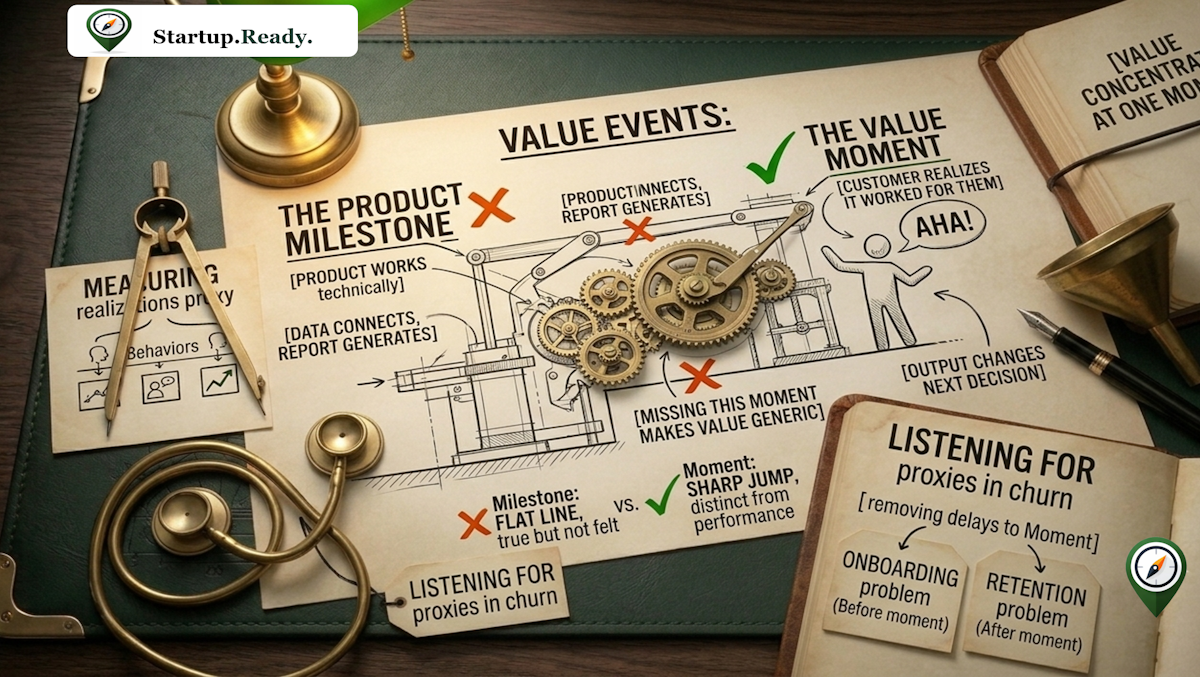
There is a moment in every customer's experience when the value stops being a claim and becomes something they have felt. Before that moment, your product is a promise they are taking on faith. After it, they know. And that moment is almost never the moment the product technically starts working.
Founders conflate the two constantly, and it is why so many value descriptions come out generic. You know the instant your product does its job, the data connects, the report generates, the workflow runs, so you describe value from there: "it improves efficiency," "it saves time." But the customer does not feel value when the machinery turns over. They feel it later, at the specific moment they realize the thing worked for them, when they look at the output and see something that changes what they will do next. The product working is an event in your world. Value landing is an event in theirs, and they are not the same event.
Find that second moment and a surprising amount of the business sharpens around it. Miss it, and you are describing a category while your customers are quietly deciding whether they ever felt anything.
TL;DR: Value Concentrates at One Moment. Name It, and Design Everything to Reach It Faster.
Value is not spread evenly across the customer journey. It lands at a specific, observable moment when the customer first feels the difference, and that moment is distinct from when the product starts working. Naming it sharpens onboarding, messaging, pricing, and, above all, your read on why customers churn. The work is to map the journey, find the moment, and work backward to get customers there faster. Here is the move, in order:
Map the journey from first use to the point where the customer has clearly felt the outcome
Find the moment, the observable event where the customer says or does something that shows they felt it
Separate it from the product milestone, because the product working is not the customer realizing it worked
Diagnose your churn with it: before the moment, churn is an onboarding problem; after, a retention problem
Work backward to remove whatever delays customers from reaching the moment
Four signals you have not located your value moment:
Your outcome description is "saves time" or "improves efficiency," true but not felt
You cannot say, for a churned customer, whether they left before or after they felt the value
Your onboarding is built for completeness, not for speed to the first real result
Your messaging describes the product category rather than the moment the customer feels the difference
If any of those describe you, this article shows you how to find the moment and build toward it.
If You Found This Article by Searching for Something Else
Most founders who need this are not searching for "value moment." They are searching for something more immediate.
Why do customers churn early.
How to improve onboarding and activation.
What is my aha moment.
Why does my product feel generic.
How to reduce time to value.
All of those point at the same underlying question. When exactly does your customer first feel the value, and is your product built to get them there fast? This article shows you how to find that moment and use it.
Value Is Not Spread Evenly
The mental model most founders carry is that value accumulates steadily as the customer uses the product, a little more with each session, a rising line. That is not how it feels from the customer's side. For the customer, value is lumpy. It sits near zero through setup and first use, no matter how much your product is technically doing, and then it jumps, all at once, at the moment they first see the difference the product makes to them specifically. That jump is the value moment, and almost everything a customer decides about your product, whether to keep using it, whether to pay, whether to tell someone, hinges on whether they reached it.
This is why generic outcome language happens. A founder describing value from the steady-accumulation model reaches for steady-accumulation words: efficiency, optimization, time saved over the month. Those are true and they are flat, because they describe the gentle rising line the founder imagines rather than the sharp jump the customer actually experiences. The customer does not remember a month of marginal efficiency. They remember the moment the dashboard showed them the leak they had been missing, or the first report that took two minutes instead of two hours. Value, to them, has a location, and if your description does not name it, your description is not where the value is.
The product working is the flat part of the line. The value moment is the jump. Founders build for the flat part, because that is what they can see, and describe value from there, which is exactly why the description comes out generic.
The Product Milestone Is Not the Value Moment
The trap worth naming precisely is the gap between two events that feel like the same event from inside the company.
The product milestone is when your product does its job: the integration completes, the model returns a result, the workflow executes without error. You can see this one clearly, you probably have a log of it, and it is tempting to treat it as the moment value is delivered. It is not. It is the moment value becomes possible. The customer can hit every product milestone and feel nothing, because doing the job and the customer noticing the job got done are different things.
The value moment is when the customer realizes it worked for them. It is observable, but on their side, not yours: they do something different afterward, upgrade, use it more, bring in a colleague, or they say something specific, "this is exactly what I needed," "I wish I'd had this six months ago." The test is simple and strict. If the moment can happen without the customer recognizing the outcome, it is a product milestone, not a value moment. The dashboard populating is a milestone. The customer looking at the dashboard and spotting something that changes their next decision is the value moment, and it might come minutes or days after the milestone, or never.
Building for the milestone and assuming the value moment comes free is the single most common way a real outcome gets described as a generic one. You shipped the capability. Whether the customer ever felt it is a separate question you have to design for on purpose.
Isn't This Just the Aha Moment?
The idea already has names. Aha moment. Activation. First value. Time to value. Fair. Product teams have circled this ground for years, and if you have run growth before, the territory is familiar.
One distinction separates this from those terms. Most activation frameworks fuse two events into one: the product doing its job and the customer feeling it. Activation gets defined as an action inside the product, imported a contact, connected a source, sent the first message, and then treated as the moment value arrived. That is the product milestone wearing a customer-value label. It is measurable, which is why teams reach for it, and it is often a weak proxy for the jump, because a customer can complete the activation action and feel nothing.
The value moment lives on the customer's side of the glass. Sometimes it coincides with the activation action. Often it trails it by minutes or days, and sometimes it never arrives. Treat the familiar terms as neighbors. The contribution here is the seam between them: name the product milestone and the value moment separately, measure both, and stop assuming the second rides in free on the first.
How to Instrument a Realization
The obvious objection: a product milestone writes to a database, and a customer's internal realization does not. You cannot log a feeling. You do not need to. A realization that matters almost always leaks into behavior, and behavior is trackable.
The move is to find the behavioral proxy, the concrete action a customer takes only because they felt the value. A few patterns:
They export or share the output. A customer who sends a generated report to Slack or email is telling you they found something worth showing their boss.
They pull someone in. A user who invites a teammate within minutes of an output is telling you they need others to act on what they just saw.
They commit to coming back. Saving a filtered view, setting a custom alert, or building their own dashboard says they expect this to keep mattering.
None of these is the realization itself. Each is a shadow the realization casts, and shadows you can measure. Pick the one or two proxies that best fit your product, instrument them, and you have turned an invisible cognitive event into a signal you can count, the same signal the churn split below depends on. If you cannot name a single action a customer takes only after the value lands, sit with that. It usually means you have not watched a real customer closely enough to know what the moment looks like from outside.
The Churn You Cannot Diagnose
Here is where naming the moment stops being conceptual and becomes worth real money. Until you know when value lands, you cannot tell why your customers are leaving, and the two reasons need opposite fixes.
A customer who churns before the value moment left because they never felt anything. That is an onboarding problem: the path to the first real result was too long, too confusing, or too much work, and they gave up before the jump. A customer who churns after the value moment felt the value and left anyway. That is a retention problem: the product did not keep earning its place after the first hit. These are completely different failures. The first is fixed by getting customers to the moment faster. The second is fixed by giving them reasons to stay past it. Apply the onboarding fix to a retention problem, or the retention fix to an onboarding problem, and you spend months improving the wrong thing.
From your dashboard, though, the two look identical. A cancelled account is a cancelled account. You cannot tell them apart without a marker for the value moment, some observable signal that says this customer did or did not reach the jump. That is the hidden operational payoff of naming the moment: it splits your churn into two piles that were sitting in one, and each pile has a different, obvious fix. Founders who cannot name their value moment are flying blind on the single most expensive number in the business, and they usually do not know it.
The Analytics Founder Who Was Building for the Wrong Line
Take a founder with a marketing-analytics product. Ask what it delivers and the answer is smooth and generic: "it gives teams visibility into their funnel and saves them time pulling reports." True, flat, forgettable.
Map the journey instead. The customer signs up, connects their data sources, waits for the dashboard to populate, and then, at some point, looks at it. The product milestone is the dashboard populating, which the founder has instrumented and celebrates. But walk one real customer past it. The dashboard fills with charts, and for a moment the customer feels nothing, it is just their same numbers, arranged. Then their eye catches one thing: a stage in the funnel where they are losing far more than they realized, a leak worth real money that they had never seen laid out. That is the jump. In that instant the product stops being "another dashboard" and becomes "the thing that showed me where I was bleeding." That realization, not the dashboard populating, is when value lands.
Now everything reorganizes around it. The founder had been building onboarding for completeness, walking every new customer through connecting all their data sources before showing them anything, which meant many customers churned during setup, before the jump, an onboarding problem she had been misreading as disinterest. So she redesigns: connect one source, surface one surprising insight in the first session, get them to the jump on day one and let them add the rest later. Her messaging changes too, from "funnel visibility and time savings," the flat line, to "see the leak in your funnel in five minutes," the moment. And she instruments the moment itself, so that for the first time she can tell whether a churned customer ever reached it. The outcome was never generic. She had just been describing the flat part of the line because that was the part she could see.
Fast Value Cannot Mean False Value
One caution on speeding customers to the moment. Reaching it faster cannot come at the cost of the output's integrity. In the analytics case the shortcut is safe: one connected source still shows a real leak. In other domains it is not so clean. Surface a quick win on partial data in security, enterprise financial modeling, or supply chain, and you risk a false positive, a misleading insight the customer acts on and gets burned by. That destroys trust faster than a slow setup ever would.
The rule is simple. Frame early value honestly. When the first insight rests on incomplete data, present it as a preliminary sample rather than a settled conclusion: "here is an early read from one source, and it sharpens as you connect the rest." You still get the jump. The customer still feels the product working for them. And you have not spent your credibility on a number that might not hold. Speed to the moment and integrity of the moment are both required, and trading the second for the first looks like progress while reading to the customer as a bug.
The One Sentence That Tells You Where You Stand
A founder who has located the moment can complete this statement concretely:
The moment value lands for my customer is [specific observable event on the customer's side], it happens about [timeframe] after first use, and the one change I am making to help more customers reach it faster is [specific change].
A founder who has not can describe what the product does in detail and stalls on the moment the customer feels it, because they have been watching the product milestone and assuming the value moment rides along with it. That stall is the diagnosis, and it is usually the reason the outcome keeps coming out generic.
If you can name the moment, you can point your onboarding, your messaging, and your churn analysis at the one event that actually decides everything downstream. If you cannot, that is not a reason to polish the value statement with better adjectives. It is the signal to map one real customer's journey, find the instant they first felt the difference, and separate it hard from the moment your product merely worked. Design for that instant, and measure who reaches it. Everything generic in your description was hiding the fact that you had not yet found it.
Two Honest Limits
Two caveats keep this framework honest.
Some products have more than one value moment. A CRM lands value when the first record imports, again when the first deal closes inside the system, again when management trusts the forecast enough to run off it. Each jump is larger than the last. The framework still holds, applied in sequence. Find the first moment first, because it is the one that decides whether the customer stays long enough to reach the rest. Map that early jump, build onboarding toward it, and work on the later moments once customers are surviving to see them.
Some products build value gradually instead of in a jump. Accounting systems, security tools, insurance, infrastructure. The value is confidence that accumulates or risk that quietly declines, and there may be no single dramatic instant. Here the moment becomes a threshold rather than a spike: the point where accumulated confidence crosses into "I trust this to run without me watching it." A threshold is harder to spot than a spike. It is still locatable, still observable, still the thing your onboarding should aim at. The line is smoother. The question is the same. When does the customer first feel they can rely on you, and is your product built to get them there sooner?
The Value Moment and Your Business Model Clarity
In the Startup Readiness Framework, Business Model Clarity treats the value moment as the most honest description of what a product delivers, because it names the point where the customer feels the outcome rather than the point where the product performs it. A generic outcome is a common early flag, and it almost always traces to an unlocated value moment: the founder is describing the flat part of the line.
What that outcome actually is, measured and provable, is the companion question, covered in how to measure the value your startup delivers, and when the customer is ready to pay for it is a related but distinct moment, covered in why "let me think about it" is a timing problem.
The Business Model Pillar is one of six pillars in the Startup Readiness Framework. If your business model is clear and defensible, the next question is whether the rest of your startup is as ready as your evidence. The Startup Readiness Assessment gives you a full-system diagnostic across all six pillars in under twenty minutes.
Take your Startup Readiness Score free today at startupready.ai →
Keep Working on the Business Model Pillar
The Business Model pillar asks one question from many angles: does your model turn real value into revenue that holds as you grow? Each article below takes one piece of that question. What you are actually competing against. Where the value lands for the customer. Whether you are pricing your effort or their outcome. What caps your growth before you reach it. Read them in any order. Each is a separate cut at the same pillar, and together they show you where your model is clear and where it still breaks.
More in the Business Model pillar:
Startup Defensibility: Why a Head Start Is Not a Moat
How to Measure the Value Your Startup Delivers Before You Try to Sell It
The Elevator Pitch Template: How to Write, Test, and Use Your One-Line Business Model
"Let Me Think About It" Is a Timing Problem, Not a Price Objection
Your Customer Is Not Deciding Whether to Use You. They Are Comparing Their Options.
If Every Customer Resets the Work, You Have Revenue but Not Leverage
You Are Pricing Your Effort. Your Customer Is Buying an Outcome.
The Constraint That Caps Your Growth Is Rarely the One You Are Worried About
A Structural Constraint Does Not Yield to Effort. It Yields to a Plan.
The Product Working Is Not the Same as the Customer Feeling It Work
Delivering Value and Naming the Exchange Are Two Different Things
Why Customers Stay Is Not the Same as Why They Chose You
A Stall in Growth and a Ceiling in the Model Are Two Different Problems
Published
By Dr. Shaun P. Digan
Originally Published on the Startup.Ready.’s Startup Readiness: Validation, Framework, and Tools Blog at https://startupready.ai/startup-readiness/measurable-customer-outcome
Original Publication Date: August 5, 2026
Last Updated: August 5, 2026
About the Author
Dr. Shaun P. Digan is the founder of Startup.Ready and the creator of the Startup Readiness Framework, a research-based system for evaluating and validating early-stage startups before launch and early growth. He holds a PhD in Entrepreneurship from the University of Louisville and has spent over 15 years teaching, advising, and consulting with founders on startup strategy, validation, and growth.
In his writing, including the Startup Readiness Blog and The Foundations of Innovation Essay Series, he focuses on how founders can make better decisions by improving clarity, alignment, and readiness before scaling.