Why Customers Stay Is Not the Same as Why They Chose You
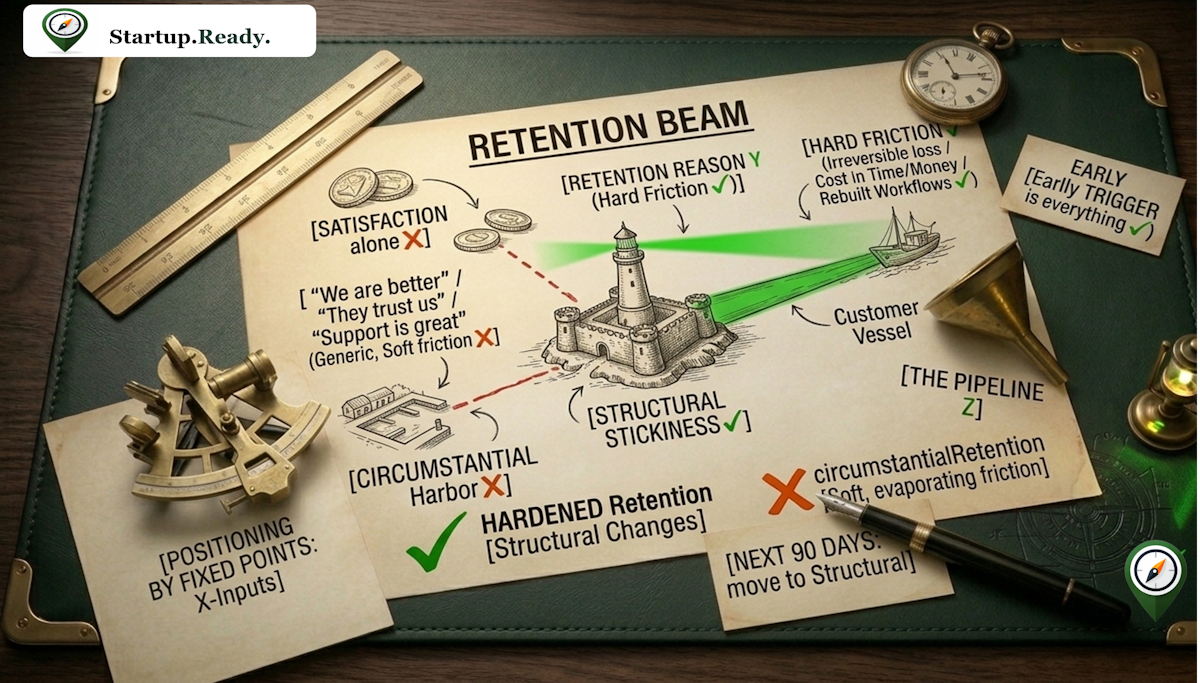
Ask a founder why their customers would stay if a well-funded competitor showed up tomorrow with the same product at a lower price, and the confident answers are the ones to worry about. "We're better." "They trust us." "Our support is great." Each of those explains why a customer chose the product. None of them explains why the customer would refuse a cheaper, equivalent version once it exists.
Those are two different questions, and founders answer the second with the first. The reason a customer picked you is your value proposition. The reason a customer would not leave is your retention reason. A business can have a strong value proposition and no retention reason at all, and from the inside the two feel identical, because the customers are happy either way.
Happy customers are not automatically hard to keep. Satisfaction holds until a good-enough alternative arrives at a lower price, and then a business finds out whether anything was holding the customer besides the fact that they liked you. Sometimes something is. The value keeps outrunning the alternatives, or leaving would genuinely cost them. Sometimes nothing is. The difference stays invisible until the moment it gets tested, which is the worst moment to learn which one you had.
TL;DR: Satisfaction Alone Doesn't Hold. Superior Value or Real Friction Does. Know Which You're Building.
Customers stay for two kinds of reasons: the product keeps beating the alternatives, or leaving would cost them something real. The first is stronger and has to be re-earned every renewal. The second you can build on purpose, which is where this worksheet concentrates, because a business with no sustained edge yet can still engineer switching cost. What collapses under pressure is satisfaction with neither behind it, and most early-stage retention is exactly that while looking sturdier. The goal is not a finished moat. It is to see clearly why a customer would stay today, test whether that reason survives pressure, and make one change that hardens it before a competitor arrives. Here is the move, in order:
Name the real retention reason, the thing that would keep them when a cheaper equivalent exists, not the reason they chose you
Sort the friction: hard friction costs time, money, or irreversible loss; soft friction is preference and familiarity
Run the three tests: would switching still hurt if someone made it easy, how fast would they evaluate a half-price offer, what exactly would they lose
Classify it honestly: structural, habitual, or circumstantial
Make one change that moves the strongest reason toward structural in the next 90 days
Four signals your retention is circumstantial:
Your answer to "why would they stay" is "we're better" or "they trust us"
No customer has ever stayed through a real competitive threat, because one has not arrived yet
You cannot name a specific thing a customer would lose by switching that they could not rebuild in a month
The friction keeping customers is mostly preference and habit, not cost and loss
If any of those describe you, this article shows you how to test the reason customers stay and harden it before it is tested for you.
If You Found This Article by Searching for Something Else
Most founders who need this are not searching for "retention durability." They are searching for the fear underneath it.
How to build a moat as a startup.
What are switching costs.
How to keep customers from churning to competitors.
Why do customers leave for cheaper alternatives.
How to defend against a bigger competitor.
All of those point at one question. When a credible competitor makes leaving easy and cheap, is there anything structural holding your customers, or only the fact that leaving has not been made easy yet? This article shows you how to tell the difference and act on it early.
The Value Proposition Is Not the Retention Reason
Start with the distinction that most competitive worry skips right past. The value proposition is why a customer chose you over doing nothing or over the alternative they had. The retention reason is why they would stay when an equivalent product arrives cheaper. Founders collapse the two because, until a competitor shows up, they never have to be separated.
Here is the test that separates them. Picture a well-funded competitor launching a nearly identical product tomorrow at half your price. Now ask why your customer stays. If the honest answer is that you are better or that they trust you, you have named a value proposition, and a value proposition is exactly what a cheaper competitor is about to attack. Being better is a claim the competitor will contest on features and price. Being trusted is a feeling that erodes the third time a customer sees the alternative do the same job for less.
A retention reason survives that scenario because it does not depend on you being the best option. It depends on leaving being genuinely disruptive. The customer might even prefer the competitor and still stay, because going would cost them something they are not willing to lose. That is the reason worth having, and it is a different kind of thing than satisfaction. It has to be built, and it rarely gets built by accident.
The perfect cheaper clone is a deliberate worst case, not a forecast. Real competitors are rarely equivalents. They arrive with tradeoffs, partial overlap, and different strengths, and the actual question a customer faces is fuzzier than "same thing for less." So run the clone as a stress test to find your floor, then ask the realistic version: what would make this customer seriously evaluate leaving? A price gap, a missing feature they have started to want, one bad quarter of your support. The answer to that question is where the real exposure lives.
Friction Is One Way to Be Hard to Leave. It Is Not the Only One.
Switching cost is the mechanism this worksheet concentrates on, and it helps to be clear about why. It is the retention a founder with no other advantage can deliberately build. It is not the only durable mechanism, and it is often not the strongest.
Some of the hardest businesses to displace hold customers through sustained superiority rather than friction. Google keeps a search user who could switch engines in ten seconds, because the results stay better. Stripe, Netflix, and Notion all live with low switching costs and retain anyway, because the product keeps outrunning the alternatives on the thing the customer came for. This is not the value proposition that won the deal. It is the product continuing to win, renewal after renewal. When you can sustain it, it holds harder than any lock-in, because the customer stays by preference rather than by cost.
Durable retention comes from four sources, and strong businesses usually combine them:
Value. The results stay superior, so staying keeps winning. The strongest source, and the hardest to hold, because it has to be re-earned every renewal.
Structure. Leaving costs time, data, or rebuilt workflows. Buildable early, which is why this worksheet leans on it.
Network. The people or tools the customer needs are already here. Powerful once it exists, slow to start.
Habit. Routines have formed around the product. The weakest on its own, and it only holds when it rides on top of one of the other three.
Amazon Prime and Apple look like habit from the outside. Underneath, the habit is riding on ecosystem, accumulated value, and real switching cost. The habit is the surface. The other three are what make it stick.
This worksheet concentrates on structure for one reason. Not because structure is the best mechanism. Because it is the one you can build on purpose before you can count on out-competing every alternative on value alone. A Fragile Model has no sustained edge to lean on yet. Structure is the retention you engineer while you work toward the kind you earn.
Hard Friction Holds. Soft Friction Does Not.
Not all reasons to stay are equal, and the difference is the kind of friction leaving would create. Sort every retention reason into one of two buckets before you trust it.
Hard friction requires time, cost, or irreversible loss to overcome. The customer has years of data in the product that will not transfer cleanly. They have built workflows and integrations that would need rebuilding. They have accumulated a history the product holds and they refer back to. Leaving means losing or recreating something real, and that cost is what makes them think twice regardless of how much they like the competitor.
Soft friction is preference, familiarity, and minor inconvenience. The team knows where the buttons are. The founder is responsive. The customer would rather not deal with a migration this quarter. Every one of those is real, and every one of them evaporates the moment a competitor makes switching easy and the price gap makes it worth the afternoon. Soft friction is what a motivated competitor is built to dissolve.
Count your friction honestly. If most of what holds your customers is soft, the retention will not survive the first serious competitive push. Not because your customers are disloyal. Because there was never anything structural asking them to stay.
Structural, Habitual, or Circumstantial
Once you have named the strongest reason a customer would stay, it lands in one of three categories, and the category tells you how much competitive pressure it can take.
Structural stickiness means leaving would cost the customer something real and irreplaceable. The disruption is genuine no matter how easy a competitor makes the switch. This is the only category that holds under sustained pressure.
Habitual stickiness means leaving is theoretically easy and simply has not happened. The product is good enough, switching is a hassle, and nobody has made the customer an offer worth the hassle yet. A motivated competitor with a lower price overcomes this the moment they decide to. It looks like loyalty right up until it does not.
Circumstantial stickiness means the customer stays because no better alternative exists today. The instant a credible one appears, evaluation begins. This is the most common early-stage position, and the easiest to misread as safety.
A business with no competitor looks exactly like a business with a durable one.
That is the trap worth sitting with. Retention durability cannot be observed until retention is challenged, so an untested customer base tells you nothing about whether it would hold. Founders read the absence of a competitor as evidence of defensibility. The two are not the same thing, and the gap between them is invisible right up until a competitor arrives to reveal it. Comparing your product against the alternatives a customer actually has, the discipline in how customers really compare you against the alternatives, is one way to test the stickiness before the market does it for you.
The Agency Tool That Was Loved and Easy to Leave
Take a founder with a proposal-writing tool for marketing agencies. Ask why customers would stay against a cheaper clone and the answer is warm and circumstantial: "agencies love how fast it is and the team is used to it." Speed and familiarity. Both soft. Both gone the afternoon a competitor ships the same speed for less.
Run the four-friction test on a real customer. Has the agency invested something in the product? Yes, they have built a library of reusable proposal sections over a year of use. Would they lose something by leaving? Yes, that library and the record of which proposals actually won business. Is there something specific to how they operate? Partly. Is there a contract creating friction? No. Two yeses, both pointing at the same place: the accumulated library and the win history. That is the one piece of hard friction buried under a pile of soft reasons the founder had been leading with.
Now the model change writes itself. The founder had been treating the template library as a convenience feature. It is actually the only structural thing in the business, so she builds it deeper on purpose. She starts tracking win rates against each template, benchmarking a client's proposals against their own history, and surfacing which sections close which kinds of deals. Inside a few months, leaving no longer means exporting some documents. It means walking away from an accumulating record of what wins the agency's business, which the agency cannot rebuild anywhere else. The stickiness moves from habitual toward structural, and it moves before a competitor forces the question, which is the only time the move is cheap to make.
Build the Friction That Earns Its Keep
Not all switching cost is the good kind, and building the wrong kind backfires at the worst point in the funnel. There are two ways to make leaving costly, and they pull in opposite directions.
Value-accruing friction is the organic byproduct of a customer getting more out of the product the longer they use it. The win-rate history the agency builds. Analytics that deepen with use. A record that becomes more useful every month. Leaving is costly because staying has become valuable, and this is the friction worth engineering, because it makes the customer stronger at the same time it makes them harder to lose.
Hostile friction makes leaving costly by making exit painful. Exports that will not run cleanly, proprietary formats, data held a little hostage. It works right up until the buyer notices, and buyers are primed to look for it now. Every ounce of lock-in that feels punitive on the way out becomes hesitation on the way in, because the next prospect is asking how hard it would be to leave before they will agree to enter. Punitive friction trades a retention gain for an acquisition cost, and it usually loses that trade.
There is a real cost even to the good kind, and it is worth naming. The tracking that builds value-accruing friction often asks the customer to do more. The agency now has to log which proposals won, work it did not do before. That is a behavioral input cost, and it raises the onboarding tax. Building structural stickiness frequently pushes the product into a higher complexity tier. The friction you add to hold a customer can be friction a new customer has to clear to start. Worth building, often. Free, never.
The One Sentence That Tells You Where You Stand
A founder who has tested their retention can complete this statement concretely:
The reason my customer would stay against a cheaper equivalent is [specific reason], it is [structural, habitual, or circumstantial], and the one change I am making to harden it is [specific change], which makes leaving cost them [specific thing they cannot rebuild elsewhere].
A founder who has not will fill the first blank with "we're better" and stall on the rest, because they have been measuring how much customers like the product rather than how much leaving would cost them. That stall is the diagnosis, and it is usually the reason a growing, happy customer base still feels quietly exposed.
If you can name a structural reason and the thing a customer would lose, you have an anchor to build on before pressure arrives. If the honest classification is circumstantial or habitual, that is not a failure to hide. It is the most useful thing to know early, while there is still time and calm to build the friction that would change the outcome. Either way, you are no longer guessing about what happens when the competitor shows up. You have tested it in advance.
Competitive Durability and Your Business Model Clarity
In the Startup Readiness Framework, Business Model Clarity separates the reason a customer chose you from the reason a customer would stay, because a business can be chosen easily and left just as easily. A retention reason that turns out to be satisfaction is a common early flag, and it usually traces to a value proposition doing a job it was never built for.
How customers weigh you against what they already have is covered in how customers really compare you against the alternatives. The structural friction that holds them once they have chosen is the next layer down, and the two together decide whether growth compounds or leaks.
The Business Model Pillar is one of six pillars in the Startup Readiness Framework. If your business model is clear and defensible, the next question is whether the rest of your startup is as ready as your evidence. The Startup Readiness Assessment gives you a full-system diagnostic across all six pillars in under twenty minutes.
Take your Startup Readiness Score free today at startupready.ai →
Keep Working on the Business Model Pillar
The Business Model Pillar asks one question from many angles: does your model turn real value into revenue that holds as you grow? Each article below takes one piece of that question. What you are actually competing against. Where the value lands for the customer. Whether you are pricing your effort or their outcome. What caps your growth before you reach it. Read them in any order. Each is a separate cut at the same pillar, and together they show you where your model is clear and where it still breaks.
More in the Business Model pillar:
Startup Defensibility: Why a Head Start Is Not a Moat
How to Measure the Value Your Startup Delivers Before You Try to Sell It
The Elevator Pitch Template: How to Write, Test, and Use Your One-Line Business Model
"Let Me Think About It" Is a Timing Problem, Not a Price Objection
Your Customer Is Not Deciding Whether to Use You. They Are Comparing Their Options.
If Every Customer Resets the Work, You Have Revenue but Not Leverage
You Are Pricing Your Effort. Your Customer Is Buying an Outcome.
The Constraint That Caps Your Growth Is Rarely the One You Are Worried About
A Structural Constraint Does Not Yield to Effort. It Yields to a Plan.
The Product Working Is Not the Same as the Customer Feeling It Work
Delivering Value and Naming the Exchange Are Two Different Things
A Stall in Growth and a Ceiling in the Model Are Two Different Problems
Published
By Dr. Shaun P. Digan
Originally Published on the Startup.Ready.’s Startup Readiness: Validation, Framework, and Tools Blog at https://startupready.ai/startup-readiness/stress-test-against-competition
Original Publication Date: August 5, 2026
Last Updated: August 5, 2026
About the Author
Dr. Shaun P. Digan is the founder of Startup.Ready and the creator of the Startup Readiness Framework, a research-based system for evaluating and validating early-stage startups before launch and early growth. He holds a PhD in Entrepreneurship from the University of Louisville and has spent over 15 years teaching, advising, and consulting with founders on startup strategy, validation, and growth.
In his writing, including the Startup Readiness Blog and The Foundations of Innovation Essay Series, he focuses on how founders can make better decisions by improving clarity, alignment, and readiness before scaling.