A Stall in Growth and a Ceiling in the Model Are Two Different Problems
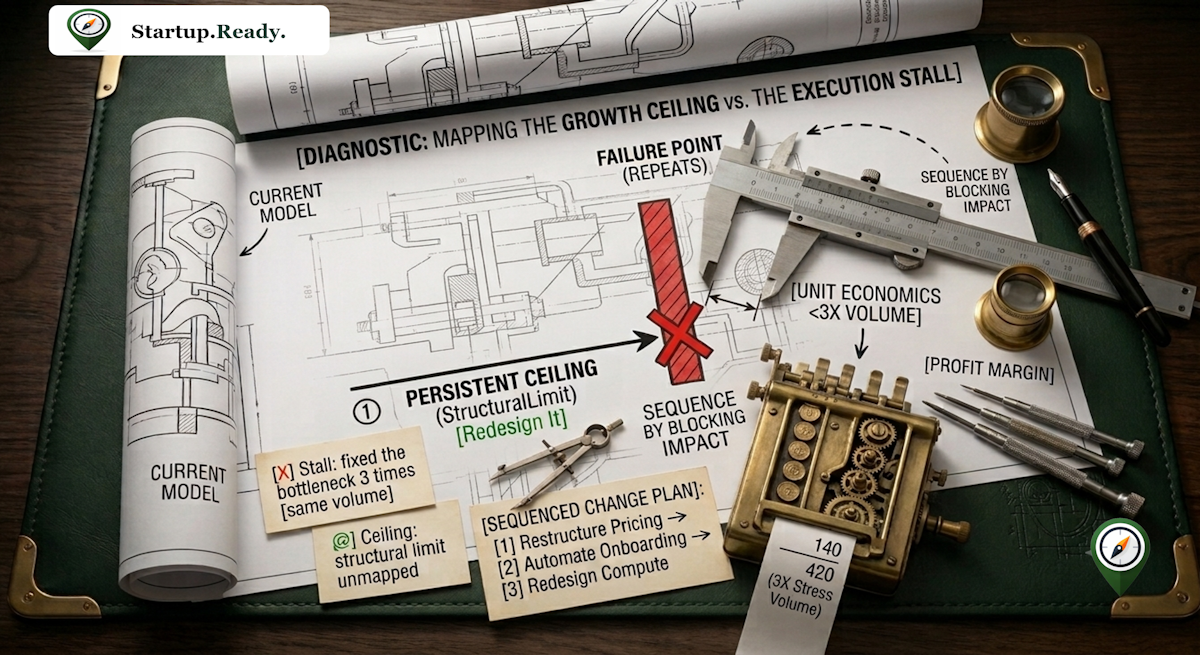
A founder hits a wall, pushes harder, and hits the same wall again. So they reach for the usual explanations. The messaging is off. The market is soft. The team needs to execute better. Each one sends more effort at the wall, and the wall does not move, because the wall was never made of effort.
Some growth stalls are execution problems. This one usually is not. When more work produces the same ceiling, the ceiling is structural. The model was built to prove the concept, and proving a concept and carrying volume are different jobs that call for different structures. Almost every early-stage business is built for the first. The trouble starts when a founder asks the first structure to do the second and reads the failure as a failure of effort.
The tell is that the ceiling keeps coming back at the same place. Not because the founder is working too little. Because the model has a fixed limit that more hours cannot lift, and that limit stays invisible as long as the stall gets blamed on execution.
TL;DR: If Volume Tripled Tomorrow, Something Breaks First. Name It, in Order, Before It Names Itself.
A growth ceiling is the point where the current model cannot carry more volume without restructuring something fundamental. Most founders discover what breaks one piece at a time, under pressure, after the resources to fix it are already spent. The work is to stress the model against a specific higher volume, mark what breaks, and sequence the changes by which failure blocks growth most completely at the lowest volume. Here is the move, in order:
Set a stress volume, usually three times your next meaningful milestone, a real number to test against
Map what breaks: run each function against that volume and mark it stable, strained, or broken
Prioritize by blocking impact, because the failure that stops all growth at the lowest volume comes first, not the one that is easiest to fix
Sequence the changes, most blocking first, since some changes depend on others
Name the first action and whether it is even possible with the resources you have
Four signals your growth ceiling is unmapped:
You keep hitting the same wall and keep blaming execution, messaging, or the market
You cannot say what would break first, second, and third at three times your volume
Every new customer adds about as much work as the last one, and you have made peace with that
Your plan for scale is "get more customers," with no matching plan for what more customers would break
If any of those describe you, this article shows you how to map the ceiling before you spend your runway hitting it.
If You Found This Article by Searching for Something Else
Most founders who need this are not searching for "growth ceiling." They are searching for the stall.
Why has my growth plateaued.
How to scale a service business.
Why does every new customer feel like more work.
How to remove bottlenecks in my startup.
Why can't I grow past a certain point.
All of those trace to one question. If your customer volume had to triple, what in your current model would break, and in what order? When you cannot answer that, the stall stays mysterious and the fixes stay random. This article shows you how to make the ceiling specific.
How to Tell a Stall From a Ceiling
From the founder's chair the two look identical: growth slowed down. They behave differently when you push on them, and the behavior is the diagnosis.
A stall is temporary and responsive. It comes from an execution gap, a slow quarter, a channel that cooled, a hire who has not ramped. Effort moves it. Fix the specific thing and growth resumes, and the failure does not come back in the same place. Performance varies around a stall.
A ceiling is persistent and structural. It comes from a limit in how the model is built, so effort does not move it. You push, growth resumes for a moment, and the same failure returns at the same volume. The failure point repeats. That repetition is the signal. A problem that keeps reappearing at the identical spot no matter how hard you work is not execution wearing you down. It is a structure telling you it cannot carry more, and it will keep saying so until the structure changes.
So the test is simple. Watch what happens after you respond. A stall yields to effort and stays gone. A ceiling absorbs the effort and returns. If you have fixed the same bottleneck three times and it keeps binding at the same volume, stop treating it as a stall. A stall you out-work. A ceiling you redesign, and no amount of the first will substitute for the second.
Proving a Concept and Carrying Volume Are Different Jobs
The first thing to see clearly is why a model that works can still be unable to grow. An early model is built to answer one question: will anyone value this enough to pay. To answer it fast, the founder does whatever it takes. Personal delivery. Manual work. Judgment applied case by case. That is the right way to prove a concept, and it produces a model optimized for learning, not for volume.
The problem is that the same structure that made proving fast makes scaling impossible. Every mechanism that let the founder learn quickly, the hands-on delivery, the founder-in-the-loop decisions, the manual steps that never got systematized, is a mechanism that adds proportional work with every new customer. The model does not break because it is bad. It breaks because it is doing exactly what it was designed to do, at a volume it was never designed to reach.
This is why "get more customers" is not a scaling plan. More customers push more volume through a structure that adds work per customer, and the structure binds. The question that matters is not how to get more customers. It is what in the current model has to change so that more customers stop costing proportionally more to serve. That is the leverage question, and it is the same one running under why effort and value have to be separated.
Stress the Model Against a Real Number
Mapping a ceiling requires a specific volume to map against, because "more" is too vague to break anything. Take your next meaningful milestone, the customer count you are actually driving toward, and multiply it by three. That is the number to stress the model against. Three times is aggressive enough to expose the limits and realistic enough to be a genuine target inside eighteen to twenty-four months.
Now walk each function of the business up to that volume and mark what happens. Delivery. Acquisition. The work only the founder can do. Unit economics. Any tool or vendor or capacity limit. Retention and support load. For each one, the honest options are simple. It stays stable, meaning no real degradation. It strains, meaning it still works but a metric gets meaningfully worse. Or it breaks, meaning it cannot operate at that volume without a structural change.
The point of the exercise is specificity. Not "scaling will be hard," which every founder already believes and none can act on. But "at roughly two hundred customers, margin turns negative because the compute cost to serve a heavy user already exceeds the flat fee." A named function, a named volume, a named reason. A ceiling described that precisely stops being a wall and becomes a list.
One warning about the arithmetic. Three times the volume rarely means three times the current process. Functions do not fail gradually. They cross thresholds. Fifty customers to a hundred and fifty is not three times the same support handled the same way. It is the point where informal team communication stops working, or where a compliance line gets crossed and you suddenly owe a SOC 2 or GDPR audit, or where infrastructure that scaled fine hits a limit that needs rearchitecting rather than resizing. When a function breaks, doing three times as much of it is rarely the answer. The process itself has to be replaced, because it was built for a scale you are about to leave behind.
Prioritize by What Blocks Growth, Not by What Is Easy to Fix
Once you have a list of what breaks, the instinct is to start with the easy one. Resist it. Breaks are not equal. Some degrade performance and some stop growth entirely, and the sequence has to follow blocking impact, not effort.
The question for each broken function is two-part. At what volume does it fail, and does its failure block all growth or only some? A function that strains and raises costs twenty percent is a problem. A function that stops you from taking on any new customers at all is a different kind of problem, and if it binds at a lower volume, it comes first no matter how hard it is to fix. The most blocking constraint is the one that halts growth most completely at the lowest volume. Everything else waits behind it, because solving a later constraint while the first one still binds buys you nothing.
This is where sequencing earns its place, and where mapping the ceiling does something that finding a single constraint does not. Some changes depend on others. Fixing acquisition is wasted motion if delivery breaks before the new customers can be served. Map the order by blocking impact first, then check the dependencies, and the vague project of "scaling the business" resolves into a first move, a second, and a third.
Finding the one constraint that binds first is where the work starts, and that is the discipline in identifying your primary scaling constraint. What the full map adds is the move after that. When you lift the first constraint, the ceiling does not disappear. It relocates, and the map tells you where. The second thing that breaks was always there, hidden behind the first, and it binds at a higher volume once the first is gone. Seeing the whole sequence in advance is what keeps each fix from stranding the next, and turning that sequence into a staged plan is the work of designing a constraint removal plan.
The AI Tool That Was Priced to Prove It, Not to Carry It
Take a founder with an AI contract-review tool for small law firms. Two hundred dollars a month, flat, a hundred and forty firms in, growth flat with it. Her explanation was the top of the funnel: leads were slow. So she poured effort into demand, and the ceiling held, because acquisition was never the constraint.
Stress the model against three times the volume and two things break, not one. Unit economics first. A slice of firms run so many reviews that the compute cost to serve them already eats the flat fee, and at current volume the light users quietly subsidize the heavy ones. Push toward three times and the customer mix shifts, the subsidy runs out, and margin turns negative somewhere around two hundred firms. Onboarding second. Every firm needs its own clause library and templates loaded, work her small team does by hand, and the support load climbs faster than revenue as volume grows.
Two constraints, and the sequence matters more than either one alone. Unit economics binds first and binds hardest, because below positive margin every new customer makes the business worse, so no amount of growth helps until the pricing structure changes. That is Change 1: restructure to usage-based tiers so cost tracks revenue. Onboarding is real, but fixing it first would have been a trap, pouring efficiency into acquiring customers who lose money faster. It waits.
Here is the part a single-constraint view misses. Fixing pricing does not end the problem. It moves it. Once margin is positive and growth resumes, the onboarding ceiling becomes the binding one, and it binds at a higher volume than it would have otherwise. The map is what let her see that coming: not only the first thing that breaks, but the thing that breaks after she fixes the first, and the order that keeps each fix from stranding the next. She had been staring at a slow funnel. Underneath it was a two-step structural sequence her flat-rate model was never built to survive.
The One Sentence That Tells You Where You Stand
A founder who has mapped the ceiling can complete this statement concretely:
The most blocking constraint in my current model is [specific constraint], it binds at roughly [specific volume], and the first change I am making to begin removing it is [specific action], which unlocks [the specific next capability].
A founder who has not will name a symptom, the plateau, the slow funnel, the soft market, and stall on the mechanism, because they have been reading a structural limit as an execution failure. That stall is the diagnosis. It is usually the reason the same wall keeps returning no matter how much effort gets thrown at it.
If you can name the binding constraint and the volume where it binds, you have a first move, and a first move is worth more than a scaling plan built on a ceiling you have not located. If you cannot, that is not a reason to push harder at the wall. It is the signal to stress the model against a real number and watch what breaks first. Either outcome trades a mysterious plateau for a specific constraint, and a specific constraint is something you can actually work.
The Opposite Mistake: Rebuilding Before You Need To
Mapping a ceiling creates its own trap. A founder who sees what will break at three times the volume can rush to fix it now, and rebuilding for scale too early is its own way to lose.
The high-touch, manual, founder-in-the-loop model is not only a scaling liability. Early on, it is the instrument that refines the product. Every manual delivery is a feedback loop. Every judgment call teaches you something about what the customer actually values. Replace those loops with rigid automated systems before you have learned what they were teaching, and you lock in a value proposition you had not finished getting right. You end up scaling a version of the product that was still supposed to be changing.
So the sequence matters as much as the map. A structural redesign earns its place once the value moment is stable and repeatable, once you can reliably get customers to the point where they feel the outcome. Before that, the manual model is doing work automation cannot: it is still finding the product. Map the ceiling early, so you see it coming. Lift it once the thing you are scaling has stopped moving underneath you.
The Growth Ceiling and Your Business Model Clarity
In the Startup Readiness Framework, Business Model Clarity treats the growth ceiling as a structural fact to be mapped rather than an execution problem to be out-worked, because a model built to prove a concept is rarely a model built to carry volume. A stall that keeps returning at the same place is a common early flag, and it usually traces to a limit in how the model is built, not a shortfall in how hard the founder is working.
Finding the single constraint that binds first is covered in identifying your primary scaling constraint, and turning it into a sequenced set of moves is covered in designing a constraint removal plan. Mapping what breaks is the step that makes both of those possible.
The Business Model Pillar is one of six pillars in the Startup Readiness Framework. If your business model is clear and defensible, the next question is whether the rest of your startup is as ready as your evidence. The Startup Readiness Assessment gives you a full-system diagnostic across all six pillars in under twenty minutes.
Take your Startup Readiness Score free today at startupready.ai →
Keep Working on the Business Model Pillar
The Business Model Pillar asks one question from many angles: does your model turn real value into revenue that holds as you grow? Each article below takes one piece of that question. What you are actually competing against. Where the value lands for the customer. Whether you are pricing your effort or their outcome. What caps your growth before you reach it. Read them in any order. Each is a separate cut at the same pillar, and together they show you where your model is clear and where it still breaks.
More in the Business Model pillar:
Startup Defensibility: Why a Head Start Is Not a Moat
How to Measure the Value Your Startup Delivers Before You Try to Sell It
The Elevator Pitch Template: How to Write, Test, and Use Your One-Line Business Model
"Let Me Think About It" Is a Timing Problem, Not a Price Objection
Your Customer Is Not Deciding Whether to Use You. They Are Comparing Their Options.
If Every Customer Resets the Work, You Have Revenue but Not Leverage
You Are Pricing Your Effort. Your Customer Is Buying an Outcome.
The Constraint That Caps Your Growth Is Rarely the One You Are Worried About
A Structural Constraint Does Not Yield to Effort. It Yields to a Plan.
The Product Working Is Not the Same as the Customer Feeling It Work
Delivering Value and Naming the Exchange Are Two Different Things
Why Customers Stay Is Not the Same as Why They Chose You
A Stall in Growth and a Ceiling in the Model Are Two Different Problems
Published
By Dr. Shaun P. Digan
Originally Published on the Startup.Ready.’s Startup Readiness: Validation, Framework, and Tools Blog at https://startupready.ai/startup-readiness/what-must-change-to-scale
Original Publication Date: August 5, 2026
Last Updated: August 5, 2026
About the Author
Dr. Shaun P. Digan is the founder of Startup.Ready and the creator of the Startup Readiness Framework, a research-based system for evaluating and validating early-stage startups before launch and early growth. He holds a PhD in Entrepreneurship from the University of Louisville and has spent over 15 years teaching, advising, and consulting with founders on startup strategy, validation, and growth.
In his writing, including the Startup Readiness Blog and The Foundations of Innovation Essay Series, he focuses on how founders can make better decisions by improving clarity, alignment, and readiness before scaling.