You Are Pricing Your Effort. Your Customer Is Buying an Outcome.
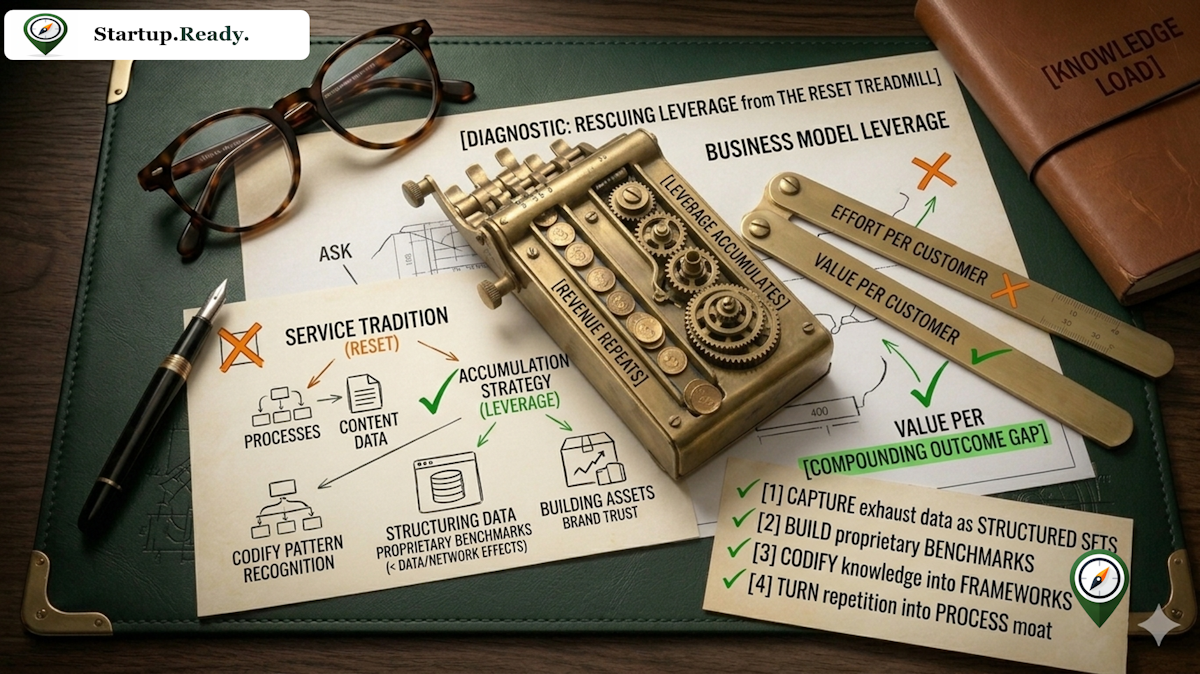
Look at how you describe what you sell. Ten hours of consulting a month. A detailed report within forty-eight hours. Three rounds of revision. Two weeks of discovery. Weekly check-ins and a monthly summary. Every one of those describes what you do, how much of it, and how long it takes. None of them describes what changes for the customer.
That is effort-based framing, and it is the natural first draft of every founder's pricing and pitch, because in the beginning the work is what you are sure of. You know how many hours it takes. You are less sure what it is worth. So you price and describe the effort, and the customer, taking your lead, evaluates you on effort too. They compare your hours to someone else's hours, your process to someone else's process, and they shop on the one axis you handed them: how much work for how much money.
The problem is that effort has a ceiling and the outcome does not. Price the effort and you cap the business at the cost of your time. Price the outcome and the ceiling moves to what the result is worth.
TL;DR: Effort-Based Pricing Caps You at the Cost of Your Time.
Founders price and position on what they do, because effort is what they can measure early. But effort-based framing sets the ceiling at the founder's hours and signals that the value is proportional to time, which invites customers to shop on price. The fix is to translate every effort-based claim into what changes for the customer. The work is to audit the language, translate it, and make sure the outcome underneath is real.
This is the real difference in value based pricing vs cost based pricing: one prices what you did, the other prices what changed for the customer. Here is the move, in order:
Audit your pricing, positioning, and pitch for language that describes what you do rather than what changes
Confirm the outcome is real first, because outcome language over an inconsistent result is worse than honest effort language
Translate each effort claim into a specific change in the customer's situation
Test each translation against a skeptic: believable, verifiable, and harder to compare on price alone
Change one thing before the next customer conversation
Four signals you are selling effort instead of outcome:
Your pricing describes hours, deliverables, or process steps
Strip out time, process, and deliverables from your pitch and little is left
Customers negotiate you on hours and compare you to cheaper providers
Every price increase forces you to justify more work rather than more value
If any of those describe you, this article shows you how to move the conversation from what you do to what the customer gets.
If You Found This Article by Searching for Something Else
Most founders who need this are not searching for "value-based pricing." They are searching for something more immediate.
How to raise my prices.
Why do customers negotiate me down on hours.
How to price a service business.
Value-based pricing for consultants.
Why does my pricing feel like a race to the bottom.
All of those point at the same underlying question. Are you charging for your time or for the result? This article shows you how to tell, and how to move from the first to the second.
Effort Has a Ceiling. The Outcome Does Not.
The deepest problem with effort-based pricing is not that it feels cheap. It is that it caps the business, structurally, at the cost of the founder's time. When the price is anchored to hours, more revenue requires more hours, and there are only so many hours, so the business hits a wall that has nothing to do with how much value it creates. You can be delivering an outcome worth ten times what you charge and still be stuck, because you priced the input rather than the result, and the input is finite in a way the result is not.
Effort-based framing also sends a signal that is hard to unsay. When you describe the value as the work, you tell the customer the value is proportional to the work, which means a faster competitor or a more automated tool can deliver the same thing for less. You have invited them to shop on hours, and on hours you will eventually lose to someone cheaper or quicker. The framing that felt safe, describing the concrete work you know you are doing, quietly positions you in a race you do not want to run.
Outcome-based framing changes both. The price anchors to what the result is worth to the customer, which lifts the ceiling off your time, and the comparison gets harder, because a specific outcome is not a commodity the way an hour is. The same work, described as the change it produces rather than the effort it takes, is a different and more valuable thing to buy.
Outputs Are Not Outcomes
It helps to see why the outcome is what the customer is really paying for, because the reason is not that outcomes sound nicer. It is that customers buy to improve their own economics. They do not experience your effort directly. They experience its consequences: revenue gained, a cost avoided, a risk reduced, a decision no longer guessed at. An hour of your work has no inherent value to them. A customer retained or a leak plugged does. The closer your language gets to that consequence, the closer it gets to how the customer already evaluates what you sell.
There is a layer founders get stuck on halfway there, and it looks like progress but is not. Between the effort and the outcome sits the output, the thing you hand over. Input is ten hours of work. Output is the report, the dashboard, the roadmap you produce. Outcome is what changes because of it: the churn that dropped, the decision that got made, the cost that came out. Many founders translate their effort language into output language and believe they have reached outcomes. "We deliver a report" feels like value. It is not. A report is an output. The decision the report lets the customer make is the outcome, and the decision is what they are actually buying. Sell the report and you are one step up from selling the hours. Sell the decision and you have arrived.
Getting value based pricing vs cost based pricing right only works once the outcome underneath the price is real and specific enough to defend.
Confirm the Outcome Is Real Before You Sell It
There is a trap on the way to value-based framing, and it is worth stopping at before going further, because falling into it is worse than staying with effort language.
Outcome language only works if the outcome is real and consistent. "You will identify your biggest growth constraint in the first session" is powerful if it is true most of the time and hollow if it is not, and a vague or unreliable outcome claim is more damaging than an honest description of effort, because it promises more while delivering less certainty, and the customer feels the gap the moment the result does not show up. Effort language at least does not overpromise.
So before you translate anything, check the outcome underneath. What specific result do customers actually get today? How often, sixty percent of the time, ninety, unknown? What evidence do you have, real feedback and cases or just hope? If the outcome is inconsistent or you cannot point to evidence, your first job is not better language. It is better delivery, and knowing whether you can actually prove the value is its own piece of work, covered in how to measure the value your startup delivers. Value-based framing is a way of describing a real outcome, not a way of manufacturing one.
The Translation
Once the outcome is real, the translation follows one rule: the new language must describe what changes for the customer, not what you do. The pattern is simple. Effort-based says "we provide [activity] over [timeframe]." Outcome-based says "you [specific change in your situation] by [specific point]."
Run it across the real examples. "We provide ten hours of consulting a month" becomes "you leave each month with a decision made and the next one teed up." "You get a detailed report within forty-eight hours" becomes "the report pays for itself if it finds one cost you were not already cutting." "Our process includes three rounds of revision" becomes "you get a final you are willing to put your name on, however many passes that takes." "We spend two weeks on discovery" becomes "by week two you know whether this is worth building before you have spent a dollar building it." In each case the hours, the deliverable, and the process disappear from the sentence, and what the customer walks away with takes their place.
One kind of outcome is easy to overlook and often the most persuasive: the loss avoided. Buyers, especially inside companies, do not only buy gains. They buy the safety of not making an expensive mistake, not committing a budget to the wrong direction, not being the person who championed the failed bet. "You leave with a plan your team can execute" is an upside outcome. "You find out whether this is worth building before you have spent six figures building it" is a downside-avoided one, and to a risk-averse buyer it often lands harder, because dodging a large, concrete loss feels more real than capturing an uncertain gain. So when you translate effort into outcome, translate some of it into risk removed, not only value added.
Learning how to price based on value not effort starts with auditing your own language for hours, deliverables, and check-ins instead of outcomes.
Notice what the translation does to price comparison. "Ten hours of consulting" invites the customer to find cheaper hours. "A decision made every month" does not have an hourly rate, so there is nothing to comparison-shop against directly. Good outcome framing should make direct price comparison harder, not easier, and if your rewritten version is still easy to line up against a competitor on price, it has not moved far enough from effort yet.
The Founder Who Sold Hours
Take a founder running a small analytics consultancy. Her pricing page is a model of effort: tiers defined by hours per month, a list of deliverables, turnaround times, a described process. Prospects consistently push back on the rate and compare her to cheaper freelancers, and she cannot figure out why, because her work is genuinely better.
The reason is on the page. She has told every prospect, in the clearest possible terms, that what they are buying is her hours, and once that is the frame, a cheaper hour always looks appealing and her quality is hard to see in advance. She is being shopped on the exact axis her own pricing established.
So she audits the language and finds effort framing in all five places it can hide: the pricing tiers, the tagline, the discovery-call opener, the proposal, and her objection handling. Then she translates, carefully, only where the outcome is real. The hours-based tiers stop being "twenty hours a month" and become "we find and fix the leaks costing you the most revenue this quarter, and you watch the recovered revenue land in your own dashboard." The proposal stops listing deliverables and starts naming the specific decision the customer will be able to make at the end that they cannot make now. She keeps effort language in exactly one place, a scope boundary, because there it protects her rather than prices her.
Now watch what happens to the price. When an audit turns up a single leak worth fifty thousand dollars a year, a five-thousand-dollar engagement stops looking like an expense and starts looking like a return. The rate is no longer the conversation, because the prospect is not comparing hours anymore. They are weighing fifty thousand recovered against five thousand paid, and against that comparison her price looks small. Nothing about the work changed. Only the axis the customer evaluates it on did, and she is the one who moved it.
Two Practical Objections
Outcome framing raises two immediate operational questions, and skipping them is where a lot of value-pricing advice quietly fails.
The first: if I do not price by hours or deliverables, what stops a client from demanding infinite work? The answer is to separate two things founders tend to fuse. Your pricing frame and your scope boundary are different tools doing different jobs. The pricing frame is outcome-based, and it sets what the engagement is worth. The scope boundary is constraint-based, and it caps the work in concrete terms: a duration, a number of review cycles, a defined set of inputs or systems. You anchor the price to the outcome and fence the work with constraints, and the two never conflict. "We find and fix your biggest revenue leaks this quarter" is the outcome. "Up to two data sources, one review cycle, across eight weeks" is the fence. Effort language belongs on the fence, never on the price tag.
The second: if the outcome varies, one customer's leak is worth fifty thousand and another's is worth two, how do you price on outcome before you know which you will find? You do not price on the realized outcome per customer, which would make your revenue hostage to each engagement's luck. You anchor to the typical or expected outcome across customers, the value you can reliably point to from your own track record. If leaks in your niche usually run into the tens of thousands and you have the cases to show it, you price against that pattern. The customer whose leak comes in low still got a fair deal, and the one whose leak comes in high got a bargain. The exception is genuine outcome-based billing, contingency or share-of-savings, which some businesses can run and most early ones should avoid, because it hands your revenue to variance you do not yet control. Anchor to the expected value. Do not stake the business on each individual result.
The One Sentence That Tells You Where You Stand
A founder pricing on value can complete this statement without slipping back into deliverables:
The effort-based language I am replacing is [specific "we do X for Y hours" phrasing], the outcome-based version is [specific change the customer gets], and the outcome underneath is real because [specific evidence].
A founder pricing on effort can describe their process and hours fluently and stalls on the outcome, or produces an outcome so vague it could not be verified, which is the tell that the value has not yet been defined clearly enough to charge for. That gap is the diagnosis.
If you can name the outcome, prove it is real, and say it in the customer's terms, you have moved the ceiling off your own time and made your price much harder to shop. If your pitch strips down to hours and deliverables with no outcome underneath, the fix is not clever wording. It is to confirm the result is real and then describe that result instead of the work that produces it.
Every founder starts by describing the work, because the work is what is visible on day one. But customers never bought the work. They bought what changed because the work happened. The more tightly your price is tied to effort, the lower your ceiling sits. The more tightly it is tied to the outcome, the closer your ceiling gets to the value you actually create.
Value Framing and Your Business Model Clarity
In the Startup Readiness Framework, Business Model Clarity treats effort-based pricing as a leverage flag, because a business that charges for the founder's time is capped at the founder's time no matter how much value it creates. Low leverage of this kind is a common early pattern, and it hides in plain sight, on the pricing page, because describing the concrete work feels safer than naming the outcome the founder has not yet proven.
Whether the outcome underneath your pricing is real and demonstrable is the prerequisite, covered in how to measure the value your startup delivers.
The Business Model Pillar is one of six pillars in the Startup Readiness Framework. If your business model is clear and defensible, the next question is whether the rest of your startup is as ready as your evidence. The Startup Readiness Assessment gives you a full-system diagnostic across all six pillars in under twenty minutes.
Take your Startup Readiness Score free today at startupready.ai →
Revisit your value based pricing vs cost based pricing split any time a prospect starts negotiating your hours instead of your outcome.
Keep Working on the Business Model Pillar
The Business Model Pillar asks one question from many angles: does your model turn real value into revenue that holds as you grow? Each article below takes one piece of that question. What you are actually competing against. Where the value lands for the customer. Whether you are pricing your effort or their outcome. What caps your growth before you reach it. Read them in any order. Each is a separate cut at the same pillar, and together they show you where your model is clear and where it still breaks.
More in the Business Model pillar:
Startup Defensibility: Why a Head Start Is Not a Moat
How to Measure the Value Your Startup Delivers Before You Try to Sell It
The Elevator Pitch Template: How to Write, Test, and Use Your One-Line Business Model
"Let Me Think About It" Is a Timing Problem, Not a Price Objection
Your Customer Is Not Deciding Whether to Use You. They Are Comparing Their Options.
If Every Customer Resets the Work, You Have Revenue but Not Leverage
You Are Pricing Your Effort. Your Customer Is Buying an Outcome.
The Constraint That Caps Your Growth Is Rarely the One You Are Worried About
A Structural Constraint Does Not Yield to Effort. It Yields to a Plan.
The Product Working Is Not the Same as the Customer Feeling It Work
Delivering Value and Naming the Exchange Are Two Different Things
Why Customers Stay Is Not the Same as Why They Chose You
A Stall in Growth and a Ceiling in the Model Are Two Different Problems
Published
By Dr. Shaun P. Digan
Originally Published on the Startup.Ready.’s Startup Readiness: Validation, Framework, and Tools Blog at https://startupready.ai/startup-readiness/value-based-pricing
Original Publication Date: August 5, 2026
Last Updated: August 5, 2026
About the Author
Dr. Shaun P. Digan is the founder of Startup.Ready and the creator of the Startup Readiness Framework, a research-based system for evaluating and validating early-stage startups before launch and early growth. He holds a PhD in Entrepreneurship from the University of Louisville and has spent over 15 years teaching, advising, and consulting with founders on startup strategy, validation, and growth.
In his writing, including the Startup Readiness Blog and The Foundations of Innovation Essay Series, he focuses on how founders can make better decisions by improving clarity, alignment, and readiness before scaling.