Your Customer Is Not Deciding Whether to Use You. They Are Comparing Their Options.
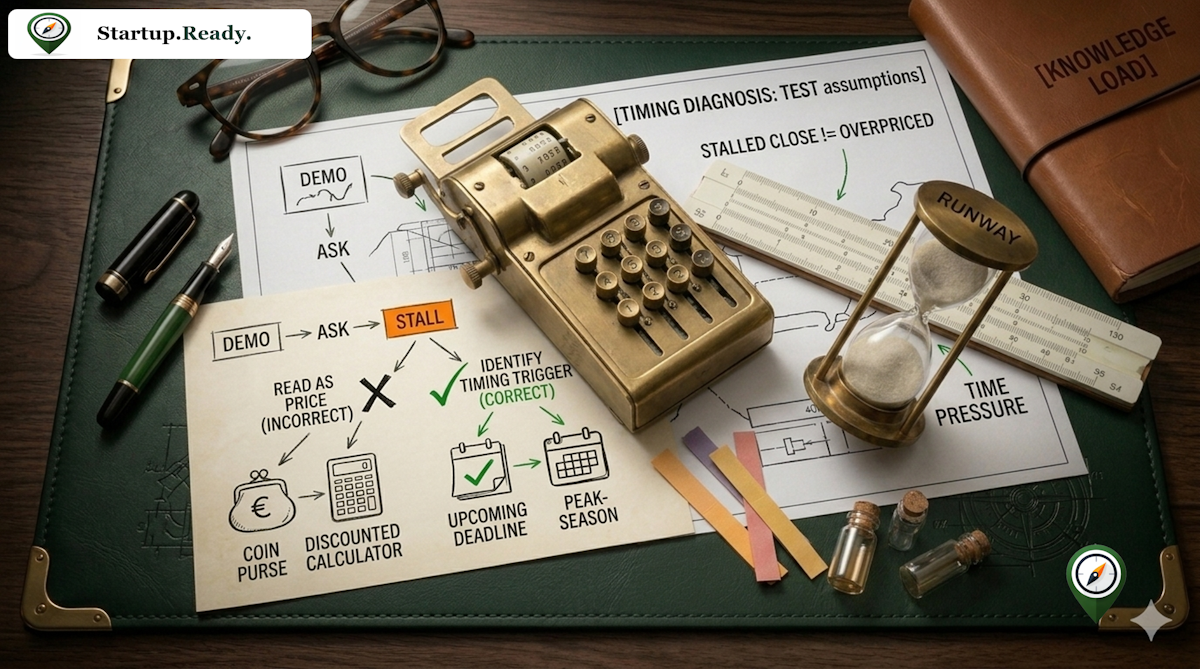
Founders evaluate their business one way, and customers evaluate it another, and the gap between the two frames is where a lot of good products quietly lose.
You look at your business and see a product with a real advantage: a smarter process, deeper expertise, better relationships, a more sophisticated approach. From inside, the decision looks like "should this customer use my product or not," and the answer feels obviously yes. But that is not the decision the customer is making. Their question is not "should I use this." It is "which of the ways I could produce this outcome is best for me," and their list of ways is longer than yours: a cheaper tool that gets them most of the way, a manual workaround, and doing nothing and living with the problem. You are not the default they are deciding against. You are one option in a set, and most of the set is invisible to you because you have never looked at your business from where they are standing.
The advantage you are proud of might not even appear on their comparison, because they are comparing outcomes, and your advantage is a process.
TL;DR: The Customer Compares Outcomes Across All Their Options. You Compare Features Against Competitors.
Customers do not choose whether to use you. They choose among every path to the outcome they want, including cheaper approximations and the status quo, and they compare the outcomes those paths produce, not the features. A process advantage the customer cannot feel in the outcome does not count. The work is to map the real alternatives and find where your outcome gap is both largest and defensible. Here is the move, in order:
Map every alternative the customer actually has: named competitors, cheaper tools, manual workarounds, and doing nothing
Compare outcomes, not features, on the three to five dimensions the customer actually weighs
Find the gap that matters, which is your largest gap on the dimension the customer cares most about
Test whether it is defensible, structural and compounding, or just a process a rival can copy
Make one move to widen the gap on the dimension that matters before a competitor closes it
Four signals you are stuck in your frame instead of the customer's:
You describe your advantage as your process, expertise, or relationships
Your competitor list is other products, with no workaround and no "do nothing" on it
You compare features, while customers ask what will actually be different for them
You have never mapped what an 80-percent-good, half-price alternative would cost the customer
If any of those describe you, this article shows you how to see your business the way the customer deciding on it does.
If You Found This Article by Searching for Something Else
Most founders who need this are not searching for "compare against alternatives." They are searching for something more immediate.
Who are my real competitors.
Why do customers choose a cheaper option.
How to position against alternatives.
Is my competitive advantage real.
Why do prospects stick with their current solution.
All of those point at the same underlying question. Are you comparing yourself to the alternatives the customer is actually weighing, including doing nothing? This article shows you how to build that comparison from their side.
The Customer's Alternatives Are Not Your Competitors
When a founder lists their competition, they list products, usually the two or three companies that show up at the same conferences and in the same search results. That list is almost always too short and slightly beside the point, because it is built from the founder's frame rather than the customer's.
The customer's alternatives are everything they could do to get the outcome, and most of those are not products at all. There is the cheaper tool that does part of the job. There is the spreadsheet or the manual process they already run. There is hiring someone to do it by hand. And there is the biggest and most-forgotten competitor of all, doing nothing and continuing to tolerate the problem, which is what most prospects are actually doing right now and what your product has to beat first. Leave any of those off the map and you are not seeing the decision the customer is making. You are seeing a simplified version that happens to flatter your product.
This matters because the alternatives you forget are usually the ones that beat you. A customer choosing between you and a direct competitor has at least decided to buy something. Most of your losses never get that far. They are losses to good enough and to nothing.
The Hardest Competitor Is Usually Inertia
Of all the alternatives on the customer's list, the one that beats founders most often is the one they never put on it: the customer doing nothing and continuing as they are. It deserves to be named first, because for most early-stage products it is the real contest.
A thorough competitive analysis for startups usually surfaces at least one competitor you weren't tracking, because customers compare outcomes, not categories.
A competitor requires the customer to choose someone else. The status quo requires them to choose nothing, and nothing has quietly powerful advantages. It needs no budget approval. It carries no vendor risk. It asks for no change to how the team already works, no migration, no learning curve, no explaining the new tool to a boss. Against all of that, being better than the other software products in your category is close to irrelevant, because the customer is not standing at "which product," they are standing at "is this painful enough to change anything at all." That is the first question, and most products lose there before the competitive comparison ever begins.
Customers rarely move straight from a competitor to you. More often they climb a ladder:
Do nothing
Manual workaround
The solution they already use
A better solution, which is where you are
You have to move them up one rung at a time, and the first rung, inertia, is the steepest, because the pain of the problem has to clear both the price of your product and the friction of any change at all. Your job is not really to beat the competitor. It is to move the customer up the ladder, and most of that work happens on the bottom rung. Founders who lose and blame a rival have usually lost one rung earlier, to a customer who decided the problem was not worth the disruption of solving.
This is worth placing in the larger sequence, because a customer moves through three questions in order: is this problem worth solving at all, is now the right time to solve it, and which option should I choose. This article is about the third question. But the third only gets asked once the first two have resolved to yes, which is why winning the comparison is not enough on its own. A founder who has the best option but has not established that the problem is worth solving now loses to inertia before the comparison ever begins, which is a timing failure rather than a competitive one, covered in why "let me think about it" is a timing problem. Win the comparison and lose the urgency question, and you still lose the sale.
Outcomes, Not Features
Here is the deeper mismatch, the one that quietly sinks strong products. You compare on features, because features are what you built. The customer compares on outcomes, because the outcome is what they are buying. Those are different axes, and an advantage on the feature axis that does not move the outcome axis is, to the customer, no advantage at all.
Learning how to compare against competitors well means mapping every path to the outcome, including the cheapest workaround and doing nothing.
The clearest way to hold this is to separate two kinds of advantage. Internal advantages are the ones you build and admire from inside: better technology, better architecture, better methodology, better expertise, a smarter process. Customer-visible advantages are what the customer actually experiences: a faster outcome, lower cost, less effort, lower risk, a better result. Customers rarely experience your capabilities directly. They experience the consequences of your capabilities, and an internal advantage only counts once it crosses that bridge into a consequence they can feel.
This is why an internal advantage is so dangerous to rely on. You may genuinely run a more sophisticated process than the cheaper alternative. But if the customer gets eighty percent of the outcome from that cheaper alternative at forty percent of the cost, your superior process is invisible to them, because they cannot feel your process. They can only feel the result, and on the result the gap is small while the price gap is large. A customer who can get most of what they need for much less will make that trade, and they will make it faster if the cheaper option is improving over time while your advantage stays trapped on the inside where they never touch it.
So the comparison that matters is not feature-by-feature against your named competitor. It is outcome-by-outcome across every alternative, on the three to five dimensions the customer actually weighs, which you have to learn from them rather than assume. Rate each alternative on each dimension from the customer's side. The picture that comes back is often uncomfortable and always more useful than the product-frame version, because it shows you where your outcome gap is real and where the advantage you were counting on does not survive contact with a cheaper approximation.
The Founder Whose Advantage Was Invisible
Take a founder building AI legal research, whose pride is the model. It is the most accurate legal-research AI in the category, and he can prove it on benchmarks. Ask about competitors and he names the two other legal-AI startups.
Then map what a lawyer actually has. The two startups, yes. But also the general-purpose AI the associate already uses for a first pass. The incumbent research platform the firm already pays for and knows. A junior associate doing it by hand. And the firm simply keeping its current research habits, which mostly work. Now ask what outcome a lawyer is actually buying, because it is not "the smartest model." It is fewer hours billed to research, fewer errors that reach a filing, a faster answer to the client, lower malpractice risk. Rate every alternative on those, from the lawyer's seat.
His accuracy edge is real, and on the dimension the lawyer weighs most it barely separates from the pack, because an associate with a general AI and a careful eye also reaches an answer good enough to file, at a cost the firm already absorbs. His model is measurably better on a benchmark the customer never runs. On the outcomes the customer does measure, hours and risk and speed, his gap over "good enough and already paid for" is thin. He built the smartest model in a market that was buying something else.
His advantage was real and invisible at the same time. He had been competing on model accuracy, an internal advantage the lawyer never directly experiences, while the lawyer compared outcomes and found the existing habit good enough. Seeing that is not comfortable, and it is the most useful thing he can learn, because it tells him exactly where to work. Either turn the accuracy into a consequence the lawyer feels, provably fewer hours or lower malpractice exposure, or find the dimension where his real edge produces a result they cannot get elsewhere. Competing harder on benchmark accuracy would have been competing where the customer was not looking.
Is the Gap a Moat or a Head Start
Finding your real outcome gap is the first half. The second is testing whether it will hold, because a gap that a well-funded competitor closes in a year is not an advantage. It is a head start on a clock, a distinction worked through in why a head start is not a moat.
It helps to know which kind of advantage you actually have, because they hold for very different lengths of time. A feature advantage ("we have more integrations") is the weakest, copyable in a sprint. A process advantage ("our workflow is better") is harder to copy but usually temporary, and it is the one founders most often overrate. A data advantage ("every customer makes the system smarter") can compound, because the lead widens as you serve more customers and is hard to match without the same customer base, though a merely larger dataset is not automatically a moat. A network advantage ("each new user makes the product more valuable") compounds fastest of all. The first two are usually head starts. The second two are the foundations that durable moats are often built from, and the difference is whether the gap grows on its own as the business grows.
Run your largest real gap through the test. Could a competitor with several times your resources replicate it within a year? If yes, it is a head start, worth using but not worth resting on. Does the gap widen as you serve more customers, through accumulated data, deepening workflow integration, or fit calibrated to one customer type, or does it stay flat? A gap that compounds is structural. A gap that stays flat is a feature or process edge, real today and copyable tomorrow. The uncomfortable version of this test is the customer version: would a customer who has used you and then evaluated the cheap alternative describe your gap the same way you do, or would they shrug and say the cheaper thing was fine? If they would shrug, the gap you are counting on lives in your product frame rather than in their experience.
The move that follows is to widen the gap on the dimension that matters and make it harder to copy: accumulate proprietary inputs, embed deeper in the workflow, calibrate to one customer type so exactly that a generalist alternative feels worse, or shift your effort from the process the competitor can copy to the outcome the customer measures. One deliberate move on the dimension the customer cares most about is worth more than a dozen features on dimensions they never weigh.
The One Sentence That Tells You Where You Stand
A founder who has mapped the customer's frame can complete this statement honestly:
On the dimension my customer cares most about, my outcome gap over their most realistic alternative (including doing nothing) is [large / small], that gap is currently [structural / procedural / speed-based], and the one move I am making to widen it is [specific action].
A founder still in the product frame can describe their features in detail and cannot say how their outcome compares to a cheap workaround on the dimension the customer weighs most, because they have never built the comparison from the customer's side. That gap in the answer is the diagnosis.
If you can name where your outcome gap is real, defensible, and aligned with what the customer values most, you know exactly where to invest and where your advantage will actually hold. If your advantage turns out to be a process the customer cannot feel, that is not bad news. It is the most useful thing you can learn, because it redirects your effort from where you were competing to where the decision is actually made. Map the alternatives, compare the outcomes, and find the gap that survives the customer's eyes. Either outcome moves you forward.
Alternatives and Your Business Model Clarity
Many founders think they have a competitive advantage problem. Often they actually have a Market Clarity problem: they have never mapped the alternatives their customer is comparing them against, so they cannot see where their advantage is real and where it is invisible. This diagnostic sits at the intersection of two pillars in the Startup Readiness Framework.
Mapping the customer's alternatives is a Market Clarity move, because the alternatives reveal what the customer actually values and how they weigh their options. Testing whether your outcome gap is defensible is a Business Model Clarity move, because an advantage the customer cannot feel will not support pricing or margin.
Understanding the alternative set answers both at once: what customers value, and whether your advantage is strong enough to build a business on. Procedural defensibility is a common early flag, where the founder believes the advantage is the process while the customer, comparing outcomes, can reach most of the value another way for less.
What makes an advantage structural rather than a temporary head start is the companion question, covered in why a head start is not a moat.
The Business Model Pillar is one of six pillars in the Startup Readiness Framework. If your business model is clear and defensible, the next question is whether the rest of your startup is as ready as your evidence. The Startup Readiness Assessment gives you a full-system diagnostic across all six pillars in under twenty minutes.
Take your Startup Readiness Score free today at startupready.ai →
Rerun this competitive analysis for startups any time a deal you expected to win goes quiet instead.
Keep Working on the Business Model Pillar
The Business Model pillar asks one question from many angles: does your model turn real value into revenue that holds as you grow? Each article below takes one piece of that question. What you are actually competing against. Where the value lands for the customer. Whether you are pricing your effort or their outcome. What caps your growth before you reach it. Read them in any order. Each is a separate cut at the same pillar, and together they show you where your model is clear and where it still breaks.
More in the Business Model pillar:
Startup Defensibility: Why a Head Start Is Not a Moat
How to Measure the Value Your Startup Delivers Before You Try to Sell It
The Elevator Pitch Template: How to Write, Test, and Use Your One-Line Business Model
"Let Me Think About It" Is a Timing Problem, Not a Price Objection
Your Customer Is Not Deciding Whether to Use You. They Are Comparing Their Options.
If Every Customer Resets the Work, You Have Revenue but Not Leverage
You Are Pricing Your Effort. Your Customer Is Buying an Outcome.
The Constraint That Caps Your Growth Is Rarely the One You Are Worried About
A Structural Constraint Does Not Yield to Effort. It Yields to a Plan.
The Product Working Is Not the Same as the Customer Feeling It Work
Delivering Value and Naming the Exchange Are Two Different Things
Why Customers Stay Is Not the Same as Why They Chose You
A Stall in Growth and a Ceiling in the Model Are Two Different Problems
Published
By Dr. Shaun P. Digan
Originally Published on the Startup.Ready.’s Startup Readiness: Validation, Framework, and Tools Blog at https://startupready.ai/startup-readiness/compare-against-alternatives
Original Publication Date: August 5, 2026
Last Updated: September 5, 2026
About the Author
Dr. Shaun P. Digan is the founder of Startup.Ready and the creator of the Startup Readiness Framework, a research-based system for evaluating and validating early-stage startups before launch and early growth. He holds a PhD in Entrepreneurship from the University of Louisville and has spent over 15 years teaching, advising, and consulting with founders on startup strategy, validation, and growth.
In his writing, including the Startup Readiness Blog and The Foundations of Innovation Essay Series, he focuses on how founders can make better decisions by improving clarity, alignment, and readiness before scaling.