Delivering Value and Naming the Exchange Are Two Different Things
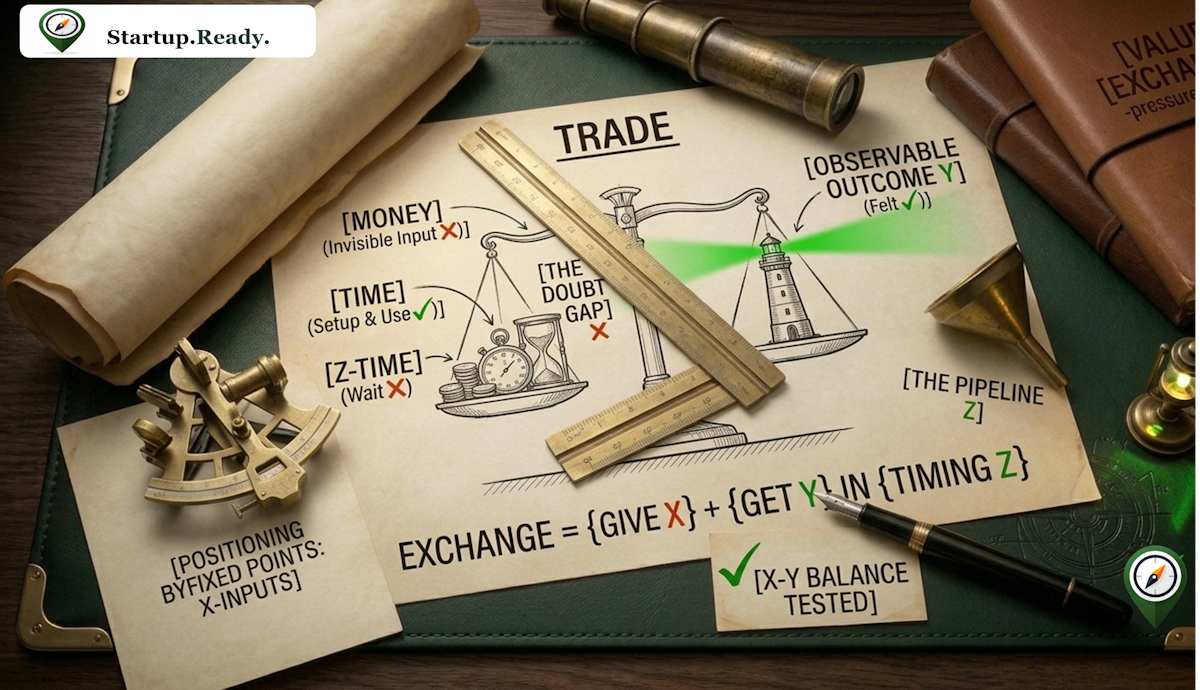
Ask a founder whether their product delivers value and the answer comes fast and confident. Yes. Obviously. They have seen it work. Ask them to say, in one sentence, what the customer gives and what the customer gets back, and the sentence does not come. It stretches into a paragraph. It reaches for features. It ends somewhere near "it depends on the customer."
That gap has a name. The founder is sure the business delivers value and cannot state the exchange. Delivery confidence is high. The exchange itself has never been put into words. A business in that position can build the thing and still not be able to price it, pitch it, or test it, because none of those is possible until you can say what is actually being traded.
Customers close that gap in their own heads before they buy, whether you help them or not. They ask one question: what exactly am I giving, and what exactly am I getting back? If your answer needs a paragraph, they supply their own, and the version they invent is rarely the one you want.
TL;DR: You Give X, You Get Y, in Z Time. If You Can't Say It Simply, You Don't Yet Understand It.
A value exchange is the trade at the center of your business: the customer gives something specific, receives something specific, within a specific timeframe. Most founders can describe what the product does and stall on the exchange, because they have been watching delivery rather than the trade the customer is evaluating. Naming it sharpens pricing, sales, and retention at once. The work is to name what the customer gives, name what they receive, name when they receive it, and assemble the three into one sentence a skeptical customer could check. Here is the move, in order:
Name what they give, all of it, money and time and data and behavior change, not money alone
Name what they receive, the observable change in their situation, not the feature that produces it
Name when they receive it, the moment value shows up, tied to something real rather than a billing date
Assemble the statement: you give X, you get Y, in Z time
Test it against a skeptic who has to know what they are committing to before they pay
Four signals you have not named your exchange:
Your pricing feels arbitrary to customers, and you cannot fully explain why it is the number it is
Sales conversations stall right before commitment, on a hesitation you cannot locate
Early customers churn saying the product was not what they expected
Asked what the customer gives, you say "money," and stop there
If any of those describe you, this article shows you how to name the exchange and test whether it holds.
If You Found This Article by Searching for Something Else
Most founders who need this are not searching for "value exchange." They are searching for the symptom.
How to price my product.
Why do sales conversations stall.
How to explain my value proposition clearly.
Why do customers churn early.
How to pitch what my product does.
All of those trace to the same missing sentence. When you cannot say what the customer gives and gets in one line, pricing floats, pitches wander, and churn shows up from customers who agreed to something they never clearly understood. This article shows you how to write that line and pressure-test it.
What the Customer Gives Is Never Only Money
The first place the exchange goes fuzzy is on the customer's side of the trade. Ask a founder what the customer gives and the answer is the price. Money is the visible input, so it stands in for the whole cost.
The customer knows better. They are also giving time, the hours to onboard, learn, and keep using the thing. They are giving data, the access and inputs the product needs to work. They are giving commitment, the change to how they already operate, the old tool they have to abandon, the habit they have to break. Every one of those is a real cost, and the customer weighs all of them before they decide, even when you only count the first.
This is why a product that looks cheap can feel expensive. The price is low and the switching cost is high: days of setup, a workflow rebuilt, a team retrained. The founder priced the money and ignored the rest, so the exchange the customer actually faces is heavier than the one the founder is describing. Name every input the customer gives, or you are negotiating a trade you cannot see the full shape of.
What the Customer Receives Is a Change, Not a Feature
The other side of the trade goes fuzzy in a predictable way too. Ask what the customer receives and the founder reaches for the feature: the dashboard, the automation, the report. The feature is what the product has. It is not what the customer gets.
What the customer gets is a change in their situation, observable to them without your help. Fewer stockouts. An hour back every morning. A number they can finally trust in a board meeting. The test is simple. Would the customer name this as the reason they bought, or would they name a feature? If it is a feature, keep going until you reach the thing the feature makes true for them.
There is a companion question underneath this one, which is whether that change can actually be measured by the customer without interpretation. A receipt they have to squint at and take on faith is not an outcome yet. It is a description hoping to pass as one. The measurable customer outcome is the discipline that turns the received side of the exchange from a claim into something the customer can verify.
In business-to-business, the received change is rarely singular. The economic buyer gets budget efficiency. The manager gets risk reduction. The end user gets an hour of manual work back. All three are real, and they are not the same Y. The sentence still has to be simple, so anchor it to the primary incentive of whoever actually signs, and carry the other outcomes for the stakeholders you also have to win over. Name the wrong person's Y and the exchange comes out perfectly clear to someone who is not in the room when the decision gets made.
A Big Behavior Change Needs a Bigger Payoff
The heaviest thing a customer gives is usually the behavior change, and it acts like a tax on the whole trade. A customer breaking a habit they have run for years is paying a real cost before your product returns anything, and a marginally better outcome will not cover it. Ask an owner to stop trusting their gut on reorders and a five percent improvement does not move them. The felt payoff has to swamp the felt cost of changing.
That leaves two levers, and most founders reach for neither. Make the payoff bigger and more obvious, so the gain is impossible to miss next to the cost of switching. Or shrink the tax itself: let the customer run your product alongside their old way for a while, ship sensible defaults so the change feels small on day one, automate the steps that would otherwise land as new work. When the behavior change is large and the outcome is only a little better, the trade fails no matter how cleanly you word the sentence. The words were never the problem. The balance was.
When Is the Part Almost Everyone Skips
The exchange has a third component, and it is the one founders leave out entirely. Not what the customer gives. Not what they get. When they get it.
A customer who does not know when the outcome arrives is a customer who will question the charge the moment it hits their card. The payment landed on the first of the month. The value has not shown up yet, or they cannot tell whether it has. In the gap between paying and receiving, doubt grows, and doubt is what cancels the second invoice. When ties the exchange to a moment the customer recognizes as the point they got what they paid for.
So the question is whether your "when" points at a real moment or an arbitrary one. Billing on the first of the month is arbitrary. Value showing up after the first full reorder cycle is real. The closer your payment structure sits to the moment value actually lands, the more the charge feels earned rather than imposed. This is the same seam covered in why "let me think about it" is a timing problem..
The Founder Who Priced the Money and Missed the Trade
Take a founder selling inventory forecasting to small e-commerce shops. Ask what the exchange is and the answer is confident and incomplete: "they pay ninety-nine dollars a month and get smarter reordering." True, and it hides most of the trade.
Name what the customer actually gives. Ninety-nine dollars, yes. Also two hours connecting their sales history and inventory feed. Also ongoing trust, because the product only works if the owner stops eyeballing reorders the way they always have and follows a suggestion from software instead. That last input is the heaviest, and the founder had never counted it. The behavior change was the real price, and the pitch never acknowledged it, which is why owners nodded along in demos and quietly kept reordering by gut.
Now name what the customer receives. Not "smarter reordering," which is a feature wearing an outcome's clothes. The change is cash. Less money frozen in dead stock on the shelf, fewer stockouts on the items that actually sell. An owner can see both in their own numbers within about a month. And name the when: the value lands at the first full reorder cycle, roughly three to four weeks in, when the first data-driven order proves out. The founder had been billing on signup day, weeks before that proof, so the first charge always landed in the doubt gap.
Put together, the exchange becomes sayable. You give ninety-nine dollars a month, two hours of setup, and a willingness to trust the reorder suggestion over your gut. You get less cash trapped in dead stock and fewer stockouts on your best sellers. You see it inside your first reorder cycle. Stated that way, the founder can finally do the thing they could not do before: hand the sentence to a skeptical owner and watch whether it lands with recognition or confusion. The reaction is the test. Not the pitch.
When the Exchange Has More Than One Side
One exchange at the center of the business is the common case. It is not the only one. Some models run several exchanges at once, and squeezing them into a single sentence hides the part you most need to see.
A marketplace has an exchange per side. Drivers give time and vehicle access and receive income. Riders give money and receive a trip. Neither sentence describes the business by itself, and the two are coupled: too few drivers and the rider exchange fails, too few riders and the driver exchange fails. A social platform runs the same way. Users give attention and content and receive connection. Advertisers give money and receive access to that attention. Enterprise software splits the exchange across people inside one organization. The buyer gives budget, the user gives the effort to adopt, and the organization receives the productivity, which is why a deal can close and still fail when the exchange with the person who actually has to use the thing was never named.
The framework holds in every one of these. You run it once per participant. Give, get, and when, for each side of the trade, each stated plainly enough to check. Layered products work the same way: a platform sold on several outcomes at once still resolves into a clear exchange per outcome, and if it cannot, that is usually a sign the model is carrying more than it has yet made sense of. When there are several exchanges, one of them is the hard side, the participant hardest to attract and easiest to lose. For a ride marketplace it is drivers. For an ad-supported platform it is whichever side the other side is paying to reach. Name every exchange, find the one the whole model depends on, and put your attention there first.
The One Sentence That Tells You Where You Stand
A founder who has named the exchange can complete this statement concretely:
My customer gives [specific X], receives [specific Y], within [specific Z], and I know the trade is fair because [the specific reason a customer would agree].
A founder who has not will fill in X with "money," stall on Y, and leave Z blank, because they have been watching the product deliver rather than watching the customer weigh a trade. That stall is the diagnosis. It is usually the reason the pricing feels arbitrary and the sales conversations stall in the same spot every time.
One caution on the word fair. Fairness is not a fixed property of the exchange. It is a judgment the customer makes, and different customers judge the same trade differently depending on their alternatives, their urgency, their budget, and what a past purchase burned them on. A trade one customer finds obvious can be a non-starter for the next. This is why the exchange gets tested against one specific, representative customer rather than an average. Test it against a real person whose pressures and alternatives you actually know, and the fairness question has an answer. Test it against "the customer" in general and it never resolves, because no general customer is doing the trade.
If you can write the sentence and it survives a skeptic, you have an anchor. Pricing, pitch, and onboarding all have a fixed point to align to. If you cannot, that is not a reason to polish the pitch with better adjectives. It is the signal to work one real customer's trade all the way through, every input they give, the change they actually receive, the moment it lands, and say it in a line they could check for themselves. Either outcome moves you forward.
The Value Exchange and Your Business Model Clarity
In the Startup Readiness Framework, Business Model Clarity treats the value exchange as the sentence the whole model rests on, because a business that cannot name what the customer gives and gets cannot price, pitch, or test what it sells. A vague exchange is a common early flag, and it usually traces to delivery confidence standing in for a trade that was never put into words.
What the customer receives, measured and provable, is covered in how to measure the value your startup delivers. When they are ready to pay for it is covered in why "let me think about it" is a timing problem. The exchange is where those two meet.
The Business Model Pillar is one of six pillars in the Startup Readiness Framework. If your business model is clear and defensible, the next question is whether the rest of your startup is as ready as your evidence. The Startup Readiness Assessment gives you a full-system diagnostic across all six pillars in under twenty minutes.
Take your Startup Readiness Score free today at startupready.ai →
Keep Working on the Business Model Pillar
The Business Model pillar asks one question from many angles: does your model turn real value into revenue that holds as you grow? Each article below takes one piece of that question. What you are actually competing against. Where the value lands for the customer. Whether you are pricing your effort or their outcome. What caps your growth before you reach it. Read them in any order. Each is a separate cut at the same pillar, and together they show you where your model is clear and where it still breaks.
More in the Business Model pillar:
Startup Defensibility: Why a Head Start Is Not a Moat
How to Measure the Value Your Startup Delivers Before You Try to Sell It
The Elevator Pitch Template: How to Write, Test, and Use Your One-Line Business Model
"Let Me Think About It" Is a Timing Problem, Not a Price Objection
Your Customer Is Not Deciding Whether to Use You. They Are Comparing Their Options.
If Every Customer Resets the Work, You Have Revenue but Not Leverage
You Are Pricing Your Effort. Your Customer Is Buying an Outcome.
The Constraint That Caps Your Growth Is Rarely the One You Are Worried About
A Structural Constraint Does Not Yield to Effort. It Yields to a Plan.
The Product Working Is Not the Same as the Customer Feeling It Work
Delivering Value and Naming the Exchange Are Two Different Things
Why Customers Stay Is Not the Same as Why They Chose You
A Stall in Growth and a Ceiling in the Model Are Two Different Problems
Published
By Dr. Shaun P. Digan
Originally Published on the Startup.Ready.’s Startup Readiness: Validation, Framework, and Tools Blog at https://startupready.ai/startup-readiness/value-exchange-statement
Original Publication Date: August 5, 2026
Last Updated: August 5, 2026
About the Author
Dr. Shaun P. Digan is the founder of Startup.Ready and the creator of the Startup Readiness Framework, a research-based system for evaluating and validating early-stage startups before launch and early growth. He holds a PhD in Entrepreneurship from the University of Louisville and has spent over 15 years teaching, advising, and consulting with founders on startup strategy, validation, and growth.
In his writing, including the Startup Readiness Blog and The Foundations of Innovation Essay Series, he focuses on how founders can make better decisions by improving clarity, alignment, and readiness before scaling.