A Trigger You Cannot Time Is a Trigger You Cannot Use
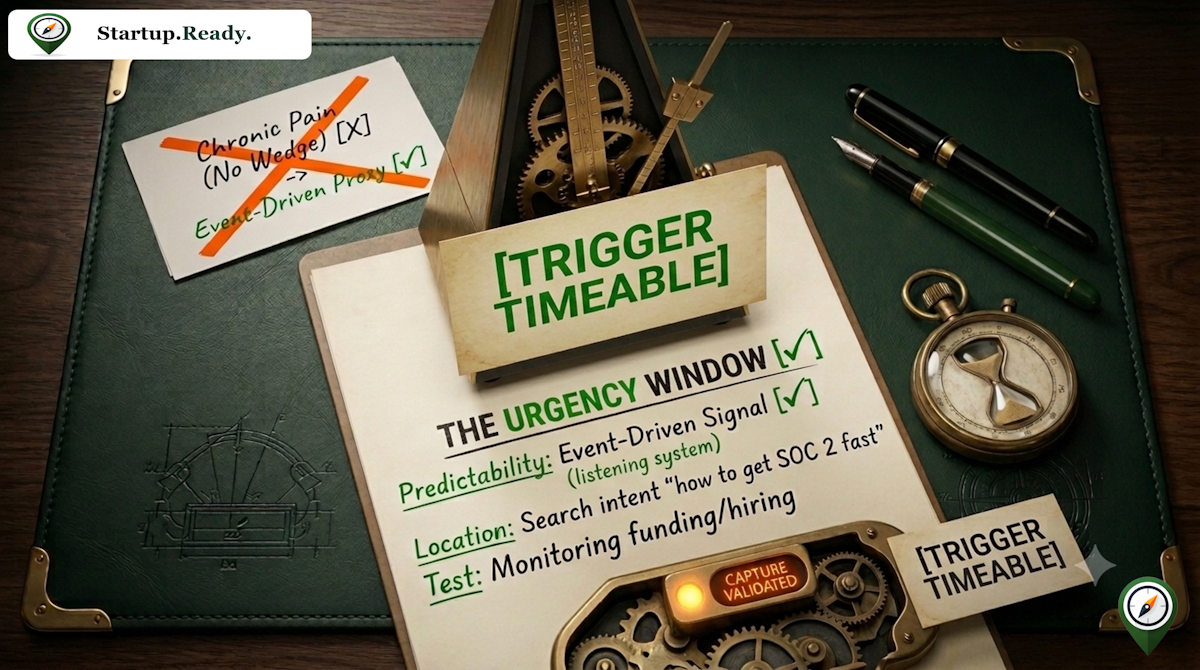
You found the trigger. You can name the event that makes your customer act. That is real progress, and it is where most founders stop.
The problem shows up when you try to build on it. A trigger is only useful if you can be present when it fires, and being present requires three things the trigger by itself does not give you: when it happens, how long the readiness lasts, and where the customer is during that stretch. Without those, you know the moment exists and you cannot aim at it.
Knowing customers act "when something changes" is not knowing the trigger. It is knowing that a trigger is out there. The gap between those two is where acquisition budget goes to die, quietly, disguised as a message problem.
A trigger without a window is a fact you cannot schedule around.
TL;DR: A Named Trigger Is Not a Timeable One. Sharpen It Until You Can Schedule Around It.
Naming the trigger is half the work. The other half is resolution: predictability, window length, and location. Take the trigger you have and make it precise enough to hand to someone building a campaign. Here is the move, in order:
Restate the trigger as an observable event, something a stranger could recognize without asking you what you meant
Classify its predictability: recurring on a schedule, event-driven but irregular, or chronic and gradual
Estimate the urgency window: how long after the trigger fires the customer stays ready to act
Locate the customer inside the window: what they search, where they look, who they ask
Name one timing test that reaches them during the window rather than before or after
Four signals your trigger is still too soft to use:
You can name the trigger but not how long the customer stays ready after it fires
You cannot say whether the trigger is predictable or random
Your outreach reaches people who are interested but not yet ready, or already decided
You describe the trigger as a state ("when they care about X") rather than a moment
If any of those describe you, this article shows you how to sharpen a real trigger into a timeable one.
If You Found This Article by Searching for Something Else
Most founders who need this are not searching for "urgency window." They are searching for something more immediate.
Why is my outreach timing off.
How to reach customers at the right moment.
Why do warm leads go cold.
How to time a marketing campaign.
My leads are interested but never ready to buy.
All of those point at the same underlying question. You know what makes your customer act, so why can you not seem to reach them at that moment? This article shows you the three things a trigger needs before it can time anything.
Named Is Not the Same as Sharp
A vague trigger fails in a way that is easy to misread. The outreach lands, but it lands across the wrong moments. Some of it reaches people who have not hit the trigger yet, so they file it under "interesting, not now." Some reaches people who passed the trigger weeks ago and already chose. A little of it lands in the window, converts, and gets buried in the average.
The founder sees a pipeline full of interested people who will not move, and concludes the message is weak or the product is missing something. Both are the wrong fix. The trigger was real. It was just too blurry to aim, so the effort spread across the timeline instead of concentrating at the moment.
Sharpening a trigger means answering three questions about it. When does it fire. How long does the readiness last. Where is the customer while it lasts. A trigger that cannot answer all three is a trigger you can describe but not schedule around, and scheduling is the entire point.
The Same Trigger, Sharpened
Take a founder selling a compliance-automation tool to mid-sized software companies. She has a trigger, and it is a real one: customers act "when security becomes a priority." True, and useless, because it is a state and states cannot be timed.
Watch it sharpen.
Make it an event. She looks at who actually bought and finds the real moment underneath the state. Security did not "become a priority." A specific thing happened: an enterprise prospect put a SOC 2 report on the table as a condition of signing. The deal was real, the requirement was hard, and the company had no report. That is the trigger. Not a mood. A blocked deal.
Classify its predictability. Is this recurring, event-driven, or chronic? It is event-driven but irregular. She cannot predict which of her prospects will get that enterprise demand or when. She can recognize it the instant it happens, which tells her the acquisition approach: not a campaign that runs ahead of a known date, but a system that catches the signal when it fires. Monitoring, not scheduling.
The three types are not academic. Each one dictates a different acquisition strategy, and getting the type wrong means building the wrong machine.
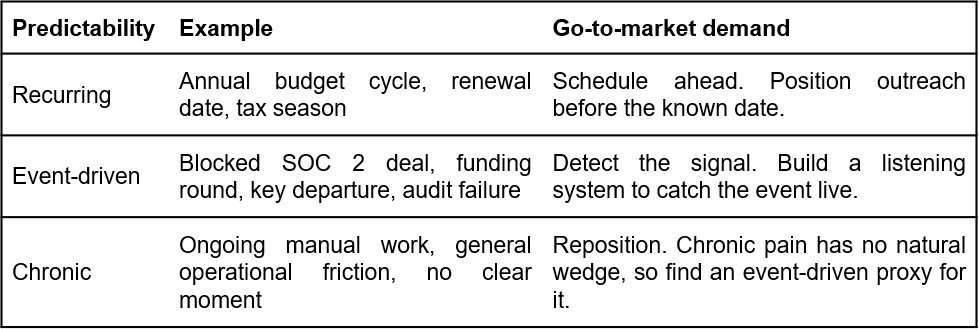
Read down the last column. A recurring trigger rewards a calendar. An event-driven one rewards a listening system. A chronic one rewards neither, which is why a chronic trigger is the weakest of the three. The move with a chronic trigger is not to market harder against a moment that does not exist. It is to find the event-driven proxy hiding inside it: the specific incident that turns the slow pain acute. "Manual data entry is painful" is chronic and unmarketable. "A failed audit traced the error back to manual entry" is the same pain with an event attached, and the event is what you can time.
The event-driven row raises the obvious question: if the trigger is irregular, how do you catch it live? A listening system is more concrete than it sounds. It is any mechanism that surfaces the trigger the week it fires. Job boards are one: a company posting for a compliance officer or a head of security is often weeks from the SOC 2 demand that follows. Funding announcements are another, since a fresh round frequently precedes the enterprise deals that create the compliance pressure. Intent-data and search ads catch the customer in the act of looking, bidding on the exact query the trigger produces. Watching a competitor's review pages, hiring pages, or status incidents can surface the moment their customers start shopping. None of these predict the trigger. Each one detects it fast enough to reach the customer while the window is still open.
Estimate the window. How long after the demand lands does the company stay ready? Short. A blocked deal is a burning window. The prospect wants to sign, the report stands in the way, and every week of delay risks the deal cooling. The urgency window is roughly two to six weeks, and it slams shut when the deal either closes with a workaround or dies. That window length dictates everything: there is no time for a nurture sequence, so the message has to convert on contact.
Locate the customer in the window. Location here means where the customer's attention goes once the trigger fires, not a geography. What are they searching, whose advice are they asking, which pages are they reading in that specific week. Where is a founder whose deal just got blocked on SOC 2? Not reading security thought-leadership. She is typing "how to get SOC 2 fast" and "SOC 2 in 30 days" into a search bar, asking peers in founder Slacks which auditor moves quickly, and reading exactly the pages that promise speed. That is a named, enterable location and a knowable search intent.
The state "when security becomes a priority" pointed nowhere. The sharpened trigger points at a specific person, in a specific week, typing a specific query, needing a specific promise. Same trigger. Now it can be timed.
The Window Is the Part Founders Skip
Of the three, the urgency window is the one most often missing, and it is the one that decides what kind of go-to-market is even possible.
A long window and a short window are different businesses. If the customer stays ready for months after the trigger, a nurture sequence works, content can do the convincing, and outreach has room to breathe. If the window is days, none of that applies, because by the time the sequence warms up the customer has already solved the problem or given up. The message has to arrive sharp and land immediately.
Most founders never estimate the window, so they build for a duration they never checked. They run patient nurture campaigns against burning windows, or fire hard-sell urgency at customers who have months to decide and resent being rushed. The trigger was right. The tempo was guessed.
Estimate the window in a concrete range. Hours. Days. A week. A month. If you cannot put a range on it, you do not yet understand the trigger well enough to spend money against it, and that is the honest read to sit with before the spend.
The Handoff Test
One test tells you whether your trigger is sharp enough to act on.
Could you hand your trigger to someone building an acquisition campaign, and would they know what to do without asking you a single follow-up question?
Say it out loud as you would hand it over. "Customers act when security becomes a priority" fails instantly. The person building the campaign has to ask when that happens, how they would know, how long they have, and where to reach anyone. Four follow-ups, which means four things you have not sharpened.
"Customers act when an enterprise prospect demands a SOC 2 report they do not have. It is unpredictable but recognizable, the window is two to six weeks, and they are searching for fast SOC 2 solutions the moment it hits." No follow-ups. The campaign builds itself from that sentence.
The follow-up count is the measure. Every question your trigger forces someone else to ask is a dimension you left soft. A trigger sharp enough to use is one that survives the handoff intact.
If your trigger cannot be observed from the outside, has no window you can estimate, or reaches no channel you can name, it is not weak. It is unusable, and the move is to replace it rather than polish it. Sharpening assumes there is a real edge under the blur. When there is not, sharpening is just spending more time on the wrong trigger.
The One Sentence That Tells You Where You Stand
A founder who has sharpened a trigger can complete this statement with specifics in every slot:
My trigger is [specific observable event]. It is [recurring / event-driven / chronic], the urgency window lasts about [concrete range], and during that window the customer is [specific location or search].
A founder with a soft trigger can name the event and stalls on the window, or names the window and cannot say where the customer is. Whichever slot goes blank is the exact dimension to sharpen next.
If you can fill every slot, your trigger can time a campaign, and the next move is to run one timed test against untimed outreach and compare. If a slot stays empty, you have found the soft dimension, and it is a smaller problem than a flat pipeline made it look. The trigger is real. It just needs resolution in one place. Either outcome moves you forward.
Urgency and Your Market Clarity
In the Startup Readiness Framework, Market Clarity treats urgency as a property of a moment, and a moment you cannot time is a moment you cannot reach. A named trigger with no window, no predictability, and no location reads as market understanding but does not function as it. Weak urgency triggers are a common early flag for this reason, because naming the trigger feels like finishing the work and the missing resolution only shows up when timed outreach is impossible to design.
Market Clarity is one of the six pillars in the framework. The Startup Readiness Assessment gives you a full-system diagnostic across all six in under twenty minutes.
Take your Startup Readiness Score free today at startupready.ai →
Keep Working on the Market Pillar
The Market Pillar asks one question from many angles: does your market resolve to specific, reachable customers, or does it stay a broad guess? Each article below takes one piece of that question. Which customer inside your market will actually pay. Where that customer actually is right now. Whether you can reach them once you have found them. What makes them move now rather than someday. Read them in any order. Each is a separate cut at the same pillar, and together they show you where your market resolves to real people and where it stays a guess.
More in the Market Pillar:
Startup Market Segmentation: What a Target Market Actually Is and Why Yours Is Probably Too Broad
How to Find Your Customer's Urgency Trigger Before You Build Your Go-to-Market Strategy
Target Customer Definition: How to Find and Validate the Right Customer
Two Customers Have the Same Problem. Why Will Only One of Them Pay You?
Knowing Where Your Customers Gather Is Not the Same as Reaching Them
A Step-by-Step Guide to Defining Your Target Customer, By Deciding Who You Don't Serve
Your Urgency Trigger Is a Guess Until Five Real People Confirm It
Published
By Dr. Shaun P. Digan
Originally published on Startup.Ready.’s Startup Readiness: Validation, Framework, and Tools Blog at https://startupready.ai/startup-readiness/sharpen-urgency-trigger
Original Publication Date: August 3, 2026
Last Updated: August 3, 2026
About the Author
Dr. Shaun P. Digan is the founder of Startup.Ready and the creator of the Startup Readiness Framework, a research-based system for evaluating and validating early-stage startups before launch and early growth. He holds a PhD in Entrepreneurship from the University of Louisville and has spent over 15 years teaching, advising, and consulting with founders on startup strategy, validation, and growth.
In his writing, including the Startup Readiness Blog and The Foundations of Innovation Essay Series, he focuses on how founders can make better decisions by improving clarity, alignment, and readiness before scaling.