You Do Not Have an Access Point. You Have a List.
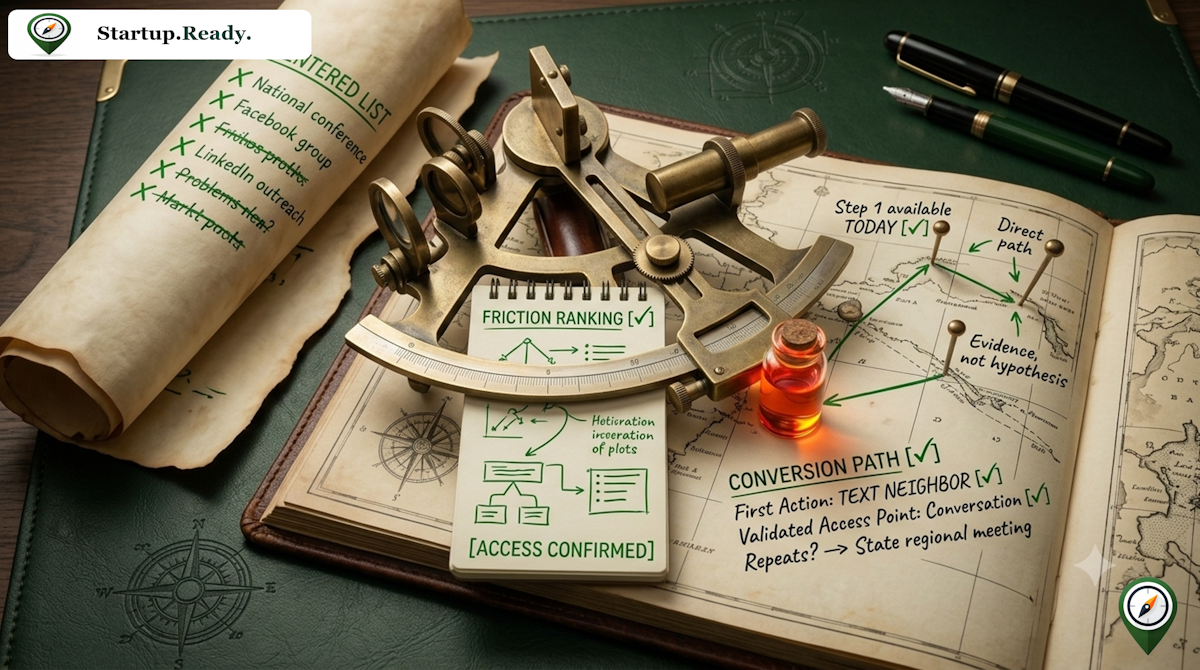
Most founders can name five places their customer gathers. Very few have entered one this week.
The list feels like progress, and it looks like progress on a slide. Five channels, each plausible, each defensible if an investor asks how you plan to reach the market. What the list does not contain is a path anyone has walked.
A place you could reach your customer and a place you have reached your customer are different objects. The first is a hypothesis. The second is evidence. Go-to-market plans get built on the first and then fail quietly, because the plan was never tested at the only point that mattered.
Access is not confirmed until a conversation has started from a specific path.
TL;DR: Reach Is How Many Could See You. Access Is How Fast You Can Start Talking.
Founders build lists of high-reach venues and call it a go-to-market plan. Reach is a volume property. Access is a speed property. Early on, only one of them produces evidence. The work is to rank what you have by friction, enter the shortest path this week, and find out whether it repeats.
This is what a real customer access point looks like: not a channel you could theoretically use, but a path you have actually walked once already. Here is the move, in order:
Name every candidate access point: communities, platforms, events, associations, referral networks, existing relationships
Sort them into reach and access: venues where many people could see you, and paths where a conversation starts quickly
Rank by friction using time to first conversation, the specific thing in the way, and how many customers the path can reach
Enter the lowest-friction path first, then test whether the same path produces a second conversation
Commit to one entry action with a date inside seven days and a success signal that involves another person responding
Four signals your access is still hypothetical:
You can name places your customer gathers and cannot name the last one you entered
Your go-to-market plan starts with a venue that is more than a month away
Your fastest path runs through someone you already know, and you discounted it because it felt too small to count
You have concluded the market is slow to respond without a single conversation from a repeatable path
If any of those describe you, this article shows you how to convert a list into an entry.
If You Found This Article by Searching for Something Else
Most founders who need this are not searching for "access points." They are searching for something more immediate.
How to find my first customers.
How to get customer interviews.
Best channels for early-stage startups.
How to reach customers with no budget.
Nobody is responding to my outreach.
All of those point at the same underlying question. Of all the places you could reach your customer, which one gets you a real conversation fastest, and what is stopping you from entering it this week? This article shows you how to rank what you have and pick.
A List Is Not a Path
Founders arrive at the list honestly. You define the customer, research where that customer spends attention, and write down what you find. That work is real, and this article assumes you have done it.
The failure comes after. A list has no next action inside it. Each item is a place, and a place is not an instruction. So the founder returns to product, or to the deck, and the list sits in the document as evidence that go-to-market has been considered.
Six weeks later the founder can still name the five places. The number of conversations that came from them is zero.
That is an entry gap, and it hides well, because the artifact looks finished.
Five Places, One Path
Take a founder building software for high school athletic directors, the people who manage eligibility paperwork, official assignments, and transportation for every team in a district. Her list has five entries: the national athletic directors conference, a four thousand member Facebook group, her state association's regional meeting, her cousin's neighbor who is an athletic director two districts over, and cold outreach on LinkedIn.
Ask which is her access point and she will say the conference. It is the one that sounds like a strategy.
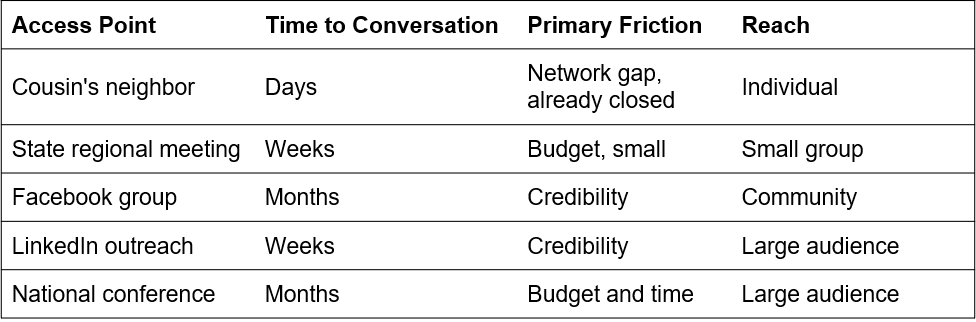
Now rank the same five on what the assessment actually asks: how long until a real conversation, what specifically is in the way, and how many customers the path can reach.
Most advice on how to reach customers without a big budget focuses on cheaper channels; the real lever is market proximity, how close you already are to a path that works.
The table reorders her list, and it exposes the pattern that misled her. The two paths that reach the fewest people are the two that produce a conversation fastest. The conference drops to the bottom on every column except reach. The Facebook group is enterable today and still months from a conversation, because she would arrive as a stranger with an ask, which is a standing problem rather than an access problem. The regional meeting is eleven days out, costs very little, and puts forty target customers in one room.
The text message is available in the next ten minutes.
Reach Is Not Access
The text is the lowest-friction path on her list, and the one she is least likely to choose.
It does not feel like go-to-market. Talking to one athletic director reachable through a family connection has none of the shape of a channel strategy, so she reaches for the conference, which has the shape but not the speed.
The confusion underneath is that two different properties share a name. Reach is how many people could see you: nine hundred conference attendees, four thousand group members, an unbounded LinkedIn audience. Access is how quickly a conversation starts: one text, one introduction, one room with forty people who already know why you are there.
Founders optimize reach before they secure access, because reach is the number that sounds like scale. Early on, reach produces almost nothing. A venue where nine hundred people could theoretically encounter you in December is worth less than a conversation on Thursday, because the conversation changes what you know and December does not.
You are not filling a pipeline yet. You are finding out whether your account of the problem survives contact with someone who has it. One person can tell you that. Nine hundred cannot tell you faster.
The Friday Test
One question tells you how hypothetical an access point still is.
If you needed a conversation with a target customer by Friday, what is the specific path you would take?
Ranking your list by friction is how you turn a wish into a customer access point you can actually test this week.
Describe it in steps, then count them. Text the neighbor, ask for twenty minutes. Two steps, both available today. Register for the conference, attend in December, meet people at the reception, follow up in January. Four steps, none available this week.
The count is a signal rather than a rule, and it is worth being precise about what it measures. Plenty of legitimate paths run long. Association partnerships, pilot agreements, and anything sold through procurement involve applications, approvals, and introductions, and a five-step chain there is a real path rather than a fantasy.
What separates them is when the first step is available. A four-step path where step one happens today is an entry. A four-step path where step one is four months away is a plan. Count the steps, then check the calendar on the first one. The chain length tells you how much can go wrong. The date on step one tells you whether you have started.
Run the test across your list. Most lists collapse to one or two real entries, and that collapse is the useful output. You do not need five access points. You need one you have walked.
The Neighbor Is an Entry, Not a Channel
One caution, because speed is the right optimization now and the wrong one soon.
The neighbor is an excellent entry and a poor path. A family connection produces one conversation and does not produce a second one, and a founder who runs only on warm introductions can collect ten conversations without ever learning whether the market can be entered by someone without her contacts.
Market Clarity measures the second thing. Proximity, in the framework, means the segment permits repeated reach through a stable path, without scale, brand, or luck. One conversation is evidence. The same path producing a third and a fourth conversation is proximity.
So enter the neighbor first because it is fastest, and treat it as a test of your framing rather than a test of your market. Then enter the regional meeting, because a state association is the kind of stable path that can repeat. If the meeting produces conversations and the next one does too, you have found proximity. If every conversation requires a new favor from a different person, you have entry without proximity, and that is a market finding worth having early.
What the Unentered List Protects
There is a reason the list stays a list.
An unentered access point cannot fail. As long as the conference is four months out, it remains a good option. Every unentered item preserves the belief that access exists.
Entry converts belief into evidence, and evidence comes back negative sometimes. The neighbor might say the paperwork is annoying rather than urgent. The regional meeting might produce forty polite conversations and no interest. Those outcomes are more useful than the list and harder to sit with, so the list persists and the calendar fills with work that cannot disconfirm anything.
Optionality feels like readiness. It is closer to deferral.
Then the cost arrives disguised. A founder who never enters concludes that the market is slow, or unresponsive, or not ready, and starts adjusting the product against that conclusion. Lack of access and lack of demand produce identical silence, and only one of them is about the customer.
Silence from a market you never entered is not a finding. It is the sound of a question you have not asked.
The One Sentence That Tells You Where You Stand
A founder who has done this work can complete one statement with specifics in all three slots:
The access point where I can reach my target customer with the least friction right now is [specific place or person].
The first action I will take to enter it is [specific action], and I will take it by [date inside seven days].
Then one more check, because the date is the part that slips. Name what would count as success, and make it something another person does. A message sent is effort. A reply, a scheduled call, a question asked back: those are signals.
If you can fill all three slots and name a response-based signal, you have an entry to make. If the first slot is easy and the date slot stays blank, the gap is not information. You already know where to go. The next move is to name what has been keeping you from going, and decide whether it is a real obstacle or a reason you have been giving yourself. Either outcome moves you forward.
Access and Your Market Clarity
In the Startup Readiness Framework, Market Clarity treats proximity as a property of the segment before it is a property of your effort. A market with proximity can be entered repeatedly through a stable path. A market without it requires a new search every time, and no amount of hustle converts the second into the first.
Unclear access points are a common early flag, because a list of plausible venues can hide the absence of a stable path for months.
Market Clarity is one of the six pillars in the framework. The Startup Readiness Assessment gives you a full-system diagnostic across all six in under twenty minutes.
Take your Startup Readiness Score free today at startupready.ai →
Revisit your customer access point any time your current path stops producing a second conversation, not just the first.
Keep Working on the Market Pillar
The Market Pillar asks one question from many angles: does your market resolve to specific, reachable customers, or does it stay a broad guess? Each article below takes one piece of that question. Which customer inside your market will actually pay. Where that customer actually is right now. Whether you can reach them once you have found them. What makes them move now rather than someday. Read them in any order. Each is a separate cut at the same pillar, and together they show you where your market resolves to real people and where it stays a guess.
More in the Market Pillar:
Startup Market Segmentation: What a Target Market Actually Is and Why Yours Is Probably Too Broad
How to Find Your Customer's Urgency Trigger Before You Build Your Go-to-Market Strategy
Target Customer Definition: How to Find and Validate the Right Customer
Two Customers Have the Same Problem. Why Will Only One of Them Pay You?
Knowing Where Your Customers Gather Is Not the Same as Reaching Them
A Step-by-Step Guide to Defining Your Target Customer, By Deciding Who You Don't Serve
Your Urgency Trigger Is a Guess Until Five Real People Confirm It
Published
By Dr. Shaun P. Digan
Originally published on Startup.Ready.’s Startup Readiness: Validation, Framework, and Tools Blog at https://startupready.ai/startup-readiness/customer-access-points
Original Publication Date: August 3, 2026
Last Updated: September 5, 2026
About the Author
Dr. Shaun P. Digan is the founder of Startup.Ready and the creator of the Startup Readiness Framework, a research-based system for evaluating and validating early-stage startups before launch and early growth. He holds a PhD in Entrepreneurship from the University of Louisville and has spent over 15 years teaching, advising, and consulting with founders on startup strategy, validation, and growth.
In his writing, including the Startup Readiness Blog and The Foundations of Innovation Essay Series, he focuses on how founders can make better decisions by improving clarity, alignment, and readiness before scaling.