Two Customers Have the Same Problem. Why Will Only One of Them Pay You?
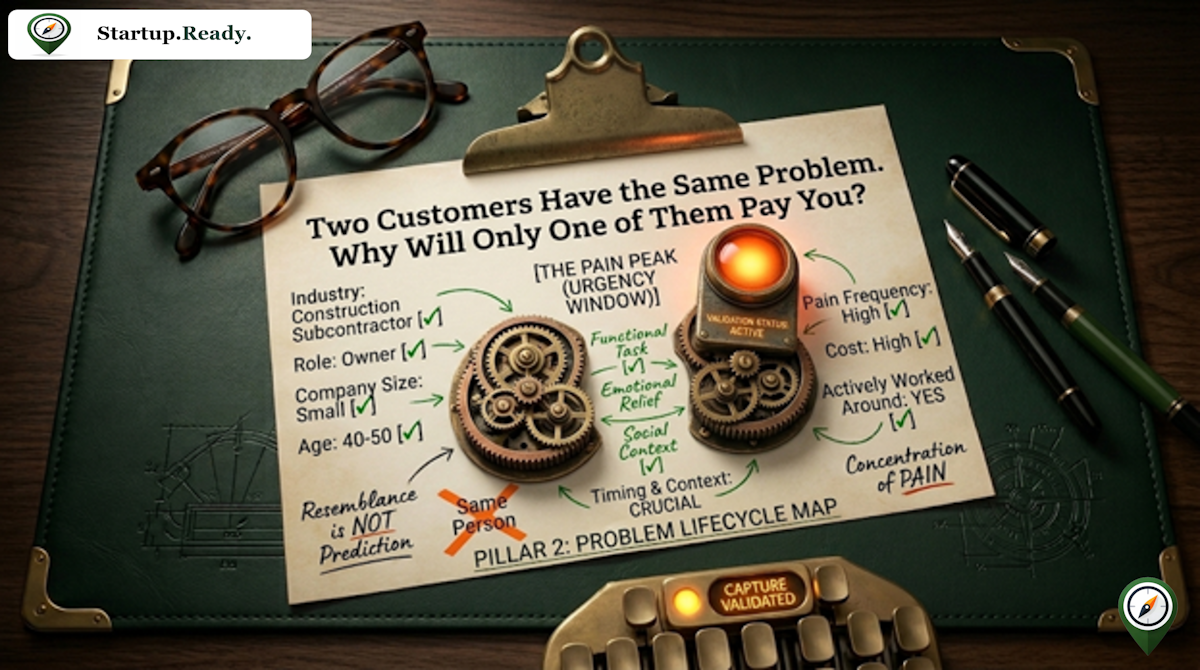
Most founders segment their market by who people are. Industry, role, company size, age, geography. They build a slide with three or four boxes, each one a type of person, and they call it segmentation.
It feels like specificity. It is sorting people by resemblance.
The trouble is that resemblance does not predict who buys. Two people can match the same description down to the title and the headcount and feel the problem in completely different ways. One has built a workaround, lost money to it, and is hunting for something better. The other notices the problem twice a year and shrugs. They are the same segment on your slide. They are not the same customer. One will pay you. The other never will.
The segment that produces traction is not a kind of person. It is a kind of pain.
TL;DR: A Segment Is Not a Type of Person. It Is a Concentration of Pain.
Demographic segments sort people by what they have in common on paper. The segments that produce early traction sort people by how acutely they feel the problem, whether they already spend to solve it, and whether you can reach them this week.
This is customer segmentation by willingness to pay in practice: the same resemblance on paper, two completely different customers in reality. The question that matters is which customer segment will actually pay, not which one merely fits the description. Here is the move, in order:
List every group that plausibly has the problem, specific by role and context
Rank them by pain: how frequent, how costly, how actively worked around
Demand evidence for each rank: a workaround, a purchase, a hire, not a guess
Cut the segments you cannot reach, and the ones that hurt but never spend
Define one entry segment by the version of the problem they feel, then commit to a dated action
Four signals your market is still sorted by the wrong thing:
Your segments are described by who people are, not by how the problem hits them
Your messaging gets polite interest from many groups and urgency from none
Customer feedback pulls in contradictory directions and you cannot tell which to follow
You acquired early users broadly and they churned fast
If any of those describe you, this article shows you how to re-sort your market by pain and pick one place to start.
If You Found This Article by Searching for Something Else
Most founders who need this are not searching for "segment by pain." They are searching for something more immediate.
How to narrow my target market.
Why my marketing isn't converting.
How to find my first customers.
My market feels too broad, how do I focus.
How to choose a beachhead segment.
All of those point at the same underlying question. Of all the people who could have this problem, which specific group feels it sharply enough to act, and can you get to them? This article shows you how to find that group by ranking pain instead of describing people.
Why "Who They Are" Feels Like Segmentation
Every incentive in the founder's environment rewards the demographic answer. Investors ask about market size. Accelerator applications ask for a customer profile. Pitch templates have a box shaped like a persona. So founders learn to describe a population and call it a market, because that is the shape the room is asking for.
A demographic description is easy to produce and easy to defend. "Independent marketing consultants" sounds specific. It has an industry and a role in it. You can put a number next to it and say there are two hundred thousand of them.
What it hides is that those two hundred thousand people do not feel the problem the same way. Some are drowning in it. Some have never noticed it. The description treats them as one group because they share a job title, and the job title is not what makes someone buy.
That is the quiet failure behind a broad market. The cost does not show up as a clear error. It shows up as conversations that go nowhere, feedback that contradicts itself, and acquisition that never becomes repeatable. The founder reads those signals as a messaging problem and rewrites the copy. The real problem is upstream. The market was sorted by resemblance, so it mixed people in agony with people in mild annoyance, and the average of the two does not exist.
Sort by Pain Instead
Re-rank the same people on a different axis. Not who they are. How hard the problem hits them.
Customer segmentation by willingness to pay is worth revisiting every time a deal that looked qualified falls through.
Pain concentration has a working definition you can apply. High pain means the problem is frequent, costly, and already being worked around. Moderate pain means there is a low-cost workaround and people live with it. Low pain means the problem is real but tolerated, noticed and never prioritized. The scale exists to force a distinction your demographic slide erased.
Take a founder building a tool to chase overdue client invoices. The demographic answer is "small businesses with cash flow problems." Sort that population by pain and it splits apart.
A freelance graphic designer gets paid late sometimes. It stings. They send an awkward email and wait. Real and tolerated. Low pain.
A marketing agency runs net-30 terms across a dozen clients. Late payment is a monthly headache. A part-time bookkeeper spends a day a month sending reminders. There is a workaround, and it costs something. Moderate pain.
A construction subcontractor lives on net-60 and net-90 terms, carries payroll for a crew every two weeks, and has watched a single late payment from a general contractor threaten the whole month. They chase money constantly. They have hired help to do it. They have turned down jobs because the cash was tied up. Frequent, costly, actively worked around. High pain.
Same problem. Same demographic bucket if you sorted by "small business." Three different customers once you sort by pain. The subcontractor is the one who buys, and you only see it when pain is the axis.
Make Every Rating Carry Evidence
A pain ranking is only as good as the evidence under it, and this is where the exercise goes wrong most often. A founder rates a segment "high pain" because it would be convenient if it were. The rating is a wish wearing the costume of an assessment.
So attach evidence to every rating, and be strict about what counts. Evidence is something you have seen, heard, or can point to. A conversation where they described the last time it happened. A tool they already pay for. A workaround you watched them perform. A job posting for someone to handle the problem. If you cannot point to anything concrete, the honest label is not "high," it is "inferred," and an inferred rating is a hypothesis you have not tested.
Customer segmentation by willingness to pay gets sharper the more closing conversations you review.
The fastest way to grade a segment's pain honestly is one question. Ask what they did the last time the problem occurred. Not what they think of it in the abstract. What they actually did in the days after it last hit them. If the answer is a workaround, a purchase, or a call to someone for help, the pain is real and you have your evidence. If the answer is "nothing, really," the pain is low no matter how reasonable it sounds that it should be high.
That evidence does a second job, and it is the one founders skip. Spending evidence proves the pain is real, and it proves money already moves toward the problem. Those are two different facts. High pain tells you a segment cares. It does not tell you they will pay. A segment can hurt badly and still have no budget, no habit of buying, and no authority to spend, and a segment in that state will validate your problem and starve your business. The subcontractor passes both tests: the pain is acute, and they already hired help to deal with it, which is spending. When you find high pain with no history of spending on it, treat the segment as a problem worth confirming, not a customer worth building for yet.
A High-Pain Segment You Cannot Reach Is Not a Starting Point
Pain tells you where to aim. Access tells you whether you can pull the trigger. Both have to hold.
A segment can have the sharpest pain on your whole map and still be the wrong place to start, because you have no path to a conversation with them this week. Access is not a growth question you solve later. It is an operating requirement now. If reaching your highest-pain segment needs credibility you have not built, a budget you do not have, or relationships that take a year to form, you cannot learn from them fast enough to matter.
So put the top-ranked segment through one test before you commit. Can you name a specific person in this group you could speak to within seven days, using a path you already have? Not a type of person. A person, or a description sharp enough that you could find one today. Where do they gather. How would you reach them, by an actual mechanism and not "social media." Do you have access right now, and if not, what is the fastest realistic way to get it.
When pain is high and access is real, you have a starting segment. When pain is high and access is missing, you have a target for later and a gap to close first. When access is easy but pain is low, you have a trap. Easy to reach and unwilling to pay is the most expensive group a founder can build for, because it generates just enough activity to look like progress.
Define the Segment by the Problem, Then Make It Findable
The output of the work is one sentence, and its shape matters. It names the version of the problem, with the kind of person as a detail inside it.
The weak form is a demographic restatement. "We are targeting construction subcontractors." That is the box on the slide again, slightly smaller.
The strong form names who, what, and where the pain lives. "We are targeting construction subcontractors running payroll for a crew on net-60 terms, who have already hired help to chase payments and have lost work to tied-up cash." The first sentence describes a person. The second describes a person in pain, with the evidence built in.
Then translate the pain back into something you can search. A pain profile is precise, but you cannot type "has lost work to tied-up cash" into a list-building tool. What you can do is pull the observable proxies out of the profile: the trade and crew size, net-60 payment terms, a recent job posting for a bookkeeper or office manager, membership in a regional contractors association. Those are the signals that tend to travel with the pain, and they are what you put into a directory, a search, or an outreach list. The pain defines the segment. The proxies are how you find the next ten people in it.
That list is what the dated action acts on. Name the first move and put a date on it: a set number of conversations with people in the segment, by a day you choose this week. A commitment without a date is a wish.
The One Sentence That Tells You Where You Stand
A founder who has done this work can fill in one statement without reaching for a guess:
The segment I am starting with is [group], feeling [the specific version of the problem].
The evidence their pain is real is [behavior I have observed], and money already moves toward it because [spending I can point to].
I can reach [a specific person] in this group by [date].
A founder who has not done it reaches back for the description. "Small businesses." "Busy professionals." "Companies in this industry." Those are the categories this exercise exists to break apart.
If you can name the segment by its pain, back the ranking with behavior you have seen, and confirm money already moves toward the problem, you have a wedge worth testing. If your top segment rests on inference, you have found the exact gap to close: go watch one of them deal with the problem, and let what they do replace what you assumed. Either outcome moves you forward.
One honest caveat. A pain-ranked segment is not a validated market. It is a sharper place to start looking. The ranking is built partly on evidence and partly on inference, and the job from here is to convert the inference into observed behavior through real conversations.
Segmenting by Pain and Your Market Clarity
In the Startup Readiness Framework, Market Clarity evaluates whether a founder has moved from a broad market description to a specific segment, defined by where the problem concentrates and backed by evidence. A market that is too broad is one of the most common flags in early assessments, because a demographic description feels like focus and the missing axis, pain, rarely announces itself.
Market Clarity is one of the six pillars in the framework. The Startup Readiness Assessment gives you a full-system diagnostic across all six in under twenty minutes.
Take your Startup Readiness Score free today at startupready.ai →
Revisit your customer segmentation by willingness to pay every time a deal falls through unexpectedly.
Keep Working on the Market Pillar
The Market Pillar asks one question from many angles: does your market resolve to specific, reachable customers, or does it stay a broad guess? Each article below takes one piece of that question. Which customer inside your market will actually pay. Where that customer actually is right now. Whether you can reach them once you have found them. What makes them move now rather than someday. Read them in any order. Each is a separate cut at the same pillar, and together they show you where your market resolves to real people and where it stays a guess.
More in the Market Pillar:
Startup Market Segmentation: What a Target Market Actually Is and Why Yours Is Probably Too Broad
How to Find Your Customer's Urgency Trigger Before You Build Your Go-to-Market Strategy
Target Customer Definition: How to Find and Validate the Right Customer
Knowing Where Your Customers Gather Is Not the Same as Reaching Them
A Step-by-Step Guide to Defining Your Target Customer, By Deciding Who You Don't Serve
Your Urgency Trigger Is a Guess Until Five Real People Confirm It
Published
By Dr. Shaun P. Digan
Originally published on Startup.Ready.’s Startup Readiness: Validation, Framework, and Tools Blog at https://startupready.ai/startup-readiness/segmenting-by-pain
Original Publication Date: June 17, 2026
Last Updated: August 4, 2026
About the Author
Dr. Shaun P. Digan is the founder of Startup.Ready and the creator of the Startup Readiness Framework, a research-based system for evaluating and validating early-stage startups before launch and early growth. He holds a PhD in Entrepreneurship from the University of Louisville and has spent over 15 years teaching, advising, and consulting with founders on startup strategy, validation, and growth.
In his writing, including the Startup Readiness Blog and The Foundations of Innovation Essay Series, he focuses on how founders can make better decisions by improving clarity, alignment, and readiness before scaling.