A Step-by-Step Guide to Defining Your Target Customer, By Deciding Who You Don't Serve
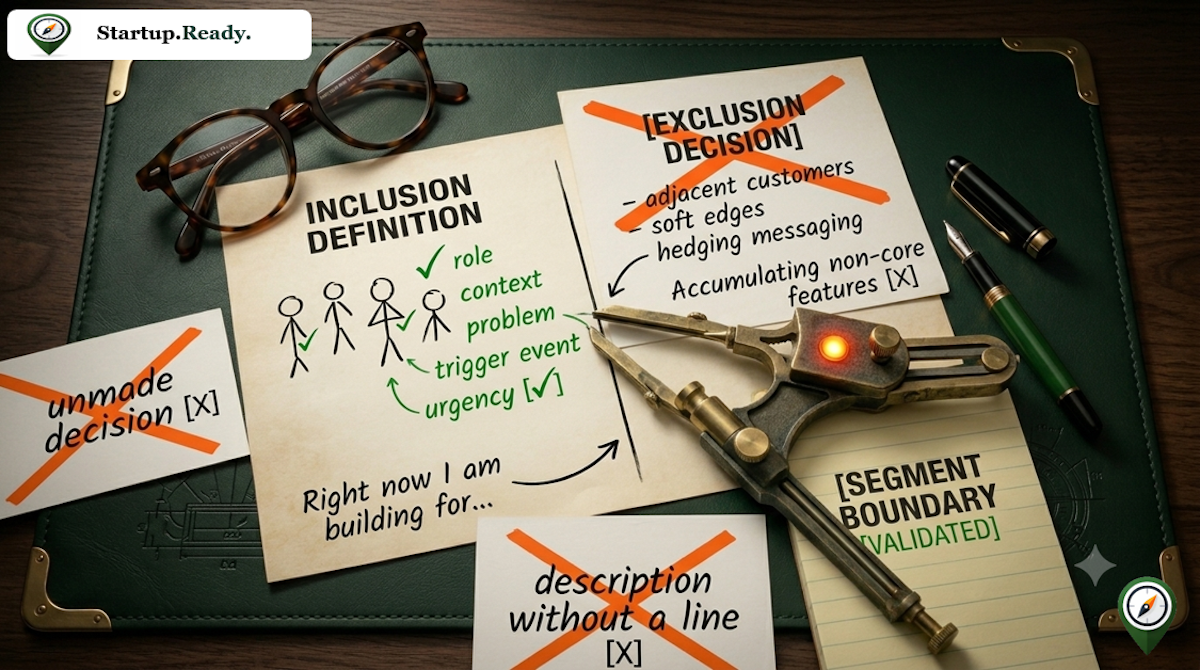
Most founders can describe their ideal customer. They have a sentence ready, sometimes a slide. Ask them who they turn away, and the sentence stops.
That silence is the problem. A customer definition that only names who is in has no edges. It tells you the direction to walk, not the line you will not cross. And a definition without a line is the reason the product keeps drifting, the messaging keeps hedging, and the sales conversations keep wandering toward whoever showed up.
You define a segment by its edges, not its center. The center is easy and it feels like clarity. The edges are where the real decision lives, because the edge is where you say no to a customer who looks close enough to keep.
A segment without an exclusion decision is a preference, not a position.
TL;DR: Clarity Comes from the Edges, Not the Center.
Naming who you serve is half a definition. The other half is naming who you do not serve, with the same specificity. The work is to write a two-sided definition: who is in, who is out, and the observable characteristic that tells them apart.
Here is the step-by-step process:
1. Write the inclusion definition in one sentence: role, context, the specific problem, the trigger that makes it urgent.
2. Name the adjacent customers: who look close but are not your target.
3. Name the disqualifying characteristics: specific and observable, not "not urgent enough."
4. Write the exclusion decision: who you are not building for right now, and why.
5. Test it: would this decision make you decline a real opportunity you would otherwise chase?
Four signals your segment has soft edges:
You can say who your customer is but not who they are not
A customer who looks "close enough" is a question you have to think about, not a fast no
Your messaging hedges so it does not exclude anyone
Your product is accumulating features built for customers on the edges
If any of those describe you, this article shows you how to give your segment a boundary that holds.
If You Found This Article by Searching for Something Else
Most founders who need this are not searching for "exclusion decision." They are searching for something more immediate.
How to define my target customer.
Why my messaging isn't landing.
How to focus my startup.
My product is getting too complicated.
How to say no to the wrong customers.
All of those point at the same underlying question. Can you name, specifically, the customer you will not serve right now and why? This article shows you how to draw that line and use it.
How Do You Identify Your Target Audience vs. Your Target Customer?
Most founders use “target audience” and “target customer” interchangeably. That looseness costs you before you have written a single sentence of your segment definition, because the two terms are answering different questions.
Your target customer is the person or organization that experiences the problem, decides to buy, and pays. Your target audience is broader: everyone your messaging needs to reach in order to get that customer to say yes. Sometimes those are the same person. Often they are not.
Take the veterinary practice-management example below. The target customer is the clinic owner, the person who signs the check. The target audience includes that owner, but it may also include the front-desk staff who will actually use the software daily and can veto a purchase, a regional veterinary association whose endorsement carries weight, or an existing software vendor's user community where switching decisions get discussed. None of those audience members are your customer. All of them can influence whether your customer becomes one.
This is where a target market gets falsely accused of being “too broad.” Founders often narrow the wrong variable. They shrink the customer definition when the actual problem is an undefined audience: they have not mapped who needs to hear the message before the customer will act on it. If your target market genuinely is too broad rather than just under-messaged, that is a separate fix worth making directly.
Here is the working distinction:
Target customer: who buys and who you build the product for.
Target audience: everyone whose attention, trust, or approval affects whether that customer buys.
Target market: the addressable population of target customers, once the definition is specific enough to size.
The exclusion work in this article is customer-level work. The disqualifiers you write, wrong context, wrong urgency, wrong purchasing reality, describe who does not become a customer. But the same discipline applies one level up: a founder who has excluded the wrong customers clearly can still dilute their message by writing to the wrong audience, hedging the copy so it also lands with the front-desk staff, the association, and the vendor community all at once. The edge you drew on the customer has to survive contact with the audience you are actually writing for.
The test is the same shape as the one used throughout this piece. Can you name, specifically, who else has to hear this message before your target customer will act on it, and are you writing to that person on purpose or by accident?
A Segment Has Two Sides
A target segment is two definitions, not one. Who is in. Who is out. Most founders write the first and skip the second, then wonder why the segment never feels sharp.
If you have not yet built the inclusion half of that definition, start by naming who your target customer actually is, then come back to draw the exclusion line.
The skip is understandable. Naming who you serve feels like progress and generates no conflict. Naming who you do not serve feels like turning down money, and at the early stage every potential customer feels like one you cannot afford to lose. So the founder leaves the edges soft on purpose, telling themselves they are staying open.
Soft edges are not openness. They are an unmade decision, and the cost arrives later, quietly. Without an explicit line, every adjacent customer who looks close enough becomes a reason to stay broad. The product starts accommodating variations. The messaging hedges so it will not exclude anyone. Sales drifts toward whoever shows interest instead of who the business was built for. Over time the company becomes harder to explain, harder to sell, and harder to improve, and no single decision caused it. The absence of a decision did.
The Dangerous Customer Is the One Who Looks Close
The customer who is obviously wrong costs you nothing. You see them coming and decline without a thought. The expensive one is the customer who looks almost right. Close enough to serve. Close enough to justify. Close enough that saying no feels like leaving money on the table.
Take a founder building practice-management software for independent veterinary clinics, the kind with two to five vets and a front desk drowning in scheduling, records, and reminders. The target is clear. The danger is everyone who looks like the target and is not. They arrive in four shapes.
Same problem, different context. A small human dental clinic also juggles scheduling, records, and reminders. The problem rhymes. But the billing, the regulations, and the workflows are different enough that serving them would mean building a second product inside the first. They look like the customer. The context is not.
Same role, different urgency. A brand-new single-vet clinic that opened last month has the same role and almost no volume. The scheduling pain that drives the target to act does not exist for them yet. They will nod along in a demo and never feel the need. Same person. Different urgency.
Same urgency, different purchasing reality. A clinic owned by a national veterinary group feels the pain just as sharply. But the software decision is made at corporate, not at the clinic, so the buyer you can reach is not the buyer who chooses. Same urgency. A purchasing reality your model cannot enter.
Adjacent use case. A pet boarding and grooming business could run your scheduler for appointments. It would even work. But building for them would pull the product toward boarding logistics and away from clinical records, bending the roadmap toward a customer you did not set out to serve. The product fits. The direction does not.
Every one of these is close. That is exactly why each one is a decision, and why a founder without an exclusion line tends to serve them all a little, and serve no one well.
Make the Disqualifier Observable
An exclusion decision is only usable if the disqualifier is something you can see. Vague disqualifiers do not survive contact with a real prospect, because in the moment, a hopeful founder can always argue the customer is the exception.
So sharpen each one until it is specific and observable. "Not urgent enough" is a feeling, and a feeling bends under pressure. "Has not yet experienced the trigger event that creates urgency" is a test you can apply. "Too small" is an opinion. "Fewer than two vets, so no dedicated front-desk role" is a fact you can check. The disqualifier has to be the kind of thing a stranger could verify without asking you what you meant.
Here is the test that tells you a disqualifier is real. If a prospect walked in tomorrow with this characteristic, would you confidently decline to serve them right now? If the answer is yes, it is a disqualifier. If the answer is maybe, it is still a preference, and a preference will not hold when the prospect is friendly and the month is slow.
The Line Is Real Only If It Costs You Something
Write the exclusion decision as a current choice, not a permanent verdict. Right now, you are building for this specific segment. Right now, you are not building for these specific adjacent customers, because of this specific reason: wrong context, wrong urgency, wrong purchasing reality, or misaligned use case. The boundary can move as the business learns. The point is to make it explicit now so every decision downstream has something to orient against.
Then apply the only test that matters. Has this decision ever made you say no?
A line that has never cost you anything is not a line. It is a description of what you were going to do anyway. The exclusion decision earns its place the first time it makes you decline an opportunity you would otherwise have chased with hesitation, the friendly prospect who is a national group's clinic, the demo request from the dental office. If you would override the decision the moment a real customer tested it, you have not made a decision. You have written down a hope.
The One Sentence That Tells You Where You Stand
A founder who has done this work can fill in one statement without flinching:
Right now I am building for [specific segment], and I am not building for [specific adjacent customer].
The observable characteristic that disqualifies them is [specific, checkable signal], and I last used this line to turn down [a real opportunity].
A founder who has not done it can complete the first half and stalls on the second. They can name who they serve. They go quiet on who they decline, because the decision was never made.
If you can name the customer you turn away, point to the characteristic that disqualifies them, and recall a real opportunity the line made you decline, your segment has edges you can build on. If the exclusion half is blank, you have found the exact gap to close: name the adjacent customer you have been half-serving, and decide. Either outcome moves you forward.
One honest caveat. An exclusion decision is not a permanent rejection of a market. It is a choice about where to concentrate first. The customers you exclude today may be the expansion you pursue later, deliberately, from a position of strength. Drawing the line now is what makes that later move a decision instead of a drift.
Exclusion and Your Market Clarity
In the Startup Readiness Framework, Market Clarity evaluates whether a founder's segment has boundaries sharp enough to drive focused execution. A vague segment is one of the most common flags in early assessments, because naming who you serve feels like a finished definition and the missing edges rarely announce themselves until the product and the messaging have already drifted.
This article is part of the Market Clarity series. Market Clarity is one of the six pillars in the framework. The Startup Readiness Assessment gives you a full-system diagnostic across all six in under twenty minutes.
Take your Startup Readiness Score free today at startupready.ai →
Keep Working on the Market Pillar
The Market Pillar asks one question from many angles: does your market resolve to specific, reachable customers, or does it stay a broad guess? Each article below takes one piece of that question. Which customer inside your market will actually pay. Where that customer actually is right now. Whether you can reach them once you have found them. What makes them move now rather than someday. Read them in any order. Each is a separate cut at the same pillar, and together they show you where your market resolves to real people and where it stays a guess.
More in the Market Pillar:
Startup Market Segmentation: What a Target Market Actually Is and Why Yours Is Probably Too Broad
How to Find Your Customer's Urgency Trigger Before You Build Your Go-to-Market Strategy
Target Customer Definition: How to Find and Validate the Right Customer
Two Customers Have the Same Problem. Why Will Only One of Them Pay You?
Knowing Where Your Customers Gather Is Not the Same as Reaching Them
Your Urgency Trigger Is a Guess Until Five Real People Confirm It
Published
By Dr. Shaun P. Digan
Originally published on Startup.Ready.’s Startup Readiness: Validation, Framework, and Tools Blog at https://startupready.ai/startup-readiness/who-you-dont-serve
Original Publication Date: August 3, 2026
Last Updated: September 5, 2026
About the Author
Dr. Shaun P. Digan is the founder of Startup.Ready and the creator of the Startup Readiness Framework, a research-based system for evaluating and validating early-stage startups before launch and early growth. He holds a PhD in Entrepreneurship from the University of Louisville and has spent over 15 years teaching, advising, and consulting with founders on startup strategy, validation, and growth.
In his writing, including the Startup Readiness Blog and The Foundations of Innovation Essay Series, he focuses on how founders can make better decisions by improving clarity, alignment, and readiness before scaling.