Your Urgency Trigger Is a Guess Until Five Real People Confirm It
Most founders can tell you what makes their customer act. Ask where the answer came from, and it turns out they made it up.
Not carelessly. The trigger sounds right. It fits the product, it fits the story, and it fits what the founder would feel in the customer's place. It has one problem. Nobody was watched arriving at it. The trigger is a theory about behavior, built from the inside, and behavior is the one thing you cannot theorize your way into.
There is a way to know instead of guess. Find five real people who actually took action on this problem, and work backward from what each of them did to what set them off. The trigger you assumed and the trigger the evidence shows are often different events. When they are, the evidence is right.
A trigger you reasoned your way to points your go-to-market at a moment that may not exist.
TL;DR: Do Not Hypothesize the Trigger. Reverse-Engineer It From People Who Acted.
The trigger that drives purchasing is a fact about the world, so find it in the world. Collect five real cases of customers who took an observable action, name what happened right before each, and look for the underlying change that recurs across them. Here is the move, in order:
Find five real actors: people who searched, bought, hired, or built a workaround, not people who agreed the problem was real
Capture the before: what specifically changed in their situation right before they acted
Classify each trigger so the cases are comparable
Read for the underlying change, not the surface event: different-looking cases often share one deeper cause
Name it in the customer's language, specific enough to time a message and pick a channel
Four signals your trigger is still a guess:
You can describe the trigger but cannot name one real person it happened to
Your evidence is what customers say would make them act, not what made them act
The trigger is something you would feel, described from your side of the problem
Every customer conversation confirms the trigger, and none of them has ever surprised you
If any of those describe you, this article shows you how to replace the guess with five facts.
If You Found This Article by Searching for Something Else
Most founders who need this are not searching for "urgency trigger." They are searching for something more immediate.
Why is my pipeline full but not converting.
How to time my outreach.
Why do people say yes and then stall.
How to find out when customers actually buy.
My messaging gets interest but no action.
All of those point at the same underlying question. Do you know the moment your customer decides to act, or did you assume it? This article shows you how to find that moment in real behavior instead of in your own head.
Agreement Is Not Evidence
A hypothesized trigger has a specific failure mode, and it is quiet. The messaging built on it generates interest. People nod, sign up for the list, agree the problem is real. Then the pipeline sits.
Interest and readiness are different states. Most stuck early pipelines are full of the first and empty of the second, and a hypothesized trigger is how they get that way, because it aims at the moment people start caring instead of the moment they start acting.
The founder reads flat conversion as a message problem or a product problem, and goes to work on the wrong thing. Rewrites the headline. Ships another feature. Neither moves the number, because the number was never about the message or the feature. It was about timing, and the timing was a guess.
Here is why guessing fails in this particular spot. You experience the problem as a builder who thinks about it every day. Your customer experiences it as a background cost they have tolerated for months and will keep tolerating until something specific tips the equation. You feel the problem at level ten and imagine they act at level six. They act at level nine, and only when a particular event pushes them there. You cannot feel your way to that event, because you were never at level three about it.
The event has to be observed. So observe it.
Pain Is Not a Trigger
The confusion underneath all of this is that founders reach for the pain when they should be reaching for the trigger, and the two are not the same object.
The pain is the ongoing cost. Scheduling is hard. It is hard every week, and it has been hard for years, and the customer has organized their life around tolerating it. Pain is a state. It sits there. It explains why a customer might eventually want a solution.
The trigger is the moment the tolerating stops. It is a single event that converts a standing pain into an action taken this week. Pain explains the want. The trigger explains the timing, and timing is what you are actually buying when you buy an urgency trigger.
This is why building on the pain produces interest and no movement. The pain is true for the whole market all the time, so a message aimed at it reaches everyone and catches no one at the moment of decision. The trigger is true for a specific customer in a specific week. Aim there.
A useful way to tell them apart: if it has been true for months, it is pain. If it happened on a particular day, it is a trigger. You market to the day.
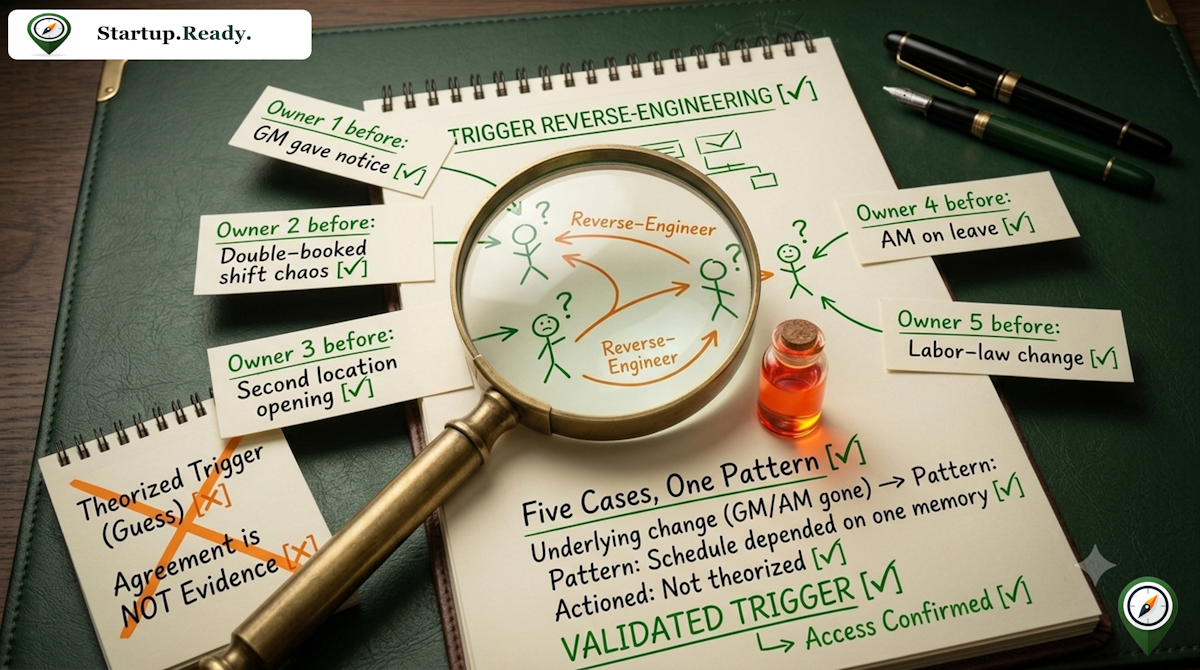
Five Cases, One Pattern
Take a founder building staff-scheduling software for independent restaurants. Her assumed trigger is the obvious one: scheduling is a weekly grind, owners hate it, and at some point the pain gets bad enough that they look for a tool.
Reasonable. It is also what she would feel. So she sets it aside and finds five real owners who actually bought scheduling software in the last year, from reviews, from two conversations, from a forum thread. For each one, she writes down what happened right before.
Owner one bought the week after her long-time general manager gave notice. The GM had run the schedule in her head for six years.
Owner two bought three days after a double-booked shift left the kitchen short on a Friday night and turned a full dining room into ninety minutes of chaos.
Owner three bought right after opening a second location, when the system that worked for one place stopped working across two.
Owner four bought the month her assistant manager, the one who handled scheduling, went out on medical leave with no notice.
Owner five bought after a labor-law change made her worry that her manual system was exposing her to overtime penalties.
Now read across, and read for the underlying change rather than the surface event. Three of the five look different on top and share one cause underneath. The GM quits. The assistant manager goes on leave. A second location breaks the one place the knowledge lived. Different events, one deeper change: the schedule had always depended on a single person's memory, and that dependency just failed. That is the trigger. Not "scheduling is a grind," which is the pain she would have guessed. The trigger is the moment the single point of failure gives way.
The reading matters more than the count. If she had stopped at the surface, she would have seen three unrelated events and no pattern. The pattern lives one level down, in the change the events have in common. A recurring trigger is rarely the same incident repeating. It is the same underlying shift showing up in different clothes.
The other two cases, the double-booked Friday and the labor-law worry, may not fit that cause at all. That is worth holding rather than forcing. They might be noise, or they might be a second trigger belonging to a slightly different segment. Either way, she does not bend them to fit the first pattern. She notes them and watches whether more evidence turns them into a group of their own.
What the Pattern Rewrites
A trigger found in evidence redirects the whole go-to-market, because a real trigger comes with a moment, and a moment comes with a place and a message. Confirming or denying the guess is the smallest thing it does.
If the trigger were "scheduling is a grind," the founder would market to tired owners at all times, which is to say she would market to everyone and reach no one at the moment of decision. That is the campaign the guess produces.
The real trigger points somewhere specific. The owner whose scheduler just left is not idly frustrated. She is in an acute scramble, covering shifts herself, searching for a way to not depend on one person's memory again. She is typing something like "restaurant scheduling software easy to hand off" at eleven at night. The message that lands is not "scheduling made simple." It is "never lose the schedule when someone quits." Same product. A message aimed at the moment the customer is actually in.
That redirection is the entire payoff of the exercise. The guess and the evidence would have produced two different companies' worth of go-to-market. Only one of them is pointed at a moment that happens.
The Five-Person Test
One question tells you whether your trigger is knowledge or a guess.
Can you name five real people in your segment who took action, and say what happened right before each one?
Not five people who have the problem. Five who did something observable about it: searched, bought, hired, switched, built a workaround. And for each, the specific before, sourced from something real. A conversation. A review. A timestamped post. A case study.
They do not have to be your customers. This is where founders think they are blocked and are not. You do not need five people who bought your product, which is a relief if you have sold to two people or none. You need five people who acted on the problem in the last year by any route: hired a competitor, paid a consultant, built a spreadsheet, assigned someone internally, posted a desperate question in a forum. Every one of those is a real case of the trigger firing, and most of them are findable without a single sales call of your own.
One caution when you reconstruct the before. Memory rationalizes. Ask a buyer why they acted and they will often hand you a clean story assembled after the fact, with the messy real trigger sanded off. So anchor to artifacts over recollection where you can. The date on the invoice. The timestamp on the first search or the first Slack message about it. The week the job posting went up. Artifacts do not rationalize, and the gap between the tidy story and the timestamp is often where the real trigger is hiding.
If you can find five, you have a trigger with evidence under it, and the pattern across them is more trustworthy than any single case. If you cannot find five, find three. Three real cases outrank five invented ones every time, and the honest gap tells you what to go learn.
The test works because it is unfakeable. You can talk yourself into a trigger. You cannot talk yourself into five named people and five specific befores. Either the cases exist and you can point to them, or they do not and you have been reasoning in a closed room.
If no single pattern appears, that is a finding rather than a failure, and often a valuable one. Two or three distinct triggers showing up across your five cases usually means your segment is broader than you thought and contains groups that act for different reasons. One group moves on growth, another on compliance, another on turnover. That is a segmentation insight arriving early, and it is worth more than a forced single answer. It tells you these may be different markets wearing the same job title, each reachable at a different moment. Name the groups. Do not average them into one blurred trigger that fits none of them.
Why the Guess Feels Safer
There is a reason founders reach for the hypothesized trigger and stay there, and it is worth naming.
The guess cannot be wrong yet. As long as the trigger lives in your head, it fits the product perfectly, because you built it to fit. Going to find five real cases risks discovering that the moment you designed your messaging around is not the moment customers actually act. That is a more useful discovery than the guess and a less comfortable one, so the guess persists and the five cases never get collected.
The comfort has a cost, and it arrives disguised as a message problem. Months of outreach aimed at level six while customers act at level nine, read as "our copy is not landing" instead of "our timing is wrong." The founder optimizes the sentence and never questions the moment.
Five real befores are harder to gather than one good theory. They are also the difference between a market you are guessing at and a market you have looked at.
The One Sentence That Tells You Where You Stand
A founder who has done this work can complete this statement with specifics in every slot:
Across five real people in my segment who took action, the event that appeared most often right before they acted was [specific trigger event].
Which means the moment to reach my customer is [specific timing], through [specific channel or context], with a message that speaks to [the situation the trigger creates].
A founder who has been guessing can fill the first blank from imagination and stalls at "across five real people," because the five were never gathered. That stall is the whole diagnosis.
If you can name the event and point to the five cases it came from, you have an evidenced trigger and a moment to aim at. If the trigger is easy to state and the five people do not exist, the gap is not your messaging. Go find five customers who already acted and read what set them off. The trigger you come back with may not be the one you left with. That is the exercise working, not failing. Either outcome moves you forward.
Urgency and Your Market Clarity
In the Startup Readiness Framework, Market Clarity treats urgency as a property of a moment rather than a property of the problem. A segment full of people who agree the problem is real is not the same as a segment full of people ready to act, and the trigger is what separates them. A missing or assumed trigger is one of the most common early flags, because a hypothesized moment feels like knowledge until conversion stays flat.
Market Clarity is one of the six pillars in the framework. The Startup Readiness Assessment gives you a full-system diagnostic across all six in under twenty minutes.
Take your Startup Readiness Score free today at startupready.ai →
Keep Working on the Market Pillar
The Market Pillar asks one question from many angles: does your market resolve to specific, reachable customers, or does it stay a broad guess? Each article below takes one piece of that question. Which customer inside your market will actually pay. Where that customer actually is right now. Whether you can reach them once you have found them. What makes them move now rather than someday. Read them in any order. Each is a separate cut at the same pillar, and together they show you where your market resolves to real people and where it stays a guess.
More in the Market Pillar:
Startup Market Segmentation: What a Target Market Actually Is and Why Yours Is Probably Too Broad
How to Find Your Customer's Urgency Trigger Before You Build Your Go-to-Market Strategy
Target Customer Definition: How to Find and Validate the Right Customer
Two Customers Have the Same Problem. Why Will Only One of Them Pay You?
Knowing Where Your Customers Gather Is Not the Same as Reaching Them
A Step-by-Step Guide to Defining Your Target Customer, By Deciding Who You Don't Serve
Published
By Dr. Shaun P. Digan
Originally published on Startup.Ready.’s Startup Readiness: Validation, Framework, and Tools Blog at https://startupready.ai/startup-readiness/validate-urgency-triggers
Original Publication Date: August 3, 2026
Last Updated: August 3, 2026
About the Author
Dr. Shaun P. Digan is the founder of Startup.Ready and the creator of the Startup Readiness Framework, a research-based system for evaluating and validating early-stage startups before launch and early growth. He holds a PhD in Entrepreneurship from the University of Louisville and has spent over 15 years teaching, advising, and consulting with founders on startup strategy, validation, and growth.
In his writing, including the Startup Readiness Blog and The Foundations of Innovation Essay Series, he focuses on how founders can make better decisions by improving clarity, alignment, and readiness before scaling.