Knowing Where Your Customers Gather Is Not the Same as Reaching Them
You found the place. You did the work, traced where your customer pays attention, and landed on a specific spot where they gather. A subreddit. A Slack. A professional group. You can name it. You know they are there.
So you send the message. You post the introduction. You show up with your ask. And nothing happens.
The instinct is to blame the message. Rewrite the subject line. Sharpen the pitch. Try again. The message is rarely the problem. You arrived as a stranger in a space where trust is earned through history, and the room treated you like one.
Learning how to reach your target market means testing repeatable access, not just naming a place where your customers exist. Call it a market reachability test: can you reach a second person there the same way you reached the first.
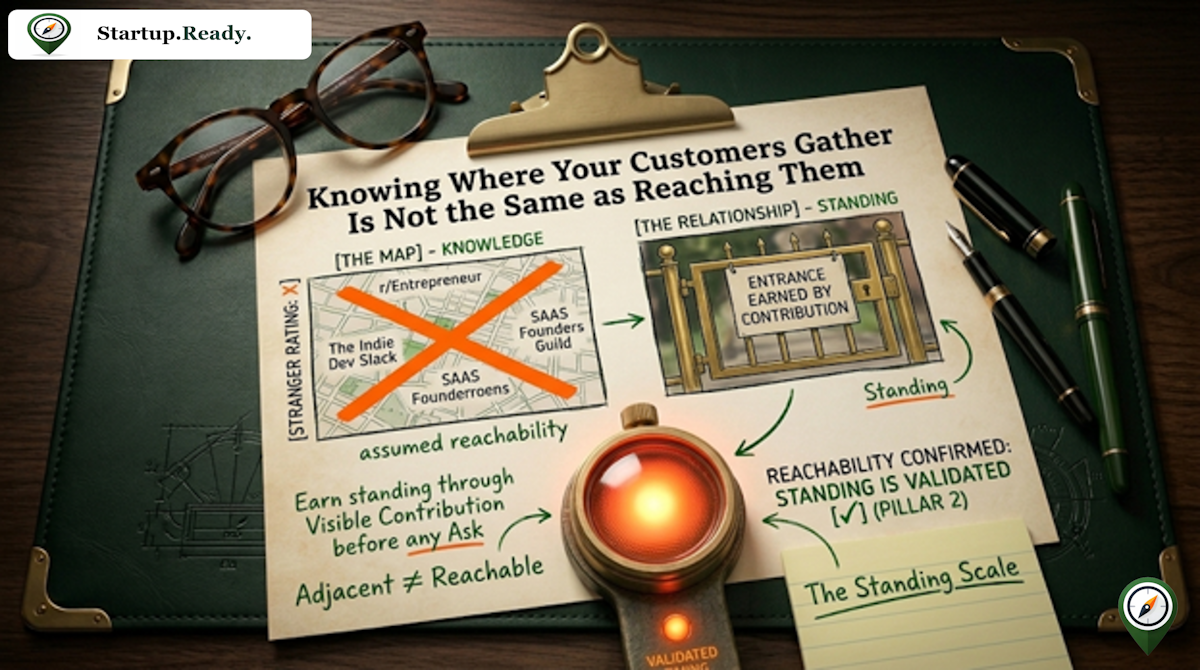
Knowing where a community is and having standing in it are two different things. The first is a map. The second is a relationship. Most go-to-market plans assume the first delivers the second. It does not.
TL;DR: Reachability Assumed Is Not Reachability Confirmed.
Finding where your customer gathers is the start. Being able to reach them there depends on whether you have standing in that space, and standing is earned through visible contribution before any ask. The work is to rate your real presence honestly, name the gap, and close it in one place. Here is the move, in order:
Rate your presence in each space: stranger, lurker, new participant, contributor, trusted member
Name the credibility gap: the specific contribution that separates lurking from standing
Pick one space, because presence is built through consistency and splitting effort earns standing nowhere
Contribute on a schedule you can name: answer this many questions for this many weeks before any outreach
Design the first message to reference shared context and make a small ask, with no pitch
Four signals your reachability is still assumed:
You know where your customers gather but have never posted, replied, or contributed there
Your outreach gets ignored and your first move is to rewrite the message
You would be a stranger to anyone you reached out to in these spaces
Your plan is to show up and pitch, not to show up and contribute first
If any of those describe you, this article shows you how to convert a place you know about into a place where you have standing.
If You Found This Article by Searching for Something Else
Most founders who need this are not searching for "earned reachability." They are searching for something more immediate.
Why is my cold outreach not working.
How to get customers from a community.
How to do community-led growth.
Why is no one responding to my posts.
How to reach customers without a budget.
All of those point at the same underlying question. You know where your customers are, so why can you not get them to respond? This article shows you the standing gap that sits between knowing a place and being able to use it.
Adjacent Is Not Reachable
A founder who knows where the customer gathers but has never participated is not reachable. They are adjacent. They are standing outside the room with their hand on the door, mistaking proximity for access.
The gap is easy to miss because the map looks complete. You can name the Slack, the subreddit, the group. On paper, you have a channel. What the paper does not show is that the people in that space have never seen you, have no reason to trust you, and will read a first-time message with an ask the way anyone reads an interruption from a stranger.
This produces a specific failure. The founder posts, sends, or attends, gets no response, and concludes the channel does not work or the message is wrong. Often neither is true. The founder arrived without standing, and standing is the thing the space runs on. Communities, especially professional ones, respond to contributors and ignore vendors. Showing up for the first time with an ask produces nothing, no matter how good the ask is.
Access is earned before it is used.
Rate Your Presence Honestly
You cannot close a gap you will not measure. So measure it. For each place your customer gathers, rate where you actually stand on a five-level scale. This honest rating is the most useful tool in the piece.
Knowing how to reach your target market means the second contact should be as easy as the first.
Stranger. You know the place exists. You have never participated. No history, no relationships, no recognition.
Lurker. You observe but do not participate. You may have an account or attend sometimes, but you have not contributed in a way anyone would notice or remember.
New participant. You have started showing up. You have contributed a few times. You are not yet known.
Contributor. You participate regularly and at least some members recognize you. You have a history of giving before asking.
Trusted member. You are known, you have relationships, and you would be received as a peer if you reached out to someone directly.
Take a founder building an analytics tool for indie game developers. They know the customer lives in a specific game-dev Discord with twenty thousand members and a busy feedback channel. They feel ready to reach out. Then they run the rating, and the honest answer is stranger. They joined months ago and have never posted. The map said reachable. The rating says adjacent. That distinction is the whole point. It changes the next move from "send outreach" to "earn the standing to make outreach land."
One important exception. Not every customer gathers in a vibrant community, and not every path requires earned presence. In communities and shared spaces, standing is built through visible contribution over time. In direct channels, a warm introduction or a one-to-one message, relevance and specificity can substitute for it. And in some verticals, enterprise manufacturing, healthcare, regulated industries, the buyer does not hang out in a Slack at all. There, standing is earned in a different currency: institutional credibility, a relevant case study, a compliance certification, a reference from someone they trust. The principle holds even when the venue changes. This work applies when the path runs through a community where participation comes before outreach.
Name the Gap, Then Close It in One Place
A credibility gap is not vague. It is the specific distance between where you stand and the standing required to start a conversation. So name it in concrete terms. Not "build a presence" but "answer enough questions that two or three members would recognize the name."
Then choose one space. This is the discipline founders resist, because picking one feels like leaving the others behind. Presence requires consistent contribution over time, and splitting effort across three communities produces shallow presence in all of them and standing in none. Pick the space where the gap is smallest, the path to standing is fastest, and the customer density makes the effort worth it.
Now make the actions specific, repeatable, and visible. The indie game-dev founder does not write "engage more." They write "answer three questions in the feedback channel each week for four weeks, sharing what I know about analytics, before sending any direct message." Each action is observable. If someone else could not watch it happen, it is not a real action. The milestone is not a date on the calendar. It is the moment a few members would recognize the name, which is when an ask stops reading as an interruption.
Design the First Message Before You Need It
Once standing exists, the first outreach carries weight, so write it now while you are thinking clearly instead of in the moment you finally feel ready.
The message that works comes from a recognized contributor and reads like one. It references something specific about the person or their work. It acknowledges the shared context, the space you have both been active in. It makes a small, specific ask. A twenty-minute conversation. One question. A request for feedback on a narrow thing. The smaller and more specific the ask, the higher the response.
The message that fails is the one that arrives as a pitch. A product description, an offer, a demo request from a name no one recognizes. If your first message includes a pitch, rewrite it. You earned standing by giving before asking. The first ask should sound like it came from the person who did that, because it did.
One warning about treating contribution as a tactic. Members of a good community can sense the difference between someone who is there and someone who is farming them. The founder who answers exactly three questions to hit a quota, then pivots to a pitch, reads as extraction, and the standing evaporates the moment the ask lands. The contribution has to be real to work. If the only reason you are answering questions is to earn the right to sell, the room will feel it. Contribute because the space is one you actually belong in. The standing that follows is the kind that holds.
The One Sentence That Tells You Where You Stand
A founder who has done this work can fill in one statement without pretending the map is the relationship:
The space I am building standing in is [specific place], where I am currently a [stranger / lurker / participant / contributor].
The contribution that will earn standing is [specific, repeatable, visible action], and I will be ready to reach out to [specific person] by [date].
A founder who has not done it points at the map and calls it a channel. "They are in this Slack." "My customers are on Reddit." Knowing where they are is the start of the work this exercise finishes.
If you can rate your real standing, name the contribution that closes the gap, and describe a first message that gives before it asks, you have a reachability plan worth running. If your honest rating is stranger or lurker in every space that matters, you have found the exact gap to close: pick one place and start contributing this week, before you send anything. Either outcome moves you forward.
One honest caveat. Earned standing is not a validated channel. It is the condition that lets a channel be tested at all. Reachability is confirmed when a real conversation starts from a path you earned, and that comes after you contribute, not before.
And this is validation work, not a growth engine. Earning standing by hand gets you the first conversations and the proof that the customer is reachable. It does not scale, and it is not supposed to. The job here is to confirm the path exists and learn what lands on it. Building that into something repeatable is a later problem, and the right one to have once the first conversations have happened.
Testing Reachability and Your Market Clarity
In the Startup Readiness Framework, Market Clarity evaluates whether a founder can reach the customer. Locating a customer and reaching one are different questions. Assumed reachability is one of the most common flags in early assessments, because a complete map of where the customer gathers looks like access and the missing standing rarely announces itself until the outreach goes silent.
Market Clarity is one of the six pillars in the framework. The Startup Readiness Assessment gives you a full-system diagnostic across all six in under twenty minutes.
Take your Startup Readiness Score free today at startupready.ai →
Keep pressure-testing how to reach your target market as you try to scale beyond the first channel.
Keep Working on the Market Pillar
The Market Pillar asks one question from many angles: does your market resolve to specific, reachable customers, or does it stay a broad guess? Each article below takes one piece of that question. Which customer inside your market will actually pay. Where that customer actually is right now. Whether you can reach them once you have found them. What makes them move now rather than someday. Read them in any order. Each is a separate cut at the same pillar, and together they show you where your market resolves to real people and where it stays a guess.
More in the Market Pillar:
Startup Market Segmentation: What a Target Market Actually Is and Why Yours Is Probably Too Broad
How to Find Your Customer's Urgency Trigger Before You Build Your Go-to-Market Strategy
Target Customer Definition: How to Find and Validate the Right Customer
Two Customers Have the Same Problem. Why Will Only One of Them Pay You?
A Step-by-Step Guide to Defining Your Target Customer, By Deciding Who You Don't Serve
Your Urgency Trigger Is a Guess Until Five Real People Confirm It
Published
By Dr. Shaun P. Digan
Originally published on Startup.Ready.’s Startup Readiness: Validation, Framework, and Tools Blog at https://startupready.ai/startup-readiness/where-customers-gather
Original Publication Date: June 19, 2026
Last Updated: August 4, 2026
About the Author
Dr. Shaun P. Digan is the founder of Startup.Ready and the creator of the Startup Readiness Framework, a research-based system for evaluating and validating early-stage startups before launch and early growth. He holds a PhD in Entrepreneurship from the University of Louisville and has spent over 15 years teaching, advising, and consulting with founders on startup strategy, validation, and growth.
In his writing, including the Startup Readiness Blog and The Foundations of Innovation Essay Series, he focuses on how founders can make better decisions by improving clarity, alignment, and readiness before scaling.