Decide How Money Moves Before You Decide How Much
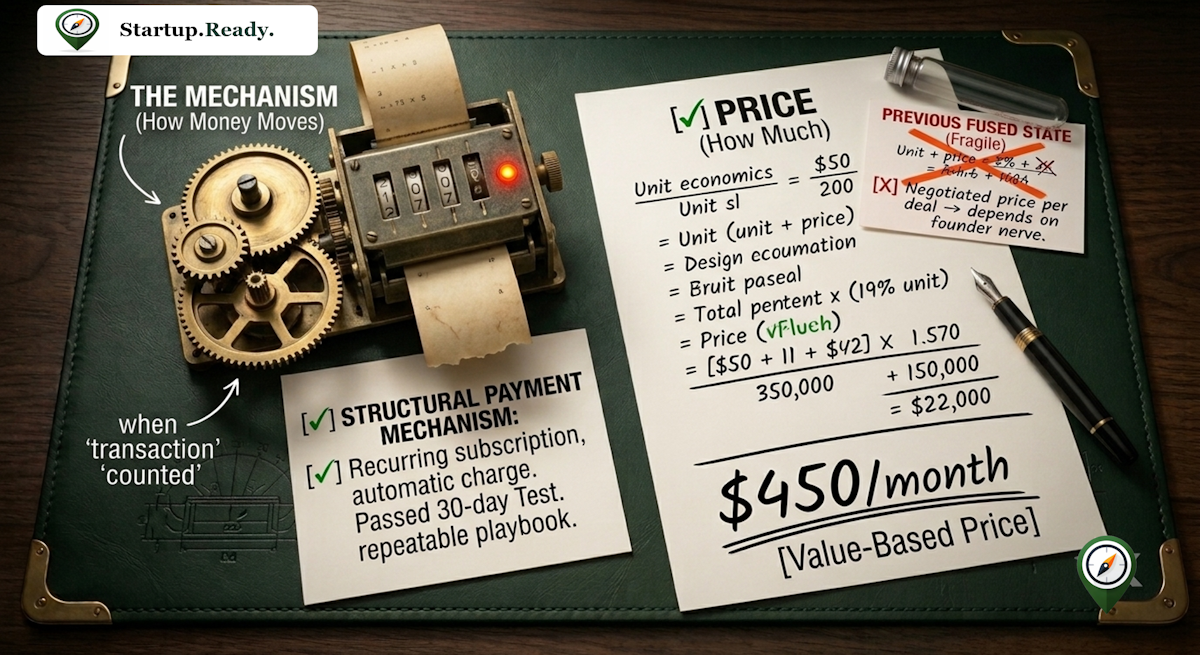
There are two questions hiding inside "how do we charge for this," and founders answer them at the same time without noticing they are separate. How does money move, and how much of it moves. The first is the mechanism. The second is the price. They feel like one decision, so founders make them as one, and that fusion quietly corrupts both.
The mechanism is structural. It is how money actually travels from the customer to you: a subscription that charges automatically, an invoice paid net-thirty at a milestone, an upfront payment before access, a platform that collects at the point of sale. The price is a different kind of decision entirely, a number set on top of the mechanism, and it should be answered second, because the mechanism shapes what a sensible price even looks like.
When the two get decided together, one always bends to the other. Either the mechanism gets contorted to fit a price the founder picked first, producing a way of paying that customers find awkward and need talked into, or the price gets set at whatever makes the mechanism close, producing a number based on the founder's nerve rather than the value delivered. Both are expensive, and both come from making one decision out of what should have been two.
TL;DR: The Mechanism Is How Money Moves. The Price Is How Much. Decide Them in That Order.
Payment mechanism and pricing are two separate decisions. The mechanism is structural: how money moves, when, and what makes it move without you personally involved in every transaction. The price sits on top of the mechanism and answers how much. Founders fuse the two, and the fusion corrupts both, because a mechanism bent to fit a price gets awkward and a price set to close a fragile mechanism gets defensive. The work is to name the mechanism honestly, test whether it survives without you, and set price on value once the mechanism is clear. Here is the move, in order:
Name the mechanism honestly, how money moves, not how you sell
Run the fragility test: if you vanished for thirty days, would new customers still pay
Spot the tangle: is your mechanism serving your price, or your price serving your mechanism
Fix the mechanism first, matching how customers in your category already pay
Then price on value, as a decision made on top of a mechanism that already works
Four signals your payment mechanism is fragile, not structural:
Every new customer requires the same negotiation before they pay
If you were unavailable for a month, new payments would mostly stop
Your price is set at whatever you think will close, not what the value warrants
Customers find your way of paying slightly awkward and need it explained
If any of those describe you, this article shows you how to separate the mechanism from the price and make the mechanism hold on its own.
If You Found This Article by Searching for Something Else
Most founders who need this are not searching for "payment mechanism." They are searching for the strain.
How to price my SaaS.
Why does every deal require a custom negotiation.
How to get customers to pay without chasing them.
Why can't I raise my prices.
How to make revenue less dependent on me.
All of them come back to one question. Does money move through your business by a structure that holds without you, or through a negotiation you personally run every time? This article shows you how to tell, and how to fix the structure before you touch the price.
A Workaround Is Not a Mechanism
The first honest thing to establish is whether you have a mechanism at all, because many founders have something that produces revenue and mistake it for a structure. A mechanism is how money moves. It is not your sales process, and it is not your ability to persuade a particular customer over a particular call. If getting paid depends on you being in the room, what you have is a workaround dressed as a mechanism, and workarounds do not scale.
The test is blunt and clarifying: if you were unavailable for the next thirty days, would the business still collect payment from new customers? If the honest answer is no, or probably not, the mechanism is fragile, and the fragility is structural rather than a matter of trying harder. A payment approach that only fires when you personally negotiate it means every new customer costs the same founder effort as the last, so revenue cannot grow without you growing with it, one deal at a time, forever. This is the same fragility as a customer base that only exists because you knew everyone. A mechanism that needs you is not a mechanism. It is a job you have not yet designed your way out of.
Structural does not mean automated, and that matters most in enterprise. Selling to a large company involves real human steps: a contract redline, a security questionnaire, a vendor-onboarding form, an invoice paid net-sixty. None of that is a workaround, because none of it depends on you specifically improvising a close. A mechanism is structural when a repeatable playbook runs it, whether that playbook is a billing system or a trained team following a standard process. It is fragile when the process is a custom negotiation only you can conduct. The thirty-day test is about your absence, not about whether people are involved. A team executing a standardized enterprise billing process passes it. A founder personally talking every deal over the line does not.
The distinction matters because a fragile mechanism does not announce itself as a payment problem. It shows up as exhaustion, as a founder who cannot step away, as a pipeline that stalls whenever attention drifts. The revenue is real, so nothing looks broken. What is broken is that the revenue is welded to one person, and that weld is the thing to see before you optimize anything else.
Fuse the Two and Both Warp
Once you can see mechanism and price as separate decisions, the cost of having fused them becomes visible, and it runs in one of two directions.
In the first, the price came first and the mechanism was bent to fit it. A founder decides the product is worth a certain number, then reverse-engineers a way of paying that hits it, and the result often clashes with how customers naturally buy: an annual prepay where the market expects monthly, a per-seat charge on something the whole team uses at once. The customer feels the awkwardness even when they cannot name it, and the objection reads as price when the real problem is a mechanism built backward.
In the second, the mechanism came first and the price was set to make it close. A fragile, negotiated mechanism turns the price into whatever gets a nervous deal over the line, so it tracks the founder's confidence on the day rather than the value the customer receives. Fragile mechanism, defensive pricing. Prices set this way run too low, because a founder improvising a close discounts to lower their own risk, and once fear has set a price it is very hard to raise, since raising it reopens the negotiation the fragile mechanism depends on. What the value is worth, covered in naming the value exchange, never enters the conversation, because the price was never a value decision. It was a closing tactic.
Mechanism First, Then Price on Value
The repair is a sequence, not a compromise. Decide the mechanism first, on its own terms, then set the price on top of it as a separate decision. Doing them in that order lets each one be answered well, because neither is distorting the other.
Start the mechanism from how customers in your category already pay, not from how you wish they would. If comparable products are bought as monthly subscriptions charged to a card, a milestone invoice you prefer for cash-flow reasons is friction you are choosing to add. Default to the mechanisms customers already understand unless you have a real reason not to. That reason can exist, and some of the strongest models were built by disrupting a category's payment norm on purpose: pay-as-you-go replacing big upfront infrastructure contracts, usage-based billing replacing per-seat licensing. Those worked because the new mechanism matched how customers actually realize value better than the old one did, not because novelty is a virtue. So the test for departing from the norm is simple: does the new way track the customer's value more closely than the way they are used to? If it does, the disruption is an advantage. If it does not, a nonstandard mechanism is just friction you are asking customers to learn. Then make the mechanism structural: money that moves on a schedule or a trigger, collected through a system rather than a conversation, that would keep working if you disappeared for a month. That is the mechanism decision, and it has nothing to do with the number yet.
Only then set the price, and set it on the value the customer receives, now that you are choosing a number on top of a mechanism that holds rather than one that has to survive a negotiation. A structural mechanism is what makes value-based pricing possible in the first place, because you are no longer setting a price to close a fragile deal, you are setting it to reflect what the outcome is worth to a customer who will pay through a structure that does not depend on you. Get the mechanism right and the price conversation becomes a strategic choice. Leave the mechanism fragile and the price will keep being set by whatever it takes to get one more nervous customer to say yes.
The Roaster Tool Priced by Nerve
Take a founder with an inventory-forecasting tool for independent coffee roasters. Every sale was a custom conversation she personally ran: a demo, a back-and-forth about terms, an invoice she sent manually, net-thirty, chased by hand when it went unpaid. Revenue existed, so the model looked like it worked. Apply the thirty-day test and it fell apart instantly. If she stepped away for a month, new payments would simply stop, because nothing moved money without her in the middle of it.
The fusion had corrupted the price too. Because every deal was a negotiation she had to win, she set the price at whatever felt safe enough to close, usually low, and she had never once raised it, because raising it meant a harder negotiation through a mechanism that was already fragile. The number had nothing to do with what avoiding a season of over-ordering was actually worth to a roaster. It was a function of her nerve on the day of the call.
So she fixed the mechanism before touching the price. Roasters, it turned out, already paid for most of their tools as simple monthly software subscriptions charged to a card, so she built exactly that: sign up, card on file, charged automatically each month, no invoice and no negotiation, a structure that would keep collecting whether or not she was around. Only once that held did she return to the price, and set it on the value, what a month of not over-ordering saves a roaster, which was several times what she had been nervously charging. The mechanism no longer needed her, so the price no longer had to survive her. Two decisions, made in order, each finally answered on its own terms.
The One Sentence That Tells You Where You Stand
A founder who has separated the two can complete this statement concretely:
Customers pay through [specific structural mechanism] that would keep collecting if I vanished for a month, and on top of that mechanism I have set a price of [specific amount] based on [the value the customer receives] rather than on what it takes to close.
A founder who has not will describe a price and a sales process tangled into one, and stall on whether payment would survive their absence, because the mechanism was never designed to. That stall is the diagnosis. It is usually the reason revenue cannot grow without the founder growing with it and the price has been stuck, too low, for longer than anyone will admit.
If you can name a mechanism that holds without you and a price set on value on top of it, you have untangled the two decisions that most founders keep fused. If you cannot, that is not a reason to rework the price. It is the signal to fix how money moves first, match it to how your customers already pay, make it survive your absence, and only then decide how much. How money moves and how much it moves are two questions. Answer them in that order, and each one gets a better answer.
Payment Mechanism and Your Financial Clarity
In the Startup Readiness Framework, Financial Clarity treats a payment mechanism that depends on founder persuasion as a specific early flag, because a mechanism that needs you does not scale and a price set to close a fragile mechanism is never set on value. Naming how money moves, separately from how much, is what turns a negotiated workaround into a structure.
These are three separate questions, and together they form a clean sequence.
Who pays, how much, and when is the payment model.
How money actually moves is the mechanism, this article.
Why that price is justified is the value exchange.
Answer them in that order, and each stops distorting the others.
Financial Clarity is one of the six pillars in the framework. Without a strong financial understanding of your startup, it’s difficult to collect evidence into your assumptions.
The Startup Readiness Assessment gives you a full-system diagnostic across all six pillars in just about twenty minutes.
Take your Startup Readiness Score free today at startupready.ai →
Keep Working on the Financial Pillar
The Financial Pillar asks one question from many angles: do you know how money comes in, how fast it goes out, and how long you have before it runs out? Each article below takes one piece of that question. Whether you can state your payment model in a single sentence. What your runway actually is, once you stop rounding toward the answer you want. Which cost is the real risk and which is merely the largest. Where the one lever sits that buys you time to fix everything else. Read them in any order. Each is a separate cut at the same pillar, and together they show you where your numbers hold and where they are still a wish.
More in the Financial pillar:
Startup Unit Economics: What They Actually Are and Why Founders Get Them Wrong
Can You Describe Your Payment Model in One Sentence?
Decide How Money Moves Before You Decide How Much
If You Can't Say Your Runway in One Sentence, You Haven't Finished the Math
The Runway Number You're Avoiding Is the One That Governs Everything
Time Is the Financial Variable You Forgot to Measure
Find the Clock That Runs You Out of Cash First
Read the Unit Economics Before You Build the Spreadsheet.
Your Biggest Cost Isn't Always Your Biggest Risk
Triage Your Costs Before You Cut Them
Your Baseline Runway Is the Scenario Least Likely to Happen
The One Move That Buys Time to Fix Everything Else
Published
By Dr. Shaun P. Digan
Originally Published on Startup.Ready.’s Startup Readiness: Validation, Framework, and Tools Blog at https://startupready.ai/startup-readiness/payment-mechanism-vs-pricing
Original Publication Date: August 7, 2026
Last Updated: August 7, 2026
About the Author
Dr. Shaun P. Digan is the founder of Startup.Ready and the creator of the Startup Readiness Framework, a research-based system for evaluating and validating early-stage startups before launch and early growth. He holds a PhD in Entrepreneurship from the University of Louisville and has spent over 15 years teaching, advising, and consulting with founders on startup strategy, validation, and growth.
In his writing, including the Startup Readiness Blog and The Foundations of Innovation Essay Series, he focuses on how founders can make better decisions by improving clarity, alignment, and readiness before scaling.