Triage Your Costs Before You Cut Them
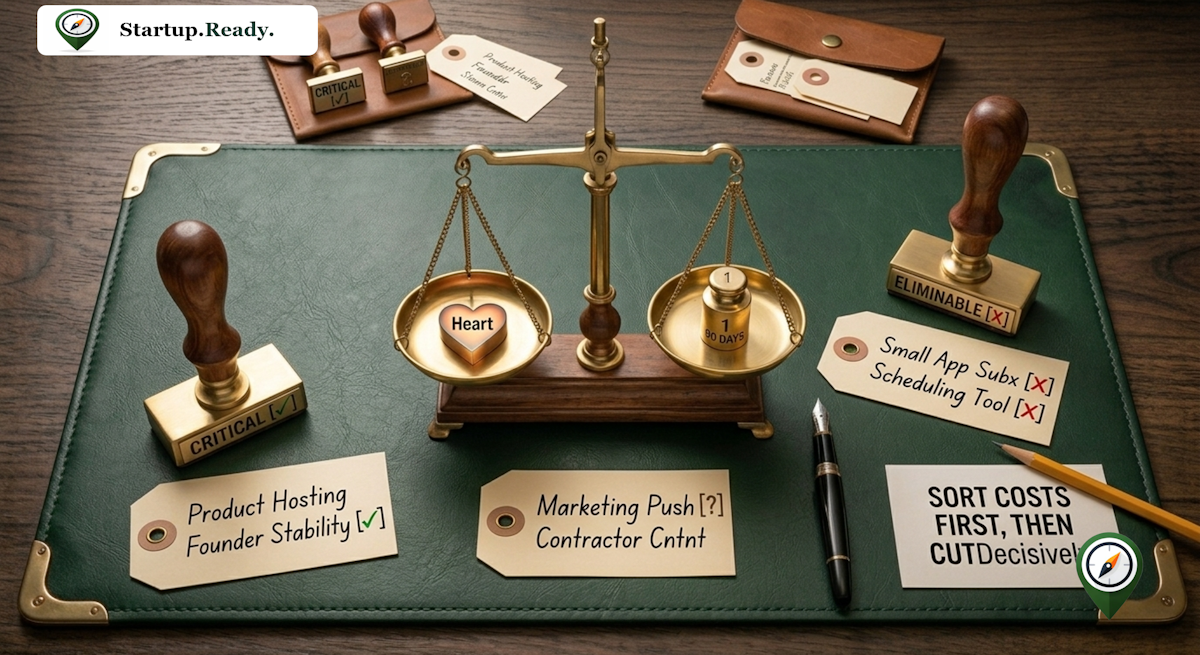
When cash gets tight, the instinct is to cut a little off everything. Cancel a subscription here, trim a tool there, shave a small expense somewhere else, spreading the pain evenly across the whole list so nothing gets hit too hard. It feels responsible and fair. It is usually the least effective thing a founder can do, because it treats every cost as equally urgent when they are not remotely equal.
Costs are not a uniform mass to be reduced proportionally. At the early stage, some costs are survival-critical: if they go unpaid in the next ninety days, the business stops. Some are deferrable: unpleasant to skip, but survivable for months. And some are eliminable: they could be stopped entirely and you would lose almost nothing. Those three kinds of cost need three completely different responses, and the founder who trims all of them a little has applied one weak response to all three.
The result of even cutting is death by a thousand small cuts that add up to no real relief. You cancel ten small things, feel like you have done something, and your burn barely moves, because the costs that could actually change the picture were sitting in a different pile than the ones easiest to trim. Triage comes before cutting. You have to sort the costs by what happens if you do not pay them before you can know which cut is worth making.
TL;DR: Sort Costs Into Survival-Critical, Deferrable, and Eliminable. Then Make One Cut That Matters.
Not all costs threaten the business equally, and treating them as if they do produces scattered, ineffective cuts. The fix is triage: sort every cost by what happens if you stop paying it, isolate the few that are genuinely survival-critical, and act on the one cut, from any pile, that produces the most relief with the least damage to important work. Here is the move, in order:
List every cost, including personal costs the startup has to cover
Classify each: survival-critical, deferrable, or eliminable, by the consequence of not paying
Resist over-classifying as critical, since most costs are not
Protect your own stability, which is survival-critical, not a luxury to cut first
Make one cut, the single action with the most relief and the least disruption
Four signals you are cutting costs wrong:
Under pressure, you trim a little off everything instead of one thing decisively
You treat nearly every cost as essential and can't say which are truly critical
You have canceled several small things and your burn barely moved
You cut the costs that were easy to cut, not the ones that mattered
If any of those describe you, this article shows you how to triage your costs and make the one cut that changes the picture.
If You Found This Article by Searching for Something Else
Most founders who need this are not searching for "cost triage." They are searching for the squeeze.
What costs should I cut in my startup.
How to reduce burn quickly.
How to extend startup runway by cutting costs.
What expenses are essential for a startup.
Why does cutting costs not seem to help.
All of them come back to one question. Of your costs, which few would you pay first if you could only cover a fraction for the next ninety days? This article shows you how to find them and what to do next.
Even Cuts Are the Wrong Cuts
The problem with trimming everything a little is that it comes from treating cost as undifferentiated, one big number to be shrunk, rather than a set of very different obligations with very different consequences. When every cost feels equally like a fixed constraint, the founder cannot see where the real pressure is, so they do the only thing that feels fair and reduce across the board.
Across-the-board reduction is the move that feels like action and produces almost none. The costs that are easiest to cut are usually the small, discretionary ones, the twenty-dollar tools and the nice-to-have subscriptions, precisely because they are small and discretionary and cutting them hurts nobody. So those are the ones that get cut, and cutting them changes the burn by a rounding error, while the one or two costs large enough to actually move the number sit untouched, because they felt too important or too awkward to touch. The founder ends the exercise feeling frugal and financially exactly where they started.
Meanwhile the undifferentiated view hides the opposite risk too: the cost that should never be cut. Treat all costs as equally negotiable and you will eventually trim something survival-critical to save a little, taking a real risk with the business to shave an expense that was holding it up. Even cutting is dangerous in both directions at once. It skips the costs that matter and endangers the costs that are load-bearing, all in the name of spreading the pain fairly, when the pain was never supposed to be spread fairly.
Three Piles: Survival-Critical, Deferrable, Eliminable
The whole method is one question asked of every cost: if you did not pay this for the next ninety days, what would actually happen? The answer sorts each cost into one of three piles, and the sorting is where the clarity lives.
Ask the three questions in order, because that is how the pressure actually sorts. First, what would literally stop the business if you stopped paying it? Those are survival-critical: the product goes offline, a legal obligation is breached, a person you cannot lose leaves, or you can no longer meet the basic obligations that let you keep working. Everything else waits for the next question. Second, what hurts to skip but stops nothing? That is deferrable, survivable for ninety days without catastrophe. Third, what could disappear tomorrow with almost no meaningful effect on revenue, learning, customer progress, or reliability? That is eliminable, and if losing it changes none of those, it probably should not still be on the list.
Two honest cautions govern the sorting. The first is that founders over-classify, marking far too many costs survival-critical because everything feels important when it is yours. The discipline is strict: if the consequence of not paying is discomfort rather than shutdown, it is deferrable, not critical. The second runs the other way. Your own ability to keep functioning, housing, health, the basic stability that lets you work, is survival-critical, and the martyr instinct to cut it first is a mistake, because a founder who cannot make rent or stay well is not a lean startup, they are a stalled one. The costs that keep the person running the company running belong in the critical pile, not on the chopping block.
One more caution, because not every deferral is free. Some deferrable costs simply pause, a marketing push you can restart later, a hire you can delay. Others are liabilities that come back with interest: a skipped software upgrade, a delayed bug fix, deferred maintenance, an unpaid vendor invoice. Those buy ninety days of cash and hand you a larger bill later, in technical debt, in churn, in a vendor relationship gone cold. Before you defer, ask whether the cost pauses cleanly or quietly accumulates. Defer the ones that pause. Be careful with the ones that compound.
Make One Cut That Matters
Triage is only useful if it ends in an action, and the action is not "cut everything you sorted into deferrable and eliminable." It is one cut: the single change that produces the most financial relief in the next ninety days with the least disruption to the most important work. One decisive cut beats a dozen small cuts, because it actually moves the burn and because it takes a fraction of the attention that a scattered cost-cutting campaign consumes.
That one cut comes from one of two places. It might be reducing or restructuring your largest survival-critical cost, not eliminating it, since you cannot, but finding the cheaper version of it: the contractor who could go to fewer hours, the subscription with a lower tier, the personal expense that could be temporarily trimmed. Or it might be deferring or eliminating your single largest deferrable or eliminable cost, the one big non-essential expense whose removal actually shows up in the burn. Between those two candidates, pick whichever produces more relief, and do that one thing well rather than ten things weakly.
How you make the cut depends on whether the cost is fixed or variable, because the two come down by different means. A fixed cost, a lease, a retainer, an annual contract, comes down through a conversation: a renegotiation, a downgrade, a cancellation. A variable cost, usage-based API calls, cloud compute, ad spend, comes down through control: a usage cap, a throttle, a lower budget ceiling. The method has to match the mechanics, because you cannot renegotiate your way out of a runaway usage bill and you cannot throttle a signed annual contract. Name the cut, then reach for the lever that actually moves that kind of cost.
The goal is not to preserve cash at the expense of all progress, which is its own way to kill a startup slowly. Cut to the minimum structure that still lets you learn, serve customers, and improve, and no further. The point of triage is not maximum austerity. It is to buy the survival time that lets the business keep working toward the thing that will actually save it, which is a working model, not an empty spreadsheet. One clean cut that extends your runway and leaves the important work intact is worth more than a month of nibbling at the edges of costs that were never the problem.
The Caterer Who Cut the Wrong Ten Things First
Take a founder building a booking and logistics tool for independent caterers, feeling real cash pressure and determined to be disciplined about it. She did what disciplined feels like: she went through her subscriptions and canceled everything she could live without, a design tool, a scheduling app, a couple of small services, maybe two hundred dollars a month all told. She felt responsible. Her runway barely noticed.
The trouble was that she had cut from the easiest pile, not the one that mattered. Sort her costs by consequence and the picture was different. Two hundred dollars of small tools were eliminable and she was right to drop them, but the number that could actually change her burn was a part-time contractor she had brought on months earlier to build marketing content, about two thousand dollars a month, work that was genuinely nice to have and, honestly, deferrable: nothing broke if it paused for a quarter. She had left it untouched because it felt more important than a twenty-dollar app and because pausing it meant an awkward conversation. Meanwhile her actual survival-critical costs, her hosting, her own rent, the one tool the product ran on, she had not distinguished from the rest at all, so a couple of them had drifted into her cancel-everything sweep and nearly got trimmed to save pocket change.
Triage fixed both errors at once. The contractor paused for ninety days, an uncomfortable ten-minute conversation that did more for her runway than every subscription she had canceled combined. The survival-critical costs got protected and left alone. And she stopped nibbling, because she could finally see that the ten small cuts had been motion, and the one real cut was the whole point. She had been cutting to feel frugal. Triage let her cut to actually survive.
The One Sentence That Tells You Where You Stand
A founder who has triaged their costs can complete this statement concretely:
My survival-critical costs are [the few that stop the business if unpaid], the one cut producing the most relief with the least disruption is [specific action, on a survival-critical or deferrable cost], worth [amount] a month, in place by [specific date].
A founder who has not will describe trimming a little off everything and a burn that barely moved, because the costs were never sorted by consequence, so the easy cuts got made and the meaningful ones did not. That pattern is the diagnosis. It is usually the reason a founder who worked hard to cut costs cannot point to a single decision that changed the runway.
If you can name your survival-critical costs and the one cut that matters most, you can buy real time with a single decisive move instead of a dozen weak ones. If you cannot, that is not a reason to cancel more small things. It is the signal to ask of every cost what happens if you stop paying it, sort them into what shuts you down, what can wait, and what you would lose nothing by ending, and then make the one cut that actually moves the number. Cutting evenly feels fair. Triage is what keeps you alive.
Cost Triage and Your Financial Clarity
In the Startup Readiness Framework, Financial Clarity treats undifferentiated cost-cutting as an early flag, because a founder who treats every expense as equally urgent applies the same weak response to costs that need three different ones. Real relief comes from separating the survival-critical from the deferrable and acting on the one cut that changes the picture, not from trimming everything a little.
This assumes you already know your cost drivers, which is naming the costs with the most impact on the business. The relief a cut produces shows up directly in your runway, and protecting the founder's own stability as survival-critical connects to the personal costs that belong in the burn.
Financial Clarity is one of the six pillars in the framework. Without a strong financial understanding of your startup, it’s difficult to collect evidence into your assumptions.
The Startup Readiness Assessment gives you a full-system diagnostic across all six pillars in just about twenty minutes.
Take your Startup Readiness Score free today at startupready.ai →
Keep Working on the Financial Pillar
The Financial Pillar asks one question from many angles: do you know how money comes in, how fast it goes out, and how long you have before it runs out? Each article below takes one piece of that question. Whether you can state your payment model in a single sentence. What your runway actually is, once you stop rounding toward the answer you want. Which cost is the real risk and which is merely the largest. Where the one lever sits that buys you time to fix everything else. Read them in any order. Each is a separate cut at the same pillar, and together they show you where your numbers hold and where they are still a wish.
More in the Financial pillar:
Startup Unit Economics: What They Actually Are and Why Founders Get Them Wrong
Can You Describe Your Payment Model in One Sentence?
Decide How Money Moves Before You Decide How Much
If You Can't Say Your Runway in One Sentence, You Haven't Finished the Math
The Runway Number You're Avoiding Is the One That Governs Everything
Time Is the Financial Variable You Forgot to Measure
Find the Clock That Runs You Out of Cash First
Read the Unit Economics Before You Build the Spreadsheet.
Your Biggest Cost Isn't Always Your Biggest Risk
Triage Your Costs Before You Cut Them
Your Baseline Runway Is the Scenario Least Likely to Happen
The One Move That Buys Time to Fix Everything Else
Published
By Dr. Shaun P. Digan
Originally Published on Startup.Ready.’s Startup Readiness: Validation, Framework, and Tools Blog at https://startupready.ai/startup-readiness/reduce-noncritical-costs
Original Publication Date: August 6, 2026
Last Updated: August 6, 2026
About the Author
Dr. Shaun P. Digan is the founder of Startup.Ready and the creator of the Startup Readiness Framework, a research-based system for evaluating and validating early-stage startups before launch and early growth. He holds a PhD in Entrepreneurship from the University of Louisville and has spent over 15 years teaching, advising, and consulting with founders on startup strategy, validation, and growth.
In his writing, including the Startup Readiness Blog and The Foundations of Innovation Essay Series, he focuses on how founders can make better decisions by improving clarity, alignment, and readiness before scaling.