If You Can't Say Your Runway in One Sentence, You Haven't Finished the Math
An investor asks a founder how much runway they have. The founder starts to answer, then qualifies it, then adds a condition, then a range, then "it depends on a couple of things." Thirty seconds in, the investor still does not have a number, and something more important than a number has already been communicated: this founder does not have a firm grip on their own finances.
That is the hidden cost of a runway you have calculated but cannot state. A number that only you understand, that needs a paragraph of context before anyone else can read it, is not yet operational. If a listener cannot extract the runway and the main thing it depends on in about ten seconds, you have not handed them a runway number. You have handed them a calculation you never finished, and they can tell.
Runway is not only a financial tool. It is a communication tool, and the two are not separable, because the people who most need to read your runway are not you. Investors deciding whether to engage, advisors deciding how worried to be, a potential cofounder deciding whether to trust the picture, an accelerator reviewer skimming a hundred applications. Every one of them needs to read the number fast and clean, and every hedge, range, and "it depends" tells them the founder cannot.
TL;DR: A Runway Statement Is One Sentence: a Number, a Date, and the One Assumption It Rests On.
A runway statement takes a finished calculation and distills it into a sentence anyone can read in ten seconds: current burn, capital, months of runway, and the single assumption the number depends on. The failure mode is not a wrong number, it is a vague one, wrapped in ranges and qualifiers that signal shaky financial awareness. The fix is to state a number instead of a range, a date instead of a direction, and one named assumption instead of a hedge. Here is the move, in order:
Start from a real calculation, because this distills a number, it does not build one
State a number, not a range: "nine months," not "six to nine, depending"
State a date, not a direction: the month you run out, not "sometime next year"
Name the one assumption the number rests on, in the same sentence
Practice it until it is reliable in any conversation, unqualified
Four signals your runway is calculated but not communicable:
Asked your runway, you answer with a range and a couple of qualifiers
You cannot say it without the phrase "it depends"
The number needs context or a caveat before anyone else can interpret it
You have a rough sense of months but not a sentence you can say out loud
If any of those describe you, this article shows you how to turn a calculation into a sentence.
If You Found This Article by Searching for Something Else
Most founders who need this are not searching for "runway statement." They are searching for the fumble.
How to talk about runway with investors.
How to answer "how much runway do you have."
How to present runway in a pitch.
What to say when investors ask about finances.
Why do investors lose interest after the money question.
All of them come back to one question. Can you state your runway, and the main thing it depends on, in a single clean sentence? This article shows you how to build that sentence.
Vague Runway Signals Vague Financial Awareness
The reason a fuzzy runway answer costs so much is that people read it as a proxy. When you cannot state your runway cleanly, the listener does not conclude that your finances are complicated. They conclude that you do not have a firm grip on them, and in most cases they are right, because a founder who genuinely knows their number can say it plainly, and one who does not reaches for ranges and qualifiers to cover the gap.
This matters most in exactly the conversations that matter most. An investor extracting a clean number from a founder in one exchange reads competence, and an investor who has to mine for it, following up three times to pin down a figure, reads risk and often just moves on. An advisor who gets a vague answer quietly downgrades how much they trust the rest of the picture. The runway number is one of the few places where a founder's financial command is visible in a single sentence, and a hedge in that sentence broadcasts the opposite of command, whether or not the underlying calculation is sound.
That last part is the trap. You can have done the math correctly and still fail this, because a correct number delivered as a mumble reads as an unknown number. The calculation and the communication are different skills, and the second one is the one that happens in the room, in front of the person deciding. A right answer you cannot say cleanly does not count as an answer, because the only version anyone else experiences is the one that comes out of your mouth.
There is a broader principle underneath this. A financial number is only finished when someone else can make a decision from it. A spreadsheet that balances but that no one but you can read is a private artifact, not a shared instrument, and runway is the number that most needs to be shared, because the people it constrains most are rarely only you.
A Number, Not a Range. A Date, Not a Direction.
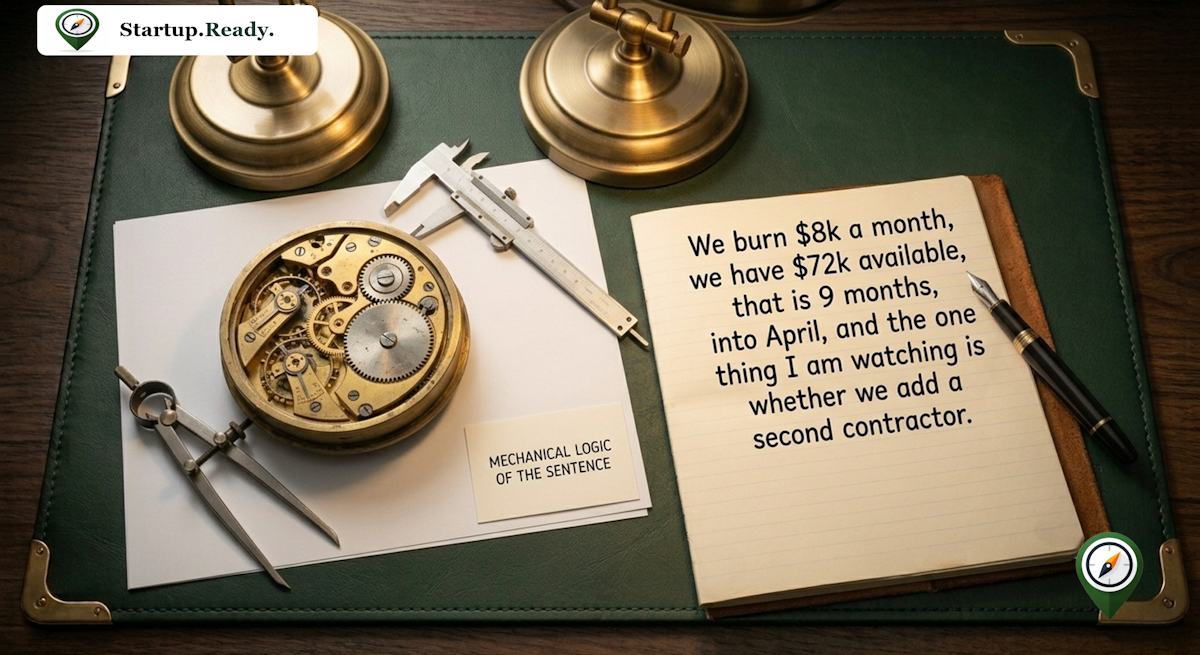
The whole discipline compresses into a single contrast. A weak runway statement sounds like "we've got about six to nine months, depending on how a few things go." A strong one sounds like "our burn is eight thousand a month, we have seventy-two thousand in the bank, which gives us nine months, into next April, assuming our one paying customer stays and hosting costs hold." Same founder, same business, opposite impressions, and the difference is entirely in the form.
Three moves separate the strong version from the weak one. It states a number, not a range: "nine months," because a range is two numbers standing in for the one you have not committed to, and the commitment is the point. It states a date, not a direction: "into April," because a date is checkable and a direction is a mood. And it names the one assumption the number rests on, right there in the sentence, so the listener knows exactly what the figure is standing on without having to ask.
One precision to nail in the sentence: the burn you state should be net burn, expenses minus the revenue actually arriving, because that is the rate your capital is really depleting at. Be explicit that it is net, since "we burn eight thousand" means very different things with revenue in it and without. And if that revenue is fragile, leaning on a client or two that could leave, state the gross number instead, the burn with revenue set to zero, because a listener would rather hear the conservative floor than discover a shaky assumption after the fact.
Notice what the strong version does not do: it does not hedge. No qualifiers softening it, no "roughly," no "it depends," no verbal insurance against being wrong. That confidence is earned rather than performed, a consequence of having actually finished the calculation, because a number you have genuinely built you can state without flinching. The hedges in the weak version only sound like honesty. What they actually broadcast is a founder who has not fully committed to their own number, and the listener hears exactly that.
Naming the Assumption Is Not Hedging
There is a real distinction hiding here, because "state it without hedging" and "name the assumption it depends on" can sound like a contradiction. They are opposites, actually, and holding both is the whole skill. A hedge blurs the number to protect the founder from being pinned to it. Naming the assumption keeps the number sharp and tells the listener the one condition it stands on. One hides uncertainty inside vagueness; the other states uncertainty precisely and moves on.
"Six to nine months, depending on a few things" hides. The listener learns nothing about what the few things are or how worried to be. "Nine months, assuming our one enterprise customer renews in March" is precise about exactly the same uncertainty, and it is far stronger, because it hands the listener the single lever that matters and trusts them to weigh it. Naming the assumption is not admitting weakness. It is demonstrating that you know precisely where your number is load-bearing, which is the kind of assumption worth watching directly, and a founder who can point to it sounds more in command than one who claims no assumptions at all.
For a startup with real revenue growth, the most honest assumption to name is often a rate rather than a cost. A company burning fifty thousand a month with three hundred thousand in the bank has six months if revenue stays flat, and effectively unlimited runway if revenue grows fast enough to cover the burn before the cash runs out. Same cash, same burn, two completely different situations, and the thing that separates them is the growth rate. So for a growth-stage business the assumption in the sentence is frequently the growth needed to reach break-even before the money runs out: "eight months at flat revenue, or default-alive if we hit fifteen percent monthly net growth." That names the real variable the runway hangs on.
So the strong statement is specific and honest at once. It commits to a number and a date, and it names the one thing that would move them, which is a more useful and more credible answer than either false certainty or a protective fog. Say the number like you mean it, and name the assumption like you are watching it, because you should be.
The Vet-Software Founder Who Lost the Room at the Money Question
Take a founder with a scheduling and records tool for veterinary clinics, in a meeting with an advisor she wanted on her side. The conversation went well until the money question. Asked her runway, she said, "somewhere around six to nine months, but it kind of depends on a couple of deals and whether we bring on another contractor." The advisor nodded, asked two follow-ups to pin it down, did not fully get there, and the energy in the meeting cooled. Her finances were actually fine. Her answer was the problem.
The calculation existed in her head, in pieces. Burn was about eleven thousand a month. Cash was around eighty-eight thousand. That is eight months, into the following March. The "six to nine, depending" was not a different reality, it was the same reality delivered as a fog, with the two deals she was hoping for smuggled in as a reason the number might be higher and the contractor she might hire smuggled in as a reason it might be lower, all mashed into one hedge that communicated nothing except uncertainty.
So she wrote the sentence, once, and practiced it until it was automatic: "We burn eleven thousand a month, we have eighty-eight in the bank, that is eight months, into March, and the main thing I am watching is whether we add a second contractor, which would pull it in by about six weeks." Ten seconds. A number, a date, one named assumption, no hedge. The next advisor she said it to visibly relaxed, because the sentence did the thing a runway sentence is supposed to do: it told him she had a grip on the constraint that governs everything, in the time it took to say it.
The One Sentence That Tells You Where You Stand
A founder who has finished the work can say this out loud, cleanly, without qualifiers:
We burn [amount] a month, we have [amount] available, that is [number] months, into [specific month], and the one thing I am watching that could move it is [specific assumption].
A founder who has not will reach for a range and an "it depends," because either the underlying number is not actually finished or the calculation has never been distilled into something sayable. That reach is the diagnosis. It is usually the reason a founder with sound finances still loses the room the moment the money question arrives.
If you can say the sentence in ten seconds, unqualified, you have turned your runway into the communication tool it is supposed to be. If you cannot, that is not a reason to explain your finances at greater length. It is the signal that the number is either unfinished or undistilled, and the fix is to build it cleanly first, then compress it to one sentence and practice it until it is reliable in any room. A number only you can understand is not operational. It is still trapped in the spreadsheet, guiding no one but the person who built it.
The Runway Statement and Your Financial Clarity
In the Startup Readiness Framework, Financial Clarity treats a runway you cannot state clearly as an early flag, because a number that needs explanation before it is interpretable signals, accurately, that the founder's financial command is not yet firm. The runway estimate is where financial awareness becomes visible to everyone else, in a single sentence.
This distills a calculation, it does not build one, so it assumes you have already produced the honest number in calculating runway from your current costs.
Financial Clarity is one of the six pillars in the framework. Without a strong financial understanding of your startup, it’s difficult to collect evidence into your assumptions.
The Startup Readiness Assessment gives you a full-system diagnostic across all six pillars in just about twenty minutes.
Take your Startup Readiness Score free today at startupready.ai →
Keep Working on the Financial Pillar
The Financial Pillar asks one question from many angles: do you know how money comes in, how fast it goes out, and how long you have before it runs out? Each article below takes one piece of that question. Whether you can state your payment model in a single sentence. What your runway actually is, once you stop rounding toward the answer you want. Which cost is the real risk and which is merely the largest. Where the one lever sits that buys you time to fix everything else. Read them in any order. Each is a separate cut at the same pillar, and together they show you where your numbers hold and where they are still a wish.
More in the Financial pillar:
Startup Unit Economics: What They Actually Are and Why Founders Get Them Wrong
Can You Describe Your Payment Model in One Sentence?
Decide How Money Moves Before You Decide How Much
If You Can't Say Your Runway in One Sentence, You Haven't Finished the Math
The Runway Number You're Avoiding Is the One That Governs Everything
Time Is the Financial Variable You Forgot to Measure
Find the Clock That Runs You Out of Cash First
Read the Unit Economics Before You Build the Spreadsheet.
Your Biggest Cost Isn't Always Your Biggest Risk
Triage Your Costs Before You Cut Them
Your Baseline Runway Is the Scenario Least Likely to Happen
The One Move That Buys Time to Fix Everything Else
Published
By Dr. Shaun P. Digan
Originally Published on Startup.Ready.’s Startup Readiness: Validation, Framework, and Tools Blog at https://startupready.ai/startup-readiness/calculate-your-runway
Original Publication Date: August 6, 2026
Last Updated: August 6, 2026
About the Author
Dr. Shaun P. Digan is the founder of Startup.Ready and the creator of the Startup Readiness Framework, a research-based system for evaluating and validating early-stage startups before launch and early growth. He holds a PhD in Entrepreneurship from the University of Louisville and has spent over 15 years teaching, advising, and consulting with founders on startup strategy, validation, and growth.
In his writing, including the Startup Readiness Blog and The Foundations of Innovation Essay Series, he focuses on how founders can make better decisions by improving clarity, alignment, and readiness before scaling.