Time Is the Financial Variable You Forgot to Measure
Founders track money carefully and time barely at all. They know their burn, their price, their runway, and they treat time as a background condition rather than a number, something that simply passes while the real financial variables do the work. That is a costly blind spot, because time is a financial variable, and in an early-stage startup it is the one most likely to be the thing that actually kills you.
Start with the literal version, because it is stronger than the metaphor. Every week has a dollar cost. A week of runway, a week of your own salary, a week of hosting and payroll and the rent on your attention, all of it burns whether or not anything moves. Time stretches every dollar you spend, because every week between doing the work and getting paid is a week of that cost carried with no revenue against it. Time delays knowing whether you were wrong, because every week between shipping something and a real signal is a week you stay committed to a decision you cannot yet evaluate. And time raises the cost of being wrong, since the longer the gap between action and signal, the more you invest before the signal arrives to tell you the action was a mistake. A business can be economically sound and still die, because time consumes its runway before the economics have the chance to matter.
The trouble is that most founders cannot say how long their cycles actually are. Ask how many weeks pass from the first real contact with a customer to the moment you learn whether the thing worked, and the answer is a shrug or a vague range. That shrug is the problem. It means you are making resource and timing decisions against a clock you have never looked at, and a clock you cannot see still runs.
TL;DR: Every Startup Runs on Three Clocks. Name Them, or You're Deciding Without One.
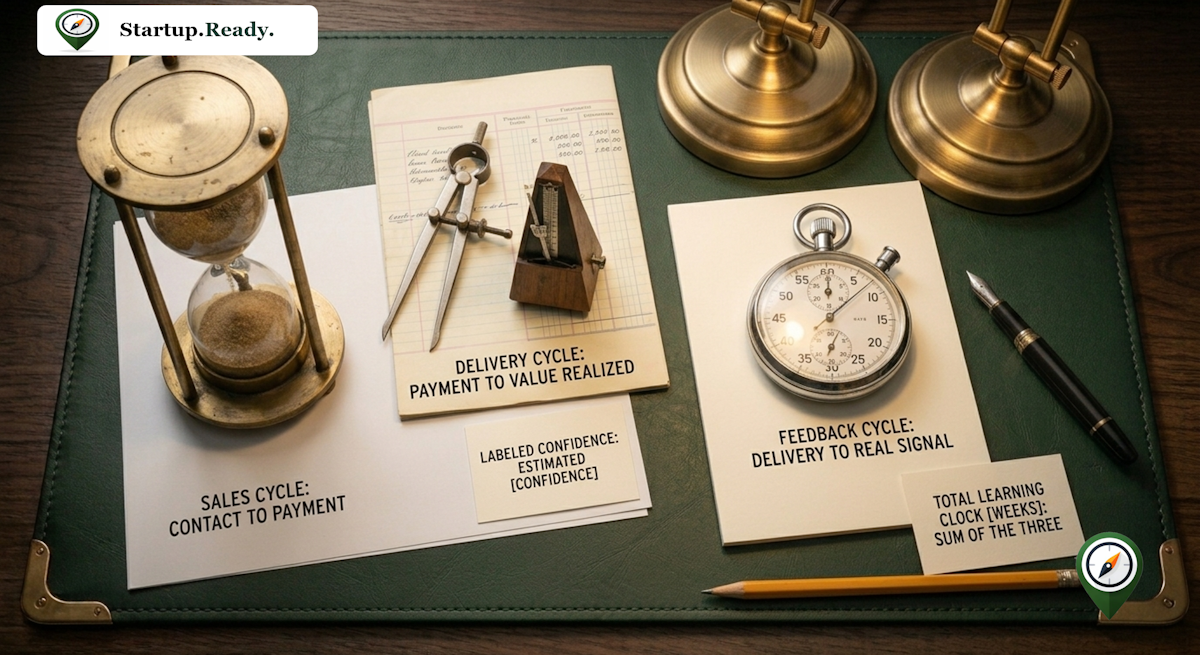
Three time cycles govern your finances: the sales cycle, from first contact to payment; the delivery cycle, from payment to the customer feeling the value; and the feedback cycle, from delivery to a signal clear enough to make a decision. When all three are unknown, cash flow is unpredictable and every timing decision is a guess. The work is to estimate each honestly, label how confident you are, and see what breaks if any one runs twice as long. Here is the move, in order:
Map the sales cycle, first real contact to money in the account
Map the delivery cycle, payment to the moment the customer actually feels the value
Map the feedback cycle, delivery to a signal you could act on
Total them, because first-contact-to-feedback is your real learning-and-cash clock
Label each confidence and stress-test each at twice its length
Four signals you're running without a clock:
You can state your burn and runway but not your sales, delivery, or feedback cycle in weeks
You feel time pressure but cannot say which cycle is creating it
You are spending or building faster than you have confirmed any cycle actually runs
Asked how long from first contact to real feedback, you answer with a shrug
If any of those describe you, this article shows you how to put the three clocks on the table before they decide your fate for you.
If You Found This Article by Searching for Something Else
Most founders who need this are not searching for "business cycles." They are searching for the pressure.
Why does my startup feel slow.
How long is a normal sales cycle.
Why am I running out of money faster than expected.
How to speed up customer feedback.
Why does everything take longer than I planned.
All of them come back to one question. How long does it actually take, in weeks, from first contact with a customer to a clear signal about whether your product worked? This article shows you how to measure that and why it governs your cash.
Time Is a Financial Variable
The reason time gets ignored is that it does not appear as a line item. Burn shows up in a bank statement, price shows up on an invoice, but the six weeks between a customer's first interest and their payment shows up nowhere, so it feels like weather rather than a number you own. It is a number you own, and it is doing financial work the whole time whether you measure it or not.
Watch how it spends money you never see leave the account. A long sales cycle means you carry the cost of pursuing a customer for weeks or months before any of their money arrives, so your effective cost of acquiring them is far higher than the ad spend suggests, inflated by all the runway burned while waiting. A long delivery cycle means you have their payment but you are still spending to fulfill, and if anything about fulfillment slips, you are committed with cash already going out. A long feedback cycle means you keep investing in a direction for weeks after you have committed to it and before you can tell whether it was right, so every wrong turn costs a full cycle of runway to discover. None of that appears as a cost. All of it consumes cash.
This is why a business with strong unit economics can still die. Margins tell you how much you make per customer once everything completes. Cycles tell you how long everything takes to complete, and how much runway you burn in the gap. A founder who has proven the margins and never measured the cycles has proven the business is profitable in a world where time is free, which is not the world they are operating in.
This also reframes where to look for improvement. Founders instinctively optimize money, trimming a subscription, shaving a cost, because costs are visible and cutting them feels like progress. Time hides, so it rarely gets optimized, and yet shortening a cycle often creates far more value than cutting a cost of the same apparent size. Saving five hundred dollars a month is real. Cutting a sales cycle from twelve weeks to six can double how fast the whole business learns, which is worth many multiples of the five hundred, and almost no one reaches for it, because the cost was sitting on the statement and the weeks were not.
Not every cycle can be shortened, and pretending otherwise backfires. An enterprise buyer's procurement and security review runs as long as it runs, and a founder who tries to rush it creates friction or gets rejected. When the sales or delivery cycle is fixed by the category, the lever is the feedback cycle instead. You cannot make the commercial loop close faster, but you can often get an actionable signal before it does: a lightweight pilot, a small paid trial, early telemetry that tells you whether the thing is working weeks before the full contract completes. Shortening the feedback cycle buys the learning speed a long sales cycle refuses to give, and it is often the only speed lever a long-cycle business actually has.
The Three Clocks
Every startup has three clocks running at once, and naming them separately is what turns a vague sense of slowness into something you can measure and manage.
The sales cycle is the time from first real contact to payment. Not first awareness, first contact: a real conversation, a demo, a reply to outreach, the first genuine interaction. It ends when money actually moves, at the payment trigger. This is the cycle founders usually feel most, because it is the one full of waiting on someone else to decide.
The delivery cycle is the time from payment to the customer realizing the value they paid for. Not when delivery is complete from your side, when the outcome lands for them, the moment the value is felt rather than merely shipped. A founder who measures delivery by their own finish line rather than the customer's realization will consistently think this cycle is shorter than it is.
The feedback cycle is the time from delivery to a signal clear enough to act on: to decide whether to continue, adjust, or stop. Not a compliment, not a vibe, a signal you could actually make a decision from. This is the cycle founders measure least and the one that most quietly determines how fast the business can learn, because the length of the feedback cycle is the speed limit on getting less wrong.
The Number That Matters Is the Total
The three cycles are worth naming individually, but the number that governs your business is the sum of all three: the total time from a customer's first contact to a signal you can act on. That total is your real learning clock, and it is almost always longer than any founder expects, because they have been carrying the three pieces separately and never added them up.
Consider what the total actually measures. It is how long it takes, end to end, to run one full loop of the business, from meeting a customer to knowing whether what you did for them worked. Everything about how fast you can improve is bounded by that number. If the loop is three weeks, you can be wrong ten times in a season and still learn fast. If the loop is nine months, you get one or two attempts before your runway is gone, and every one of those attempts has to count, because you cannot afford the iterations a shorter loop would give you for free. Two businesses with identical products and identical margins can have completely different odds of survival based only on how long their loop takes to close.
Which means runway is not really measured in months. It is measured in loops. Twelve months of runway is a dozen attempts at a two-week loop and barely one attempt at an eight-month loop, and those are not the same runway at all, even though the bank balance is identical.
One clarification, because the loop can sound more serial than it is. The total governs how fast your strategy can iterate, not how you have to run your pipeline. You do not wait for one customer's whole loop to close before starting the next. Sales, delivery, and feedback run in parallel across many accounts at once, so cash collection and validation overlap across cohorts, and the business keeps moving between loops. The loop length tells you how long until you learn from any given cohort. Stagger the pipeline and every clock runs concurrently, even though each individual clock is exactly as long as it is.
This is why the total is the most decision-relevant time number you own. It tells you how many real attempts your runway buys you, which tells you how careful each attempt has to be, which shapes how you spend, hire, and plan. A founder who knows their loop is nine months makes different decisions than one who assumes it is six weeks, and the only way to know which founder you are is to add the three cycles up honestly.
Label the Confidence, Then Double It
A cycle estimate is only as useful as it is honest, and honesty here means two things: labeling how much you actually know, and testing what happens if you are wrong. Both are quick, and both are where founders flinch.
Label each cycle observed, estimated, or assumed. Observed means real customers have actually moved through it and you timed them. Estimated means you reasoned it from adjacent evidence. Assumed means you picked a number because the plan needed one. Most early cycle estimates are assumed and dressed as observed, and the gap matters, because an assumed sales cycle is often the optimistic one, the version where customers decide faster than real customers ever do. The label tells you which numbers to trust and which to go replace with real observation first.
Then stress each cycle by doubling it. If your sales cycle ran twice as long, what breaks? If delivery took twice the time, what does it cost? If feedback took twice as long to arrive, how much more do you spend committed to a direction before you can judge it? Doubling is realistic rather than pessimistic: founders underestimate how long things take by far more than they underestimate what things cost, so a two-times stress on a cycle is closer to the truth than it sounds. The cycle whose doubling does the most damage is the one to watch hardest. Usually it is the one you are least confident in and most optimistic about at the same time, which is exactly the combination that ambushes founders who never ran the test.
The Banking Tool That Was Profitable in a World Where Time Was Free
Take a founder with a fraud-detection tool for regional credit unions. The margins were genuinely good, and she could recite them. Ask about time and the picture went blurry, and the blur was the whole story. She had been treating the business as its margins described it, and the margins described a world where time did not exist.
Map the three clocks and the real business appeared. The sales cycle, from first contact with a credit union to a signed contract and payment, ran close to five months, because these buyers move through committees, security reviews, and budget cycles, none of which she could hurry. The delivery cycle, from payment to the tool actually integrated and catching fraud the customer could see, ran another two months of implementation. And the feedback cycle, from going live to a signal clear enough to prove the tool reduced fraud losses, ran two months more, because fraud is measured over time. Added up, the loop from first handshake to "this actually works" was around nine months, and she had been running the company as if it were closer to two.
That number changed everything about how she should operate, and it did so while she still had room to act on it. Nine months meant she could not afford to learn by trial and error the way a two-week-loop business can, so each credit union she pursued had to be chosen carefully, because a wrong one cost the better part of a year to discover. It meant her runway bought her far fewer real attempts than she had assumed, which made the case for raising more, sooner, or narrowing her focus hard. The margins said the economics worked. The cycles determined whether she would survive long enough to prove it.
The One Sentence That Tells You Where You Stand
A founder who has mapped their clocks can complete this statement concretely:
My sales cycle is about [weeks], my delivery cycle [weeks], my feedback cycle [weeks], for a total loop of [weeks] from first contact to real signal, and the one cycle most likely to surprise me is [specific cycle].
A founder who has not will state their margins fluently and go vague on how long anything takes, because time never felt like a financial number worth pinning down. That vagueness is the diagnosis. It is usually the reason a business that looks profitable on paper generates a financial pressure the founder can feel but cannot locate.
If you can name your three cycles and their total, you know how many real attempts your runway buys and how careful each one has to be. If you cannot, that is not a reason to keep tracking only the money. It is the signal to time the three clocks honestly, add them up, and mark which one you are guessing at. Margins tell you whether the business works. Cycles tell you whether you will still be here when it does.
Time Cycles and Your Financial Clarity
In the Startup Readiness Framework, Financial Clarity treats unmapped time cycles as an early flag, because a founder who cannot state how long their sales, delivery, and feedback loops take is managing cash and learning speed against a clock they cannot see. Time is the most underestimated financial variable at the early stage, and a strong-margin business with long cycles can still run out of runway before clarity arrives.
The end of the sales cycle is the payment trigger you named in your payment model, and the end of the delivery cycle is the moment value lands. Once all three are mapped, the next question is which one most threatens your cash if it slips, covered in finding the clock that runs you out of cash first, and the runway all of this consumes is the number every cycle spends against.
Financial Clarity is one of the six pillars in the framework. Without a strong financial understanding of your startup, it’s difficult to collect evidence into your assumptions.
The Startup Readiness Assessment gives you a full-system diagnostic across all six pillars in just about twenty minutes.
Take your Startup Readiness Score free today at startupready.ai →
Keep Working on the Financial Pillar
The Financial Pillar asks one question from many angles: do you know how money comes in, how fast it goes out, and how long you have before it runs out? Each article below takes one piece of that question. Whether you can state your payment model in a single sentence. What your runway actually is, once you stop rounding toward the answer you want. Which cost is the real risk and which is merely the largest. Where the one lever sits that buys you time to fix everything else. Read them in any order. Each is a separate cut at the same pillar, and together they show you where your numbers hold and where they are still a wish.
More in the Financial pillar:
Startup Unit Economics: What They Actually Are and Why Founders Get Them Wrong
Can You Describe Your Payment Model in One Sentence?
Decide How Money Moves Before You Decide How Much
If You Can't Say Your Runway in One Sentence, You Haven't Finished the Math
The Runway Number You're Avoiding Is the One That Governs Everything
Time Is the Financial Variable You Forgot to Measure
Find the Clock That Runs You Out of Cash First
Read the Unit Economics Before You Build the Spreadsheet.
Your Biggest Cost Isn't Always Your Biggest Risk
Triage Your Costs Before You Cut Them
Your Baseline Runway Is the Scenario Least Likely to Happen
The One Move That Buys Time to Fix Everything Else
Published
By Dr. Shaun P. Digan
Originally Published on Startup.Ready.’s Startup Readiness: Validation, Framework, and Tools Blog at https://startupready.ai/startup-readiness/map-your-time-cycles
Original Publication Date: August 7, 2026
Last Updated: August 7, 2026
About the Author
Dr. Shaun P. Digan is the founder of Startup.Ready and the creator of the Startup Readiness Framework, a research-based system for evaluating and validating early-stage startups before launch and early growth. He holds a PhD in Entrepreneurship from the University of Louisville and has spent over 15 years teaching, advising, and consulting with founders on startup strategy, validation, and growth.
In his writing, including the Startup Readiness Blog and The Foundations of Innovation Essay Series, he focuses on how founders can make better decisions by improving clarity, alignment, and readiness before scaling.