Find the Clock That Runs You Out of Cash First
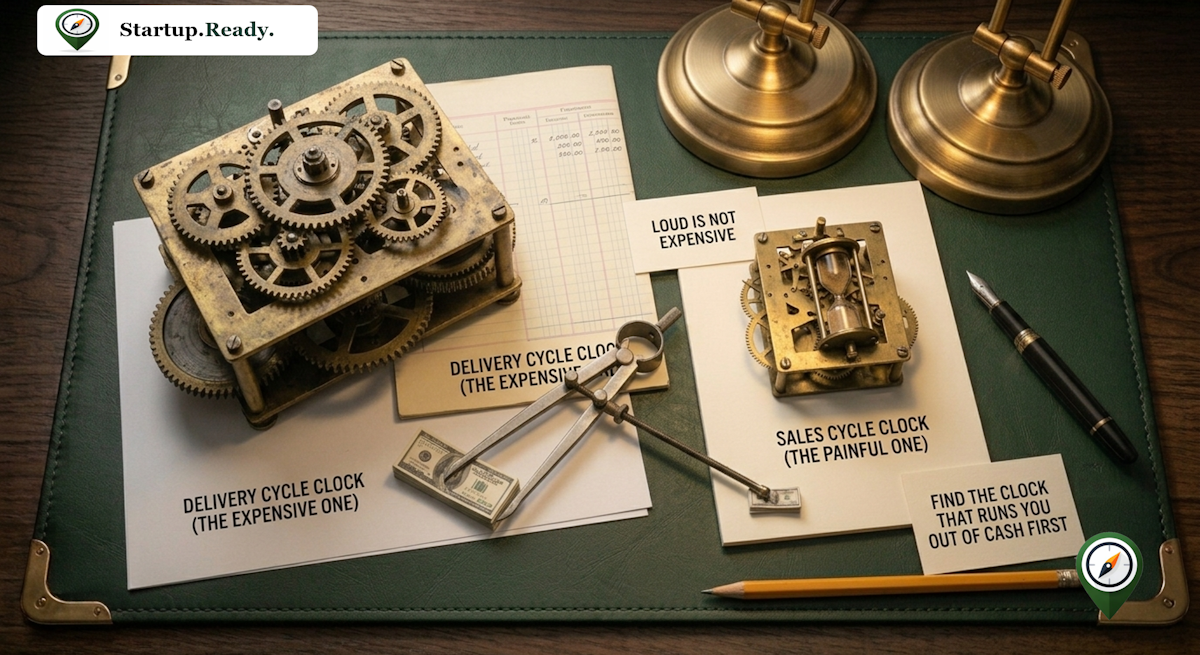
Once you have mapped your business cycles, it is tempting to feel finished. You have named the sales cycle, the delivery cycle, and the feedback cycle, put weeks against each, and seen the total. That is real progress, and it is not the same as safety, because knowing your cycles does not tell you which one is dangerous. One of them will run the business out of cash before any other problem becomes visible, and it is rarely the one you would guess.
The trap is that the cycle you feel most is usually not the cycle that will kill you. The sales cycle is the one that hurts: the long wait, the deals that stall, the frustration of chasing a decision you cannot control. So founders fixate there, because that is where the pain lives. Meanwhile a different clock, quieter and less frustrating, is the one actually draining the account, and because it does not hurt in the moment, it goes unwatched until the cash consequence arrives all at once.
The difference between the cycle that hurts and the cycle that kills is the whole point of this work. A painful cycle is a morale problem. A dangerous cycle is a solvency problem, and the two are frequently not the same clock. Finding out which one threatens your cash first, before it slips, is the difference between a constraint you manage and a crisis you did not see coming.
TL;DR: Not All Cycles Are Equally Dangerous. Find the One That Drains Cash Fastest and Defuse It.
A cycle becomes a cash problem when the business keeps spending while it waits, for payment, for value to land, or for a signal. The most dangerous cycle is the one with the widest gap between money going out and money coming in, and it is often not the cycle that feels worst. The work is to map what each cycle does to your cash if it slips, find the one that threatens solvency first, and reduce its impact with one deliberate change. Here is the move, in order:
Double each cycle and describe exactly what happens to your cash
Separate the threats: a cash threat burns runway, a learning threat delays decisions
Find the dangerous clock, the one where you spend most while waiting to be paid
Choose one lever: shorten it, front-load payment, cut its cost, or buffer against it
Watch it, because the highest-risk cycle is the one to track most closely
Four signals you have mapped your cycles but not your cash risk:
You know your three cycle lengths but not which one would break you if it slipped
You are focused on the cycle that frustrates you, not the one that drains cash
You keep spending to deliver or acquire well before the matching payment arrives
You could not say, without pausing to calculate, which slipping cycle shortens your runway most
If any of those describe you, this article shows you how to find the dangerous clock and defuse it before it fires.
If You Found This Article by Searching for Something Else
Most founders who need this are not searching for "cash cycle risk." They are searching for the surprise.
Why did I run out of cash so suddenly.
How to manage cash flow in a startup.
Why is my cash always tight despite sales.
How to reduce the cash impact of a long sales cycle.
What is the most dangerous financial risk for my startup.
All of them come back to one question. Of your business cycles, which one, if it ran long, would threaten your ability to operate first? This article shows you how to find it and reduce its bite.
The Cycle That Hurts and the Cycle That Kills
Start with the distinction that reorders everything: a cycle drains cash for one reason, the business keeps spending while it waits for that cycle to close. Length alone is not the danger. The longest clock is not automatically the dangerous one. The dangerous clock is the one that forces the greatest cash exposure before the money comes back, which is a different thing than the one that takes the most weeks. A six-month sales cycle that costs almost nothing to wait through can be far safer than a three-week delivery cycle that burns fifty thousand in payroll before payment lands. The gap between money out and money back is the danger, not the length, and the cycle with the widest gap is the one to fear, whether or not it feels worst.
This is why the sales cycle, the one founders agonize over, is often not the killer. A long sales cycle is painful, but during much of it you may not be spending heavily on that specific deal, so the cash bleed can be slower than the frustration suggests. The delivery cycle is frequently the more dangerous clock, because delivery consumes labor and cost before the customer's payment arrives, so cash goes out to fulfill while the money for it still sits ahead of you. That holds whether or not you spent much to acquire the customer, which is why it catches even lean, low-acquisition-cost businesses. The sales cycle is loud. The delivery cycle is expensive, and loud is not the same as expensive. The feedback cycle is a different kind of threat again: it rarely drains cash directly, but it delays the decision that would stop you spending in the wrong direction, so its damage is measured in runway burned before you learn.
Naming which kind of threat each cycle poses is half the work. A cash threat burns your runway faster and shows up in the bank account. A learning threat keeps the runway burning at the same rate but points it the wrong way, so you spend the same money making a mistake you cannot yet see. Both are expensive. They are expensive differently, and they call for different responses, which is exactly why lumping all three cycles together as "things that take too long" hides the one that will actually end you.
Map the Cash Cost of Doubling Each Cycle
The way to find the dangerous clock is not to reason about it in the abstract but to double each cycle and watch the account. Take each cycle in turn, run it out to twice its length, and answer three concrete questions: how much additional cash the delay demands, how soon you would feel it, and whether it is reversible once it happens.
Double the sales cycle and ask what it costs you in weeks of carrying the business with that revenue still not arrived, and how many deals it pushes past the point where your runway can wait for them. Double the delivery cycle and ask what the extra fulfillment time costs while payment sits where it sits, and whether the longer delivery also delays the payment itself. Double the feedback cycle and ask which decisions you would be making blind for those extra weeks, and how much you would spend committed to a direction before the delayed signal could redirect you. The numbers do not need to be precise. They need to be honest enough to rank.
Then compare the three on the dimensions that decide danger: how much cash each demands, how fast the impact lands, and whether it can be reversed. A cost that hits in six months is a different threat than a smaller one that hits in three weeks with no way to undo it. The dangerous clock usually combines a real cash cost, a short fuse, and no easy reversal, and once you rank the three that way, the one quietly draining you stops being invisible. It has a name, a number, and a fuse length.
Four Ways to Defuse the Worst Clock
The goal is not to eliminate cycle risk, which is impossible, but to reduce the cash impact of the single most dangerous clock, and there are four levers for doing it. Most founders reach only for the first and forget the other three.
Shorten the cycle. Change the sales process, the delivery method, or the feedback mechanism so the same outcome arrives in less time, which reduces the runway consumed before cash or clarity returns. This is the obvious move and often the hardest, because some cycles are set by the customer's world, not yours. Front-load the payment. If you cannot shorten a dangerous delivery cycle, change when money arrives relative to when you spend it: a deposit, a pre-payment, milestone billing that pulls cash forward so you are not fully funding delivery before any of it lands. This lever is the one founders most consistently overlook, and it often defuses a delivery-cycle threat faster than any process change could. Reduce the cost of running the cycle. If a cycle cannot be shortened or front-loaded, make it cheaper to wait through, lowering the cost-per-week of the sales effort or the delivery or the feedback mechanism, so the same length burns less. Build a buffer. When none of the first three fully solve it, extend runway or cut burn so the business can absorb the dangerous cycle running long. A buffer does not stop the slip. It keeps the slip from being fatal. Reach for it last, though, because idle cash held only to absorb a fixable cycle is capital doing no work, and a structural fix like a deposit or milestone billing beats a static reserve every time one is available.
The right lever depends on which cycle is dangerous and why. A delivery cycle that bleeds cash before payment is usually a front-loading problem, solved by a deposit rather than a faster process. A feedback cycle that burns runway pointed the wrong way is usually a shortening problem, solved by finding a faster signal. Match the lever to the specific way the clock is dangerous, rather than defaulting to "work faster," and you defuse the threat instead of just straining against it.
One caution on front-loading, because a signed deposit is not the same as cleared cash. A payment trigger tells you when the customer owes you. It does not tell you when the money lands, and in mid-market and enterprise, corporate accounts payable runs on its own terms, net thirty, sixty, sometimes ninety, so cash can clear a month or more after the deposit is agreed. When you move a trigger earlier to defuse a delivery cycle, check the buyer's actual payment terms too, or you will have fixed the trigger and kept the gap, waiting on receivables while payroll still goes out. The clock that matters is when cash hits the bank, not when the contract says it is owed.
The Integration Founder Who Feared the Wrong Clock
Take a founder whose product connected logistics software for regional freight companies, each sale requiring weeks of custom integration work before the customer went live. Ask what kept him up and he pointed straight at the sales cycle, four painful months of committees and procurement, because that was the part that hurt. He was pouring his worry into shortening it. The sales cycle was not the clock that was going to end him.
Double each cycle and the real danger surfaced. When the sales cycle ran long, it was frustrating, but he was not spending much on a given prospect during the wait, so the cash bleed was slow and reversible: he could walk away from a stalled deal. The delivery cycle was a different animal. The customer paid on go-live, but the integration work, weeks of his engineers' time, happened before go-live, which meant every extra week of delivery was a week of real payroll going out against a payment that had not arrived and now arrived even later. A doubled delivery cycle did not just frustrate him, it demanded thousands in additional cash on a short fuse with no way to claw it back, on several deals at once. The clock he feared was painful. The clock he ignored was the one draining the account.
So he matched the lever to the actual threat. Shortening the integration was hard and slow, set partly by the customers' messy systems. Front-loading the payment was neither: he moved to a fifty percent deposit at contract signing, before the integration work began, so his engineers' weeks were funded by the customer's cash rather than his runway. The delivery cycle was exactly as long as before. It was no longer dangerous, because money now went out and came in on nearly the same clock instead of on opposite ends of a two-month gap. He had spent a year worried about the cycle that hurt while the cycle that could kill him sat one deposit away from being harmless.
The One Sentence That Tells You Where You Stand
A founder who has found the dangerous clock can complete this statement concretely:
The cycle that most threatens my cash if it slips is [specific cycle], because [the specific way it drains cash before money arrives], and the lever I am using to defuse it is [shorten, front-load, reduce cost, or buffer], in place by [specific date].
A founder who has not will name the cycle that frustrates them most and mistake it for the cycle that endangers them most, because pain is louder than solvency until the day it is not. That mistake is the diagnosis. It is usually the reason a founder who felt on top of a long, visible sales cycle gets blindsided by a cash crunch from a delivery cycle they never thought to watch.
If you can name the dangerous clock and the lever that defuses it, you have turned a hidden risk into a managed one before it fired. If you cannot, that is not a reason to keep straining against the cycle that annoys you. It is the signal to double each cycle, watch which one hits your cash hardest and soonest with no way back, and aim one deliberate change at that one. The cycle that hurts will keep asking for your attention. The cycle that kills is the one that has earned it.
Cycle Cash Risk and Your Financial Clarity
In the Startup Readiness Framework, Financial Clarity treats a set of mapped cycles with no ranked cash risk as an early flag, because knowing your cycles without knowing which one endangers cash is still flying half-blind. The most dangerous cycle is usually the one where the business spends most while waiting to be paid, and it is often not the cycle the founder feels most acutely.
This work assumes the cycles are already named, which is mapping your three time cycles. The cash any slip consumes is measured against your runway, and finding the single clock that binds first is the same discipline as naming the constraint that caps everything else.
Financial Clarity is one of the six pillars in the framework. Without a strong financial understanding of your startup, it’s difficult to collect evidence into your assumptions.
The Startup Readiness Assessment gives you a full-system diagnostic across all six pillars in just about twenty minutes.
Take your Startup Readiness Score free today at startupready.ai →
Keep Working on the Financial Pillar
The Financial Pillar asks one question from many angles: do you know how money comes in, how fast it goes out, and how long you have before it runs out? Each article below takes one piece of that question. Whether you can state your payment model in a single sentence. What your runway actually is, once you stop rounding toward the answer you want. Which cost is the real risk and which is merely the largest. Where the one lever sits that buys you time to fix everything else. Read them in any order. Each is a separate cut at the same pillar, and together they show you where your numbers hold and where they are still a wish.
More in the Financial pillar:
Startup Unit Economics: What They Actually Are and Why Founders Get Them Wrong
Can You Describe Your Payment Model in One Sentence?
Decide How Money Moves Before You Decide How Much
If You Can't Say Your Runway in One Sentence, You Haven't Finished the Math
The Runway Number You're Avoiding Is the One That Governs Everything
Time Is the Financial Variable You Forgot to Measure
Find the Clock That Runs You Out of Cash First
Read the Unit Economics Before You Build the Spreadsheet.
Your Biggest Cost Isn't Always Your Biggest Risk
Triage Your Costs Before You Cut Them
Your Baseline Runway Is the Scenario Least Likely to Happen
The One Move That Buys Time to Fix Everything Else
Published
By Dr. Shaun P. Digan
Originally Published on Startup.Ready.’s Startup Readiness: Validation, Framework, and Tools Blog at https://startupready.ai/startup-readiness/cash-cycle-impact
Original Publication Date: August 7, 2026
Last Updated: August 7, 2026
About the Author
Dr. Shaun P. Digan is the founder of Startup.Ready and the creator of the Startup Readiness Framework, a research-based system for evaluating and validating early-stage startups before launch and early growth. He holds a PhD in Entrepreneurship from the University of Louisville and has spent over 15 years teaching, advising, and consulting with founders on startup strategy, validation, and growth.
In his writing, including the Startup Readiness Blog and The Foundations of Innovation Essay Series, he focuses on how founders can make better decisions by improving clarity, alignment, and readiness before scaling.