Can You Describe Your Payment Model in One Sentence?
Almost every founder can describe what they are building and who they are building it for. The pitch is fluent, the customer is clear, the problem is real. Then ask a narrower question, the one that actually determines whether any of it becomes a business: what exactly has to happen for money to change hands? And the fluent answer stops.
That gap has a name. A startup with a clear product and a clear customer but no clearly defined way money moves is not yet a business. It is a value hypothesis with a revenue assumption attached, and the revenue assumption is the part everyone skips, because building the product and finding the customer feel like the hard parts, and getting paid feels like something that will sort itself out once those are done.
It does not sort itself out. A payment model is not a detail you fill in after the product works. It is a structural decision that shapes your go-to-market, your unit economics, and ultimately your runway. Until you can name it in a single sentence, the most important number in your business, whether it makes any, rests on a hope.
The term can mislead, because a payment model is not the same as a pricing model or a revenue model. Pricing answers what you charge. A revenue model sketches where the money comes from. A payment model answers the concrete question underneath both: what exactly has to happen for money to move.
TL;DR: A Payment Model Is Four Named Things: Who Pays, How Much, When, and What Triggers It.
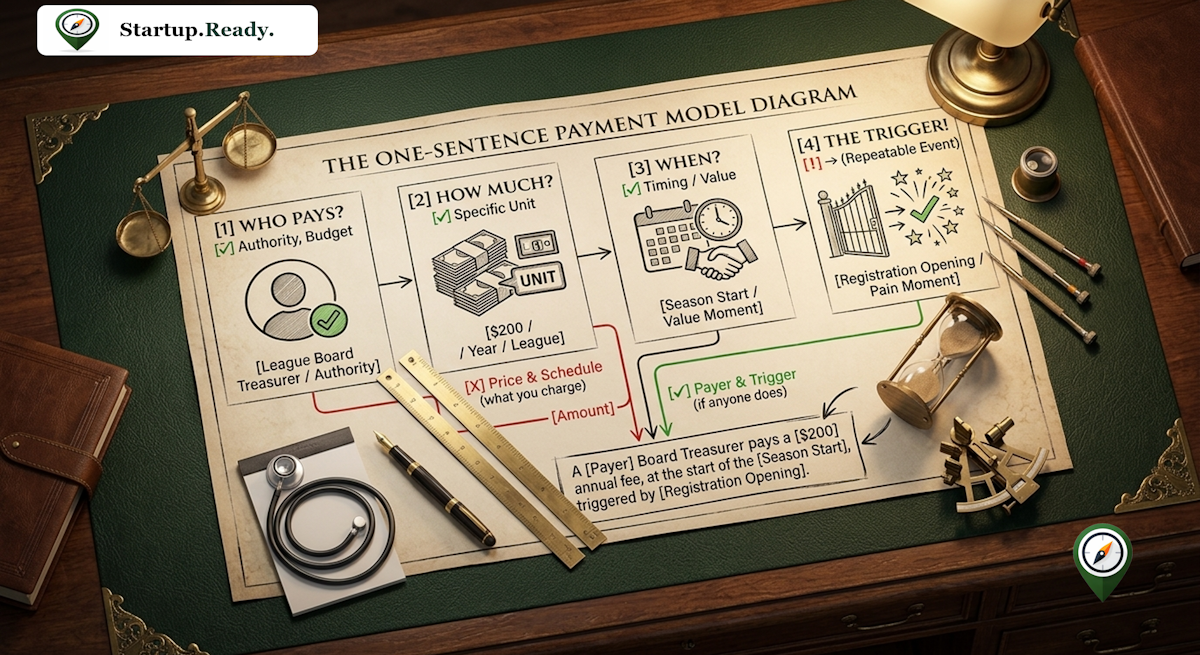
A payment model answers what has to happen for money to move: who specifically pays, how much, at what point in the journey, and the specific event that converts interest into commitment. Together those four answer every question money needs to move; leave one undefined, and every sales conversation has to invent it from scratch. Most founders can name the price and hand-wave the other three, especially the trigger. The work is to name all four with enough precision that you could say them in one sentence to a customer and they would know exactly what they were committing to. Here is the move, in order:
Name who pays, which is not always who uses, and confirm they have budget and authority
Name how much, one specific number you would test first, not a range
Name when, and whether it is tied to a moment of value or an administrative date
Name the trigger, the specific event that converts interest into a commitment
Assemble one sentence and test whether it is repeatable without you in the room
Four signals your payment model is assumed, not designed:
You can state your price but not the specific event that makes a customer actually commit
The person who uses the product and the person who pays are not clearly the same, and you have not resolved which one you are selling to
Your payment sentence sounds different depending on who is asking
Getting paid currently requires you, personally, to engineer each commitment
If any of those describe you, this article shows you how to name the four components and turn a revenue assumption into a payment model you can test.
If You Found This Article by Searching for Something Else
Most founders who need this are not searching for "payment model." They are searching for the friction.
How to price my product.
Why won't customers commit to buying.
Who should I be selling to.
How do startups actually charge customers.
Why do my deals stall at the end.
All of them come back to one question. Can you name, precisely, who pays you, how much, when, and what makes them commit? This article shows you how, and which of the four you are probably missing.
Who Pays Is Not Always Who Uses
The first component founders get wrong is the most basic one, because it seems too obvious to examine: who actually pays. In many businesses the person using the product is not the person writing the check, and getting that split wrong produces sales friction that looks like a product problem when it is really a payment-model problem.
When the payer and the user differ, they care about different things, and a payment model aimed at the wrong one stalls. The user cares about the daily experience, the hours saved, the annoyance removed. The payer cares about the outcome that justifies the spend, the number on their own scorecard. Build your whole case for the user's delight and take it to a payer who answers for a budget, and the enthusiasm in the room never converts, because the person nodding is not the person who can say yes. The friction feels like the customer not wanting it. It is actually the founder selling the right value to the wrong role.
So name the payer specifically, and confirm two things about them: that they have the budget, and that they have the authority. A user who loves the product and has to "check with someone" is not your payer, they are your champion, and a payment model that treats a champion as a decision-maker will keep producing warm conversations that never close. Resolve who pays before anything else, because every other component, how much, when, and what triggers it, is answered differently depending on whose money it is.
The Component Founders Hand-Wave
Ask a founder how they get paid and they will usually name a price and a schedule. Ask what specifically causes a customer to commit, the exact event that turns interest into a signed yes, and the answer gets vague. "When they see the value." "Once they're convinced." Those are not triggers. They are hopes wearing the grammar of a plan.
The payment trigger is a specific event or condition, not a general disposition. A trial hitting its limit. A quarter closing. A new hire starting. A compliance deadline landing. The completion of a milestone the customer can see. Something happens, and because it happened, the customer moves from interested to committed. If you cannot name that event, you do not have a trigger, you have a wish that customers will eventually decide on their own, and customers left to decide on their own mostly do not.
Two tests separate a real trigger from a hopeful one. First, is it repeatable: would the same event convert the next customer through the same sequence, or was this one a special case you talked into it? Second, does it fire without you: would the trigger still work if a different founder ran the next ten conversations, or does it depend on your personal persuasion in the room? A trigger that only fires when you are there to engineer it is not a payment model. It is a founder doing sales by hand, one deal at a time, which is the fragility the next piece on payment mechanisms takes apart. Name a trigger that repeats and fires without you, and you have the component that turns the other three into a model.
One caveat for complex sales. In self-serve and mid-market deals, a single trigger usually carries the whole commitment. Enterprise works differently: commitment comes as a sequence, where a security review clears, a pilot succeeds, and a procurement budget opens before money moves, and collapsing that into one superficial trigger hides the real hurdles. If you sell into complex buying, name the sequence, and in particular name two triggers: an entry trigger that starts a paid pilot or first commitment, and an expansion trigger that converts it into the full contract or the next tier. The move does not change, name the specific events, but a complex deal has more than one to name.
The One-Sentence Payment Model
The four components are worth naming separately, and they only become a payment model when they lock into a single sentence: who pays how much per unit, at what point, triggered by what. "A regional sales manager pays four hundred dollars a month per team, billed when they add their first five reps, triggered by their quarterly number coming in short." That sentence is testable. You can say it to a customer and watch whether they understand exactly what they would be committing to, and you can hand it to someone else and see whether the trigger fires without you.
The format flexes for usage-based models too, where the amount and the timing float with consumption rather than sitting fixed. "An engineering lead pays a fraction of a cent per API call, billed monthly, triggered automatically when the free credit tier runs out" is the same four components, with a metered rate as the price and a usage threshold as the trigger. All four still get named, whether the price is a flat fee or a per-unit rate, and whether the trigger is a sales event or a consumption limit.
Those are the two tests, and they map to the two ways the model fails. If a customer hears the sentence and does not know what they are agreeing to, one of the four components is vague, and the vague one is where the work is. If the trigger only fires when you personally are in the conversation, the model is not yet structural, however clear the sentence sounds. The value of forcing all four into one line is that vagueness has nowhere to hide: a missing payer, an uncertain price, a timing tied to nothing, or a trigger that is really just hope all show up the moment you try to say the whole thing at once.
When the sentence does not come cleanly, that failure is the diagnosis. The component you stumble on is the component that has not been designed, and it is almost always the trigger or the payer, the two that founders skip because price and schedule feel like the whole question. They are not. Price and schedule tell you what you charge. Payer and trigger decide whether anyone ever does.
The League Tool That Never Resolved Who Pays
Take a founder with a scheduling and communication tool for youth sports leagues. The product was genuinely useful, coaches and parents loved the demos, and the founder could describe all of it fluently. Ask for the payment model, though, and it dissolved. The tool was used by coaches and parents, but who paid, the league itself, each team, the parents individually, was never resolved, so every sales conversation started the money question over from scratch.
Name the four components and the block appears immediately at the first one. The user was clear, coaches and parents, but the payer was not, and the founder had been pitching the people who loved it rather than the people who could fund it. Once she forced the question, the answer was the league administrator, usually a volunteer board treasurer with a small budget and real authority over it. That changed everything downstream. The how-much became a per-league annual fee the board could approve, not a per-parent charge no one owned. The when became the start of a season, when the board sets its budget. And the trigger, the piece that had been pure hope, became concrete: registration opening for the new season, the moment a league feels its scheduling pain most acutely and a treasurer has budget in hand.
Assembled, the sentence finally held: "A league board treasurer pays a two hundred dollar annual fee, at the start of the season, triggered by registration opening." The product had not changed. What changed was that she stopped selling to the people who used it and built a payment model around the person who pays for it, at the moment they are ready to. The warm demos had never been the problem. The missing payer had.
The One Sentence That Tells You Where You Stand
A founder who has designed their payment model can complete this statement concretely:
[Specific payer] pays [specific amount] per [unit], at [specific point], triggered by [specific event], and I know the trigger is real because it would fire for the next customer without me in the room.
A founder who has not will describe the product and the customer fluently and stall on the payer or the trigger, because those two get skipped while price and schedule feel like the whole question. That stall is the diagnosis. It is usually the reason a business with real interest and warm conversations cannot reliably turn either into revenue.
If you can say the whole sentence cleanly and the trigger fires without you, you have a payment model you can test in your next three conversations. If you cannot, that is not a reason to keep refining the product. It is the signal to name who actually pays, what specifically makes them commit, how much, and when, and force all four into one line until the line holds. A product and a customer are a value hypothesis. A payment model is the part that turns the hypothesis into a business.
The Payment Model and Your Financial Clarity
In the Startup Readiness Framework, Financial Clarity treats an undefined payment model as one of the most serious early flags, because a business that cannot name how money changes hands is making pricing decisions by intuition, sales calls by improvisation, and forecasts by optimism. A clear product with an assumed revenue model is a value hypothesis, not yet a business.
Defining the model is the first step. Whether the mechanism behind it is structural or held together by your personal involvement is the work of separating the payment mechanism from the price.
Financial Clarity is one of the six pillars in the framework. Without a strong financial understanding of your startup, it’s difficult to collect evidence into your assumptions.
The Startup Readiness Assessment gives you a full-system diagnostic across all six pillars in just about twenty minutes.
Take your Startup Readiness Score free today at startupready.ai →
Keep Working on the Financial Pillar
The Financial Pillar asks one question from many angles: do you know how money comes in, how fast it goes out, and how long you have before it runs out? Each article below takes one piece of that question. Whether you can state your payment model in a single sentence. What your runway actually is, once you stop rounding toward the answer you want. Which cost is the real risk and which is merely the largest. Where the one lever sits that buys you time to fix everything else. Read them in any order. Each is a separate cut at the same pillar, and together they show you where your numbers hold and where they are still a wish.
More in the Financial pillar:
Startup Unit Economics: What They Actually Are and Why Founders Get Them Wrong
Can You Describe Your Payment Model in One Sentence?
Decide How Money Moves Before You Decide How Much
If You Can't Say Your Runway in One Sentence, You Haven't Finished the Math
The Runway Number You're Avoiding Is the One That Governs Everything
Time Is the Financial Variable You Forgot to Measure
Find the Clock That Runs You Out of Cash First
Read the Unit Economics Before You Build the Spreadsheet.
Your Biggest Cost Isn't Always Your Biggest Risk
Triage Your Costs Before You Cut Them
Your Baseline Runway Is the Scenario Least Likely to Happen
The One Move That Buys Time to Fix Everything Else
Published
By Dr. Shaun P. Digan
Originally Published on Startup.Ready.’s Startup Readiness: Validation, Framework, and Tools Blog at https://startupready.ai/startup-readiness/define-payment-model
Original Publication Date: August 7, 2026
Last Updated: August 7, 2026
About the Author
Dr. Shaun P. Digan is the founder of Startup.Ready and the creator of the Startup Readiness Framework, a research-based system for evaluating and validating early-stage startups before launch and early growth. He holds a PhD in Entrepreneurship from the University of Louisville and has spent over 15 years teaching, advising, and consulting with founders on startup strategy, validation, and growth.
In his writing, including the Startup Readiness Blog and The Foundations of Innovation Essay Series, he focuses on how founders can make better decisions by improving clarity, alignment, and readiness before scaling.