Your Problem Is Real. That Does Not Mean It Hurts Enough.
Most founders worry their problem might not be real. The more dangerous possibility is that it is real and nobody cares enough to do anything about it.
A real problem and a painful problem are not the same thing. People can know a problem exists, agree it is annoying, and still change nothing. They have lived with it this long. They will keep living with it. The problem is genuine, and it sits below the line where pain turns into action. That line is the pain threshold, and most of the problems founders fall in love with are sitting just underneath it.
Awareness is not motivation. A founder who confuses the two builds for a market that nods along and never moves.
TL;DR: Awareness of a Problem Is Not Motivation to Solve It.
The pain threshold is the level at which a problem stops being tolerable and starts driving people to act, pay, or change behavior. Below it, you get agreement. Above it, you get customers. The whole job of pain validation is finding out which side of that line you are on, using evidence rather than hope.
That's the real version of “Is my problem worth solving?”: not whether it's real, but whether it clears the pain threshold that turns awareness into action. Think of it as a quick problem severity test.
The pain threshold: the line where acknowledgment turns into action
Invisible traction: polite interest, sign-ups, and trials that never become use or payment
The pain spectrum: low (noticed, no action), moderate (cheap workaround), high (costly, repeated, urgent behavior)
The behavior test: what people already do about the problem, not what they say about it
Three paths if pain is low: go deeper, reframe the consequence, or move on
Four signals your problem is below the pain threshold:
People agree the problem is annoying and do nothing differently afterward
You have sign-ups, trials, or interest that never turn into real use or payment
You cannot name a single person who did something painful, expensive, or embarrassing to work around it
When you picture handing them a free, perfect solution today, you are not sure they would rush to use it
If any of those describe you, this article shows you how to locate yourself on the pain spectrum honestly, and what to do if you are below the line.
If You Found This Article by Searching for Something Else
Most founders who need this are not searching for "pain validation." They are searching for something more immediate.
How to validate a startup idea.
Will customers actually pay for this.
Why won't people buy.
How to know if a problem is worth solving.
How to tell real demand from polite interest.
All of those point at the same underlying question. Does this problem hurt enough that someone will act, or only enough that they will agree? This article shows you how to tell the difference before you spend a year finding out the hard way.
Awareness Is Not Motivation
There is a gap between knowing a problem exists and being moved to solve it. Founders collapse that gap constantly, because from the inside, a problem they care deeply about feels like a problem everyone must care deeply about.
Picture a founder building an app that automatically tidies the cluttered files on your desktop. Ask anyone with a messy desktop and they will agree it bothers them. The founder hears that agreement everywhere and reads it as demand. But a cluttered desktop is a low background hum. Every few weeks the person spends ten minutes dragging files into folders, feels briefly better, and forgets about it. The annoyance is real. It never reaches the threshold where someone goes looking for a tool, installs it, and changes how they work. The problem is real and the pain is low, and low pain does not pull a business forward.
Now picture a medical clinic that hired a part-time person whose entire job is chasing denied insurance claims. That is not a grumble. That is a payroll line. Someone looked at the cost of this problem and decided it was worth a salary to manage. The pain is above the threshold, and you can see it, because it changed what someone did with real money.
The difference between those two is the whole question. One problem produces agreement. The other produces behavior.
Invisible Traction
The danger of a low-pain problem is that it does not feel like failure. It feels like progress.
Asking is my problem worth solving before writing a line of code is uncomfortable but far cheaper than finding out after.
You get polite interest. Positive conversations. People who say "I'd definitely use that." You might even get sign-ups, a waitlist, a handful of trials. All the surface signs of traction are present, and underneath them, nothing is moving. The sign-ups never log in twice. The trials never convert. The enthusiastic conversations never turn into a purchase. This is invisible traction, and it is expensive, because it looks enough like the real thing to keep you building for months.
Low-pain problems attract the curious. The curious cost you nothing to acquire and give you nothing to build on. They are happy to try, happy to comment, happy to wish you well. What they will not do is sacrifice anything, time, money, or habit, to get what you are making, because the problem was never costing them enough to justify the switch. Committed customers come from problems that hurt. Curious onlookers come from problems that merely annoy.
Where You Are on the Pain Spectrum
Pain is not binary. It runs along a spectrum, and your job is to locate yourself on it using evidence you have actually observed, not evidence that would make sense if your assumptions were true.
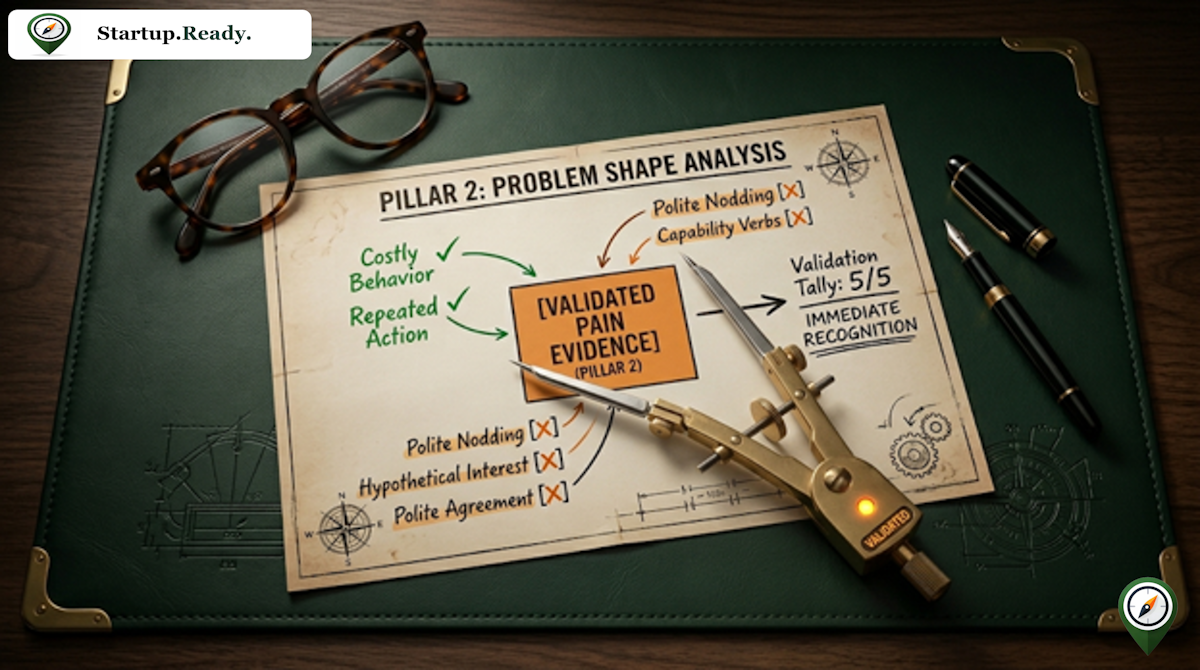
Low pain looks like recognition with no action. People notice the problem, agree it is real, and do nothing. Moderate pain looks like a cheap workaround. People have cobbled together a fix that mostly works and costs them little, so the motivation to replace it is weak. High pain looks like costly, repeated, or urgent behavior. People spend real time, money, or effort dealing with the problem, again and again, and they describe it in strong language.
So audit what you actually have. List the specific evidence that this problem causes real pain, and allow only what you have observed, heard directly, or measured. Not what is logical. Not what should be true. Then ask the hardest question in the worksheet: what is the single strongest piece of pain evidence you have? If a costly, repeated behavior comes to mind immediately, you are probably above the line. If you have to reach, or if everything on your list is someone agreeing in a conversation, that hesitation is your answer.
Asking is my problem worth solving isn't pessimism. It's the question that saves the most wasted time.
Watch What They Do, Not What They Say
The most reliable signal of real pain is behavior. Talk is cheap, agreement is free, and both are easy to give a hopeful founder. What people do about a problem costs them something, which is exactly why it tells the truth.
One question cuts straight to it. Have you watched someone do something painful, expensive, or embarrassing to work around this problem? A clinic adding a salary. A team running a nightly manual process nobody wants to own. A person paying for an inferior tool just to make the problem smaller. If you can name behavior like that, the pain is real and you are close to it. If you cannot, you may not be close enough to the pain yet, and that distance is the thing to fix before anything else.
There is a second test you can run in your head right now. If you handed this person a free, perfect solution today, how fast would they act on it? If the honest answer is "immediately," the pain is probably high. If the answer is "eventually," it probably is not. A free, perfect solution that people would not rush to adopt is a solution to a problem that does not hurt.
This is the behavioral read at a glance. Going deeper, reading the full set of workarounds and putting a number on what they cost, is its own piece of work, and it is where you go next once you know the pain is real.
If the Pain Is Low, Three Honest Paths
Suppose you do the audit and the evidence points to low pain across the board. That is not the end of the project. It is a fork, and there are three honest ways forward.
Go deeper. The same problem is often mild for most people and severe for a narrow group. Expense reports are a shrug for a salaried employee and a real wound for a freelancer whose unfiled receipts are lost income at tax time. Ask who feels this most acutely, and whether you have actually been talking to them or to the comfortable majority who only ever shrug.
Reframe the consequence. Sometimes the pain is real and you are describing it wrong, because you are naming the symptom instead of the cost. "Expense reports take too long" is a symptom. "Reps stop submitting, so the company loses tax-deductible spend and finance cannot close the month on time" is a cost. Same problem, named at the level where it actually threatens something. Follow the problem downstream until you hit what it puts at risk: revenue, status, a relationship, safety. If a real cost is hiding there, the pain was never low. Your description was.
Reconsider the problem. If the pain is genuinely insufficient across every segment you can find, and no reframing reaches a real cost, the honest move is to go back to discovery before you invest further. Look at what surfaced in your research that showed more intensity than the problem you started with. The adjacent problem you kept dismissing may be the one that actually hurts.
The One Sentence That Tells You Where You Stand
A founder who has done this work can finish one sentence with specifics: the strongest evidence I have that this problem causes real pain is this observation, and the next thing I will do to validate or sharpen that signal is this action.
A founder who has not done it will reach for agreement instead of behavior. "Everyone says it's a real problem." "People love the idea." Agreement and affection are what low-pain problems generate. They are the very thing this exercise exists to see past.
If you can name a costly, repeated behavior and a next move to test it further, your problem clears the threshold and you can build on it. If you cannot, you have not failed. You have found out early, while you still have the time and capital to go deeper, reframe, or move to a problem that hurts more. Either outcome moves you forward.
Pain Validation and Your Problem Clarity
In the Startup Readiness Framework, Problem Clarity evaluates whether a problem generates enough real pain to move people. Agreement is easy to earn. Action is the thing it measures. Insufficient pain validation is one of the most common flags in early assessments, and one of the most disorienting, because the conversations feel encouraging right up until the conversions fail to arrive.
A founder who can confirm the problem is real has demonstrated awareness. A founder who can point to costly, repeated behavior that proves the problem hurts has demonstrated validation.
If your Problem Clarity flagged insufficient pain, start here. Audit only the pain evidence you have actually observed. Find the strongest piece, or notice that you cannot. Watch what people do, not what they say. And if the pain is low, choose a path honestly rather than building against agreement and calling it demand.
Problem Clarity is one of six pillars in the Startup Readiness Framework. If your customer discovery is solid, the next question is whether the rest of your startup is as ready as your evidence. The Startup Readiness Assessment gives you a full-system diagnostic across all six pillars in just about 20 minutes.
Take your Startup Readiness Score free today at startupready.ai →
Keep asking is my problem worth solving as the market and the competition shift around you.
Keep Working on the Problem Pillar
The Problem Pillar asks one question from many angles: is the problem real, specific, and painful enough that customers will pay to end it? Each article below takes one piece of that question. Whether the problem is real or only agreed with. Whether it hurts enough to move a customer, or is merely present. How often it fires and how hard it bites. Whether you can describe it in your customer's own words without sliding into your solution. Read them in any order. Each is a separate cut at the same pillar, and together they show you where the problem is sharp enough to build on and where it is still a guess.
More in the Problem pillar:
Customer Validation: Interview Questions That Actually Work
The Founder-Problem Fit: How to Build Earned Insight Into a Problem You Did Not Live
Your Customers Are Already Telling You Everything. You're Just Not Listening in the Right Places.
How to Validate Your Problem by Finding the Workarounds Your Customers Already Use
How to Test Your Problem Statement With Five Customers Before You Trust It
How to Define Your Problem Around the Job Your Customer Is Trying to Get Done
How to Map Problem Frequency and Intensity Before You Build the Wrong Business
How to Map the Problem Lifecycle and Reach Customers When the Pain Peaks
How to Describe Your Problem Without Describing Your Solution
Your Problem Is Real. That Does Not Mean It Hurts Enough.
Your Problem Description Sounds Professional. Your Customer Cannot Picture It.
You Remember What Your Customers Meant. You Lost the Words They Used.
Your Customer's Workaround Is Expensive. Can You Put a Number on It?
Published
By Dr. Shaun P. Digan
Originally Published on the Startup.Ready.’s Startup Readiness: Validation, Framework, and Tools Blog at https://startupready.ai/startup-readiness/pain-validation
Original Publication Date: June 3, 2026
Last Updated: August 6, 2026
About the Author
Dr. Shaun P. Digan is the founder of Startup.Ready and the creator of the Startup Readiness Framework, a research-based system for evaluating and validating early-stage startups before launch and early growth. He holds a PhD in Entrepreneurship from the University of Louisville and has spent over 15 years teaching, advising, and consulting with founders on startup strategy, validation, and growth.
In his writing, including the Startup Readiness Blog and The Foundations of Innovation Essay Series, he focuses on how founders can make better decisions by improving clarity, alignment, and readiness before scaling.