How to Map Problem Frequency and Intensity Before You Build the Wrong Business
Most founders ask whether their problem is real. Far fewer ask what shape it is.
Shape is the combination of two things: how often the problem happens, and how much it costs when it does. Frequency and intensity. A founder who knows the problem is real but has never measured its shape is working with half the information. And the missing half is the half that determines what kind of business they can build.
Frequency is not importance. A problem can matter enormously and still happen once a year. A problem can happen every day and barely register. The shape of the problem, not the existence of it, decides whether a subscription makes sense, whether customers will pay, and when they are in market to buy. Get the shape wrong and you build a business the problem cannot support, no matter how real the problem is.
TL;DR: The Shape of the Problem Determines the Shape of the Business.
Frequency is how often the problem occurs in the life of one customer. Intensity is how much one occurrence costs them in time, money, disruption, or emotional and social weight.
That combination, problem frequency and severity, is what most founders skip when they only ask whether the problem is real. Call it problem intensity mapping, and it's the missing half of most validation work.
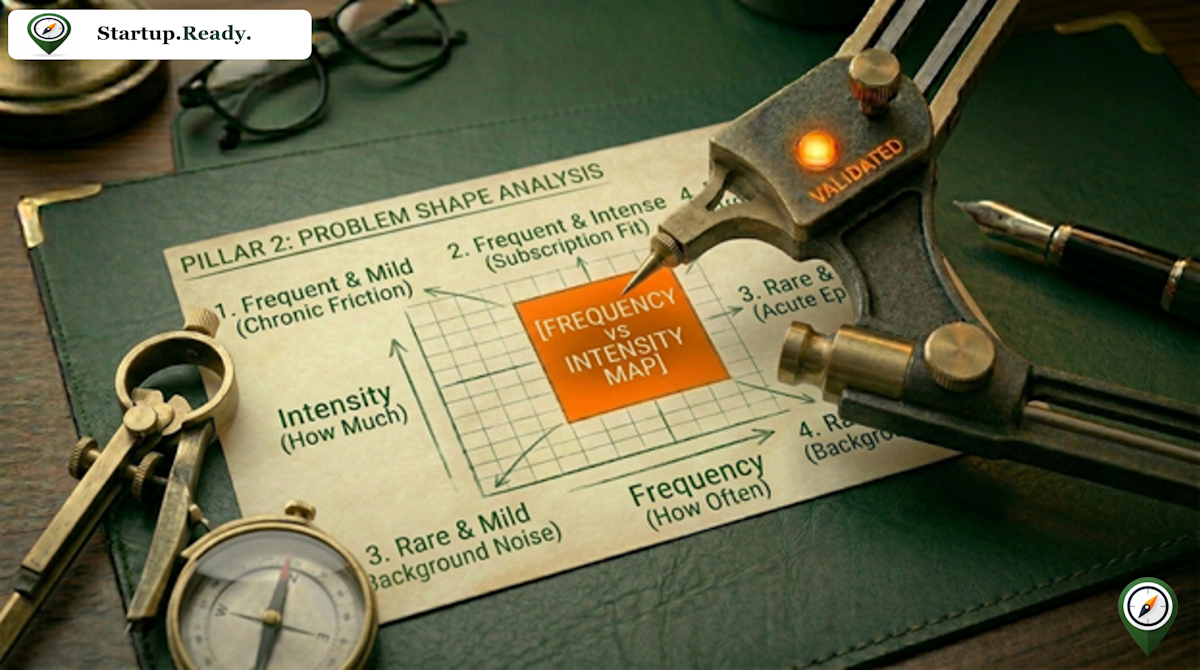
Plot the two against each other and you get four shapes, each one favoring a different kind of business:
Frequent and intense: the strongest shape. Customers feel it often and feel it sharply. Subscriptions and habits fit.
Frequent and mild (chronic friction): viable but hard. Each instance is small, so pricing has to be low or value has to accumulate.
Rare and intense (acute episodes): usually transactional. The exception is selling standby itself, the way insurance does.
Rare and mild (background noise): rarely supports a startup on its own.
Four signals indicate you have not measured the shape yet:
You can say the problem is real but cannot say how often one customer hits it
You are assuming a subscription model without knowing the problem recurs often enough to justify one
You cannot name what one occurrence actually costs the customer
Your customer cannot point to the last three times they experienced the problem
If any of those describe you, this article walks you through measuring frequency, measuring intensity, finding the quadrant your problem occupies, and reading what that quadrant favors.
If You Found This Article by Searching for Something Else
Most founders who need this are not searching for "problem frequency." They are searching for something downstream of it.
Should my product be a subscription.
Why is my retention so low.
How to price my product.
Why won't customers pay for this.
How to know if my idea is big enough.
All of those point at the same underlying question. Does the shape of your problem support the business you are trying to build on top of it? This article shows you how to find out before the model is already chosen.
Frequency Is Not Importance, and Founders Confuse the Two
A founder feels the problem is real, so they assume its shape is favorable. Real and frequent feel like the same thing from the inside. They are not.
Picture a founder building a subscription tool that helps people prepare their taxes. The problem is real. It is also intense. Taxes are stressful, expensive to get wrong, and emotionally loaded. So the founder builds a monthly subscription. Retention collapses in February. Not because the product is bad. Because the problem happens once a year, and nobody wants to pay every month for a problem they feel once. The product was fine. The shape was wrong, and the pricing model was built against a shape the problem does not have.
The reverse failure is just as common. A founder builds a high-touch, premium solution for a problem customers hit every day but barely notice. The frequency is there. The intensity is not. Customers agree it is annoying and will not pay much to remove a small annoyance. The founder reads the daily frequency as demand and misses that demand needs intensity behind it.
Both founders did real problem validation. Both skipped the shape. The shape is where the business model is actually decided.
Measure the Frequency
Frequency is how often the problem occurs for one customer. Not across the market. In the experience of one person.
The market view inflates everything. "Millions of people have this problem" can be true while each of them feels it once a decade. Frequency is a property of a customer, not a market. What matters for your business is the rhythm inside a single person's life, so get specific. Does this problem hit a given customer once a day, once a week, once a month, once a quarter, once a year, or once in a career?
Then name the trigger. Every occurrence has one: a calendar date, a workflow step, a seasonal cycle, an internal milestone, an external change. If you cannot name what sets the problem off, your frequency estimate is softer than it looks. You are guessing at a number without knowing what produces it.
Mapping problem frequency and severity early prevents a lot of wasted positioning work later.
And ask the question founders skip. Does the frequency hold across customers, or does it swing? A problem that hits weekly for one segment and yearly for another is two different problems wearing the same name, and they cannot be served by the same business. The clarity check is simple: could the customer say when this last happened, and the time before that? If the answer is "I think it happens, but I am not sure when," you do not have a frequency reading. You have a hope.
One prompt does most of this work in an interview. Ask: walk me through the last three times this happened. A customer who can answer hands you the frequency, the trigger behind each occurrence, the cost each time, and how recent it was, all in one story. A customer who cannot is telling you the frequency is lower, or vaguer, than the idea needs.
Problem frequency and severity isn't a one-time measurement. It shifts as your market and customer base shift.
Measure the Intensity
Intensity is how much one occurrence costs the customer when it happens. Measure it across four kinds of cost: time, money, emotional and social weight, and downstream consequence.
Start with a concrete contrast. Resetting a forgotten password costs ten minutes and a flash of irritation. Losing access to payroll the day before payday costs sleep, trust, and possibly people. Both are access problems. Only one of them funds a business. Intensity is the difference between them, and you have to measure it as deliberately as you measure frequency.
Time is the simplest to read: minutes, hours, days per occurrence. Money is the next layer: direct cost, indirect cost, and the opportunity cost of the time spent. Emotional and social cost is the one founders underweight and customers feel most. Stress, embarrassment, reputational risk, the strain on a relationship or a standing with a boss. A finance lead does not fear the hour an error takes to fix. They fear being the person who let the wrong number reach the board. Downstream consequence is the last: some problems are mild in the moment and compound if ignored, others are sharp and absorb cleanly.
The tell for intensity is language. Customers describe high-intensity problems in strong words. They describe moderate ones as frustrating or annoying. They describe low-intensity ones as a nuisance. Listen to how the problem gets said. The wording carries the intensity that a simple yes hides.
Problem frequency and severity isn't a one-time measurement. It shifts as your market and customer base shift.
The Four Shapes
Put frequency on one axis and intensity on the other and the problem lands in one of four quadrants. Each one favors a different business.
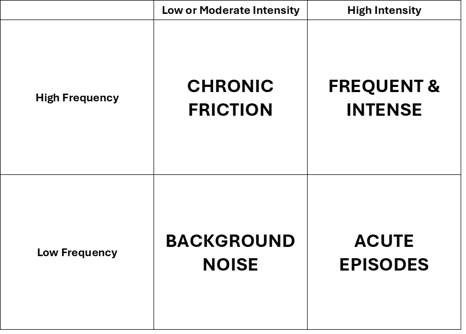
Frequent and intense is the strongest shape a startup can have. Customers feel the problem often enough to be in market most of the time and sharply enough to pay. Subscriptions fit because the value recurs as often as the problem, habits form because the customer touches the solution constantly, and word of mouth runs hot because people talk about what bugs them every day. Think of a tool a sales team lives inside because the problem shows up in every deal. Your job here is to confirm the frequency really holds for your segment, then build something the customer can fold into their routine.
Chronic friction is frequent but mild. Each instance is small, so charging much puts the price above the pain of any single occurrence. The value has to come from accumulation, a hundred small frictions removed, or from bundling the problem with a higher-intensity neighbor. Many consumer productivity tools live here and struggle here, because saving someone ninety seconds is real and rarely worth a monthly fee on its own.
Acute episodes are rare but severe. The customer cares enormously when the problem hits and forgets it the rest of the time. This shape favors transactional or project pricing. Tax preparation, divorce attorneys, and disaster restoration live here, paid heavily at the moment of pain and nothing in between. The instructive exception is selling standby itself: insurance and monitoring charge a recurring fee to be ready for a rare event. Otherwise the hard part is timing. You have to be present at the moment the problem strikes, and an unpredictable trigger is an acquisition problem to solve, not assume away.
Background noise is rare and mild. Customers will agree it is a problem and do nothing, because nothing about it demands action. This shape rarely supports a startup on its own. The honest move is to look for an adjacent problem that shares the customer or the trigger and carries more frequency or intensity. If you cannot find one, the next step is back to problem discovery, not forward to building.
Read Your Quadrant Before You Choose a Model
The quadrant is not a grade. It does not tell you the problem is good or bad. It tells you what kind of business the problem strongly favors, and it exposes the model decisions founders usually make on instinct.
Subscription leans on recurring value, which leans on recurring frequency. Per-use pricing fits a problem that hits hard and rarely. Low-cost-high-volume fits chronic friction. Embedding inside another product fits background noise that cannot stand alone. These are tendencies, not laws, and the exceptions are instructive: insurance proves a rare problem can carry a subscription when what you sell is readiness. The mistake is not breaking the pattern on purpose. The mistake is choosing the model first, from preference or fashion, and then discovering the problem will not support it.
Most founders want recurring revenue. Far fewer have a recurring problem to attach it to.
So run your problem through the work. Name the frequency tier with a real source behind it. Name the intensity tier from how customers actually describe the cost. Find the quadrant. Then let the quadrant inform the model and the pricing, rather than backfilling the shape to justify a model you already picked.
The One Sentence That Tells You Where You Stand
A founder who has done this work can complete one sentence with specifics:
The shape of my problem is this quadrant, which means the kind of business it favors is this model, and my next move is this specific action.
A founder who has skipped it will reach for the existence of the problem instead of its shape. "This is a huge problem." "Everyone deals with this." Size is not shape, and a huge problem with the wrong shape still sinks the model built on it. Specific and measured beats big and vague every time.
If you can name your quadrant from real evidence and the model downstream of it matches, you have a problem shape you can build on. If you cannot, you have found a more specific question to answer, how often and how much. Either outcome moves you forward.
Shape tells you what kind of business the problem can carry. When in the customer's cycle the problem peaks, and which segment feels it most, is the next layer down. That is where mapping the problem across time and across people comes in, and it is the subject of the next piece.
Frequency, Intensity, and Your Problem Clarity
In the Startup Readiness Framework, Problem Clarity evaluates whether a founder has moved beyond believing a problem is real to understanding its shape well enough to build the right business on it. Low or unclear problem frequency is one of the most common flags in early assessments. Not because the problem is not real, but because the founder has measured whether it exists without measuring how often and how much.
A founder who can say the problem is real has demonstrated conviction. A founder who can place the problem in a quadrant from evidence and match the business model to it has demonstrated clarity.
If your Problem Clarity flagged low or unclear frequency, start here. Measure the frequency for one customer. Measure what one occurrence costs. Find your quadrant. Then check that the model you are building matches the shape you found.
Problem Clarity is one of six pillars in the Startup Readiness Framework. If your customer discovery is solid, the next question is whether the rest of your startup is as ready as your evidence. The Startup Readiness Assessment gives you a full-system diagnostic across all six pillars in just about 20 minutes.
Revisit problem frequency and severity whenever you consider expanding into an adjacent segment.
Take your Startup Readiness Score free today at startupready.ai →
Revisit problem frequency and severity whenever you consider expanding into an adjacent segment.
Keep Working on the Problem Pillar
The Problem Pillar asks one question from many angles: is the problem real, specific, and painful enough that customers will pay to end it? Each article below takes one piece of that question. Whether the problem is real or only agreed with. Whether it hurts enough to move a customer, or is merely present. How often it fires and how hard it bites. Whether you can describe it in your customer's own words without sliding into your solution. Read them in any order. Each is a separate cut at the same pillar, and together they show you where the problem is sharp enough to build on and where it is still a guess.
More in the Problem pillar:
Customer Validation: Interview Questions That Actually Work
The Founder-Problem Fit: How to Build Earned Insight Into a Problem You Did Not Live
Your Customers Are Already Telling You Everything. You're Just Not Listening in the Right Places.
How to Validate Your Problem by Finding the Workarounds Your Customers Already Use
How to Test Your Problem Statement With Five Customers Before You Trust It
How to Define Your Problem Around the Job Your Customer Is Trying to Get Done
How to Map Problem Frequency and Intensity Before You Build the Wrong Business
How to Map the Problem Lifecycle and Reach Customers When the Pain Peaks
How to Describe Your Problem Without Describing Your Solution
Your Problem Is Real. That Does Not Mean It Hurts Enough.
Your Problem Description Sounds Professional. Your Customer Cannot Picture It.
You Remember What Your Customers Meant. You Lost the Words They Used.
Your Customer's Workaround Is Expensive. Can You Put a Number on It?
Published
By Dr. Shaun P. Digan
Originally Published on the Startup.Ready.’s Startup Readiness: Validation, Framework, and Tools Blog at https://startupready.ai/startup-readiness/mapping-problem-frequency
Original Publication Date: June 3, 2026
Last Updated: August 4, 2026
About the Author
Dr. Shaun P. Digan is the founder of Startup.Ready and the creator of the Startup Readiness Framework, a research-based system for evaluating and validating early-stage startups before launch and early growth. He holds a PhD in Entrepreneurship from the University of Louisville and has spent over 15 years teaching, advising, and consulting with founders on startup strategy, validation, and growth.
In his writing, including the Startup Readiness Blog and The Foundations of Innovation Essay Series, he focuses on how founders can make better decisions by improving clarity, alignment, and readiness before scaling.