How to Map the Problem Lifecycle and Reach Customers When the Pain Peaks
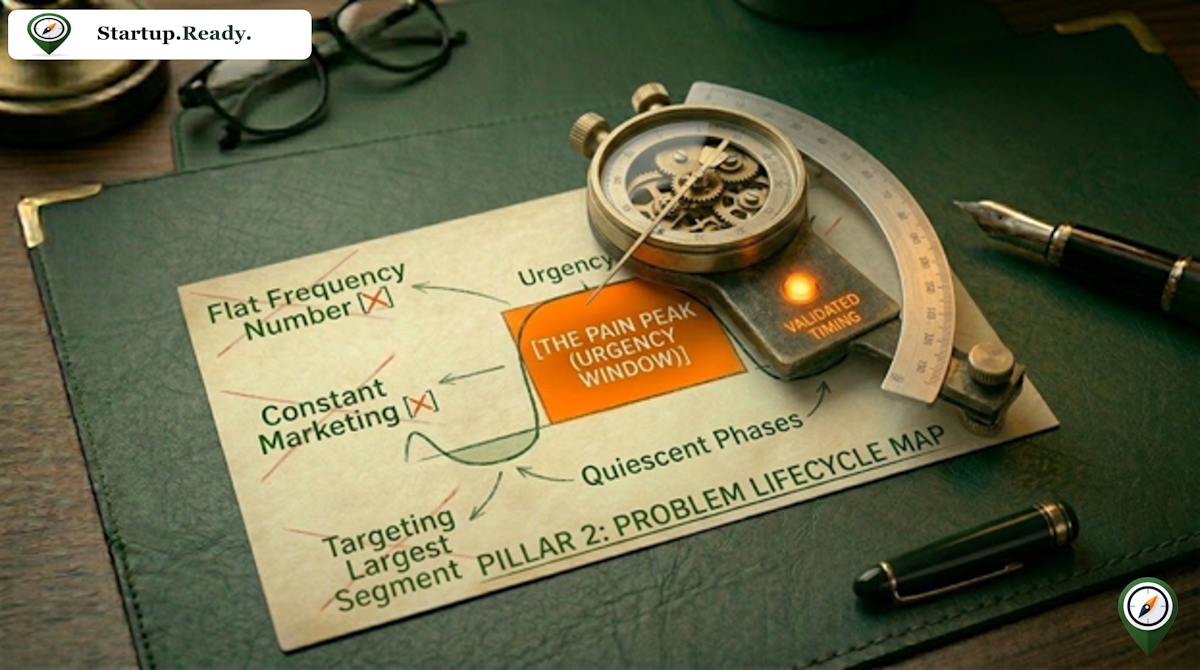
Most founders treat frequency as a single number. The problem happens monthly, or weekly, or twice a year, and that number goes in the deck.
The number hides the thing that matters. A problem you measured as monthly is not felt evenly across the month. It clusters. There is a moment when the customer feels it sharply and would pay to make it stop, and there are long stretches when the same customer barely remembers the problem exists. Reach them in the first moment and you are pushing on an open door. Reach them in the second and you are interrupting someone who is not thinking about you.
The shape of a problem tells you whether a business is possible. The lifecycle of a problem tells you when to show up and who to show up for. This piece is about the second one.
TL;DR: A Customer Is Not in Market. They Are in Market at a Moment.
Frequency is not constant. The same customer feels the problem at different intensities across a cycle, and different segments feel it on different schedules.
That's problem lifecycle mapping: knowing not just how often the pain occurs, but exactly when it peaks, and it's what makes timing customer outreach effective instead of a guess.
Mapping the lifecycle means finding five things:
The cycle: the calendar, workflow, or life stage the problem follows
The peak: the one phase where the problem is sharpest and the customer will act
The window: how long that peak lasts, which sets how precise your timing has to be
The lead time: how far ahead of the peak the customer starts looking for a fix
The wedge segment: the group that feels the problem most often and most sharply
Four signals indicate you have not mapped the lifecycle yet:
You can state a frequency but cannot say when in the customer's cycle the problem is worst
You market year-round, conversion is flat, and you have no sense of when it should spike
You are targeting the largest segment instead of the most acute one
You cannot name what the customer is searching for or doing at the moment the pain peaks
If any of those describe you, this article walks you through mapping the cycle, finding the peak, finding the segment that feels it most, and turning those five observations into two decisions: when to show up and who to start with.
If You Found This Article by Searching for Something Else
Most founders who need this are not searching for "problem lifecycle." They are searching for something more immediate.
When should I launch.
How to time my marketing.
Which customer segment should I target first.
How to find a beachhead market.
Why is my conversion so low.
All of those point at the same underlying question. Are you reaching the right customer at the moment they are ready to act? This article shows you how to find that moment and that customer.
Frequency Is Not Constant
The previous piece mapped the shape of your problem, how often it happens and how much it costs. That gives you a single reading. The lifecycle takes that reading apart across time.
Most problems are not random. They follow a cycle tied to a calendar, a workflow, a life stage, or a business rhythm. A fiscal year for a finance team. A sales quarter for a rep. A school year for parents. A retail calendar for an ecommerce brand. A pregnancy for an expectant parent. Each cycle has phases, and the problem lives in some phases and goes quiet in others.
Take a founder building analytics for ecommerce brands. The cycle is the retail year. The problem, knowing which ads actually drove sales, is present all year at a low hum. It becomes urgent in the weeks before the fourth quarter, when a brand is about to spend the bulk of its annual ad budget in a six-week window and cannot afford to spend it blind. That is the phase where the problem bites. In February the same brand will agree the problem is real and do almost nothing about it.
So map the cycle for one customer. Name its length and its phases. Find the phase where the problem is acute. Then watch what the customer does in the phases when it is quiet. Do they forget it, work around it, or brace for the next time it hits? The behavior in the gaps tells you whether the problem registers between peaks or vanishes entirely. If you cannot find a cycle at all, the problem may be triggered by unpredictable events instead, which is its own pattern and changes how you reach people.
Find the Peak
Inside the cycle there is usually one moment when the problem is sharpest and the customer is most willing to pay. That is the moment to engage. Every other moment reaches them when they have less reason to act.
Get specific about it. Not "during tax season." The week before the deadline. Not "at quarter close." The three days the numbers have to be right. The narrower you can name the peak, the more precisely you can aim.
Problem lifecycle mapping is worth revisiting any time your acquisition timing stops converting the way it used to.
Then answer three questions about that moment. What is the customer feeling, doing, or saying when the problem peaks? That language and that emotional state are what your messaging has to match, because anything written for the calm months will sound wrong during the crisis. What is the customer actively searching for, asking about, or trying to do at the peak? That is where intent lives, and if you know what they search at the peak, you know where to be. And how long does the peak last?
The length of that window is its own decision, because a two-week window and a two-hour window are different businesses. A wide window leaves room to educate and nurture: you can catch the customer early, earn trust, and still be there when they act. A narrow window collapses that into a single moment, and your only option is to be immediately visible at exactly the right time. The shorter the window, the more your acquisition has to be precise rather than patient.
The last question is whether the peak is predictable or not. The ecommerce brand's fourth-quarter crunch arrives on the same schedule every year, so you can be ready for it, build content ahead of it, and be visible before the brand starts looking. A security breach or a burst pipe arrives without warning, so you cannot schedule around it. For unpredictable peaks, acquisition has to be always-on, or you have to ride a partner who is already in the room when the trigger hits, an insurer, an IT provider, a contractor.
Mind the Lead Time
The moment the problem peaks is not always the moment the customer buys. People usually start looking before the pain arrives, and the gap between the two is the lead time. Miss it and you show up at the peak to find the decision already made.
Tax filing peaks in April, and people start searching for help in January. Black Friday peaks in November, and the brands preparing for it evaluate software in August. A wedding peaks on the date, and couples choose vendors months ahead. In each case the buying decision runs ahead of the pain by a predictable interval, so the place to be present is the start of the search, not the height of the crisis.
For companies the lead time has a second source. The buying cycle is a separate frequency from the problem cycle. A buyer in real pain still has to clear a budget window, procurement, and contract timing, so the problem can peak in March while the money unlocks in July. Whether the lead time comes from how early customers start looking or from how slowly they can buy, the job is the same: be present when the search begins, and stay present until they can act.
The Same Problem Is Not Felt Equally by Everyone
A cycle describes one customer across time. Segments describe many customers at once, and they do not feel the problem on the same schedule or with the same force.
Problem lifecycle mapping gets more valuable the more customers you observe going through it.
One segment hits the problem weekly and sharply. Another hits it once a quarter and shrugs. The differences usually come from role, industry, life stage, company size, or context. A brand that does eighty percent of its revenue in the fourth quarter feels the attribution problem far more sharply than a steady-state subscription business that sells the same amount every month. Same problem. Same product. Completely different urgency.
So list the three to five segments who plausibly have this problem and estimate, for each, how often they hit it and how hard it lands. The segment with the highest combined frequency and intensity is your wedge. Not the largest segment. The most acute one. A narrow, painful segment converts and refers, because the people in it are actively looking and they talk to each other. A broad, mild segment drains your runway while you explain why they should care.
Then check two things. What is the evidence behind your estimates? If most of the grid is assumption, your wedge is a hypothesis, not a finding, and the next move is to confirm it. And is your current target market the same as your wedge segment, or different? If they are different, you have been pointing at the wrong customer, and that single correction can change everything downstream.
Translate It Into When and Who
The cycle and the segment map collapse into two decisions: when to show up, and for whom.
When follows the peak and its lead time. If customers buy at the moment of pain, use intent channels, the places people go when they are actively looking: search, marketplaces, referrals. If they decide ahead of the pain, use content and education that earns trust before the search begins. If the problem never really peaks, go always-on. If it strikes without warning, ride partners who are already there.
Who follows the wedge. For an early-stage startup that is almost always the most acute segment, even if it is smaller, because a narrow painful market is where conversion and word of mouth come cheapest. Going broad is safe only when the problem is genuinely consistent across segments, which most founders assume and few can prove.
One question pulls most of this out of a customer in a single conversation. Ask them: walk me through your last cycle, and tell me where in it this problem actually bit. A customer who can answer hands you the cycle, the peak, and what they did about it, in their own words. A customer who cannot is telling you the problem is flatter, or vaguer, than your plan assumes.
Frequency without a lifecycle is a number. Frequency with a lifecycle is a strategy.
The One Sentence That Tells You Where You Stand
A founder who has done this work can complete one sentence with specifics:
The peak urgency for my problem is this specific moment, my wedge segment is this specific group, and my next move is this specific action.
A founder who has skipped it reaches for "always" and "everyone." The problem is always there. Everyone could use this. Always and everyone are what you say when you have not found the moment or the segment, and they are expensive words, because they justify spending everywhere instead of where it works. Specific and timed beats constant and broad every time.
If you can name the moment and the segment from real evidence, you know when to show up and who to show up for. If you cannot, you have found a more specific question to answer, which moment and which group. Either outcome moves you forward.
The shape of the problem tells you what kind of business is possible. The lifecycle tells you when and for whom. The next layer is where: the channels that reach that segment at that moment, which is where go-to-market begins.
Lifecycle, Segment, and Your Problem Clarity
In the Startup Readiness Framework, Problem Clarity evaluates whether a founder understands the problem well enough to act on it. Knowing a problem is real is not the same as knowing when it is sharp and who feels it most. Low or unclear problem frequency is one of the most common flags in early assessments. Often the founder has a frequency number but no lifecycle behind it: a reading with no sense of when it peaks or which segment carries it.
A founder who can state a frequency has demonstrated awareness. A founder who can point to a specific moment in a specific segment's cycle and say, with evidence, that this is when and where the problem is sharpest has demonstrated clarity.
If your Problem Clarity flagged low or unclear frequency, start here. Map the cycle for one customer. Find the peak and how long it lasts. Find the segment that feels it most. Then turn both into a decision about when to reach customers and who to start with.
Problem Clarity is one of six pillars in the Startup Readiness Framework. If your customer discovery is solid, the next question is whether the rest of your startup is as ready as your evidence. The Startup Readiness Assessment gives you a full-system diagnostic across all six pillars in just about 20 minutes.
Take your Startup Readiness Score free today at startupready.ai →
Keep refining your problem lifecycle mapping as you learn more about when customers actually act.
Keep Working on the Problem Pillar
The Problem Pillar asks one question from many angles: is the problem real, specific, and painful enough that customers will pay to end it? Each article below takes one piece of that question. Whether the problem is real or only agreed with. Whether it hurts enough to move a customer, or is merely present. How often it fires and how hard it bites. Whether you can describe it in your customer's own words without sliding into your solution. Read them in any order. Each is a separate cut at the same pillar, and together they show you where the problem is sharp enough to build on and where it is still a guess.
More in the Problem pillar:
Customer Validation: Interview Questions That Actually Work
The Founder-Problem Fit: How to Build Earned Insight Into a Problem You Did Not Live
Your Customers Are Already Telling You Everything. You're Just Not Listening in the Right Places.
How to Validate Your Problem by Finding the Workarounds Your Customers Already Use
How to Test Your Problem Statement With Five Customers Before You Trust It
How to Define Your Problem Around the Job Your Customer Is Trying to Get Done
How to Map Problem Frequency and Intensity Before You Build the Wrong Business
How to Map the Problem Lifecycle and Reach Customers When the Pain Peaks
How to Describe Your Problem Without Describing Your Solution
Your Problem Is Real. That Does Not Mean It Hurts Enough.
Your Problem Description Sounds Professional. Your Customer Cannot Picture It.
You Remember What Your Customers Meant. You Lost the Words They Used.
Your Customer's Workaround Is Expensive. Can You Put a Number on It?
Published
By Dr. Shaun P. Digan
Originally Published on the Startup.Ready.’s Startup Readiness: Validation, Framework, and Tools Blog at https://startupready.ai/startup-readiness/mapping-problem-lifecycle
Original Publication Date: June 3, 2026
Last Updated: August 4, 2026
About the Author
Dr. Shaun P. Digan is the founder of Startup.Ready and the creator of the Startup Readiness Framework, a research-based system for evaluating and validating early-stage startups before launch and early growth. He holds a PhD in Entrepreneurship from the University of Louisville and has spent over 15 years teaching, advising, and consulting with founders on startup strategy, validation, and growth.
In his writing, including the Startup Readiness Blog and The Foundations of Innovation Essay Series, he focuses on how founders can make better decisions by improving clarity, alignment, and readiness before scaling.