Founder-Problem Fit and Founder-Market Fit Are Not the Same Test
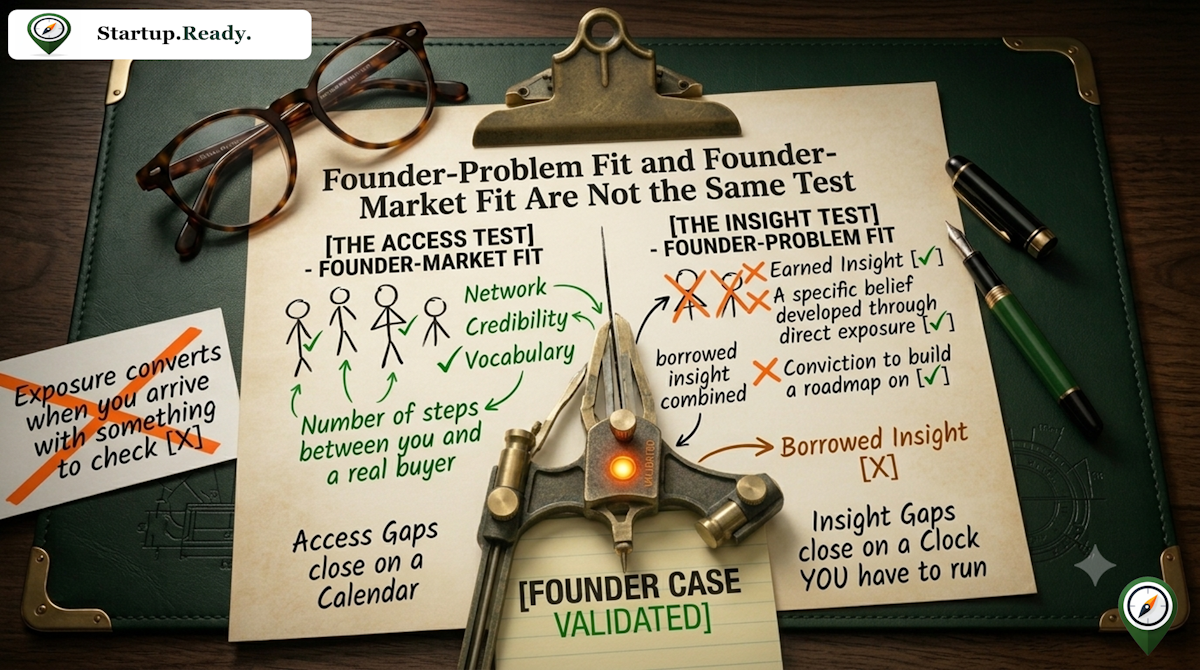
Most founders can make a case for why they are the right person to build this. The case usually answers only half the question.
The half it answers is access. You know the industry. You know the buyers. You can get the meeting, read the room, and decode the vocabulary without a translator. That is founder-market fit, and it is the half investors screen for, so it is the half founders learn to lead with.
The other half is insight. Do you know something specific about this problem that the people living inside it have not yet said out loud? That is founder-problem fit, and nothing about strong market access guarantees you have it.
The two travel together often enough that founders stop distinguishing them. Then they come apart, and the founder discovers which one they were missing at the worst possible time.
TL;DR: Access and Insight Are Two Different Tests, and They Fail Differently.
Founder-market fit asks whether you can reach the customer. Founder-problem fit asks whether you understand the problem in a way the market does not yet. A founder can have one without the other, and the gaps are not equally expensive to close.
Founder-market fit is access: network, credibility, vocabulary, and the number of steps between you and a real buyer
Founder-problem fit is earned insight: a specific belief about the problem you developed through direct exposure, held with enough conviction to build a roadmap on
Access gaps close on a calendar. Hires, advisors, associations, and partnerships shorten them on a legible timeline
Insight gaps close on a clock you have to run yourself. The belief has to be held by whoever makes the commitments, so it can be acquired but not compressed
Borrowed insight is the dangerous combination: strong access carrying the industry's own account of its problem, held confidently enough to pass for earned
Four signals your case rests on access alone:
Your "why me" story is mostly a résumé
Your description of the problem matches what the industry already says about itself
You can name who to call, and you cannot name what they are wrong about
Customer conversations confirm what you expected rather than correcting it
If any of those describe you, this article shows you how to separate the two tests and find out which one you are actually passing.
If You Found This Article by Searching for Something Else
Most founders who need this are not searching for a distinction between two terms. They are searching for something more immediate.
What is founder market fit.
Am I the right person to start this company.
How investors evaluate founders.
Why my customer interviews aren't teaching me anything.
Do I need a co-founder.
All of those point at the same underlying question. Which half of the founder case are you making, and which half are you assuming? This article separates them and gives you a test for each.
Two Questions That Look Like One
Ask a founder why they are the one to build this, and you almost always get an access answer. Eleven years in the industry. Two hundred relationships. A former title that opens doors. Every one of those facts is real and every one of them is useful.
None of them says anything about what the founder knows that the industry does not.
That gap is easy to miss because the two things correlate. People who spend years near a market usually do learn things outsiders never see. Usually.
Access is the raw material insight gets made from. In enterprise software, defense, healthcare, and anything sold through a procurement office, repeated entry into the room is the main way a founder learns anything true about how the work actually runs. Nobody writes it down. You get it by being there again and again until the pattern separates from the noise. Treating access as the shallow half would be a misread.
The question is what the founder does with the room once they are in it. The same eleven years produce insight for one person and fluency for another, and the difference is whether the founder was testing the industry's account of itself or absorbing it. Exposure converts when you arrive with something to check. It does not convert on its own.
Fluency sounds like insight in a pitch. It performs differently under a roadmap.
The Same Venture, Two Founders
Take a specific idea: software that helps independent pharmacies synchronize a patient's refills to a single monthly pickup date. Same market, same product concept, two founders.
Founder A spent eleven years as a regional manager for a pharmacy chain. She can name two hundred independent owners, and roughly forty of them will take her call this week. She speaks the reimbursement vocabulary fluently. Her account of the problem is that independents are losing patients to chains and need better retention tooling.
That account is accurate. It is also the story the industry tells about itself at every conference, in every trade publication, and in the first ten minutes of every owner conversation she has ever had. She did not develop it. She absorbed it.
Founder B spent six years as a technician at a single independent pharmacy before leaving. She has no owner network. Getting five conversations will take her two months of cold outreach and a membership in the state pharmacists association.
What she has is a belief the owners would argue with. Owners attribute prescription abandonment to copay cost. She watched the counter every day and thinks a meaningful share of it is trip count: the patient who is making four separate pickups a month abandons the third one, and the reason is the trip, not the price. She can point to which prescriptions got left behind, in what order, and on which visit. She has never seen an owner track it that way.
She may be wrong. That is the point. She holds a claim specific enough to be wrong, and specific enough to build the product around.
Founder A has the access. Founder B has the insight. Both of them have half a case.
The Halves Cost Different Amounts to Repair
Here is where the distinction stops being semantic.
Founder B can buy what Founder A has. It is expensive and slow, and the path is legible from where she stands. She joins the association. She hires a sales lead with an owner network. She recruits an advisor who makes twenty warm introductions. Twelve months and real money, and her access problem is materially smaller. Every step is a step she can name today.
Access splits at the door, though, and the split matters. An advisor's introduction gets Founder B into the room. It does not get her the contract. Early buyers extend trust to the founder personally, and what they are testing in that first real conversation is whether she understands their operation well enough to be worth the risk of switching. The introduction is purchasable. The close is not.
That looks at first like a limit on the asymmetry. It is closer to a confirmation of it. The reason a warm introduction stops working at the contract is that the buyer has started running an insight test, and no advisor can sit that exam for the founder. What looks like an access failure at the close is often an insight failure arriving late.
Founder A cannot buy what Founder B has at speed. That qualifier is doing real work, so it is worth being exact about it. She can acquire the insight. Immersion, embedded research, and a disciplined run of customer development will get her there, and her access makes each of those cheaper to arrange than they would be for almost anyone else. What she cannot do is compress it. There is no hire that installs a contested belief about the problem, because the belief has to be held by the person making the commitments, and holding it requires having seen the thing yourself.
So the constraint is a rate, not a wall. Founder B's access gap closes on a calendar she can buy her way through. Founder A's insight gap closes on a clock she has to run personally, at whatever speed the problem gives up its structure, while her competitors do not have to run it at all.
The asymmetry strongly favors insight over access, with one instructive exception. A co-founder is not a hire. A founder with access who brings in a genuine co-founder with earned insight has closed the gap, because the belief now lives inside the company's decision-making rather than in an advisor's inbox. That exception sharpens the rule instead of weakening it. What cannot be delegated can sometimes be shared, and the test for whether it has been shared is whether the insight holder can overrule the roadmap.
Borrowed Insight Is the Combination That Hides Longest
Founder A looks better in every room she enters. Investors screen for access because access is verifiable in a way that insight is not. A network is checkable. A belief about prescription abandonment requires the person across the table to reason about pharmacy operations, which most of them will not do in a thirty-minute meeting.
So the founder with access gets the meeting, the warm response, and the follow-up. The signal she receives from the market is that her case is strong. Nothing in that feedback loop is designed to surface the half she is missing.
It surfaces later, in the product. The roadmap gets built from what customers say they want, because there is no independent belief to weigh their answers against. Feature requests arrive and all of them sound reasonable. Interviews confirm the story she walked in with, since she is asking questions that grow out of the same story.
Call it borrowed insight. The founder holds a real account of the problem, sourced from the market rather than developed against it, and carries it with the confidence of someone who earned it. Borrowed insight is not ignorance. It is the industry's own explanation of its own pain, held by someone fluent enough to deliver it convincingly, including to themselves.
That is the tell. A founder with earned insight has customer conversations that correct her. A founder with borrowed insight has customer conversations that agree with her, and mistakes the agreement for validation.
Twenty conversations that confirm your framing are not twenty pieces of evidence. They may be one piece of evidence, repeated, that you and your customers share a vocabulary.
Count the corrections, not the conversations.
The Disagreement Test
One question separates earned insight from fluency.
What do you believe about this problem that the people closest to it would argue with?
Answer it out loud. Then check the answer against three conditions.
It has to be contested. If the people who live inside the problem would nod along, you have described the industry's own account of itself. Founder A's retention story fails here. Founder B's trip-count claim passes, because an owner would push back on it.
It has to come from observation, not inference. You need to be able to say where the belief came from, in specifics. Which counter, which patients, which order the prescriptions were abandoned in. A belief assembled from market reports and podcasts is a hypothesis worth testing. It is not yet an earned secret, and treating it as one is how founders overweight their own framing.
It has to be load-bearing. If the belief turned out to be false, something in your plan would have to change. A claim that no decision depends on is an opinion you are carrying, not an insight you are building on.
Load-bearing cuts both ways, and the second direction is the useful one. If something in the plan would change, you can usually find out which way it goes for far less than the cost of building. Founder B does not need a product to test trip count. She needs one pharmacy's refill records and an afternoon. A belief specific enough to be contested is almost always specific enough to be checked cheaply. If you cannot describe a test that costs less than a quarter of engineering, the belief is still too broad to be the one you build on.
A founder who has been close to the problem answers this in under a minute and gets specific without prompting. A founder running on fluency reaches for the industry narrative, then reaches for their résumé.
The second outcome is useful information rather than a verdict. It names the work.
The One Sentence That Tells You Where You Stand
A founder who has separated the two tests can complete both halves of this statement without stalling:
I can reach my customer because of [specific access: network, credibility, or channel], and it takes me [number] steps to get in front of a real buyer.
I believe [specific, contested claim about the problem], which I developed from [specific direct observation], and the people closest to the problem would argue with it because [specific reason].
Most founders complete the first half easily and slow down on the second. Some complete the second and go quiet on the first.
If both halves are filled in with specifics, your founder case is whole, and you can stop defending it and start building. If the access half is thin, you have a cost to plan for: a legible one, with named steps and a timeline. If the insight half is thin, you have found the more expensive gap, and the next move is direct exposure rather than research. Go get closer to the problem than a market report can take you, and come back with something an insider would dispute. Either outcome moves you forward.
Where This Sits in the Framework
In the Startup Readiness Framework, Founder Readiness is the first pillar evaluated, and it measures the operational foundation underneath everything in this article: your capacity, your skills, your motivation, and the constraints you have to build around. That is what determines whether you can sustain the work at all.
Insight and access are not elements of that pillar. They are a dependency running between three of them, which is part of why a weak founder case is so hard to locate from the inside. Whether your belief about the problem is earned or borrowed is a Problem Clarity question, since the framework tests problem understanding against customer language and observed behavior rather than founder interpretation. Whether you can reach the buyer repeatedly is a Market Clarity question, and the framework treats reach as a property of the segment before it is a property of your network.
The framework's name for this is the foundation web. The pillars form a loop rather than a line, and a strong pillar routinely conceals a weak one beside it. Borrowed insight is one of the cleanest instances of that concealment. Founder Readiness reads as strong, because the capacity and the motivation and the credibility are all real. Market Clarity reads as strong, because the meetings happen. The weakness sits in Problem Clarity, propped up on both sides long enough for an entire roadmap to get built on top of it.
That last point is worth holding onto, because it sets a limit on the repair advice above. Founder B can hire her way toward access only because independent pharmacy owners cluster in identifiable places: state associations, buying groups, trade shows. The segment has a stable path into it. In a market with no such path, a sales hire does not fix the problem, because the problem was never the founder's network.
Founder Readiness is one of the six pillars in the framework. The Startup Readiness Assessment gives you a full-system diagnostic across all six in under twenty minutes.
Take your Startup Readiness Score free today at startupready.ai →
Published
By Dr. Shaun P. Digan
Originally published on Startup.Ready.’s Startup Readiness: Validation, Framework, and Tools Blog at https://startupready.ai/startup-readiness/founder-problem-vs-market-fit
Original Publication Date: August 3, 2026
Last Updated: August 3, 2026
About the Author
Dr. Shaun P. Digan is the founder of Startup.Ready and the creator of the Startup Readiness Framework, a research-based system for evaluating and validating early-stage startups before launch and early growth. He holds a PhD in Entrepreneurship from the University of Louisville and has spent over 15 years teaching, advising, and consulting with founders on startup strategy, validation, and growth.
In his writing, including the Startup Readiness Blog and The Foundations of Innovation Essay Series, he focuses on how founders can make better decisions by improving clarity, alignment, and readiness before scaling.