Week 17: Karl Popper and the Discipline of Trying to Prove Yourself Wrong
Every founder runs tests. They build a landing page and watch the signups. They show the demo and listen for the gasp. They ask ten customers if they would pay and count the yeses.
Most of those tests are rigged. Not on purpose. The founder builds the page to convert, frames the question to flatter, and reads the result through the answer they were hoping for. The test was designed to pass.
A test designed to pass teaches nothing.
Karl Popper spent his life on the difference between a test that can pass and a test that can fail, and on why only the second kind counts.
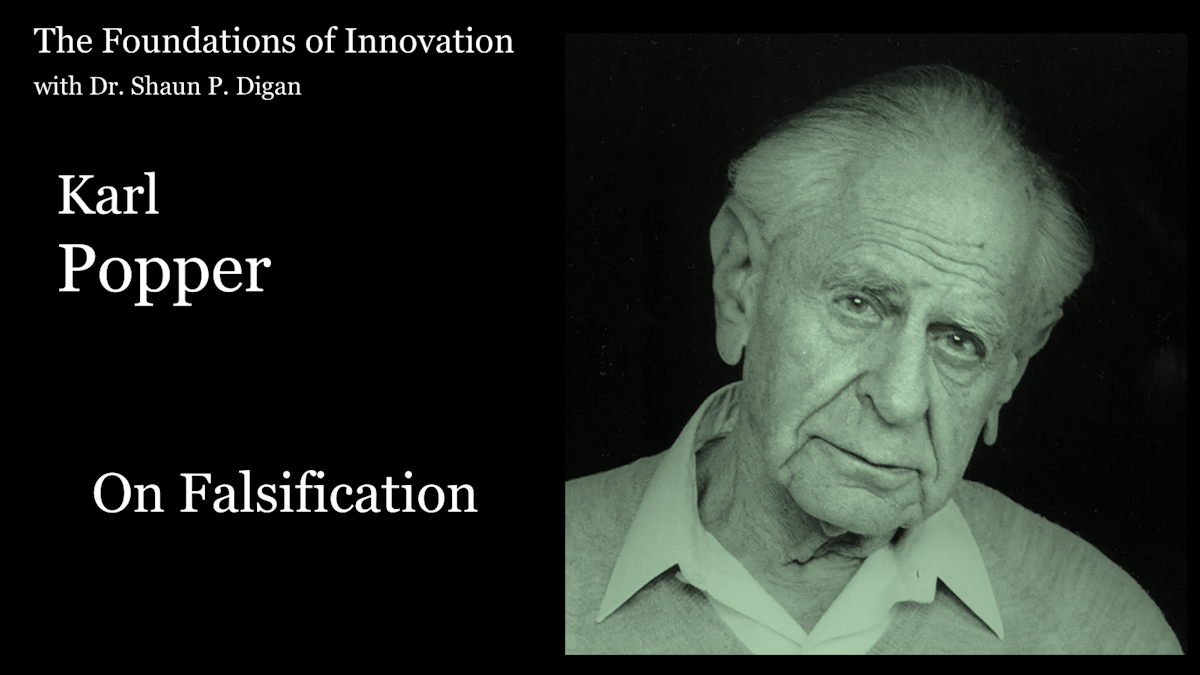
Popper was born in Vienna in 1902, into a city that was about to become the center of an argument about what knowledge is. He trained in mathematics and physics, took a doctorate in psychology, and then spent decades as a philosopher of science, first in New Zealand during the war, then at the London School of Economics. His first book, Logik der Forschung, appeared in 1934 and reached English readers in 1959 as The Logic of Scientific Discovery. The book asked a question that sounds academic and turns out to be the most practical question a founder can ask. What separates a claim that science can test from a claim that only pretends to be testable?
Keep one thing in view from here. The loop every founder runs, the one Eric Ries named build-measure-learn, is Popper's discipline wearing a startup's clothes. Most founders run it without knowing whose discipline it is, and they run it backwards.
Popper's Contribution
The problem that started it all was a problem of telling things apart.
As a young man in Vienna around 1919, Popper was surrounded by grand theories that explained everything. Marxism explained all of history. Freud's psychoanalysis explained every action. Alfred Adler's individual psychology explained every neurosis. Their believers experienced this explanatory reach as strength. A theory that could account for any fact, that was never caught off guard, felt unbeatable.
Popper came to see it as the opposite. A theory that explains every possible outcome forbids nothing, and a theory that forbids nothing tells you nothing about the world. Whatever a patient did, the Freudian could fit it to the theory. Whatever happened in history, the Marxist could absorb it. The fit was guaranteed in advance, which meant the world was never given a chance to disagree.
Then he looked at Einstein. General relativity made a risky prediction. It said starlight passing the sun would bend by a specific amount, an amount Newton's physics did not predict. In 1919 Arthur Eddington sailed to observe a solar eclipse and check. The prediction could have failed. If the light had not bent as Einstein said, the theory was finished. Einstein had staked his theory on an observation that could have killed it.
That contrast gave Popper his answer to the demarcation problem, the line between science and everything dressed up to look like it.
A theory is scientific only if it forbids something, only if it can be refuted by a possible observation.
He called this falsifiability, and it inverted the common sense of his day. People assumed a theory earned its standing by piling up confirmations. Popper said confirmations are cheap. You can find support for almost any theory if you go looking for support. What is hard, and what counts, is surviving a sincere attempt to knock the theory down.
Underneath this sat an old logical problem Popper had taken from David Hume. No number of confirming observations can ever prove a universal claim. You can watch a thousand white swans and you have still not proven that all swans are white. The thousand-and-first might be black. But a single black swan refutes the claim completely and forever. The logic is asymmetric. Verification is impossible. Falsification is decisive.
So Popper rebuilt the picture of how knowledge grows. Science does not crawl upward by accumulating proof, because proof is not available. It advances by conjecture and refutation. You make a bold guess. You expose it to the most severe test you can design, a test it will fail if it is false. If it fails, you have learned something exact and you discard it. If it survives, you have not proven it. You have corroborated it, which means only that it has not been killed yet. Every theory in science is provisional, one good experiment away from the grave.
The discipline this demands is unnatural. The scientist's job is not to defend the theory. It is to attack it, as hard as possible, with the sharpest test available, and to mean it.
Why It Mattered
Before Popper, the prestige of an idea grew with the evidence stacked in its favor. He showed that this instinct is exactly wrong, and the correction reshaped how serious people think about evidence.
The shift was from confirmation to refutation. A pile of supporting cases is weak, because you selected for them. One honest test that the idea could have failed and did not is worth more than a thousand instances you went out and collected to agree with you. This reframed what evidence even means. Strength comes from the severity of the tests an idea has survived. The volume of agreement you gathered is close to worthless, because you went out and gathered it.
It also drew a usable line around pseudoscience. The astrologer and the conspiracy theorist are never surprised, because their claims are built to absorb any outcome. The theory that risks nothing learns nothing. After Popper, "what would prove you wrong?" became the question that separates a claim worth taking seriously from one that only performs seriousness. A person who cannot answer it does not have a weak theory. They have a theory that is not in contact with reality at all.
And it made error respectable, the same way Ries would later make the pivot respectable. A refuted conjecture is not a failure. It is the mechanism. Knowledge grows by the elimination of what is false, so every theory that dies under a severe test is doing the work. Being wrong, found out cleanly, is how the system moves forward.
This is the philosophical floor under all modern experimental practice. The clinical trial built to detect harm. The A/B test that could show the new version is worse. The hypothesis stated before the data is collected so the data can rule on it. When Ries told founders to treat every plan as a set of hypotheses and run experiments to test them, he was applying Popper to commerce, mostly without saying so. The build-measure-learn loop is conjecture and refutation with revenue attached.
What It Left Open
Here the series has to be careful, because Popper gave founders the logic of testing and almost nothing about the strategy of it.
Start with what he assumed and never supplied. Popper's picture begins after the hard part is done. You already have a conjecture. You already know which claim you are putting at risk. His method tells you how to test a hypothesis well. It is silent on which hypothesis to test first.
In science, that silence is survivable. Science is a community working across decades. Thousands of researchers test thousands of conjectures, and over time the field sorts out which questions were load-bearing. No single scientist has to choose correctly under a deadline, because the collective process is the safeguard. A founder has none of that. One person, one runway, a handful of tests before the money runs out. The order of testing is the whole game, and Popper offers no help with the order.
He also treats conjectures as roughly equal candidates for testing. Bold guess, severe test, repeat. But a startup is not a flat list of guesses. It is a structure of beliefs where some carry the weight of everything above them and others are decoration. An assumption about whether the customer feels the problem urgently enough to switch is load-bearing. An assumption about the color of the onboarding screen is peripheral. Popper's logic applies identically to both and cannot tell them apart. Falsifying a peripheral assumption with great rigor produces a precise answer to a question that did not matter.
There is a deeper crack, and Popper's own critics found it. You never test a hypothesis alone. Every test rides on a stack of background assumptions, that the instrument works, that the sample is right, that the measure means what you think. The philosophers Pierre Duhem and Willard Quine showed that when a test fails, pure logic does not tell you which belief to blame. The headline hypothesis might be false. Or the test was built wrong. The clean refutation Popper promised is rarely clean in practice, because the failure could live anywhere in the bundle. Later thinkers, several the series reaches in coming weeks, pushed on exactly this. Thomas Kuhn argued that scientists do not abandon a theory at the first refutation and were right not to. Imre Lakatos tried to rescue falsification by moving it from single theories to whole research programs. The naive version, one failed test kills one clean hypothesis, did not survive contact with how science actually works.
For a founder this is not abstract. A failed experiment is the normal case, and the dangerous moment is reading it. The landing page got no signups. Is the problem not real, or was the headline wrong, or was the traffic the wrong audience? In its simplest reading, Popper treats refutation as decisive. He does not say what got refuted. Without a map of which assumptions the test depended on, the founder draws the wrong lesson and kills the right idea for the wrong reason.
And even a test that cleanly hits the right assumption can mislead you, in the other direction. A refutation can be a false negative. The problem was real, the assumption was load-bearing, the test aimed at it correctly, and the result still came back no, because the timing was off, the execution was thin, or the customer was not ready to hear it yet. Popper's clean kill assumes the test was a fair trial of the belief. Plenty of real ones are not. That cuts both ways against the founder. Read a rigged test as validation and you keep a dead idea breathing. Read a botched test as refutation and you bury a live one. A single failed experiment is rarely a verdict, and the founder who treats it as one will kill good companies on bad evidence.
So the logic is necessary and it is not sufficient. Testing your beliefs honestly is the price of admission. It does not tell you which belief to put on the table first, which ones hold the structure up, or where to look when the result comes back bad. Popper handed founders the discipline. He left the strategy open.
What This Means for Founders Now
Start with the part Popper got exactly right, because most founders violate it daily. The test has to be one the idea could fail, and most founders run the other kind. A test that cannot return a no is a performance with you as the audience.
The fix is to design the test that could kill the idea, and to want the honest answer more than the comfortable one. Replace "would you buy this?" with a price and a payment link and watch whether money moves. Replace "do you have this problem?" with "tell me about the last time you tried to solve it" and listen for whether they ever did. The asymmetry Popper found is the founder's sharpest tool. One real refusal, one customer who had the problem and still did not act, outweighs fifty enthusiastic maybes. Go looking for the black swan. It is the only bird that tells you anything.
Then comes the part Popper left open, and it is where most of the wasted motion lives. The discipline of testing is worthless if you point it at the wrong assumption. A founder can run a flawless, severe, genuinely falsifiable experiment on a belief that did not matter, get a crisp answer, and be no closer to knowing whether the company should exist.
This is the work that has to happen before the loop starts, the work Ries also left for someone else. Surface what you are actually assuming, across every part of the venture. Then sort those assumptions by two questions Popper never asked. Which ones is the whole business standing on. Which ones are you least sure are true. The assumption that is both load-bearing and uncertain is the one to test first. Everything else waits.
There is an honest limit here, the same one the last few issues have kept hitting. A worksheet is not a laboratory, and writing down an assumption does not test it. Only contact with the market tests it. What the structured work does is earlier and different. It forces the buried belief into the open where it can be named, ranks it against the others so the scarce experiments land on what matters, and records what the test depended on so that when the result comes back bad you can tell which assumption actually failed. That last move is the answer to the Duhem-Quine problem in miniature. A refutation you cannot trace teaches you nothing. A refutation tied to a specific, written assumption tells you exactly where the structure broke.
Do that, and the loop finally has somewhere to point. That is what build-measure-learn was always missing. Not the rigor. The target worth the rigor.
Popper drew the line between an idea that risks something and an idea that risks nothing. Most of the startup world runs tests that risk nothing and calls the warm result validation. The discipline is real, and it is harder than "test your assumptions" makes it sound. The hard part was never running the test. It was choosing the right one to run, and reading the answer honestly when it comes.
If you can name the test that would prove your riskiest belief wrong, and you are willing to run it, you have a hypothesis worth your runway. If you cannot, you do not yet have a theory of your business. You have a hope you have been protecting from the world.
Theoretical Takeaway
Popper established the logic that the modern startup runs on without crediting him. Knowledge does not grow by piling up confirmations, because confirmations are cheap and you select for them. It grows by conjecture and refutation, by exposing a belief to a test it will fail if it is false. The asymmetry is the engine. No amount of agreement proves an idea, and a single honest refusal can sink it. Build-measure-learn is this discipline applied to commerce. What Popper left open is the strategy underneath the logic. He assumed you already knew which hypothesis to test, treated all conjectures as roughly equal, and could not say which belief to blame when a test failed. A founder cannot afford any of those gaps, because the runway is short, the assumptions are not equal, and a misread refutation kills the wrong idea. The logic of testing is necessary. The structured work of choosing which assumption is load-bearing, testing it first, and tracing the result to the belief it hit is the part the founder still has to build. That is the part the instrument is built to address.
Next week: Everett Rogers and the diffusion of innovations. How a new thing spreads through a population in a pattern you can name and predict, the adoption curve, the categories of adopters, the role of opinion leaders, and why knowing the shape of the curve still does not tell a founder whether their innovation was ever built to travel it.
Originally Published in the Startup.Ready. Foundations of Innovation Series at https://www.startupreadinessscore.com/essays/popper
Original Publication Date: June 29, 2026
Last Updated: June 29, 2026
By Dr. Shaun P. Digan, MBA, PhD
Sources
The Logic of Scientific Discovery, Karl Popper, Routledge (1959; first published as Logik der Forschung, 1934)
Conjectures and Refutations: The Growth of Scientific Knowledge, Karl Popper, Routledge (1963)
The Lean Startup, Eric Ries (2011)
About the Author
Dr. Shaun P. Digan is the founder of Startup.Ready and the creator of the Startup Readiness Framework, a research-based system for evaluating and strengthening the foundations of early-stage startups. He holds a PhD in Entrepreneurship from the University of Louisville and has spent 15 years teaching, advising, and consulting with founders. In this series, The Foundations of Innovation, he writes on the ideas that built the startup world and the one idea still missing from all of them.